WEDU Arts Plus
1315 | Episode
Season 13 Episode 15 | 26m 30sVideo has Closed Captions
Ars Sonora, University of Tampa | African American food | New England Transcendentalism | Glasstrees
The world's most technologically advanced bell tower, Ars Sonora, can be found on campus at the University of Tampa. Culinary historian Michael Twitty explores African American foodways and food history. An exhibition focuses on New England's connection to Transcendentalism and alternative thought. An exhibition in Boca Raton presents glass works by over 30 artists new to the medium.
Problems playing video? | Closed Captioning Feedback
Problems playing video? | Closed Captioning Feedback
WEDU Arts Plus is a local public television program presented by WEDU
Major funding for WEDU Arts Plus is provided through the generosity of Charles Rosenblum, The State of Florida and Division of Arts and Culture and the National Endowment for the Arts, and the Hillsborough County Board of County Commissioners.
WEDU Arts Plus
1315 | Episode
Season 13 Episode 15 | 26m 30sVideo has Closed Captions
The world's most technologically advanced bell tower, Ars Sonora, can be found on campus at the University of Tampa. Culinary historian Michael Twitty explores African American foodways and food history. An exhibition focuses on New England's connection to Transcendentalism and alternative thought. An exhibition in Boca Raton presents glass works by over 30 artists new to the medium.
Problems playing video? | Closed Captioning Feedback
How to Watch WEDU Arts Plus
WEDU Arts Plus is available to stream on pbs.org and the free PBS App, available on iPhone, Apple TV, Android TV, Android smartphones, Amazon Fire TV, Amazon Fire Tablet, Roku, Samsung Smart TV, and Vizio.
Providing Support for PBS.org
Learn Moreabout PBS online sponsorship- [Narrator] This is a production of WEDU PBS.
Tampa, St. Petersburg, Sarasota.
- [Dalia] Funding for WEDU Arts Plus is provided by Charles Rosenblum, Hillsborough County Board of County Commissioners, the State of Florida and Division of Arts and Culture, and the National Endowment for the Arts.
In this edition of WEDU Arts Plus, the Art of Sound.
- This offered a really important advantage that anyone could play bell music through this new technology.
- Culinary history.
- Food is a vehicle for conversation, food is a means by which we can begin to understand ourselves and our neighbors on a much deeper level.
- [Dalia] Transcendentalism and creativity.
- Throughout New England, particularly in Massachusetts, there were a number of agrarian settlements who lived communally and strive for a better working society on a small scale.
- [Dalia] And contemporary glass art.
- [Man] Each of these works are very different from one another, just as each of the artists are different.
And that's what it really so brilliant about the Berengo Studio.
- It's all coming up next on WEDU Arts Plus.
(upbeat music) Hello, I'm Dalia Colon and this is WEDU Arts Plus.
The idea for a bell tower to accompany the chapel at the University of Tampa campus was hatched nearly 20 years ago.
Former university President Ron Vaughn and John Sykes partnered with the Paccard family in France.
Eight generations of bell makers with an exciting new concept called an ARS Sonora.
Together, they created the most technologically advanced bell tower in the world.
(bell rings) - I remember telling Dr. Vaughn that we had created something, something new that we call Ars Sonora, which would bring so much more opportunities than a simple bell tower.
- So they offered a new technology that would electronically tie into a keyboard where each key was tied into a bell note.
This offered a really important advantage that anyone could play bell music through this new technology.
- Well, I think the Ars Sonora is kind of a, it's one of those once in a lifetime projects that I think people that go into architecture and construction kind of dream about doing.
- Where we are now is the bringing it all together into what now as a sculpture, and we're here watching that happen before our eyes.
- So what's important to us right now is when this prefabricated structure shows up to Tampa, does it all fit together?
(bell rings) When the nine containers arrived on site, we were able to then assemble the entire sculpture in four days.
That process took us four weeks in France.
So we definitely learned a lot from that process and it went very smoothly in the US because of it.
You know, when the Sykes and the Vaughns and the rest of the project team were sitting there watching this final piece be placed, it was nice just to take that moment to pause and reflect on everything we've accomplished and just marvel at this sculpture that we'd created.
- You know, it's just a great shared feeling that we have done this, even though we've got a bit more to go.
(bell rings) - Here, we've got the sculpture outside in a big plaza, so we still have a lot of adjustment, a lot of tuning of the responses of the keyboard.
- This work has to be done with the musicians, of course.
You can hear the right hand?
Yeah, it's much better over there.
- I feel that I have to play it too loud to hear it, but from here, but what does it sound like out there?
(chimes music) - So we ask Thomas to use the software developed to rearrange, rebalance this work.
(chimes music) - Yeah, it is perfect.
- Okay, thank you.
- Yeah, I'm happy.
- We now have our musical department set up and it's gonna culminate into the first performance, and we're really excited to hear it.
- It will just be a huge crescendo on campus.
- I can't wait.
(laughs) (orchestral music) - One of my goals for this concert was to just show off that variety of not just what kind of music we can play, but with whom we can also play and collaborate with.
- It's been really cool to hear it with all the different instruments and the vocalists.
I think it's gonna offer a lot of really cool opportunities for performing.
- Yeah, for sure.
Like now we have another performance space, which is like super cool, so-- - We're so lucky.
- Yeah, we really are.
(orchestral music) - Awesome, I'm mute.
I can't explain it.
- The amount of people that showed up to hear this incredible instrument is really, I think, inspiring and it gives me a lot of hope for the concerts I have planned for the future.
(orchestral music) (bell rings) - I think it's important to have music like this in our everyday lives.
It's something I feel is oftentimes taken for granted.
(chimes music) Students come to me and say they look forward to the music every day.
It just sort of sparks a little bit of joy, I think, in some people.
(chimes music) - It's just beautiful, just like a masterpiece to look at and to hear.
It's just a great way to get like the UT community together and song.
- It's so special, I think, to have an instrument like this in the center of our campus to bring everybody together and for them to have that one thing in common.
(chimes music) (crowd applauds and cheers) - To me, UT has always been a very special place, and most people see that in a variety of different ways.
This adds to the specialness.
I hope it'll inspire people and add to the enjoyment on the campus.
- I hope that this Ars Sonora will bring the student in UT hope when they need it, love when they need it, and music and spirit when they need it.
(inspiring music) - For more information, visit ut.edu/arssonora.
Visit Williamsburg, Virginia to meet culinary historian and author, Michael Twitty.
In his work, he explores African American food ways and the role that food has played throughout history and across cultures.
- This would be less mature than that.
- I'm gonna do this one.
- Okay.
- We're also making sweet potato pumpkin, also known as cushaw, and that's the big striped pumpkin you see over there.
It's originally from the West Indies and was brought to the American South by enslaved Africans.
Food is a vehicle for conversation, food is a means by which we can begin to understand ourselves and our neighbors on a much deeper level.
I think when it comes to southern food, one of the biggest misconceptions is that it just came outta nothing.
The reality is, is that southern food is a result of multiple historical and cultural collisions, particularly between Europe, Africa, and Native America.
When it comes to people of African descent, are these extremely powerful notes that food is how we pass in our culture.
Food is how we resisted enslavement and oppression, and food is how we showed our agency, it wasn't passive.
One of the things that gets me the most concerned is when people refer to African-American vernacular food ways and sort of like what was given to us.
No, it's what we created for ourselves and for others.
So I think it's incredibly empowering to learn about that tradition from the historic side, the way I do here at Colonial Williamsburg.
Field peas, blackeyed peas, we think of them as something you just eat for good luck on New Year.
Something that, you know, fills the bill at a meat and three.
Black eyed peas, your green sweet potatoes and you little meat.
Well, it's deeper than that.
When I went to Senegal, West Africa, I went to Gore Island, which is where enslaved people were prepared for shipment to the new world, including some of my own ancestors.
And the last remaining slave castle, the meison disc glove, they explained to us that black eyed peas were one of the foods that were given to enslaved Africans cooked in palm oil to fatten them up.
One thing about sweet potatoes is that in the West Indies anywhere they were boiling sugar.
They were really quick energy food.
And when the men would go to the sugar boiling house, their job was to pour the sugar all night long.
You know, talking about long lados molten hot cane syrup, that becomes molasses and then it becomes fermented into rum, which of course, will then cross the ocean, buy more enslaved people and feed a triangular trait.
But what happens is, while they're cooking this, this syrup down all night, they're dumping some of it over top of a iron pot filled of sweet potatoes.
What does that sound like to you?
It sounds like candy yams.
And they would eat that to keep them up all night because they had to be up on it.
It was a high energy snack.
Every time you eat candy yams now, I want you think about an enslaved man in their sugar boiling house all night long, making that dish happen as a means to stay awake.
I'm not interested in recipes, I'm not interested in formulas.
I don't think about food and cooking other people do.
I think of it in terms of big black ideas.
Ultimately it's to create something that tastes good.
Dude, that's the best black I piece ever, taste that.
It's not about how much of this or that you put into it or what technique you use.
Black cooking is more about flavor, it's about spirit.
And I think it's less about like gourmet techniques that require a lot of fancy, because we didn't have that.
Only thing we had was our feeling about the food and feeling about each other.
For me, I think the epiphany moment was my parents asked me, what do you want to be when you grow up?
And I said, I want to be a writer, I want to be a teacher.
I want to be a chef, and I want to be a preacher.
For me, all those elements are conjoined.
This idea of feeding people as a spiritual exercise, this idea of feeding people as being an educator, this idea of feeding people as creating a text that's edible, all of that, to me, it all makes sense, it's all part of one holistic worldview.
The secret to the best cooking is trying to find things where everything compliments each other.
It's about creating communalism among your ingredients, and that's how you make the food taste good.
We call our food soul food, why?
It's named after something that transcends life and death.
It's not about our nation, it's about our spirit.
And that's what makes me, like, so proud of it.
One of the things that surprises people about me is that I'm Jewish.
I became officially Jewish by conversion when I was 22 years old.
For me, particularly in Judaism, food and faith go hand in hand a very particular way.
Every single part of the Jewish diaspora has its unique recipes and formulas that go hand in hand with the holidays.
And they tell stories, they're there for a reason.
It's not just because people like to eat them.
You sitting down in a Jewish household, the springtime, we have Passover, we have Matza, and Matza tells the story of how a people who were oppressed, enslaved, got their freedom overnight.
How do we make the world a better place?
How can we learn from our mistakes as a human species?
Those are really big questions in Judaism and Torah.
And that's undergirds a lot of my work, including the work I do with food.
I wanted to write, and one thing it's important to do is really do your own research.
But I think for African Americans, one of the struggles we have is that it's not easy for us to find out where we come from.
Because when we say that our names were taken and our identities were switched around for other people's benefit, we are not joking.
That's how it happened.
We have to scale a lot of brick walls to get to where other people just hop on back.
For some people, they're satisfied knowing that their ancestors came from Germany.
For a lot of African-Americans, they don't know which countries, plural, in West Africa their ancestors came from.
So in the cooking gene, I decided to do all of those pieces.
I wanted to know how did, you know, my ancestors who were enslaved, what kind of work did they do?
How did they process all these crops into consumables?
And to know that if it were not for certain choices and accents of history, you might be in their shoes.
And they have that sort of feeling of gratitude that you're not.
So how, you know, how hard was it for these folks?
Our ancestors are forebearers, to deal with those situations like that and somehow make a way outta no way.
I never say the word, slave.
I say slaves and identity, enslaved as a condition.
So we don't wanna put on our ancestors a label that they themselves would reject because it wasn't true.
Once you have that roadmap to where things start, you can kind of have a roadmap to where things are gonna go.
And for me, that's extremely powerful.
- To learn more about Twitty and his work, go to afroculinaria.com.
Visit the decor of a sculpture park and museum in Massachusetts for an exhibit focused on New England's connection with transcendentalism and alternative thought.
The exhibit explores the movement's history and features work by contemporary artists engaged with its ideas.
- [Reporter] New England is dotted with the clapboard shelters of thought, the old mans where Ralph Waldo Emerson sussed out spirituality in nature.
Orchard House where Louisa may Alcott's father, Bronson, treaded a transcendentalist path.
And fruit lands kuts short-lived utopian commune.
- Throughout New England, particularly in Massachusetts, there were a number of agrarian settlements who lived communally and strive for a better working society on a small scale.
- It's the belief of Sarah Montross, curator of the exhibition, Visionary New England, at the decor of a sculpture park and museum, that those utopian notions linger here, taking root today via a host of contemporary artists.
Sarah, this is gorgeous on the surface, but tell me what's happening here.
- So we are standing amid an installation of photography and a floor piece by the New Haven artist, Kim Weston.
Kim designed this array of incredible photographs activated by a memorial that you're at thousands of red silk tobacco bundles.
And each of these signifies a life lost.
So the memorial is to women and children of Native American descent who suffer much higher degrees of violence, disappearance, and death.
Behind us are large scale photographs printed on metal that Kim took at various powwows throughout New England that Kim and her family are a part of.
The spirit energy of the ancestor or the deity who's inhabited by the performers is expressed through Kim's work.
- [Reporter] Here you'll find the traditional trappings of transcendentalism like Henry David Thoreau's pencils, but also new sculpture by artist, Sam Durant.
It stems from 2016 when the California based artist stationed himself and conquered at the old man's.
Durant built the outline of a home reflecting those of conquered first free black men and women.
The installation became a meeting place for public conversation and is resurrected here along with this sculpture of fused furniture.
A desk representing 18th century black poet Phyllis Wheatley morphed with a recreation of Emerson's chair.
- [Sarah] Both of these pieces of furniture that which these writers, these creators, these world builders would've sat and put pen to paper, are now being shown in dialogue, and in fact, supporting one another.
- [Reporter] In gallery upon gallery, artists in the exhibition interrogate utopian ideals.
The vibrant paintings of the late artist, Paul Laffley, are like diagrams for transcendence mantras says.
While artist Michael Medos envision a future world after climate change.
- [Sarah] Utopian thought emerges during particularly contested historic epox.
And so I do think right now amid COVID, amid different crises, we are seeing a regeneration of utopian energy.
- The artists who I was interested, who I found interesting in our collection, were invested in social progress.
- Sam Adams is the curator of the companion show, Transcendental Modernism, which presents artists from the museum's collection who crafted their own 20th century take on the theme.
- [Adam] Overall, I would have to say they're darker.
You know, the show opens with exiles and emigres who are escaping Nazi Europe.
The development of mysticism in their art is different, but it meets up with the same strands from transcendentalist thinkers from the 19th century.
- [Reporter] Adam says, for some of the artists, including poe,t Gary Rickson, the spirituality comes in the actual making.
- For him painting, this is a very charged experience where he's channeling these words that have come to him.
- [Reporter] For more than 200 years, America's thought leaders, writers, and artists have charted paths to utopia, but as this exhibition reminds us, none have made it there.
What is utopia?
- Oh, it's such a great question, hard to answer.
I think Utopia is a concept ideal that is never achieved.
- Find out more@thetrustees.org.
At the Boca Raton Museum of Art, the exhibit glass dress presents works of glass from over 30 artists who don't normally work with the medium.
Made alongside glass artisans from a studio in Italy, this collaboration breathes new life into the art of glass blowing.
(downbeat music) - Adriana Berengo wanted to start this project where you make it relevant in the contemporary world again by bringing contemporary artists who are not glass artists to work in a new medium and work with these maestros who have, you know, they're generations of experts.
So, you know, these people know everything there is to know about glass.
- The artist, as certainly we have seen this last year, have responded to contemporary events.
Tim Tate's work that is really about the pandemic.
- [Kathleen] This is his second pandemic because he's an HIV positive artist.
But he did go through, you know, so many people dying of aids.
- The whole idea of glass stress was sort of endemic from the very beginning, from the very concept, something that was sort of born a fire and becomes this amazing object that is at once fragile, but also there's sort of a durability about it.
There's a toughness about it.
I mean, I think of the works like Nancy Burson's DNA has no color.
These block letters, which has a very strong message to it.
Or behind me, you see Vik Muniz's large goblets that takes a simple wine goblet and makes it life size.
- [Kathleen] You just associate Venice with those colors and that imagery.
And even in, you see those goblets and paintings, Venetian paintings over the centuries.
- Well, it's almost impossible to come to a, a glass workshop and not to be fascinated by the material.
Glass is so flexible.
Glass can become almost anything you want.
It belongs already to creative real.
(upbeat music) - Each of these works are very different from one another, just as each of the artists are different.
And that's what it really was so brilliant about the Berengo Studio.
He's inviting artists of all sorts of persuasions and really test the will of the maestros who are adept at turning this liquid form into something that's provocative and fragile.
And as we see in this exhibition, full of meaning.
- [Kathleen] A video artist could actually make something outta glass or an installation artist.
It's wide open, so it's just for the artist to come up with an idea and for the maestros to figure out how to do it.
- I was invited by the curator to participate in glass stress, and I thought this is a great opportunity to try new material.
I have never tried to work with glass before because I know that the technique is so difficult and I happen to be a sculptor that likes to put the hands and the material.
So for me, glass was a fascination, at the same time, I had a certain sense of not being entirely with it.
- Another one that's interesting is the Renate Bertman.
She represented Austria in the Venice Biennale, and you see the glass flowers.
But they did a field of over 200 red glass flowers, Durango Studio did, for the Austrian Pavilion.
Some artists take, you know, the traditional and update it like the piece behind you.
It's a traditional Murano glass smear from the 18th century style, but with this ghost image of a Beto and woman.
- I think this exhibition that is born out of Venice, which has seen such difficulties last year, I think it really underscores the resilience that art has.
(downbeat music) - Check out more@berengo.com.
And that wraps it up for this episode of WEDU Arts Plus.
To view more, visit wedu.org/artsplus, or follow us on social.
I'm Dalia Colon, thanks for watching.
(upbeat music) Funding for WEDU Arts Plus is provided by Charles Rosenblum, Hillsborough County Board of County Commissioners, the State of Florida and Division of Arts and Culture, and the National Endowment for the Arts.
Video has Closed Captions
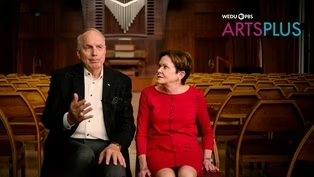
Clip: S13 Ep15 | 7m 18s | The most technologically advanced bell tower in the world stands in Tampa. (7m 18s)
Providing Support for PBS.org
Learn Moreabout PBS online sponsorship

- Arts and Music
The Best of the Joy of Painting with Bob Ross
A pop icon, Bob Ross offers soothing words of wisdom as he paints captivating landscapes.












Support for PBS provided by:
WEDU Arts Plus is a local public television program presented by WEDU
Major funding for WEDU Arts Plus is provided through the generosity of Charles Rosenblum, The State of Florida and Division of Arts and Culture and the National Endowment for the Arts, and the Hillsborough County Board of County Commissioners.