WEDU Arts Plus
1316 | Episode
Season 13 Episode 16 | 26m 44sVideo has Closed Captions
Jazz bassist John Lamb | Online couture garments | New Orleans on canvas | Key West Pottery
Jazz bassist John Lamb is a musical legend, playing live music in St. Petersburg at age 90. Nevada artist Sarah Hambly designs and sews couture garments that she shares online. Painter Terrence Osborne is inspired by his hometown of New Orleans and expresses his love for this city in his vivacious canvases. The team behind Key West Pottery shares the process behind their unique clay designs.
Problems playing video? | Closed Captioning Feedback
Problems playing video? | Closed Captioning Feedback
WEDU Arts Plus is a local public television program presented by WEDU
Major funding for WEDU Arts Plus is provided through the generosity of Charles Rosenblum, The State of Florida and Division of Arts and Culture and the National Endowment for the Arts, and the Hillsborough County Board of County Commissioners.
WEDU Arts Plus
1316 | Episode
Season 13 Episode 16 | 26m 44sVideo has Closed Captions
Jazz bassist John Lamb is a musical legend, playing live music in St. Petersburg at age 90. Nevada artist Sarah Hambly designs and sews couture garments that she shares online. Painter Terrence Osborne is inspired by his hometown of New Orleans and expresses his love for this city in his vivacious canvases. The team behind Key West Pottery shares the process behind their unique clay designs.
Problems playing video? | Closed Captioning Feedback
How to Watch WEDU Arts Plus
WEDU Arts Plus is available to stream on pbs.org and the free PBS App, available on iPhone, Apple TV, Android TV, Android smartphones, Amazon Fire TV, Amazon Fire Tablet, Roku, Samsung Smart TV, and Vizio.
Providing Support for PBS.org
Learn Moreabout PBS online sponsorship- [Announcer] This is a production of WEDU PBS, Tampa, St. Petersburg, Sarasota.
(gentle music) - [Announcer] Funding for "WEDU Arts Plus" is provided by Charles Rosenblum, Hillsborough County Board of County Commissioners, the State of Florida and Division of Arts and Culture, and the National Endowment for the Arts.
- [Gabe] In this edition of "WEDU Arts Plus," keeping the jazz beat alive at age 90.
- Success means you've accomplished something, but to me, it's something that I had to keep doing.
- [Gabe] A fashion designer's influence.
- [Sarah] I teach DIY tutorials.
I make things from beautiful fabrics and I make things from bedsheets or bags.
- [Gabe] Painting a city.
- [Terrance] People who are not artists, they experience the same thing that I experience when they look at the city locals.
The difference is that I have the mortar skills to interpret my perceptions.
- [Gabe] And an artistic pottery duo.
- While he was painting, I would make pottery, and then he started sort of commandeering my pots to paint on.
- It's all coming up next on "WEDU Arts Plus."
(upbeat jazzy music) Hello, I'm Gabe Ortiz and this is "WEDU Arts Plus."
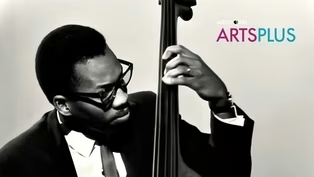
Jazz bassist John Lamb plucked out rhythms with the likes of Duke Ellington and Ella Fitzgerald in the '60s and '70s.
Now at age 90, John carries on the tradition of jazz by mentoring others, and you can still find him performing in St. Petersburg.
(jazzy bass music) - How did I get interested in music?
Oh yeah, we had to go to church, and all the ladies and men were involved in singing every Sunday and I was a kid sitting on the second row and I learned from that how to get into the music and feel.
I think that's where it started.
So after high school, I went into the military.
They took me into the Air Force as a tuba player.
I stayed in the military about eight or nine years and got out.
That's when I met Duke Ellington.
- John was a wonderful player and got recruited in the '60s to play for Duke Ellington and he kind of thought Duke was a little bit over the hill at that point.
He was more interested in Miles Davis.
His wife said, "Take that gig."
And it turned out to be the greatest gig of his life.
They toured all over the world, they won Grammys.
(upbeat jazz music) - At first when they said they were going overseas, I said, "No, I can't.
I don't wanna do that."
Then Mercer came and says, "Try it anyway, you might like it."
(laughing) So I continued on.
I said, "Okay, I'll try it for a month."
So I went over, sort of fell into the musician's habit.
(rhythmic jazzy music) - He and Buster Cooper, who's a trombone player with Ellington at that same time, Buster moved here in St. Petersburg and John and his wife followed.
They were educators.
John in particular I know mentored a lot of the young jazz talent that we have here, and he continues to do that.
John has got a real spark to him and it's kind of hard to explain what that star quality is.
He'll be out in the audience.
He comes to a lot of music, and before long, they're gonna have him on stage 'cause, "Hey, John's here."
Everyone's excited that he shows up and I think it's that star quality that he brings and the presence that he has and the talent that he continues to show off to the world.
(upbeat jazz music) - Well, I've known John for the better part of nearly 40 years.
I took bass lessons when I got out of high school from him originally, that's how I met him.
But over the years, we've worked together on the music scene and musically he's always been a huge inspiration.
You know, playing with Duke Ellington, he learned all these great tricks over the years and fun things on stage.
(mellow bass music) He'll come in here and say, "Hey, let's play something slow and melancholy," and he'll start, he'll stomp it off.
Other times he's gonna sit down at the piano with us and say, "Hey, let's play some blues and let's go."
(bluesy jazz music) Everyone loves to play with John because they never know, like I said, what to expect.
He can take that song and push it a certain way and make a singer or a trumpet player or whatever, kind of follow his lead and it's a fun time to watch that happen.
(bluesy jazz music) - He has a strength, still.
He has a force.
He has the ability, the knowledge, it's all there, it's all clear, and we're always happy to see him and have him join us on stage.
He's kind of like this wise elder.
If he feels like I need to hear it, he'll pull me aside.
If I feel like I need something, I'll pull him aside.
He's been a constant supporting figure, not only for me, but for a lot of local musicians, it's incredible.
- But it's just more than just that knowledge.
Some people you can't talk to about education, they will never know what you're talking about.
You have to be able to communicate it to them in a different way and music taught me how to do that.
(bluesy jazz music) - We've been celebrating his birthday since he turned 80.
We did 80, we did 85, and the last one for 90, we had 600 people in the audience to see John perform, but what we really had was every jazz musician in the area wanted to be part of that show and we had the best in the brightest, all who were influenced and loved John and were happy to be on the stage.
- Success means you've accomplished something, but to me, it's something that I had to keep doing to survive.
I mean, I had enough to keep me going, but I wanted to survive.
I wasn't trying to get rich.
I was already rich already from inside.
It will always be there.
It's the whole being, it's everything, man.
You feel it, it's there.
All you have to do is just tune in.
(slow jazzy music) - Really been a great, a great influence, not only in my life, but I know in so many other people's lives, he's always touched people and I've never had somebody say anything bad.
They've always said, "John Lamb, oh, I love John Lamb."
Everybody I know has said, "I love John Lamb.
I love John Lamb."
- John's impact on this community is not that hard to measure.
It's in every jazz performer that I know of, he's inside them 'cause he's inspired them and you're going to feel his legacy for decades to come because all these guys have learned from him and they're gonna take that out into the world.
(bass music) - [Gabe] To learn more, visit Wikipedia.org and search John Lamb musician.
Up next, head to Reno, Nevada to meet artist and social media influencer Sarah Hambly.
With a love for pop culture, she sews a wide range of couture garments that she shares online for her followers.
(gentle music) - Hi, my name is Sarah Hambly and I am a social media content creator/internet influencer.
So a social media influencer is basically like a marketing team/personality online, so I do everything from getting a brand deal to setting up all the products and taking all the pictures, and then pushing it onto an audience that would enjoy it.
So my art form that I create in is I sew on the internet, I teach DIY tutorials, I make things from really beautiful fabrics, and I make things from bedsheets or bags.
(gentle music continues) I got into sewing in a really kind of roundabout weird way.
(sewing machine clicking) I have my degree in photography.
I was working as a photo editor in Los Angeles and my dad passed away really suddenly.
It was suggested to channel my grief into something totally new, so I didn't just go to work, come home, cry, type of situation.
So I picked up sewing through that.
(sewing machine whirring) The conception of the project starts with usually finding inspiration either in my mind or from like a television show or from movies, and then it goes down on paper.
Sometimes the idea is so clear that I don't need to put it on paper and then becomes a process of like do I already have a pattern that I've made that I can modify to make this dress, or do I have to start from scratch?
Most dresses that I create can be anywhere from a few hours to many months.
This one behind me, this was three or four days to do, mostly because I had to really accommodate the bead work on there.
So it really depends on like the complexity level of what I'm doing.
(upbeat music) My social media journey is kind of your typical overnight type situation.
I wanna say October 2019 is when I really started to focus on posting the dresses I made 'cause before then I wouldn't share them.
A friend of mine got me into TikTok, filming the process and everything, and it just kinda snowballed from there.
(upbeat music continues) Around March 2021 the pandemic started.
I had a lot of free time, as most people did, and so I decided to try and remake Ariana Grande's Grammy dress that she wore that year.
I thought that'd be really fun to like attempt to remake.
So I did part one and I ended up with 35 million views pretty much overnight and went from like 100,000 followers to 1.5 million.
(upbeat music continues) The impact of social media these days is huge.
I didn't realize that it's its own industry.
I used to sew for other people.
I used to do commissions and wedding dresses and I did Miss Nevada Rodeo.
When I started posting on social media and gained a following, I gained a new career.
This dress here was inspired by what's called Royalty Core, which is an aesthetic online.
I was really inspired by like the whole concept of like flowing gowns and running through castles and those kind of imagery that you get in your mind.
When I do photograph these, I try and create a whole world, like a whole concept, so it's not just the dress, it's like props, it's the backdrop.
I will do photo shoots around Reno and I'll go to parks or I'll go and hike a trail, and I did one down in Davis Creek campground area where I had a girl on a horse in the dresses and people just loved it.
(fairy fantasy music) I think we live in a really beautiful, unique ecosystem here, having the ability to share both the desert and the mountains within relative posts online, so I could go and do something in the desert and then post something in the mountains and I've only driven an hour, that's fantastic.
There's like no part of the day where I don't feel like the world that I'm in is inspiring.
- To see more of her art, go to TikTok and Instagram and follow @OfficalHambly.
Born and raised in New Orleans, Louisiana, artist Terrance Osborne loves to paint his city.
His compelling canvases are full of expression and vivacity.
(upbeat music) (upbeat music continues) - I'm one of five.
We used to play under our house, these shotgun houses.
They're raised, so we used to play archeologists digging up bottles and things like that.
I developed a love for antiques and rustic things and all things New Orleans.
My mom collected a lot of antiques.
That was something that she did, a lot of rustic stuff she liked.
What I try to do is paint about those things.
Playing under the house gave me an idea of how the structure of a house was formed 'cause I could underneath.
So when I started painting them as an adult, I just painted from memory.
It was easy to understand them.
There's the artist who sees the culture and who mimics the culture.
I'm gonna paint a guy playing a trumpet or I'm gonna paint some crawfish or something like that, and that's fine because that introduces people to the culture and gives them something to take back, but then there's another artist that I'm partial to.
This artist is born of the culture, and when he produces something, he produces it from a place where he's not trying to mimic, he's creating the culture and that's what I do.
My job is to take the culture and show what it is.
I'm not mimicking, I'm giving birth to culture, and so when people see my work, they recognize that.
People who are not artists, they experience the same thing that I experience when they look at the city, locals, right?
The difference is that I have the mortar skills to interpret my perceptions.
Even though someone might think of what Mardi Gras is, I can paint the expression of it.
There's this piece called "Per Me Something Mista," where this lady has her arm stretched out and she has beads and you can see the enthusiasm in her face.
She is Mardi Gras personified, right?
Now that's how everybody feels, but I can paint about it.
Most of my pieces originally were about the houses and the neighborhoods and things like that, but I'm gradually starting to move into painting people more and then putting houses on their heads or umbrellas on their heads or alligators, anything that represents the culture here.
I've been painting a lot of women in sort of a regal look centered around something having to do with Mardi Gras or New Orleans and oftentimes I use my wife and my daughter as models.
I'll take a picture of 'em with the right angle and paint 'em in.
Sometimes it's my wife's eyes and my daughter's face, or vice versa, just to create these women.
Typically something centered around Mardi Gras and I enjoy that.
I put my family in my work.
I've always done that.
I don't know what else I would paint.
For me, that's real life.
"Lady Mardi Gras" is my absolute favorite.
I use this image on all of my cards and the advertising.
You could easily find her at a mall or something.
She would be the lady that stands out.
When I painted this piece, I needed something to intertwine her hair through the house to lock the house on her head, so I added these birds.
Then I added the cat because I tend to add something that doesn't belong 'cause birds and cats don't really get along to give it contrast.
Also, the black cat is mysterious as well, so it gives her that sort of mystery about her.
The "Bayou St. John Bridge," it's actually called the Magnolia Bridge, right, and one day this lady called me and said, "My husband and I are retired and one of our favorite things to do is to sit on the porch, sip wine and watch people get married on the bridge."
It's mostly a pedestrian bridge.
So she says that her husband mentioned one time, he said, "Honey, when I die I would love for a band to second line across that bridge to celebrate my life."
So she said, "His birthday's coming.
She said, I want to give him the gift before he dies.
Could you paint a scene of a band celebrating my husband's life on the bridge?"
So I did, and also I put them in the boat on the scene, and also my wife is in the center of that bridge so I thought that was a sweet sentiment for her husband.
(jazzy upbeat music) The house that's in the scene, it's the house that's closest to the bridge with the picket fence around it.
"Uptown Bound" is one of my favorite ones because it has all of my family's names in it.
So on the left, if you look at the buildings, you'll see Stephanie, my wife.
The second one is Seth.
He's my 20-year-old.
He's the culinary artist in the family.
Then LT is my oldest.
LT stands for Little Terrance.
He's not so little, he's 26.
He's a graphic artist.
And then there's a sign that says Sydney.
My daughter, she's 17 and she's a vocal artist.
And 524 on the streetcar is my wedding anniversary date, so it's the only one that has my entire family in it, and the streetcar is nice.
This pandemic was happening and you saw all of these women.
80% of the people who are in the medical industry on the front lines are women, so a friend of mine suggested that I paint the Rosie the Riveter.
I thought it was a fantastic idea.
His wife was a nurse, so I painted her, and what I ended up doing was donating about 5,000 of the posters to the hospitals in New Orleans and some hospitals around the country and the image went viral.
I really felt like I was contributing to the pandemic.
There's no competition for the Jazz Fest Poster.
This one guy called and said, "I'm responsible for selecting the artist for a jazz festival and I'd like you to do the Jazz Fest Poster," so that was in '07.
Jazz Festival is the highest-grossing festival in the world.
The Jazz Fest Poster is the highest-grossing festival poster in the world, so if you get it, of course it's a huge honor.
Your work goes all over the world.
If your poster does well, they call you again to do another poster, so I've done five Jazz Fest Posters so far.
That really put me on the map early on.
Most people think that the artist creates it all, but it's not, it's more of a collaboration between the producer of it and the artist.
The most excitement I got was when my third poster did well.
The third one is one of Jazz Fest's bestseller, the Trombone Shorty, the 2012.
I like how it came out.
I like the enthusiasm that everyone got from it.
I enjoyed working on it.
(upbeat jazzy music) - See more at TerrenceOsborne.com.
Meet the team behind Key West Pottery.
Originating in 2009, the artists Kelly Lever and Adam Russell render a variety of unique styles and designs out of clay.
(gentle upbeat music) - Pot never forgets the hands that make it, so I think that that's something that I'd want each person to walk away with is that feeling, that compassion, that creativity and that love.
- Kelly and I are actually both classically trained as painters and we met in painting school in Bowling Green, Ohio, actually.
Kelly is a lifelong potter.
And the correlation between painting and ceramics was not obvious to me at first.
- I ended up buying some used equipment and starting a studio within our home, kind of doing more the art fair circuit in Ohio, and at that time Adam had his painting studio in the same space, so while he was painting, I would make pottery and then he started sort of commandeering my pots to paint on, and eventually 10 years later, he was converted to the dark side of pottery.
- I couldn't make pots and I had to paint on her pots to begin with.
Lo and behold, people loved them.
We had a little bit of commercial success with those pots.
It was this kind of whole new world between painting, making impression, but also creating something into a three-dimensional reality.
Painting for me at that time was mostly about creating an illusion, to make something three-dimensional was a whole new world for me.
- Pottery to me is a meditation.
I love the process.
I love centering the clay.
I love the feeling and how it relates inside of me, so kind of using the elements, using the earth, using the water, the fire in the kiln, the air to dry it.
- Differentiating between Kelly and I's work has become more difficult over time because like any good partnership, over time it's really become hers, mine and ours, so a lot of the things we just simply make together.
Those things we sign KWP, Key West Pottery, or our studio maker's mark.
- We get people from all over the world that have collected our work and we also have a really big local following as well.
I love making the functional wares, so not necessarily the one-of-a-kind, but production items.
I love art for the everyday.
- Being an artist in the Keys is wonderful.
There's absolutely no shortage of inspiration.
The wildlife, we have exotic birds of every variety that change throughout the year and that's how we can see the season.
- We have a full range of works.
We definitely gear towards more fine art.
Being painters, our work, we really love the one of a kind.
So even my production wares, we tend to incorporate imagery and color and try to take a modern approach to an ancient art form.
Our work is very unique and very colorful and color is an indication of health, so having the full spectrum present can give you that feeling, that good feeling, that good vibe.
- What I love about the Keys is that there is a certain colloquial nature to the culture down here where we're populated with plenty of intellectuals.
There's a lot of actually quite famous authors, artists.
And at the same time, we'll have this kind of Caribbean-based culture that is very welcoming of anyone.
It doesn't seem like it is elitist, or you know, this work is for everyone and that really kind of speaks to the core value of I think why we make the work to begin with.
That's why I like it.
Plus, the weather's not so bad.
- Discover more at KeyWestPottery.com.
And that wraps it up for this episode of "WEDU Arts Plus."
To view more, visit WEDU.org/ArtsPlus, or follow us on social.
I'm Gabe Ortiz.
Thanks for watching.
(upbeat music) - [Announcer] Funding for "WEDU Arts Plus" is provided by Charles Rosenblum, Hillsborough County Board of County Commissioners, the State of Florida and Division of Arts and Culture, and the National Endowment for the Arts.
(gentle music)
Video has Closed Captions
Clip: S13 Ep16 | 6m 31s | Jazz bassist John Lamb recounts his career and continues to play in St. Petersburg at the age of 90. (6m 31s)
Providing Support for PBS.org
Learn Moreabout PBS online sponsorship

- Arts and Music
The Best of the Joy of Painting with Bob Ross
A pop icon, Bob Ross offers soothing words of wisdom as he paints captivating landscapes.













Support for PBS provided by:
WEDU Arts Plus is a local public television program presented by WEDU
Major funding for WEDU Arts Plus is provided through the generosity of Charles Rosenblum, The State of Florida and Division of Arts and Culture and the National Endowment for the Arts, and the Hillsborough County Board of County Commissioners.