WEDU Arts Plus
1317 | Episode
Season 13 Episode 17 | 26m 45sVideo has Closed Captions
Sarasota Opera's costumes | Islamic faith | Togo artist | Mural celebrating volunteers
With over 100,000 costume pieces, Sarasota Opera has one of North America's largest rental costume businesses. The Utah Museum of Fine Arts presents an exhibition that educates visitors on the Islamic faith. Togo artist Talle Bamazi creates paintings that reflect his life experiences.. The Food Bank of Northern Nevada commissions a mural to honor and celebrate its volunteers.
Problems playing video? | Closed Captioning Feedback
Problems playing video? | Closed Captioning Feedback
WEDU Arts Plus is a local public television program presented by WEDU
Major funding for WEDU Arts Plus is provided through the generosity of Charles Rosenblum, The State of Florida and Division of Arts and Culture and the National Endowment for the Arts, and the Hillsborough County Board of County Commissioners.
WEDU Arts Plus
1317 | Episode
Season 13 Episode 17 | 26m 45sVideo has Closed Captions
With over 100,000 costume pieces, Sarasota Opera has one of North America's largest rental costume businesses. The Utah Museum of Fine Arts presents an exhibition that educates visitors on the Islamic faith. Togo artist Talle Bamazi creates paintings that reflect his life experiences.. The Food Bank of Northern Nevada commissions a mural to honor and celebrate its volunteers.
Problems playing video? | Closed Captioning Feedback
How to Watch WEDU Arts Plus
WEDU Arts Plus is available to stream on pbs.org and the free PBS App, available on iPhone, Apple TV, Android TV, Android smartphones, Amazon Fire TV, Amazon Fire Tablet, Roku, Samsung Smart TV, and Vizio.
Providing Support for PBS.org
Learn Moreabout PBS online sponsorship- [Narrator] This is a production of WEDU PBS, Tampa, St. Petersburg, Sarasota.
(soft music) - [Narrator] Funding for "WEDU Arts Plus" is provided by Charles Rosenblum, Hillsborough County Board of County Commissioners, the State of Florida and Division of Arts and Culture, and the National Endowment for the Arts.
- [Gabe] In this edition of "WEDU Arts plus," an enormous costume collection.
- We have tens of thousands of costumes in our warehouse, and we do alterations on them for the particular person.
- [Gabe] An installation that celebrates the Muslim community.
- [Satin] There are things Islam is and there are things Islam is not.
We're using this space to showcase that and separate what Islam is from ideology, separate what Islam is from culture.
- [Gabe] A message in a brushstroke.
- I want us to have experience of human being that we don't have that no more, we let that go.
I want everybody to know that I love everyone.
- [Gabe] And a collaborative mural.
- Our team helped fill out the words that are used to describe our appreciation for volunteers.
It was just a very organic but natural process, and it's just incredible.
- It's all coming up next on "WEDU Arts Plus."
(bright music) Hello, I'm Gabe Ortiz, and this is "WEDU Arts Plus."
In 2019, a costume shop in Canada closed.
That inventory wound up in a 17,000-square-foot warehouse owned by Sarasota Opera.
Now the local arts venue has the largest rental costume business in North America.
(opera singer sings in foreign language) - I always refer to opera as the all-encompassing art form.
It is a musical form.
It's also a dramatic form.
It contains singers, orchestra, chorus.
It also has visual elements like sets and costumes.
So it's all of the pieces that create this wonderful art form.
(singer sings in foreign language) - Costumes and sceneries set you to the time and place.
- We have tens of thousands of costumes in our warehouse, and we do alterations on them for the particular person.
If we don't have a costume for a particular part, then we build it or we make it right here in the costume shop.
So we do both.
- For many years, Sarasota Opera had been renting costumes from companies throughout North America, but our primary source was a company in Toronto called Malabar.
They were the largest and probably the best collection of rental costumes available for traditional opera productions.
Our costume designer, Howard Kaplan, worked with Malabar for a long time.
He also had designed specific productions for Malabar to build and rent.
- And I became very close with the department managers, and they said, "Oh, we've seen your sketches, sew Luigi your sketches."
And then Mr. Speca commissioned me to design "Pirates of Penzance" for Cleveland Opera.
- When the owner of Malabar, Luigi Speca, decided he wanted to retire and slow down, he first came to Howard, knowing that Howard had the same aesthetic and that Sarasota Opera would be a good steward of this incredible collection that he created.
- We purchased the collection in the fall of 2019, and it moved down in 10 tractor trailers during that time.
We paid basically $33 a costume.
- We were lucky to be able to find a warehouse and a nice, clean space.
Actually, before we used it, it was a volleyball gym that we were able to build out, and it's about 16,000 square feet we are able to house these costumes.
We now have about 50,000 complete costumes.
That's about 100,000 pieces when you count every coat, every pants, every shirt.
Sarasota Opera purchased this collection to use for their own use.
But a significant part of what we are doing now is renting these costumes to other opera companies, theater companies, universities.
And we've actually done some work in film.
We've had some of our costumes featured in a Netflix feature.
We've also, a Kia car commercial used some of our costumes.
- [Howard] The Kia people called us because someone had booked every 18th century costume in the whole city for, I don't know what, it was some pirate movie they were doing.
So everything was on reserve.
They were desperate to find 18th century clothing.
(dramatic music) - One of the things that we were surprised when we got these costumes from Malabar, a lot of them have name tags and had the names of singers who've used them over the years.
Yeah, this one was worn by Mr. Pavarotti and has his name still in the label, and we have other great singers as well.
People like Luciano Pavarotti, Beverly Sills, Placido Domingo, Marilyn Horne.
So it's great to have not only the wonderful costumes that they used but also a little bit of history with them.
(opera singers singing) - Everything is organized by shows or productions.
So there's a "Tosca" aisle, there's a "Carmen" aisle, there's a "Traviata" aisle.
- These dresses are made to be altered.
By that I mean the inseams are three or four inches, the hems are maybe six or eight inches, so it can go up or down or in or out, but there is a lot of flexibility there to fit other people in that same dress.
- When working on a production, we'll first read the libretto, listen to the music, and then we'll move forward with sketches and purchasing of fabrics, going through our huge stock to see what we can use for that production.
(soft music) "Golden Cockerel," I would say, is one of my favorite productions, and we did it years ago, "Alzira," which was kind of an Inca opera.
There was a Inca art exhibit, art and textile exhibit up at the St. Pete Museum.
I was able to purchase replicas.
They were like tea cozies or something, you know, copper plates and stuff you'd hang on the walls.
And then we ended up being able to put 'em on the front of the armor and stuff, so they really looked like real Inca copper pieces and gold pieces and stuff.
So that was kinda fun.
(opera singer singing in foreign language) - One of the things I think is great about opera is that the stories are timeless and the music is so engrossing.
(singer singing in foreign language) Many of our audiences are longing for that live performance experience.
And I've been really heartened by the fact that in the post-COVID era, we've seen huge numbers of new first-timers coming to the opera.
- I love the challenge.
I love the dedication that the artists have to their work.
They have to learn their music.
They have to learn the language, every opera is maybe sung in a different language.
And so it's a very dedicated profession and I appreciate that, I enjoy being around that.
I love it!
(chuckles) (dramatic music) (audience clapping) (soft music) - Visit sarasotaopera.org to learn more.
Head to Salt Lake City to view the collaborative installation "Ummah."
Located at the Utah Museum of Fine Arts, "Ummah" teaches visitors about the Islamic faith and celebrates the Muslim community.
- After 9/11 happened, like a couple years later, somebody in our community actually, like, reported us to the FBI.
They said, you know, suspected terrorist activity.
And so these FBI agents came and, like, interviewed us at our house.
And I kind of stood, like, outside of my bedroom with the door open and I kind of, like, peeked in and listened to them, and they asked a lot of questions.
They were very, very kind, very respectful.
And I remember, like, being kind of nervous.
I even had, like, a couple nightmares where police came and took my parents away.
So I think even though it wasn't, like, that significant of a thing, it was a little bit nerve, made me nervous.
So after they left, my mom had a conversation with me that, I think, shaped a little bit of the direction of my life.
She said, "Satin, I know that what you saw here today was a little bit scary.
I know, like, it was kind of weird having them come here and ask us a lot of these questions.
But people are really afraid right now after," you know, like, referring to what happened on 9/11, "so people are very scared, and so that's why they're kind of going out of their way to just check everything 'cause they wanna make sure that doesn't happen again.
And people are gonna say mean things to you that might be unkind, but don't ever, ever hate America.
This country has been so incredibly generous to us, and what America means is so much greater than everything that you see right now.
This country is a land for immigrants, and I don't want you to ever hate America, I want you to take care of it the way that America took care of us."
But I remembered that and it became a theme in my life, you know, as I went to high school and I went to college, and it wasn't always about misrepresentation of Islam, it was in maybe another area, but I think a lot of my purpose comes from that.
So, this is me taking care of my country the best way that I know how, and sometimes that means saying that I am an American when maybe somebody else questions that.
So, ultimately, I think "Ummah" is about the Muslim community.
But as an American Muslim, I believe in a greater community of people of color that all come here to call themselves American.
So, this exhibition is very, very meaningful to me.
- "Ummah" is part of the ACME initiative, it takes place in our lab space, and this is the first of the lab exhibitions to really engage with our local community.
So these, we're working with Salt Lake City, members of the Salt Lake City community who happen to be Muslim to design and conceptualize the entire space.
- "Ummah" means the collective community of Muslims.
So, a lot of, a really big misconception is that Muslims are very alike, but they actually transcend borders.
So Muslims come from all different backgrounds, ethnicities, they speak many different languages, they have different identities, they have different cultures, different foods, et cetera.
So "Ummah" is the collective community of people who are Muslim and their ties to one another is religion.
So it's actually a beautiful concept because it unites people past the things that divide them.
- We love the Utah Museum of Fine Arts, I remember coming here when I was a kid.
And for them to approach us and say, "Hey, we are thinking of this idea, we have an ACME Lab, we have fourth-graders that come in and they get to have this interactive experience and really have a love for art and different cultures or different themes within the exhibit or within the museum," so we were sold right from the get-go.
We just, we couldn't pass up even we wanted to, and they've been great to us.
- We know that every fourth-grader in Salt Lake County will have the chance to come through this museum exhibit.
And, you know, we talk about how when we were in fourth grade, when we went on a field trip, there wasn't anything representing Muslims that we could walk through.
So this is like a very, it's a very significant moment for us when, you know, we grew up in front of a TV that said, you know, red terror alert day, that was the attribution to Islam and Muslims.
But now they get to have an experience that's positive, and I think that is different and it's new and it's in Utah.
So I think it's a blessing for the Emerald project to be involved with ACME in this exhibition and we're so grateful.
(people chattering) For the pillar section, obviously we know what the five pillars of Islam are.
So the key is to find pieces that fit the pillar and not build the pillar in a way that fits the piece.
So we went back to the fundamentals.
So what is the first pillar?
The first pillar is Shahada, what you recite when you convert to Islam.
What piece would best capture what this pillar is about?
And we try to engage the community a little bit with some of the pillars.
So for Salah, which is the second pillar, that's the pillar that obligates each Muslim to pray five times a day, we wanted to represent Muslims in the community.
So we had some younger, our younger Muslims, some of the kids in our community who actually are able to recite it correctly, record those prayers so you can actually listen to them.
For the Ramadan pillar, which is Sawm, we had our team actually come in and paint these clocks that represent from dawn to dusk, which is when we fast for the month of Ramadan.
But that one was a little bit more of like, you know, we get to be a little bit more involved with that pillar and paint it and decorated and design it.
(soft music) So, it's a combination of finding the right piece to meet the pillar and also engaging the community.
- The community section is really, really beautiful to me because it's literally different people within Salt Lake, within Utah, within different backgrounds who contribute things that represent Islam to them, whether it's their own little handheld Qur'an or a bracelet or a misbaha.
I think it's great that they can literally be a part of the exhibit.
Even if they're coming through, they still have an opportunity to fill out the paper and bring something later on so they don't really get to miss the boat on participating.
And the other part of the exhibit that I absolutely love is the Qur'an we have under the glass because, you know, no matter everything else going on in the world, me as a Muslim, I know that is my source, that is the book, that is the faith that I go back to at the end of the day and that is my truth, and that's why it's in the center of the exhibit because that is the center of our faith, that is the pillar that strengthens us and holds us together.
- If I have a message to share with newcomers to the museum or someone who's maybe never met a Muslim or has had very little interaction with Islam and Muslims, I would say that it is a completely safe space.
The goal is not for you to walk away with this understanding or, you know, 1-2-3 bullet points as much as it is to hold a space in your mind that Islam is something, you may not know that something and that's okay, but know that it is something that may not necessarily be represented in the media.
There are things Islam is and there are things Islam is not.
We're using this space to showcase that and separate what Islam is from ideology, separate what Islam is from culture.
So it's okay to come here, it's okay to walk away with questions, it's okay to come here and maybe not even change your mind.
But the point is that we wanna make sure that everybody feels welcome, and hopefully you can attend some of our dialogues and programming so that we can engage in a deeper conversation.
(gentle music) - For more information, visit umfa.utah.edu/ummah.
Artist Talle Bamazi creates paintings that reflect his life experiences.
From visualizations of the COVID-19 virus to cultural symbols of his home country in Togo, West Africa, Bamazi documents the world around him.
(lighthearted music) - My name's Talle, and I'm from Togo, West Africa.
I get here in 1995 from West Africa.
I was invited to have a show in Philadelphia, and so I just started going to school and then later on went to New York Academy, graduate.
And then later on, I decided to come to Ohio, my ex-wife and I.
So we decide to search.
And so when I search, I found out Ohio, and especially in Columbus, they have a major world-renowned collectors.
And I was like, "Wow, sweetheart, that's where we're going."
(chuckles) (lighthearted music continues) I was very surrealist also at that time.
You know, I kinda changed it as I came over there, kinda find my way.
I kind of master all style now.
So going abstract, surrealism, realism, and so I can understand all cultures, you know, I can answer any questions in any style.
My role is document the moment, and that's what I'm doing.
(gentle music) You've seen the symbol of a coronavirus, I begin to introduce them.
The first one was the other one there, which is death.
There's no one that will not die.
If you're born, you're gonna die.
Anything that is being created will spoil.
If you understand that rule, you will live longer and peaceful.
(soft music) When you look at them, as dark they are, they're beautiful.
As dark they are, you see the beauty in.
So, in this moment right now, I appreciate it.
Say every second that I live, for me is grateful time.
So I use that wisely.
I present life with eggs.
Anytime you see eggs in my paintings, it mean life.
(gentle music) In a calabash, I always put a calabash inside my work because this is the symbol of life, 'cause that thing for me, that's the beginning of conscience of a human being.
Anywhere you go, you will see the calabash.
It just is my effect, is Africa.
So we use that daily just to drink our wine.
Daily, we have that.
The queen used to put her jewels inside.
You know, it's a different way that this is served in Africa.
(gentle music) So it's beautiful, it's kind of, it's earthy, you know, it's beautiful when you look at it.
(soft music) I'm a human, and as long as I will live, I'll be human.
I don't care who you are, when I met you, when I met anyone, I want us to have experience of human being that we don't have that no more, we let that go.
I want everybody to know that I love everyone.
I don't care where you're from, what you do bad, bad, good, I love you.
If we can love each other, what else can you give someone beside love?
- See more at instagram.com/bamazitalle.
As a way to honor their volunteers, the Food Bank of Northern Nevada decided to create a mural that reflects all that they do.
Working with muralist Bryce Chisholm, everyone came together for this meaningful project.
(light music) - I'm Nicole Lamboley, and I'm the president and CEO of the Food Bank of Northern Nevada.
We are a charitable food distribution organization serving 90,000 square miles throughout northern Nevada in the eastern slope of the Sierra.
Today, we're standing in the warehouse out here on Italy Drive in McCarran, or Sparks, Nevada.
This is our warehouse where we receive inventory and distribute food to our 147 partner agencies throughout our service area.
(light music) Where we are actually standing is our volunteer area, and volunteers are the lifeblood of our organization.
They provide over 30,000 hours annually.
- They have their hands in everything that we do, and they help bring so much inspiration and passion even to the staff who are here doing the job alongside them.
We literally could not do this work without them.
- Our team of marketing and communications professionals brought this idea forward about how do we really reflect our appreciation to our volunteers.
And so they went through a process and contacted several artists throughout the community who have done work in the northern Nevada area.
They submitted proposals, and then we went through a process of evaluating who really could capture a message that we wanted to share with our volunteers.
(bright music) - I'm Bryce Chisholm.
I paint under the name AbcArtAttack.
I'm an artist and muralist around the Reno area.
My style is somewhat graffiti-inspired, very colorful and bright, and it's got that high-contrast pop.
One of the things I like about what I do with my colors, I call it color therapy.
I free my mind and it's just coloring, you know, as a kid would.
And I feel like that's how people should go about art is that free-minded creation, don't overthink it, just let it go.
The food bank reached out to me, and they had an idea of they wanted to do something that would incorporate volunteers and bring it all together.
- We're so thrilled to have the opportunity to create a mural that really captures the heart of the food bank and the service that our volunteers provide to us.
(upbeat music) - [Bryce] The mural is a little girl biting into an apple, and everything behind her, the words and everything, are different positive words for food health: "I fight hunger," "nourishing hope," themes that the food bank has incorporated into their model.
- All of the employees are getting the opportunity to choose a word from a list that we put together as a staff.
And I chose to paint the word "together."
When the community comes together, the smallest acts make such an enormous difference for so many people in our community, and so to me, togetherness really sums up what this work is for me.
- It's really special to have the employees come about and, like, be able to put their artistic touches into the mural.
It creates that sense of ownership where they can come back and be like, "Look it, I painted this right here and I was part of that.
I was there that day when we did all that."
So, it's a great feeling for them as well.
- Having the opportunity was a little nerve-wracking to be able to get up there and say, particularly as a lefty, can I actually paint words with penmanship that's legible?
But it was really fun, and I felt inspired by being able to participate.
And I think that's what is so great about Bryce as an artist is that he has the trust in people to also contribute to his masterpiece that he is doing for us.
I painted "indispensable" because our volunteers are truly indispensable.
- I think the mural is gorgeous.
It's really just a beautiful piece of art that signifies what goes on here.
It's a place that's just alive and it says what needs to be said about the operation of this whole facility.
- Volunteers are members of our community, and together as a community, we can lift up people needing nourishment through food bank services, through the arts, and celebrating the contribution of artists.
So volunteers are just part of the American culture and of who we are as a community, and so we are proud to be able to provide the opportunity for people to serve their fellow neighbors.
(soft music) - See more of Chisholm's work by heading to abcartattack.com.
And that wraps it up for this episode of "WEDU Arts Plus."
To view more, visit wedu.org/artsplus or follow us on social.
I'm Gabe Ortiz.
Thanks for watching.
(intense music) - [Narrator] Funding for "WEDU Arts Plus" is provided by Charles Rosenblum, Hillsborough County Board of County Commissioners, the State of Florida and Division of Arts and Culture, and the National Endowment for the Arts.
(bright music)
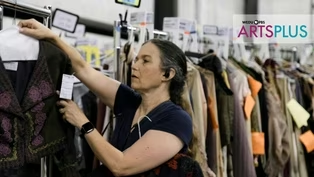
1317 | Sarasota Opera's Costumes
Video has Closed Captions
Clip: S13 Ep17 | 6m 11s | Sarasota Opera shares its expansive collection of costumes (6m 11s)
Providing Support for PBS.org
Learn Moreabout PBS online sponsorship

- Arts and Music
The Best of the Joy of Painting with Bob Ross
A pop icon, Bob Ross offers soothing words of wisdom as he paints captivating landscapes.












Support for PBS provided by:
WEDU Arts Plus is a local public television program presented by WEDU
Major funding for WEDU Arts Plus is provided through the generosity of Charles Rosenblum, The State of Florida and Division of Arts and Culture and the National Endowment for the Arts, and the Hillsborough County Board of County Commissioners.