WEDU Arts Plus
1318 | Episode
Season 13 Episode 18 | 26m 45sVideo has Closed Captions
OXH Gallery | Africobra | Corky Bennett | Salem Witch Trials
The OXH Gallery in Tampa works to amplify the voices of women in the arts. Learn the history and significance of Africobra, a Chicago-based collective of African American artists founded in 1968. Meet Corky Bennett, a Nevada-based musician and entertainer who loves to play the accordion. An exhibition at the Peabody Essex Museum in Massachusetts features artifacts from the Salem witch trials.
Problems playing video? | Closed Captioning Feedback
Problems playing video? | Closed Captioning Feedback
WEDU Arts Plus is a local public television program presented by WEDU
Major funding for WEDU Arts Plus is provided through the generosity of Charles Rosenblum, The State of Florida and Division of Arts and Culture and the National Endowment for the Arts, and the Hillsborough County Board of County Commissioners.
WEDU Arts Plus
1318 | Episode
Season 13 Episode 18 | 26m 45sVideo has Closed Captions
The OXH Gallery in Tampa works to amplify the voices of women in the arts. Learn the history and significance of Africobra, a Chicago-based collective of African American artists founded in 1968. Meet Corky Bennett, a Nevada-based musician and entertainer who loves to play the accordion. An exhibition at the Peabody Essex Museum in Massachusetts features artifacts from the Salem witch trials.
Problems playing video? | Closed Captioning Feedback
How to Watch WEDU Arts Plus
WEDU Arts Plus is available to stream on pbs.org and the free PBS App, available on iPhone, Apple TV, Android TV, Android smartphones, Amazon Fire TV, Amazon Fire Tablet, Roku, Samsung Smart TV, and Vizio.
Providing Support for PBS.org
Learn Moreabout PBS online sponsorship- [Announcer] This is a production of WEDU PBS, Tampa, St. Petersburg, Sarasota.
- [Dalia] Funding for "WEDU Arts Plus" is provided by Charles Rosenblum, Hillsborough County Board of County Commissioners, the State of Florida and Division of Arts and Culture, and the National Endowment for the Arts.
In this edition of "WEDU Arts Plus," a Tampa gallery amplifies the voices of women in the arts.
- By having something very tactile, such as Rima's work, with something super technology-oriented like Venera's "Black" show also make the point of connection, that art is not just on the eye of the beholder, but it's also a whole concept.
So what you look at is one thing, but also it should sort of push you more into thinking about what you're looking at.
- [Dalia] The AfriCOBRA art movement.
- [Wadsworth] You know, we had a political slant with an aesthetic.
It's about politics, life.
- [Dalia] An accomplished accordion player.
- I love music, and I like to make people laugh and be happy.
- [Dalia] And artifacts that tell a story.
- [Dan] These are pieces of paper that people wrote on by hand.
These are objects that the people involved owned.
- It's all coming up next on "WEDU Arts Plus."
(elegant upbeat music) Hello, I'm Dalia Colon, and this is "WEDU Arts Plus."
Located in Tampa, OXH Gallery is a female-led space dedicated to showcasing works by nationally and internationally renowned women artists.
Their latest exhibition showcases how two artists with different backgrounds approach costume design and performance.
(wings flapping) (pensive music) - I was always drawn to both Rima and Venera.
I never really saw them in relation or in conversation to each other until I felt that in a space pristine and white like this, I just wanted a pop of color and the sort of texture that is there, but it's not really there.
So you have video, and you have a lot of texture, but then it's still a screen.
It's very sleek.
And then you have all these books, and you have so much needling and the thread and the needle work, but at the same time it's so pristine.
You're almost afraid to touch.
Having those conversation in a blindly white space, that was done on purpose because I wanted people to just take in color.
(paper rustling) - I think Odeta's perspective in the local Tampa scene is elevating women, looking at the contemporary scene as something more of an open-ended question rather than a set idea of this is just like artists that we've seen over this course of the past couple of years.
She's introducing a lot of new artists, a lot of women artists, elevating that front, and kind of creating an open space just for community, welcoming other people, like especially with like the growing Tampa arts scene.
(gentle elegant music) - It takes the cues from telling a story.
Between the books, you flip the pages of the books.
and the videos.
Each video you see a different part of a story being told.
And by having something very tactile, such as Rima's work, with something super technology-oriented like Venera's, "Black" show also makes the point of connection, that art is not just on the eye of the beholder, but it's also a whole concept.
So what you look at is one thing, but also it should sort of push you more into thinking about what you're looking at.
(elegant music continues) (paper rustling) (calm upbeat music) - Her agenda to bring internationally known artists to Tampa and letting us see that, it's really great to see new voices but also from voices that we're not really used to and always in places that we know about, but we don't know what's happening in them.
And it's great to see here.
- I think it's really incredible to be able to walk up some stairs and find international artists.
And I think it's really important to showcase art from all over the world and really have, like, local people be exposed to that.
(calm upbeat music continues) - OXH Gallery actually stands for my own initials.
I am originally born and raised in Albania, and the reason why I named it after myself is because I am a female.
I am a immigrant.
I've made the States my home, but that's really not (laughs) where I was born and raised.
So by putting a name, my name to the gallery, I sort of make a state that this is my place and this is who I truly am and how I have fully become myself in a country, in a culture, that has accepted me.
It allowed me to be fully integrated.
- She is so incredibly bright, and she has such a vision for art.
And I'm a Tampa native, and our local arts scene has leaned a little bit more towards the decorative side of art for many, many years.
With Odeta coming in, she's bringing an intellectualism to it and an aestheticism that is very different from what we've seen before.
So I think it's a void that needed to be filled in our Tampa art world for sure.
(pensive music) - I continue to make art.
I continue to exhibit as an artist.
What I find very inspiring at this stage of my life is that besides putting my own point of view and my sensibility and my aesthetics out there, also since thankfully I'm able to do it, to provide a sanctuary for women artists.
The sense of pride that I get so far from running the gallery is the fact that these artists trust me well enough to allow me to also use my own concepts of how their work should be showcased.
- "Red Gasps" really brings that idea of intimacy into a very sacred space.
I think that the detail in Rima's work is so stunning with the soft quality of the thread exploding into a space that feels shocking in a way with how the craftsmanship is so subtle, so detailed.
There's so much care in all of her work.
And I think that echoes really well with Venera's work.
It's something that has so much care in the costumes.
You can tell there's a lot of attention to detail.
But definitely just like the stop-motion quality of her costumes, like, there's time, and there's a lot of care, and it goes beyond the element of craft.
It definitely feels like there's a warmth there.
- There is a whole lot of art going on in Tampa.
The art ecosystem is very vibrant.
What I feel in a sense, it sort of speaks to itself, and my contribution to the already set-up ecosystem is to bring artists that otherwise would not really find their way in Tampa.
(pensive music continues) (gentle music) - To learn more, visit oxhgallery.com.
The African Commune of Bad Relevant Artists, otherwise known as AfriCOBRA, was founded in 1968.
This Chicago-based collective of African American artists created a revolutionary visual aesthetic that is a source of inspiration to this day.
(keys jingling) - [Reporter] Cleveland artists Wadsworth and Jae Jarrell have spent their lives creating images of Black power and beauty.
The Jarrells work as individual artists and as members of AfriCOBRA, a collective established in 1968 to create art addressing issues of equality and civil rights.
Wadsworth's new book "AFRICOBRA" documents the group's history, origins, and its mission.
(upbeat funky music) Art brought Jae and Wadsworth together in the 1960s.
They both studied at the Art Institute of Chicago and began dating, Jae studying fashion design and Wadsworth painting.
- She was designing fashion when I met her, and she had a business.
I painted at night and on the weekends.
And Chicago was very important in this movement and our art.
Art had in the past all been basically created, especially movements, not in a city like Chicago.
It was New York City and things like that.
So what we ended up doing was making Chicago a major city where art came out of.
(psychedelic music) - [Reporter] The '60s were a tumultuous time in US history, the beginning of the Black Power movement and the call for civil rights.
Inspired by the movement, in 1965, Black poets, musicians, writers, and artists in the New York-Newark area started the Black Arts movement to create Black art for Black people.
It soon spread to major cities around the country.
In Chicago, Wadsworth and other African American artists collaborated on a large outdoor mural called the "Wall of Respect."
It was the first of its kind in the country.
- The first thing happened in Chicago was the "Wall of Respect" that went viral, not just nationally, but internationally.
And this was the first visual art during the Black Power movement.
New York opened up the Black Repertory Theater without any visual arts.
So what I'm saying is Chicago was the first one to put visual arts during the Black Power movement that went viral with the "Wall of Respect."
- [Reporter] With the success of the "Wall of Respect" in 1968, Wadsworth and Jae Jarrell and three other Chicago artists launched AfriCOBRA, the African Commune of Bad Relevant Artists.
As visual artists, they were at the forefront of the Black Arts movement.
- [Wadsworth] We formed a collective that we named COBRA in the beginning, and we added some Afri to it to make it AfriCOBRA, African Cobra.
There was five founding members, who was Jeff Donaldson, Jae Jarrell, Wadsworth Jarrell, Barbara Jones-Hogu, and Gerald Williams.
- [Reporter] Themes within the art included African designs and positive messages of unity.
The group embraced the use of lettering, straight lines, and bright, vivid colors known as Kool-Aid colors to create a Black aesthetic.
- Kool-Aid color is a variegation of bright, intense colors with a sensibility and harmony.
Kool-Aid color was representative of what Black people was, clothing they was wearing in the '60s, real bright-colored clothing.
So we chose that as one of... That was the first principle we chose.
And we had frontal images, which is inspired by African sculpture, which is always a frontal view, never a three-quarter view, which represents strength and directness.
And we wanted to use positive images.
That's another principle.
- [Reporter] AfriCOBRA held its first major exhibit, "Ten in Search of a Nation," at the Studio Museum in Harlem in 1970.
Its purpose was to educate the public and empower the Black community.
Wadsworth remained a member of AfriCOBRA until 1998, eventually finding his way to Cleveland, his wife Jae's hometown.
Over the decades, he began to see a retelling, a revision of the history of AfriCOBRA, and sought to set the record straight.
- I wrote the book basically to correct all of the improper information that was online and everything.
Everything put out about it in writing basically was not right.
Even a member of the group, the guy that was basically the spokesman for the group, he started writing false things about the group like, you know, dropping two members, adding a member that did not exist, did not join the group.
So that's why I wrote the book.
- [Reporter] Some 60 years later, the work of AfriCOBRA artists is being recognized.
In 2017, the Cleveland Museum of Art purchased a painting by Wadsworth Jarrell for more than $97,000.
In addition, the history, ideas, and paintings found between the pages of the book "AfriCOBRA" are being taught in art classes around the country.
- [Wadsworth] Because AfriCOBRA is far more about than just making art.
You'll read that, you know, we had a political slant with an aesthetic.
It's about politics, life.
It's an art history book, arts initiative, not just African American art history.
It's art history, period.
(gentle music) - For more information, visit africobra.com.
Corky Bennett, AKA the King of Reno, is a Nevada-based musician and entertainer who loves to play the accordion.
With his instrument, he has traveled across the country delighting audiences for decades.
- My legal name is Leighton Wiley Brumble.
Now, a lot of people know me as Corky Brumble, but even more people know me as Corky Bennett, the King of Reno.
(jovial accordion music) I grew up in a little town called Sequim, Washington back in the '40s.
When I was seven years old in 1949, I heard a guy play the accordion on the radio, and I didn't know, but it was Dick Contino.
And Dick Contino in those days was a huge, huge star.
I heard Dick play, and I go, "Wow, that's awesome."
So I said to my mom, "When I grow up, I wanna be an accordion player."
She says, "Corky, you can't do both," so I became an accordion player.
(lively accordion music) About three years later, my dad brought home a little 12 bass accordion.
He says, "Here, play this.
Try it out."
So I played a little bit.
He says, "You like it?"
I go, "Yeah."
The next week he signed me up for music lessons at a music store downtown Seattle, and I took to it pretty quickly.
About three months after I started, they put a bigger accordion on my lap.
And he says, "How do you like that?"
I go, "Well, that's beautiful."
He says, "Well, that's good 'cause your parents just bought it for you," and I started crying.
I thought that was so cool, (laughs) you know?
My parents had bought me a big-boy accordion.
(light-hearted music) I was in a band called "The Buckaroos," and we were little country band, and I was 11.
We played for the Kiwanis clubs and the Rotary clubs and things like that.
Our moms made us satin shirts with fringe all over, and we wore cowboy hats, and cowboy boots, and we were slick.
(laughs) The accordion is my favorite instrument in the world because you can play so many different styles on it.
You can play polkas like.
(lively polka music) Or you can play jazz.
(upbeat jazz music) Country music.
(upbeat country music) Or you can play Cajun music.
(lively Cajun music) (upbeat jazz music) The first gig I ever had in Reno, Nevada was at the old Golden Hotel.
This was in 1963, and then it turned into Harrah's Club.
That's how I honed my craft, was doing shows in Nevada.
I'd do a lot of comedy in my shows.
I just liked making people happy.
I was playing at this place called the Hardy House on California Avenue, and it was packed.
It was like a Friday night.
And a guy comes up to me, and he says, "You know, Corky, you're the King of Reno."
I go, "Really?"
Well, a brand was born.
(laughs) I became the King of Reno.
(slow upbeat accordion music) The accordion works just like the human body.
The bellows are your lungs, and they push air over reeds.
And the reeds are like your vocal cords.
And the more air you push over it, the harder you pump or pull, the more air you're pushing over those reeds, and you get louder or softer just like your voice.
And then when you push a key, (slow elegant accordion music) that's like opening your mouth.
That's how the music comes out, and the sound comes out of the grill here.
This is the bass side.
This would be like the left hand of the piano where you play a note and then you play a chord.
The thing about the accordion is it covers the whole spectrum.
It can make people laugh.
It can make people cry.
It can make people happy, sing along.
Accordion's great that way.
It's the most versatile instrument there is.
(upbeat accordion music) ♪ Goodbye Joe ♪ ♪ Me gotta go, me oh my ♪ ♪ Me gotta go pole the pirogue down the bayou ♪ I get emotionally charged up by music.
When I'm playing at home, I play things like "Rhapsody in Blue," Gershwin songs.
I play like "MacArthur Park," a Jimmy Webb song.
I love that kind of music.
It's my whole world.
There's nothing more important to me.
(gentle music) - Up next, take a look at the exhibit "The Salem Witch Trials: Reckoning and Reclaiming" at the Peabody Essex Museum in Massachusetts.
On view are an assortment of artifacts that date to this moment in history.
- [Reporter] Centuries after its notorious witch trials, Salem, Massachusetts is still spellbound.
It's a brew of memorials, historic sites, and tourist trails.
It also doesn't shy away from being a cauldron of camp, from "Bewitched" to "Hocus Pocus."
- Hello, Salem!
(crowd cheering) My name's Winifred.
(vocalizes) ♪ I put a spell on you ♪ - [Reporter] But as a new exhibition at the Peabody Essex Museum reminds us, the history here is real, and it is grim.
- The people involved in this crisis had fears and emotions just like we do and that this was a harrowing experience for everybody involved.
- [Reporter] The show of fragile, rarely exhibited artifacts delivers us to 1692, when rapidly rising hysteria resulted in a torrent of accusations that brought down some 400 people in the Massachusetts Bay Colony and led to the deaths of 25.
And it was all very diligently recorded says co-curator Dan Lipcan.
- [Dan] These are pieces of paper that people wrote on by hand.
These are objects that the people involved owned, a chair that someone sat in.
That helps us identify with the people that were involved in this crisis.
- [Reporter] That crisis emerged from a set of events that have a chilling resonance today.
- And there was extreme weather.
There were really dry summers, very cold winters.
There had been a smallpox epidemic.
There was a war to the north, and there were refugees coming into town from Maine and New Hampshire.
- People begin to look for answers.
Who's responsible for our problems?
It basically becomes an issue of scapegoating, right, rushing to judgment, looking for someone to blame for your problems.
- [Reporter] Historian Emerson Baker is the author of "A Storm of Witchcraft."
He says the blaming was easy.
There was even this 15th-century book, the "Malleus Malleficarum," that was a manual for taking down witches, something that had plenty of precedent in Europe.
- What happened in Salem is really just the tip of a huge iceberg.
Between about 1400 and 1750, which is generally called the great age of witch hunts in Europe and your colonies, about 100,000 people were accused of witchcraft, and about half of them were executed.
- [Reporter] The accusations began to fly in Salem in January.
By June, there was this warrant for the execution of Bridget Bishop, the first woman to be hanged.
She'd initially been acquitted for a lack of evidence.
- Witchcraft is a gendered crime.
About 3/4 of the people accused in Salem and elsewhere across time are women.
- [Reporter] In Salem, they were subject to intense physical examinations that were neatly recorded.
- A group of women and typically a male surgeon were instructed to inspect the accused for any skin abnormalities that might be seen as a sign of, you know, the Devil's influence.
- [Reporter] I know this is one of the few surviving remnants of the jail.
What were the circumstances in the jail like?
- The jail was dirty.
It was infested with vermin.
People were screaming.
I think it was a pretty horrific place to be.
- [Reporter] The exhibition acquaints us with how Salem's villagers lived ordinary lives.
The accused embroidered, and they had arthritis.
- George Jacobs was somebody who was accused and later executed.
And so he used two walking sticks to get around town.
And in the testimony of folks that accused him, including his own granddaughter, they mentioned as one of the ways in which he afflicted them, was that his specter or his ghost would beat them with walking sticks and with his two canes.
- [Reporter] By the spring of 1693, the hysteria faded.
Villagers began to stand up for their neighbors, and the community collectively realized it had gone too far, not that it would acknowledge as much says Emerson Baker.
- I believe that this is the first large-scale government coverup in American history.
When Governor Phips ends the trials, he also issues a publication ban and basically says, you know, it really wouldn't do to have a lot of talk about this.
And we have the one book here we want.
We have Cotton Mather, who's really the apologist for the government, who's written this perfect book describing how no innocent lives were lost, and we did everything right.
- History, of course, would correct course.
And at the Salem witch trials' memorial days after the anniversary of when the final group of eight witches were hanged in September 1692, we found the victims were not forgotten.
How much does it strike you that people are still coming here placing flowers?
- This story is very much alive with people today.
It resonates.
People know what it's like to be scapegoated, to be victimized, and they'd like to come here to pay their respects.
It's a pretty moving space.
(gentle music) - Discover more at pem.org.
And that wraps it up for this episode of "WEDU Arts Plus."
To view more, visit wedu.org/artsplus, or follow us on social.
I'm Dalia Colon.
Thanks for watching.
(energetic music) Funding for "WEDU Arts Plus" is provided by Charles Rosenblum, Hillsborough County Board of County Commissioners, the State of Florida and Division of Arts and Culture, and the National Endowment for the Arts.
(bright elegant music)
Video has Closed Captions
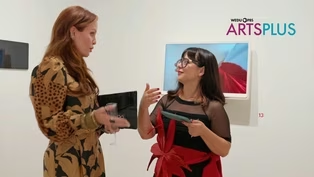
Clip: S13 Ep18 | 7m 14s | Discover OXH Gallery, a female-led space in Tampa dedicated to showcasing women artists. (7m 14s)
Providing Support for PBS.org
Learn Moreabout PBS online sponsorship

- Arts and Music
The Best of the Joy of Painting with Bob Ross
A pop icon, Bob Ross offers soothing words of wisdom as he paints captivating landscapes.













Support for PBS provided by:
WEDU Arts Plus is a local public television program presented by WEDU
Major funding for WEDU Arts Plus is provided through the generosity of Charles Rosenblum, The State of Florida and Division of Arts and Culture and the National Endowment for the Arts, and the Hillsborough County Board of County Commissioners.