WEDU Arts Plus
1320 | Episode
Season 13 Episode 20 | 26m 46sVideo has Closed Captions
Lakeland fiber artist | Art as commentary | Electric cellist | Textiles & photography
Lakeland resident Marcia Morse Mullins creates woven baskets that are receiving international attention. Visual artist Andrew Ina reflects on the current social and political climate in his work. Electric Cellist Iain Forrest performs contemporary music for commuters. An exhibition features the work of Letitia Huckaby, who reflects on the past through the use of textiles and photography.
Problems playing video? | Closed Captioning Feedback
Problems playing video? | Closed Captioning Feedback
WEDU Arts Plus is a local public television program presented by WEDU
Major funding for WEDU Arts Plus is provided through the generosity of Charles Rosenblum, The State of Florida and Division of Arts and Culture and the National Endowment for the Arts, and the Hillsborough County Board of County Commissioners.
WEDU Arts Plus
1320 | Episode
Season 13 Episode 20 | 26m 46sVideo has Closed Captions
Lakeland resident Marcia Morse Mullins creates woven baskets that are receiving international attention. Visual artist Andrew Ina reflects on the current social and political climate in his work. Electric Cellist Iain Forrest performs contemporary music for commuters. An exhibition features the work of Letitia Huckaby, who reflects on the past through the use of textiles and photography.
Problems playing video? | Closed Captioning Feedback
How to Watch WEDU Arts Plus
WEDU Arts Plus is available to stream on pbs.org and the free PBS App, available on iPhone, Apple TV, Android TV, Android smartphones, Amazon Fire TV, Amazon Fire Tablet, Roku, Samsung Smart TV, and Vizio.
Providing Support for PBS.org
Learn Moreabout PBS online sponsorship- [Announcer] This is a production of WEDU PBS, Tampa St. Petersburg.
Sarasota - [Dalia] Funding for "WEDU Arts Plus" is provided by Charles Rosenblum, Hillsborough County Board of County Commissioners, the State of Florida and Division of Arts and Culture, and the National Endowment for the Arts.
In this edition of "WEDU Arts Plus", weaving with natural materials.
- I had a Native American elder tell me that I should listen to the tree for it would tell me what it wanted to become.
And what he meant by that was that the spirit of the tree remains in whatever you make from its wood.
- [Dalia] Art that reflects on the world today.
- I feel like my work has always confronted the viewer.
It's not a window that you go into and kind of like go into a landscape or into a portrait - [Dalia] Performing music below ground.
- Amongst all that kind of like chaotic energy with people, you know, bustling and the crowds moving, I think the best part of that is just seeing how the music impacts these people.
- [Dalia] And contemporary quilts full of history.
- Quilting is a process that's long connected with women, and so, Letitia's thinking about the women in her family, the matriarchs, and how they kind of made do and worked creatively with what they had.
- It's all coming up next on "WEDU Arts Plus".
(upbeat music) Hello, I'm Dalia Colon, and this is "WEDU Arts Plus".
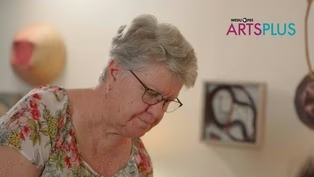
Lakeland resident Marcia Morse Mullins never imagined that her childhood interest in nature would blossom into a career making art from natural materials.
Today, Marcia is president of the Bartow Art Guild and a skilled artisan whose woven baskets are receiving international attention.
(upbeat music) - My name is Marcia Morse Mullins.
I am a basketry artisan.
(upbeat music) I grew up in Illinois.
Both of my parents were scout leaders, so there was always a connection to the environment.
We were always out camping and hiking and doing all those things that scouts do, and I became very focused on plants.
Ended up getting a degree in botany, and that's what I incorporated into my weavings.
My very first experience with making baskets was when my kids were little and a neighbor was trying to figure out what to do for Christmas, and she called me to say, "Hey, I found this book.
Let's see if we can make baskets."
And as they say, that's history.
(Marcia laughing) (somber drumming music) I went to an art festival and had this feeling in my chest that was like when you're at a parade and that big drum goes by and you can feel it pounding in your chest.
That's what I was hearing and feeling, but it was something different.
Turned out to be a Native American elder who was back behind his booth pounding on a freshly cut black ash log to make splint for his weavings.
I got talking with him.
Next thing I knew, he showed up at our house and said, "Pull on your muckers.
Find a saw.
We're going out back."
And he taught me the traditions of his tribe, which is Potawatomi.
Taught me the traditional techniques for selecting felling and preparing black ash tree for basketry.
(hammer thudding) - The most significant thing about the fiber art that Marcia does is she is trying to make an intentional connection with the natural world.
Any art that does that I think resonates with people.
- It's not just making a basket, it's making art and its tradition and its history, and the woman kneels down at the foot of the tree before she cuts it down and offers up a prayer.
(gentle music) - I had a Native American elder tell me that I should listen to the tree for it would tell me what it wanted to become.
And what he meant by that was that the spirit of the tree remains in whatever you make from its wood.
(upbeat music) When I get it back here, I finish preparing it so that it's down to the the very thin flexible splint that I use with my basketry, and I then weave with it.
Sometimes I will plan a piece out in entirety.
Other times when it is a more naturally shaped piece, like my signature antler pieces, those just kind of happen.
- It has expanded my own horizons and understandings of what fiber art or basket art can be.
- There's just something very all encompassing when you're actually, making something out of the materials that you collected in the out of doors.
- Fiber arts do not get the credit they should.
When they sit there and say, "It's just stitching or you're just making a basket, aren't you?
I mean, it's just a basket.
We did that in Girl Scouts, right?"
It's a slam.
It's a slam.
You wouldn't have clothes on your back, if it weren't for fiber artists.
You wouldn't have shoes, you wouldn't have hats.
So, it's all, it's always been important.
- Most of the basket makers that I come into contact with are female.
- It's a man's world.
It's a man's world.
In order for it to be acknowledged as fine art, we have to educate those that are showing it and those that are viewing it, and Marcia does a very good job of that.
(gentle upbeat music) - I have grown to think more of myself as being an artist and artisan.
The thing that took this to another level is having my work at Homo Faber 2024, which is a huge exhibition held in Venice, Italy.
(gentle music) I received an email out of the clear blue sky saying, "Hey, I'm an art researcher from the Michelangelo Foundation.
We'd like to have your art in this show in Venice.
Are you interested?"
And I thought, oh yeah, right.
There are approximately 400 artists whose work are in Homo Faber and only 50 of those artists are from the US.
- We were all like, "Are you sure this is real?
My God, get this checked out.
Don't be sending one of your baskets to Italy."
But it was real.
It was real.
(Marcia laughing) (upbeat music) - Boy, once I got there, it was just a whole different world.
The thing that is appealing to people is the fact that you are making something yourself with your own hands.
The same thing with throwing a pot, or doing stitch work, or whatever the mechanism is that you're using, whatever the medium is that you're working with, you're making it.
(bright music) - See more at borderweave.com.
In his work, visual artist and filmmaker Andrew Ina reflects on the world today and responds to the current social and political climate.
Up next, visit an exhibit of his art at the Fisher Gallery at Otterbein University in Ohio.
(bright upbeat music) - We're at the Fisher Gallery here on the Otterbein University campus.
I've got about 30 pieces of artwork that we're installing today.
My name's Andrew Ina.
I'm a visual artist, and also filmmaker.
The show's titled "Unintended Consequences".
(bright upbeat music) I've always worked in the non-objective realm.
I find that there's a lot of power to non-objective or some people will interpret it as abstract work.
You're not locked into an image or a specific association that you will see with representational work, whereas I feel like the non-objective work, it's more of a universal language.
So, it can speak in ways that sometimes I feel like the representational work can be limiting.
I feel like my work has always confronted the viewer.
It's not a window that you go into and kind of like go into a landscape or into a portrait.
The surface is coming to you.
They tend to be bold, they tend to be dynamic, and the surfaces tend to be very rich and tactile, and you just kind of wanna put your hands on 'em, and that's the type of work I tend to make and tend to be attracted to.
(bright upbeat music) (canvas rustling) So, this show is actually, has been a long time in the making.
The work speaks to the sort of nonsensical political and social climate that we find ourselves in over the last number of years, and a lot of the work is charged in that way.
(canvas rustling) My work most recently has been focusing on symbolism and more specifically, the caution sign or the caution pattern, and you'll see that as a kind of a common thread throughout the show.
(staples thudding) I became interested in how I can kind of subvert the meaning of these patterns and of these symbols and reorient them in ways where they take on a new meaning or a new life.
(gentle music) This piece is titled "Nothing To See Here", and literally, it's like a pile of discarded caution signs.
I feel like every day you wake up to the news cycle and it's an overwhelming series of whether it's headlines or stories.
And I don't think a lot of what we've been experiencing the last few years is normal or okay.
I find it hard to reconcile this feeling of wanting to just kind of disassociate yourself from all this or be desensitized to all this.
But I think it's very important now more than ever to be vigilant and to not look away and to not allow this to be normalized.
(somber music) So, this piece is titled "Neither Here Nor There", and the form that I start with is the safety cone.
And what I've done is taken wallpaper and collaged over the cones in a way to conceal their power or their function.
I grew up in the suburbs of Cleveland, and the wallpaper that I used to wrap the cones with was the exact wallpaper that I had in my kitchen growing up.
I thought that this treatment was appropriate to cover these cones, because oftentimes those are the kinds of settings where, you know, people don't like to get political, people don't like to have those uncomfortable conversations.
So, it feeds back into this idea that we're missing a lot of warning signs.
(somber music) So, the piece you see behind me is a large scale piece, and it is made up of 50 20-by-20 inch tiles or surfaces.
The framework behind this piece is this idea of taking lots of surfaces of varying characteristics or personalities, as I like to say, and trying to conform them into a system.
So, in this particular case, you have a grid and I enjoy the sometimes harmonious moments and sometimes when the pieces don't quite fit together, they don't speak, and yet, they're cohesive, because they're made to conform to this system.
I love large paintings and larger artworks in general, that kind of visceral interactive nature of it to walk up to it and be confronted by it.
I'm really excited that this space could accommodate a piece of this scale.
I think my sense of urgency to make this work has been escalating, because I think that's the responsibility in many ways of artists is to shine a light on things that we may otherwise miss or feel uncomfortable talking about.
And so, I hope this work can start those types of conversations and make people comfortable being uncomfortable.
As cliche as that sounds, I think that's the function of art, and my hope is that this work can kind of continue that in that direction.
(bright music) - Discover more at andrewina.com.
Iain Forrest is an electric cellist, medical student, and participant in the Metropolitan Transportation Authority's Music Under New York program.
With his cello, he performs contemporary music for commuters underground.
(upbeat music) - I started cello in fourth grade when our music teacher came around with a cart of instruments.
So, I picked up the cello, and I played the first note, which was a really low resonant note, and I just loved the sound of it, that bass note.
But after high school, me and a friend, we actually, went out to the streets of Washington DC and we started playing contemporary songs.
And I remember the reaction of people walking past on the streets.
It struck me like, hey, this could be really something special here.
After college, I moved up here to New York City area for medical school at Mount Sinai, and one of the things that drew me to New York City was obviously, the culture that we have with the arts.
And as soon as I came here, I saw street musician after street musician, and I immediately thought this could be my next home.
That's when I looked up MUNY, Music Under New York, and I found out they had a whole audition process, sent them an application, did the audition, (upbeat music) and thankfully, everything worked out.
And now, I can call myself a street musician in New York City.
And the reason why I chose Eyeglasses is because of two reasons.
So, I wanna be an ophthalmologist.
I wanna help people see better, specifically, kids who have lost their vision at a young age.
The second reason, which is a bit more lighthearted, is that Beethoven, he wrote a piece called "Eyeglasses Duet".
When musicians sat down and read the sheet music in front of them, there were so many notes on it, it was such a tricky, difficult piece to play that the only way musicians could read the music, is if they wore really, really strong glasses.
So, I absolutely loved the story behind that.
I took inspiration from that.
(somber music) So, I played the electric cello, and it's made by Yamaha, and it's the exact same four strings as an acoustic cello.
The only difference is they stuck a little pickup inside the electric cello so it can be amplified.
So, it's louder.
(high bass upbeat music) What I love to do is also use a looper.
So essentially, what I do is I'll play a base part, percussion part, a harmony part on the cello, and then I can loop that segment over and over again.
So it essentially, comes down to I'm playing nine or 10 different cello parts at the same time.
So, it just opens up a lot of doors as to what I can do musically.
(upbeat music) I've had people come down, they come off their subway, they come up to me like, "Where's the orchestra?"
And I'm like, "No, it's just me one electric cellist."
(upbeat music) So unfortunately, there's not much sheet music out there for like nine cellos to play like pop songs or rock songs.
So yeah, oftentimes, I'll just hear a song on the radio or on Spotify, and then once I've listened to it a couple times, I kind of extrapolate it out and try to create, you know, a cello rendition of it.
(upbeat music) Amongst all that kind of like chaotic energy of people, you know, bustling and the crowds moving, I think the best part of that is just seeing how the music impacts these people who, you know, are either have their headphones on just watching their phone, trying to get from point A to point B as quickly as possible.
And then just seeing them being able to stop.
Just enjoy the moment for what it is.
(somber music) In medicine and music, you really have to connect with the human being sitting in front of you.
Helping to uplift them with music, I find it actually, makes me a better medical student and hopefully, a better doctor down the road too.
(somber music) - So, follow Iain on Instagram @eyeglasses.stringmusic.
Visit Louisiana State University Museum of Art in Baton Rouge to learn about the art of Letitia Huckaby.
Combining photography and quilting, Huckaby focuses on the African American experience and reflects on the past and its connection to the present day.
(somber jazz music) - Letitia Huckaby is an artist and she was a military child.
Her father was pretty high up in the military actually, so she lived in Germany, and she really didn't deal with race in the same way that a lot of people living in the South would have.
And so, I think there was kind of a moment in her adulthood where she had to contend with her past, this history of oppression, their ties to slavery.
And you see that in the work, because it really was out of sight out of mind, A large part of her life, her parents really shielded her.
Much of the work is called "LA 19 Project".
It's based on her family who lives along Louisiana Highway 19.
Highway 19 connects Baton Rouge with East Feliciana Parish.
Her work references her family's history in East Feliciana Parish.
And there's a plot of land that several of her family members live on.
Her grandmother had 11 kids, and so, her mom moved back to Louisiana after the death of her father.
And so, Letitia found herself visiting here even more than she had as a child.
And so, what you see in this work is her finding that history, finding that lineage, thinking about the matriarchs in her family, and really becoming familiar with this place that's been so integral in her history.
Cotton is important to the process and her meaning cotton is accessible, it's warm, it's comfortable, it's something that everyone can connect to.
And I think that that's really important to her.
Quilting is something that's shared, it crosses racial boundaries.
Just about everyone has quilts in their lives, or grandmothers or mothers.
So, there's really, there's something here for everyone.
I've had people come in and respond to this work.
This is called "Quilt Number One".
And what you can really see here is so much of her process and how it relates to meanings.
She is printing this on cotton, but also shooting through cotton.
So, a lot of times Letitia Huckaby shoots through quilts.
She always says her work is about faith, family, and heritage.
And so, she references her heritage through the cotton, which she kind of makes it as precious as a rose and cotton references picking cotton, her family's history of enslavement, East Feliciana Parish.
And then faith is represented by this addition of light.
So, the light shining through the cotton brings the person into focus.
So, we can see images of her husband, her son, their hands touching.
With the addition of this historic symbol of cotton and faith, the self comes into focus or your history comes into focus.
And so, we're also talking about this process of quilting.
Quilting is a process that's long connected with women.
And so, Letitia's thinking about the women in her family, the matriarchs, and how they kind of made do and worked creatively with what they had.
Every work is quilted or collaged with images collaged together.
A quilt entitled "Cotton Pest and Diabetes" is another incredibly personal work.
Letitia Huckaby created it soon after the passing of her father due to complications of diabetes.
That work is incredibly important, because it connects up the historic inequity related to cotton picking and enslavement with the ravages of diabetes that disproportionately affect African American communities today.
And so, it features images of kind of cotton fields after the harvest that are kind of just broken down and beaten down.
And she puts those with tissues that are kind of infected by diabetes.
And then the obituary of her father is featured in the center and then other members of her family who are kind of contending with diabetes.
- [Letitia] When you see me as an African American artist working with cotton fields, it immediately brings certain things to mind.
Right away you're thinking about slavery and oppression and all those kind of things, but that sort of continues and we're seeing that conversation explode in today's time at looking at how some of those oppressions are still here and it shows up in lack of healthcare and those kind of resources.
And so, this piece for me, it's a little emotional, because I lost my father and it's the first time I'd lost someone really close to me.
But at the same time, I feel like it speaks really powerfully for issues within my culture.
- "Look What a Woman's Got" is kind of a play on a saying in Letitia's family.
There was a serviceman who came home, I think it was like an uncle, and he had sardines and crackers and he just burst through the door and said, "Look what a man's got."
And her grandmother just picked up on that and it became this saying in her family for any time things were going well.
And so, Letitia after the passing of her grandmother, inherited these heirloom fabrics and then took images of her grandmother throughout her life.
There are images from when she's 16, there's an image of her at Letitia's wedding.
And then combine them into this clothes line as like a reference to that kind of experience in Greenville, Mississippi.
- See more at huckabystudios.com.
And that wraps it up for this episode of "WEDU Arts Plus".
To view more, visit wedu.org/artsplus, or follow us on social.
I'm Dalia Colon.
Thanks for watching.
(upbeat music) Funding for "WEDU Arts Plus" is provided by Charles Rosenblum, Hillsborough County Board of County Commissioners, the State of Florida and Division of Arts and Culture, and the National Endowment for the Arts.
(dramatic music)
Video has Closed Captions
Clip: S13 Ep20 | 6m 47s | Lakeland resident Marcia Morse Mullins creates woven baskets from materials found in nature. (6m 47s)
Providing Support for PBS.org
Learn Moreabout PBS online sponsorship

- Arts and Music
The Best of the Joy of Painting with Bob Ross
A pop icon, Bob Ross offers soothing words of wisdom as he paints captivating landscapes.












Support for PBS provided by:
WEDU Arts Plus is a local public television program presented by WEDU
Major funding for WEDU Arts Plus is provided through the generosity of Charles Rosenblum, The State of Florida and Division of Arts and Culture and the National Endowment for the Arts, and the Hillsborough County Board of County Commissioners.