WEDU Arts Plus
1322 | Episode
Season 13 Episode 22 | 26m 46sVideo has Closed Captions
Caitlin Albritton's jewelry | Doctor Atomic, the opera | Chinese art | Immersive Van Gogh
Caitlin Albritton (Tampa) creates jewelry pieces that serve as daily reminders of emotional strength. Opera director Peter Sellars shares the inspiration behind Doctor Atomic, an opera about the atomic bomb. Artist Caroline Young is inspired by her Chinese heritage's culture, mythology, and history. An immersive exhibition in Boston allows visitors to step into the famous paintings of Van Gogh.
Problems playing video? | Closed Captioning Feedback
Problems playing video? | Closed Captioning Feedback
WEDU Arts Plus is a local public television program presented by WEDU
Major funding for WEDU Arts Plus is provided through the generosity of Charles Rosenblum, The State of Florida and Division of Arts and Culture and the National Endowment for the Arts, and the Hillsborough County Board of County Commissioners.
WEDU Arts Plus
1322 | Episode
Season 13 Episode 22 | 26m 46sVideo has Closed Captions
Caitlin Albritton (Tampa) creates jewelry pieces that serve as daily reminders of emotional strength. Opera director Peter Sellars shares the inspiration behind Doctor Atomic, an opera about the atomic bomb. Artist Caroline Young is inspired by her Chinese heritage's culture, mythology, and history. An immersive exhibition in Boston allows visitors to step into the famous paintings of Van Gogh.
Problems playing video? | Closed Captioning Feedback
How to Watch WEDU Arts Plus
WEDU Arts Plus is available to stream on pbs.org and the free PBS App, available on iPhone, Apple TV, Android TV, Android smartphones, Amazon Fire TV, Amazon Fire Tablet, Roku, Samsung Smart TV, and Vizio.
Providing Support for PBS.org
Learn Moreabout PBS online sponsorship- [Announcer] This is a production of WEDU PBS.
Tampa, St. Petersburg, Sarasota.
- [Dalia] Funding for "WEDU Arts Plus" is provided by: Charles Rosenblum, Hillsborough County Board of County Commissioners, The State of Florida and Division of Arts and Culture, and the National Endowment for the Arts.
In this edition of "WEDU Arts Plus."
Jewelry that shows quiet strength.
- My figurative jewelry are kind of like tiny talismans of inner strength for me.
- [Dalia] Staging an opera.
- Opera is a way you bring many communities together into one place, and you deal with something absolutely crucial to the future of the human race.
- [Dalia] A painter's exploration of Chinese culture.
- These stories have been handed down by word of mouth through thousands of years.
- [Dalia] And an immersive exhibition of Van Gogh's work.
- [Julien] It's a journey where they can discover a panorama of the main masterpieces in vivid colors and in a poignant, vibrant way.
- It's all coming up next on "WEDU Arts Plus."
(bright music) Hello, I'm Dalia Colon, and this is "WEDU Arts Plus."
What do you get when you combine a talent for painting with a love of rock collecting?
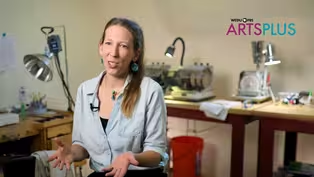
For Caitlin Albritton, these passions have led to a career in jewelry making.
Let's visit the artist at her home studio in Tampa.
- I'm Caitlin Albritton, and I'm a lapidary jeweler.
(upbeat music) Lapidary is the art of cutting stones.
And I cut the stones to fit very specific channels into my jewelry, and that technique is called inlay.
(upbeat music continues) So the Skyway Exhibition is this amazing exhibition where the curators select local artists from the whole Tampa Bay area.
- Caitlin's work is an exit fit in the Skyway Exhibition, as it is the only jewelry-based practice represented in the exhibition here at the Ringling Museum.
So her work really helps redefine what is considered fine art and what can be included in a formal exhibition at a museum such as the Ringling.
(bright music) - So I've always been doing art ever since I was little.
What I do now, I'd like to say I kind of me my passions of both rockhounding and painting.
Growing up in Florida, I'm a Florida native, and there's always this culture of pirate lore and treasure.
So I've always been really interested in hunting treasure, not just, you know, gold, also treasures of the earth.
(gentle bright music) Then I'll go to the painting side of it.
Always been painting since I was little.
It wasn't until I was in high school that I start to make more meaningful paintings.
At that time, I really suffered from a bad eating disorder.
I had a lot of the problems of, you know, me versus me at that time.
So I was making kind of more figurative-based works at that time.
And even into college, I was always making kind of works about the figure and the body 'cause I was kind of trying to wrap my head around the issues that I was going through at that time.
Eating disorder problems never really go away, but I like to say that my figurative jewelry are kinda like tiny talismans of inner strength for me.
I really like this quote that I'm gonna read real quick.
It's by the Chinese philosopher, Lao Tzu.
It's, "Water is fluid, soft and yielding, but water will wear away a rock which is rigid and cannot yield.
As a rule, whatever is fluid, soft and yielding will overcome whatever is rigid and hard.
This is another paradox.
What is soft is strong."
I thought of that strength as the internal voice that I have.
Am I gonna use the hammer voice today speaking to myself or am I I gonna use like the soft flowing river when I speak to myself?
So, that's where I wanted to come from in terms of like trying to portray inner strength because that is really hard to do.
So that's how I kind of combine my passions of rockhounding and the painting.
- She produces wearable paintings.
That's how I would describe her jewelry.
Her pieces remind me of some of the paintings by various artists from a cross art history, like some of the impressionists or fauvists, artists working in Art Nouveau such as Henri Matisse or Gustav Klimt.
So she really also uses old outline, vibrant colors to portray motion, movement and emotions of her figures.
(bright music) - I did go to school for arts.
I went to Savannah College of Art and Design.
That's where I got my undergrad degree in painting.
And then after that, I went to Maryland Institute College of Art, where I got a studio art degree also in painting.
During our travels out west, I came across a lot of Native American jewelry.
So that really, you know, inspired me 'cause it really is painting with different stones cut up into different pieces to make the mosaic.
Arts Council Hillsborough County does grant for professional development for artists, and I applied to take some classes at William Holland School of Lapidary Arts in Young Harris, Georgia.
So I went up there for three weeks.
I learned how to do inlay and intarsia, which are two different ways of making mosaics out of stone.
And after that, I put my paintbrushes down and I haven't touched them since because this is my life passion.
Like, I really knew immediately that, like, this is what I was meant to do for the rest of my life.
Some of the stones I use in my jewelry are actually things that I've personally found in mine.
But a lot of times, I source some from friends that are minors.
So I get my materials from all over the world, basically.
- She uses such a wide variety of different stones.
From Jaspers, to agates, obsidians, jade, but also turquoise and coral.
So her palettes of stones, it's quite wide ranging.
- So everything usually starts with a drawing.
And then from there, I make, like, a little template that I use to bend my wires.
So once I have that all pulled together, I'll solder all the joints together.
So I have like pretty much like a little framework.
Then I can start picking my color palette.
And that's usually the time that takes me the longest 'cause I like to look through my stones and feel like what's the feeling of this piece that I wanna kind of get across.
So then after I have all the stones cut, I can epoxy it in place and then a little extra cleanup, and then it's all done.
- [Ola] So what I really admire about Caitlin Albritton is not only is she a very skilled and fantastic artist, but her willingness to share that knowledge with other people.
- Think about making some of those things you could have never dreamed of making before, like those Native American style cups you've been drooling over for years now.
I'm here to help you demystify these difficult looking techniques, and I share everything I do with you with the goal that you can easily do this on your own without any hangups.
With lapidary arts, there's a lot of confinements.
Like, you can't make your own color palette, you know, you have to work with what mother nature gives you.
But I think there's a lot of freedom in having this confinement.
You know, like, we're gonna choose for dinner.
Having too many choices is kind of problematic.
It, like, makes it really hard.
So working within these limitations of what these kind of art forms have is really liberating and really exciting for me.
(bright music) - To see more of Caitlin's jewelry, go to c-albritton.com.
"Dr. Atomic" is an opera about the creation of the atomic bomb.
In this segment, head to New Mexico to meet one of the artists behind the production, renowned opera director, Peter Sellars.
(birds chirping) - Because people come to the Santa Fe Opera from all over the world, it is a to just say, "Okay, let's convene everybody and let's look at this."
I think the question right now is the future of New Mexico.
- Los Alamos is right over there.
(Peter laughs) - It's right there.
'Cause the atomic world is not the past, it's the future here, and that New Mexico could be a front runner in actually different set of life choices.
I think this opera has a role to play in that conversation.
(solemn music) Opera is a way you bring many communities together into one place, and you deal with something absolutely crucial to the future of the human race.
You actually are engaging in anthropological survival ritual, which is there are certain things we need to talk about, and we need to talk about them in a way that goes beyond politics, that goes beyond psychology, that goes beyond all the ways we have of reducing and compartmentalizing everything and say, "No, if a generation of young people are committing suicide, we have to come together and talk about that."
That's painful.
You know, you can't just make new legislation that we'll fix that.
It's a deeper human question that we all need to face together, and we need to face it from as many different angles, points of view, and ways of understanding it as possible because our current ways of understanding it are just not good enough.
So, you make an art form that is about composite reality because reality is composite.
And you have poetry and music and dance and visual art, and so opera is kind of sublime in its attempt to just touch something that is like a totality and make something powerful enough to engage people from all these different spectrums of a society.
(solemn music) - When you worked on the libretto for "Dr. Atomic" with composer John Adams, what about the subject matter captured your imagination?
- You know, there's something Homeric about this thing.
The creation of the atomic bomb, the creation of the atomic era is gonna echo down in human history for millennia.
It's not a story for this week or next week or last week.
It's a story that the human race is gonna be dealing with for millennia from now.
That's really powerful.
We're dealing with something that the half-life and the afterlife doesn't quit, and each generation is gonna ask themselves, "How did this happen?"
- [Megan] How did you go about the creative process?
So much has been written about the Manhattan Project.
- There is so much that has yet to be understood, opened and talked about honestly.
Now, one of the beautiful things about music is, music, you can explore difficult areas of the human psyche and motives and hopes and dreams 'cause music takes you there.
One of the most important things for me was that Hiroshima does not appear on stage.
You cannot make art out of atrocity.
Something should never be presented as something aesthetic.
I'm sorry.
That has to remain in its category of unspeakable.
What you can do, and that's why we focused on the 24 hours into the first atomic test, the first time a bomb was exploded in Alamogordo in New Mexico.
What we can put on stage is what do human beings think they're doing and what are the stories they tell themselves as they're undertaking certain things?
What was the pressure that created the culture of this atomic age?
The text of the opera is entirely things people actually said and did.
And so it's great because a lot of declassified documents are now set to music by John Adams, and I'm very thrilled that something the US government did not want you to hear has been set for orchestra and chorus, (laughs) and it's going to be shouted from the mountaintops.
That's thrilling.
A lot of what some of these gentlemen thought at the very end of their lives has made it into this libretto.
Meanwhile, Oppenheimer was obsessed with poetry, and he and his wife, Kitty, trying to evade the 24-hour surveillance that they were under, communicated to each other with phrases from Baudelaire poems.
- In French, or... - Which totally did have the effect of confusing their security detail.
Meanwhile also, of course, he was reading the "Bhagavad Gita," he knew Sanskrit.
So, that's in there.
And meanwhile, I needed a voice for the women because the women were just being good wives and zipped their lips.
So I needed another source, and I used the mid-century poet, Muriel Rukeyser, who went to school with the Oppenheimers in the School of Ethical Culture in New York City on the west side.
And she has a voice that you can really hear for Kitty, and she was also quite fearless.
So the libretto was all of these things that were swimming in the air.
And, of course, the Trinity test site was named by Oppenheimer from a John Donne poem, which is "Batter my heart, three-person'd God."
- You used that in the opera.
- Exactly.
I mean, because these things were on Oppenheimer's mind.
These are... Like, to ask, "What was this man thinking?
Where was he coming from?
What was the internal drama and struggle in the midst of this overwhelming moment in human history?"
- Why was this project so important for you to pursue?
- I think when we look at the world now, and we think so many things are out of control, we think, you know, it's very easy to get very dark about a lot of things right now and about governments doing things that, you know, have appalling, unbelievably destructive consequences, but nobody's called to count.
Nobody's asking, "Wait a minute, how did this happen?
And meanwhile, what are we now doing next about this?"
And again, because we're surrounded by endless public relations campaigns about everything, how do we reach into the heart not only of the issue, but into our own hearts?
The news of our lifetimes has been presented to us in such an impersonal way.
You know, television news has to, quote-unquote, "be objective."
Well, excuse me, what?
That's one thing physics showed, is that there's no such thing as observer.
You're the participant observer.
(Pete laughs) - The Heisenberg uncertainty principle.
- And at this- - Yeah.
- At this moment, we have to say to all of humanity, "You're not just watching this, you're in it."
What music does is say, "You're in it.
And now, let's take action together."
(bright music) - To find out more about productions at the Santa Fe Opera.
Head to SantaFeOpera.org.
Reno, Nevada artist Caroline Young is inspired by the culture, mythology, and history of China.
With acrylic, watercolor, and gouache, she connects with her heritage, depicting characters and stories.
(serene music) - [Narrator] "In ancient times in Yunnan province, there lived a magical songbird called the nugello with the sweetest singing voice.
The people loved listening to it, but none more than a beautiful village maiden who would become lovesick if she skipped even a day of it.
Every morning, she would go into the forest and lose herself in the song of the nugello.
She cherished its memory and she began to sing like nugello had sung of the joys and sorrows of her people."
- I grew up in Hong Kong.
My parents were expatriate American Chinese living in Hong Kong.
And just like you growing up in the US you hear about "Cinderella," you hear about "Snow White and the Seven Dwarfs," well, we heard about Chang'e, we heard about (indistinct).
These are people from Chinese history and Chinese mythology.
So when I started painting as a career in Honolulu, there was no one representing the Chinese culture over there.
And so I started painting that, it became more interesting than just a pretty picture.
It had depth, it had meaning.
And in a way, people were learning about the Chinese culture through my paintings.
(bright music) These stories have been handed down by word of mouth through thousands of years, as long as the Chinese civilization has been in existence.
And because they're handed down by word of mouth, you'll find different endings or different versions of the same story, which is really interesting.
- [Narrator] "Guan Yin is the goddess of mercy.
She's the epitome of beauty and benevolence.
She said to travel from heaven to earth on the back of the mighty dragon.
She's also the patron saint of sailors.
When sailors get into a fierce storm at sea, they pray to Guan Yin to save them.
And she's seen riding through the waves on the back of the mighty dragon to the rescue."
- I take my inspiration from stories that I read, and I do research into the legends and the history.
And as I'm reading the story, an image will pop into my mind.
And that is what I paint.
I work in watercolor, acrylic, and gouache.
I actually mix all the three mediums together, anything that's watercolor, and basically I water all the paints down till it's a light wash. And I put down multiple layers of light washes to build up the intensity of the color and put in the shading.
I work on silk mostly.
It's Japanese silk that's been pretreated so it doesn't bleed.
And the silks take a long time to do.
For instance, in the faces and the skin tones, that takes anywhere between 18 to 22 layers of washes.
For a large painting, if it's a woman, it generally takes me, oh, anywhere between two to three months to do.
And that's working six days a week between eight to 10 hours a day.
As I'm painting it, I'm always thinking about the story, trying to get the mood of the story into the painting.
Every color I put down affects what color I'm gonna put next.
And so sometimes what I think I'm gonna end up with is not what I end up with, but it's something better.
I hope that when someone sees my work, they will enjoy the story behind it, appreciate it for much more than just a pretty picture, and understand the culture that's behind it.
- See more at CarolineYoungStudios.com.
"Imagine Van Gogh" is an immersive exhibition that provides the exciting opportunity to step into the famous paintings of Vincent van Gogh.
Visit Boston, Massachusetts to find out more.
- [Narrator] For the last two of his brief 37 years, Vincent van Gogh moved to the south of France.
There in the blazing sun and amid flower field fields, his own life as an artist bloomed.
- You can see in his paintings that there's a lot of positivism probably to balance with what he experienced in his everyday life.
- [Narrator] Speaking to us from France, Julien Baron is the co-director of "Imagine Van Gogh."
(bright music) Illuminating a one-time subway power station, projections of Van Gogh paintings splash across this cavernous space.
- People can dive into Van Gogh masterpieces.
It's a journey where they can discover a panorama of the main masterpiece in vivid colors and in a poignant, vibrant way.
- I think it's a feeling experience.
- [Narrator] Annabelle Mauger is the show's co-director.
In conceiving the installation, she's concentrated on Van Gogh's End of life work.
That's when, struggling with Ill health, the painter produced the bulk of his paintings as he traveled throughout Provence.
- [Annabelle] Those last two years was when he really decided to be a painter.
He really was the painter of all those landscape around him.
You know, Vincent van Gogh paint dreaming landscape, but he also paint people like you and me.
- [Narrator] Build as an immersive experience, "Imagine Van Gogh" is comprised of 57 HD video projectors rendering the artist's work on more than 20 towering screens, accompanied by a soundtrack of classical music.
(gentle bright music) But what you won't see here are Van Gogh's works strictly as he painted them.
Instead, it's Van Gogh in pieces, faces rather than figures, flowers rather than fields, and just a sense of the sea.
- [Annabelle] When you look at all those details, what you'll see is that Vincent van Gogh was painting with very straight brush strokes, sometimes it could be very violent.
But at the same time, when you take just a little distance with those details, you will see that this painting is curved all the times.
It's very soft.
- So as you're doing this, are you mindful of changing Van Gogh's work?
- I'm very aware of that.
I'm always remember that I'm not an artist, I'm a director.
The artist here is Vincent Van Gogh.
- The show is one of a number of immersive Van Gogh exhibitions touring the world.
It's made possible because 130 years after his death, his work is now in the public domain, and it's made popular by social media and shows like Netflix's "Emily in Paris."
- This is incredible.
I feel like I'm actually in the painting.
- [Narrator] "Imagine Van Gogh can be a launching pad," Mauger says.
"A way to enter into the world as Van Gogh captured it before seeing the real artwork."
- It's another way to experiments art and culture.
And then if you like it, you can discover more like reading books, go to the museum.
You know, yesterday, I was in the Harvard Museum.
I saw one of the self portrait of Vincent van Gogh.
It was such a surprise, and I was very happy to discover it.
- For more information, go to Imagine-VanGogh.com.
And that wraps it up for this episode of "WEDU Arts Plus."
To view more, visit WEDU.org/ArtsPlus, or follow us on social.
I'm Dalia Colon.
Thanks for watching.
(spirited music) Funding for "WEDU Arts Plus" is provided by: Charles Rosenblum, Hillsborough County Board of County Commissioners, The State of Florida and Division of Arts and Culture, and the National Endowment for the Arts.
(inspirational music)
Video has Closed Captions
Clip: S13 Ep22 | 6m 53s | Caitlin Albritton (Tampa) creates jewelry pieces that serve as daily reminders of emotional strength (6m 53s)
Providing Support for PBS.org
Learn Moreabout PBS online sponsorship

- Arts and Music
The Best of the Joy of Painting with Bob Ross
A pop icon, Bob Ross offers soothing words of wisdom as he paints captivating landscapes.












Support for PBS provided by:
WEDU Arts Plus is a local public television program presented by WEDU
Major funding for WEDU Arts Plus is provided through the generosity of Charles Rosenblum, The State of Florida and Division of Arts and Culture and the National Endowment for the Arts, and the Hillsborough County Board of County Commissioners.