WEDU Arts Plus
1324 | Episode
Season 13 Episode 24 | 26m 46sVideo has Closed Captions
Bojitt's authenticity | Power & politics in art | Juana Valdes' video installation | Amanda Wicker
Tampa Bay artist Bojitt strives for authenticity in her work. An Iranian contemporary artist examines power and political issues through his work. Artist Juana Valdes creates a video installation that explores the migration experience and refugee crisis. Learn the legacy of African American fashion designer Amanda Wicker.
Problems playing video? | Closed Captioning Feedback
Problems playing video? | Closed Captioning Feedback
WEDU Arts Plus is a local public television program presented by WEDU
Major funding for WEDU Arts Plus is provided through the generosity of Charles Rosenblum, The State of Florida and Division of Arts and Culture and the National Endowment for the Arts, and the Hillsborough County Board of County Commissioners.
WEDU Arts Plus
1324 | Episode
Season 13 Episode 24 | 26m 46sVideo has Closed Captions
Tampa Bay artist Bojitt strives for authenticity in her work. An Iranian contemporary artist examines power and political issues through his work. Artist Juana Valdes creates a video installation that explores the migration experience and refugee crisis. Learn the legacy of African American fashion designer Amanda Wicker.
Problems playing video? | Closed Captioning Feedback
How to Watch WEDU Arts Plus
WEDU Arts Plus is available to stream on pbs.org and the free PBS App, available on iPhone, Apple TV, Android TV, Android smartphones, Amazon Fire TV, Amazon Fire Tablet, Roku, Samsung Smart TV, and Vizio.
Providing Support for PBS.org
Learn Moreabout PBS online sponsorship- [Announcer] This is a production of WEDU PBS, Tampa, St. Petersburg, Sarasota.
(bright music) - [Announcer] Funding for "WEDU Arts Plus" is provided by Charles Rosenblum, Hillsborough County Board of County Commissioners, the State of Florida and Division of Arts and Culture, and the National Endowment for the Arts.
- [Gabe] In this edition of "WEDU Arts Plus," an artist who strives for authenticity, - All creatives are always young.
Like you can't grow up, you can't.
There is a little child and we need to nourish that child.
- [Gabe] The work of a contemporary artist.
- [Shahpour] I make ceramics, and at the same time, I do painting, drawing, photography, everything.
- [Gabe] A large scale video installation.
- [Juana] I wanted a viewer who walked into the space to feel like they were occupying that space, that sort of sensation that they were part of this experience - [Gabe] And the power of fashion design.
- I think a lot of people don't necessarily think that teaching someone sewing is a form of activism, but it can give you a skill to become something different.
- It's all coming up next on "WEDU Arts Plus."
(upbeat music) Hello, I'm Gabe Ortiz, and this is "WEDU Arts Plus."
Arts can be a tool for self-expression, spreading love, and connecting with others on a profound level.
For artist Bojitt, it's not just about the medium, but the passion and authenticity it brings to life.
(upbeat music) - Inspiration lives in us.
That's what...
I don't even need to say I believe in it.
I know that inspiration lives in us.
I believe that I learned to just let it be and be my...
It's like I'm taking a ride.
Somebody else is driving, I mean, of course, but it's like detaching myself from just following the emotion.
But I'm here as a tool and I'm creating, but the emotion is going by its own.
I never stop it.
I never question it.
It takes time to arrive to that stage.
And I think as we are getting more experienced, I'm not saying like as we are getting older, because all creatives are always young.
Like you can't grow up.
You can't.
There is a little child and we need to nourish that child in us.
So that child is just taking a ride with experienced me pretty much.
I actually painted my whole life.
I studied fashion design and textile design, and I pursued fashion design career back home in Serbia.
But even when I was creating clothing, my final touch was painting on them.
And it's not that paint is my only medium, but that's the medium that really makes me most alive.
I just got burned out there because I was really going like full speed for seven years.
And it's not that it was too much, but when you hear people getting burned out, they are not burned out because they work a lot.
They're burned out because that what they're doing is really not something that their soul is feeling from.
So it wasn't exactly the medium, it wasn't the exactly that creative outlet that I needed.
And I found out when I just came here.
(upbeat music) So I had a plan, and my plan was, okay, I'm gonna become full-time artist.
One day I'm just gonna say no to everything else that is coming my way.
So TV shows, movies, styling.
I learned to say no so I can actually fully be in my studio and create.
It doesn't really only take like, okay, you go to your studio and you just create, no, and especially in today's world, you need to be business-savvy and you need to know how to actually place yourself where you wanna be and how to, if you can't just inject yourself where you wanna be, you need to make a plan.
Just whatever you have a passion for and whatever you have a drive for, if you really pursue it full-time, it's gotta work.
I am a big promoter of spreading more love.
And I think our job as creatives, as artists is to use our voice.
Whatever you're standing for, like you have to communicate it.
And even though that we use the voice and words to communicate, our art communicates much further.
So our job as artists is to bring that out, to bring the emotion out, to bring something positive, to spread love.
It's simple like that.
Like you just spread love and figure out how.
(bright music) I don't see world without art.
Art in any form is more about how do we actually carry our culture?
How do we carry what we do?
How do we cope?
Because every artist, no matter what we are saying that we are doing and what our work is, we are actually capturing the moment of time.
And if there is no art, there is no history.
That's how important art is.
And I think that if they take it out of schools, actually it's gonna bring art into the completely next amazing level.
So yes, we are scared of taking art out of schools, but you can't stop artist from being an artist.
You can't.
No, you can't, there is nothing to do about this.
You can't stop somebody.
You can make them miserable by putting them to do something else, but that's fascism.
So you cannot, like you have a creative kid, you can't stop them.
If you leave them alone, the next thing you know, they're drawing on the wall.
If you didn't tell them not to, now you tell them not to, they're gonna go outside and draw on the wall.
So stopping art in schools is just gonna create more revolt, and I see it as a positive revolt.
So they are gonna have more art outside.
That's how I see it, so yeah.
(gentle music) - If you want to experience more of her work, visit bojittart.com.
Take a trip to New York to meet Shahpour Pouyan, an Iranian contemporary artist.
Through an array of visual art forms, he examines power, history, and political issues.
(gentle music) - I make ceramics, and at the same time, I do painting, drawing, photography, everything.
The fun part is doing everything with my own hands.
I grew up in Tehran and live in Brooklyn now.
Iran is a modern name, meaning in political terms, Persia, of course, it has a thousand years of history.
I don't think it's about Iran, it's not about the specific geography, it's more about the culture and interactions that happen.
(gentle music) Projectiles are based on this old practice of producing armor in Iran, which has been in Iran for 2,000 years, 3,000 years.
The physical process is about bringing this very old medieval technique and just bring it back to life as a very contemporary form of practicing art.
Armor is layers of history, layers of aggression.
And at some point, it turned to be a very poetic product, which is covered by decoration, poetry, and layers and layers of rich culture.
People always ask me what you're trying to say, but telling anything about these works just makes it more complicated because these works have very strong roots in the misunderstanding between different cultures, so I would say it's layers and layers of misunderstanding, which is the truth.
I collected, selected this very specific miniature from medieval and 15, 16th centuries.
We're talking about a very vast geography of today as many countries.
(soft music) With very important historical moments.
And then I removed all the figures, heroes, anti-heroes.
I freed the miniature from that weight of figures.
So what you see is this empty landscape or architectural scene.
There is a story there, however you can read it or not.
So it is just, I would say, updated.
I do many sketches.
I keep doing sketches and just doing again, again, changing and changing and changing, but they're all coming from an idea.
So I have something in my mind and I have like a concept and something that has to get a three-dimensional form.
And then I go to studio and sitting and start building the ceramic piece.
And it keep changing, changing, and the final result is something else.
(gentle music) Working with clay is amazing because it deceive me.
Every day you go and you're waiting that somehow it's gonna surprise you with something, with a new crack, with a change, with deformation, with many other things.
But it's a fight between medium and me.
It's like a discussions like I wanna take you to the perfect step, and he's just resisting.
And then getting the shape, getting the form, and then you fire it two times, and then what it's coming at is a monster is totally different.
And it's like the moment like, hmm.
So the negotiation worked.
My ideas and the sketches are not from specific places, not really.
So what I do is get that essential alphabet in form of architecture and bring it to my sculptures.
(soft music) When I was working on this cityscape, I was thinking the best way to celebrate a nation is architecture.
I didn't glaze these new works because it's like an unfinished project.
The sketch of a future is like a dream or nightmare.
Ceramic is very fragile.
It's about fragile condition of all of us, as people, as a nation, as a city, as a state.
So everything happened is the truth that you try to find, but how much is correct, you never know.
(gentle music) - Find out more at shahpourpouyan.com.
Multidisciplinary artist Juana Valdes created "Rest Ashore," a large scale multi-channel video installation that explores the migration experience and refugee crisis.
Visit Locust Projects, the longest running alternative art space in Miami.
(gentle music) - When artists speak, they simultaneously are using imagery, right?
We're translating everything we do in our minds visually.
It's an automatic, we don't even think about it.
It became really clear to me that I needed to work with a moving image, right?
There's several sequences that take place underwater and there was no other way of representing that.
I'm Juana Valdes, I was born in Cuba, and I came with my family to the United States in 1971 through the Freedom Flights.
The exhibition is "Rest Ashore."
The idea was always to do a video in which there would be no physical bodies in the video.
I wanted a viewer who walked into the space to feel like they were occupying that space, that sort of sensation that they were part of this experience.
(gentle music) As a Cuban, I know what it means to migrate by sea because we have been, as a community, experiencing this for the last 50 years.
And so I wanted to use that personal experience and that knowledge and that understanding, and I wanted to take that and then open it up to the greater global crisis that is happening.
And especially that started to happen in 2015 in Europe because of the Syrian refugees.
When we think of migration right now, we imagine people in third world countries coming to America or even to Europe for escaping poverty, sometimes war, famine.
But we are experiencing the pandemic right now that has made, like if you were in some cities, people have chosen to leave the city and go to the country.
So the whole idea also partly with the video and not having an individual be represented in the video wants to deal with that, due to climate change or due to some other situation, any one of us at any particular time right now could or would be forced to migrate.
And when you first enter the space is you sort of dealing with the history of what you are about to encounter.
The very first thing you encounter is a wall of palettes.
So you really don't know what you're entering.
And in that way, it kind of gets a little bit menacing.
And it was done intentionally because it was meant to give you the sensation that maybe you were entering the back of a shipyard, right?
And what it would be like if you were gonna be taking this kind of risky journey.
And you go from being a person to also being thought of as cargo and as a package, right?
And here, you're seeing the contemporary artwork.
The video takes you from one day in the life almost.
The journey begins and it takes you through the whole process of what would happen if maybe there was a capsize.
The video ends very slowly with a sort of small view that then enlarged itself or what seems like countless numbers of clothing that have washed up on the shore.
Then slowly but surely, the video begins to expand and move up and you see the ocean again, and then the sunset.
And you hear the motor almost very far in the distance.
And the journey begins again.
(upbeat music) - At Locust Projects, we're a place of yes for artists.
So we let artists really realize their wildest dreams, most ambitious ideas.
We're really unique in the Miami arts ecosystem in that way.
We commission artists to create these large scale site-specific installations.
So you'll never see these exhibitions in another place.
Only here at Locust while they're on view.
They're typically immersive.
And we really give artists the opportunity to experiment in new media with new ideas.
In our 2020-21 season, we're focusing on Miami women artists and turning the space over to them.
So we've seen in this season, Christina Peterson, who was able to realize a project she had been wanting to do for more than 10 years, which was to create a cemetery, to cover the floors with pine needles, and to fill the room with the sounds of the song called "In The Pines" and actual tombstones that memorialized really important figures from South Florida's history, but also memorialize the creatures that have been lost due to development in the pine rocklands of the Everglades.
In the case of Juana Valdes, again, you're really seeing Locust Projects' mission in motion.
This is the first time that Juana has had the opportunity to work in video.
And here she's doing it in massive large scale.
Artists, in order to have careers, have to have exhibitions, and that's where Locust Projects comes in.
A lot of artists will have their very first exhibition at Locust, and more established artists will be able to do something they weren't able to do before.
(gentle music) - For more information about Valdes and her work, go to juanamvaldes.com.
In her lifetime, Amanda Wicker was many things.
She was a fashion designer, teacher, business owner, and mentor.
In the face of hardship, she became an integral part of the African American fashion community in Cleveland, Ohio.
(upbeat music) - [Narrator] When Amanda Wicker moved to Cleveland nearly a century ago, she put her education to work.
Having studied teaching and sewing, she started her own business out of her home, training others in dressmaking.
- As she's launching this business in basically what is the era of the Great Depression, that's when her business is taking off.
And she's a widow, a childless widow at the end of the 1920s and through the 1930s, but she doesn't give up.
- [Narrator] Wicker's determination paid off.
Not only did she create unique designs for herself and her clients, she helped others do the same.
- She started out with a business in her home with a single client teaching them how to sew, and turned it into this huge school that taught teenagers, adults, she taught high fashion design couture techniques, but also if you wanted to be trained in garment industry factory work, she could train you on machines that way too.
- [Narrator] Wicker moved her business out of her home and established the school at East 89th Street and Cedar Avenue in Cleveland's Fairfax neighborhood.
In tribute to her own fashion instructor in Washington DC, Addie Clark, Wicker named her business The Clark School of Dressmaking and Fashion Design.
- I really like the fact that she's an alumna of Tuskegee Institute and of course the founding principal of that school in Alabama was Booker Taliaferro Washington.
And he was someone who preached self-help for Black people.
So it was an industrial and a normal school.
Certainly lots of jobs available in manufacturing, sewing, textiles, creating the fabric, working with the thread, and then creating the garments once the fabric has been manufactured.
And so I like to think that Booker T. Washington would have been proud of that Tuskegee alumna who eventually studied in Washington DC and then made her way to Cleveland and became the focal point of a burgeoning Black fashion community here on America's north coast.
- [Narrator] For decades, Wicker celebrated Cleveland's Black fashion scene with annual shows.
The large scale events featured models wearing the latest designs, live entertainment, and scholarship awards for students.
- [Patty] She called her fashion shows the Book of Gold, and you get a program with a gold cover.
And it was sort of part graduation ceremony for students and then part just a way for locals to display their work because the fashion shows were kind of a mix of student work, Amanda Wicker work, but also they would bring in local milners to showcase their hats on the models.
- [Narrator] Wicker designed clothes throughout her life from wedding dresses to suits and evening wear.
More than a dozen of those creations, as well as her photograph collection, were donated by her niece to the Western Reserve Historical Society.
Those photos and designs live on in a display now on view at the Cleveland History Center.
- I think like playful is a good word for her style.
So fun, a little bit of sparkle sometimes, fun silhouette.
I have a personal favorite.
It's a sort of chartreuse green dress that's covered in a gray lace.
And then on the back it has a detail that's almost like sort of half of a cape.
It's like on the one hand, somewhat conservative, but then has these little twists.
- [Narrator] Wicker also had a talent for helping the community look its best.
She was an active member of Antioch Baptist Church and the Cleveland NAACP.
She taught her trade for more than 50 years until selling her school and retiring in the late 1970s.
- I think a lot of people don't necessarily think that teaching someone sewing is a form of activism, but it can give you a skill to become something different.
It can help support a community.
- The freedom of expression, I would have to say, associated with fashion design and dressmaking.
I think that's something that Black women in particular came to appreciate in the years following the end of the Civil War.
And certainly something that Amanda Wicker was the expert on.
And she taught other people to express themselves in excellent ways.
- [Narrator] Her legacy lives on through the exhibit "Amanda Wicker: Black Fashion Design in Cleveland."
(gentle music) - Discover more at wrhs.org.
And that wraps it up for this episode of "WEDU Arts Plus."
To view more, visit wedu.org/artsplus, or follow us on social.
I'm Gabe Ortiz.
Thanks for watching.
(dramatic music) - [Announcer] Funding for "WEDU Arts Plus" is provided by Charles Rosenblum, Hillsborough County Board of County Commissioners, the State of Florida and Division of Arts and Culture, and the National Endowment for the Arts.
(bright music)
Video has Closed Captions
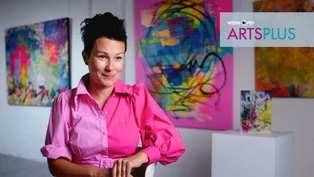
Clip: S13 Ep24 | 5m 54s | Tampa Bay artist Bojitt shares the process of creating her vibrant painted works. (5m 54s)
Providing Support for PBS.org
Learn Moreabout PBS online sponsorship

- Arts and Music
The Best of the Joy of Painting with Bob Ross
A pop icon, Bob Ross offers soothing words of wisdom as he paints captivating landscapes.












Support for PBS provided by:
WEDU Arts Plus is a local public television program presented by WEDU
Major funding for WEDU Arts Plus is provided through the generosity of Charles Rosenblum, The State of Florida and Division of Arts and Culture and the National Endowment for the Arts, and the Hillsborough County Board of County Commissioners.