WEDU Arts Plus
1403 | Episode
Season 14 Episode 3 | 26m 39sVideo has Closed Captions
Classic video games | Wildlife awareness through art | Stories over the radio | Undersea photography
Unlimited Video Games Superstore & Arcade in Pinellas Park shares the art of restoring classic video games. Wildlife artist Ali Armstrong uses her work to raise awareness about endangered species. A radio station in Ohio provides a space for high school students to share their stories on air. Underwater photographer Stephen Frink has spent four decades capturing undersea wildlife.
Problems playing video? | Closed Captioning Feedback
Problems playing video? | Closed Captioning Feedback
WEDU Arts Plus is a local public television program presented by WEDU
Major funding for WEDU Arts Plus is provided through the generosity of Charles Rosenblum, The State of Florida and Division of Arts and Culture and the National Endowment for the Arts, and the Hillsborough County Board of County Commissioners.
WEDU Arts Plus
1403 | Episode
Season 14 Episode 3 | 26m 39sVideo has Closed Captions
Unlimited Video Games Superstore & Arcade in Pinellas Park shares the art of restoring classic video games. Wildlife artist Ali Armstrong uses her work to raise awareness about endangered species. A radio station in Ohio provides a space for high school students to share their stories on air. Underwater photographer Stephen Frink has spent four decades capturing undersea wildlife.
Problems playing video? | Closed Captioning Feedback
How to Watch WEDU Arts Plus
WEDU Arts Plus is available to stream on pbs.org and the free PBS App, available on iPhone, Apple TV, Android TV, Android smartphones, Amazon Fire TV, Amazon Fire Tablet, Roku, Samsung Smart TV, and Vizio.
Providing Support for PBS.org
Learn Moreabout PBS online sponsorshipThis is a production of WEDU PBS, Tampa, St. Petersburg, Sarasota.
Funding for WEDU Arts Plus is provided by Charles Rosenblum, Hillsborough County Board of County Commissioners, the State of Florida, and Division of Arts and Culture, and the National Endowment for the Arts.
In this edition of Arts Plus, the art of preserving classical video games.
Is to maintain these games in a way that preserves the feel of these games when they were made.
A wildlife artist and activist.
The way I add color in scarce is in a very specific way.
So I paint extinct animals in black and white.
A youth radio training program.
In youth radio is a safe place for teenagers to tell stories about their lives.
And pictures of marine life.
For marine life photography, I think proximity is one of the most important things.
It's all coming up next on WEDU Arts Plus.
[music] Hello, I'm Dalia Colon, and this is WEDU Arts Plus.
This first segment was produced by students at St. Petersburg College in partnership with WEDU.
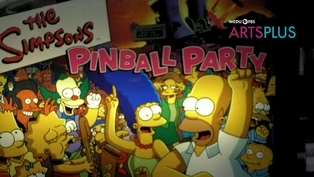
For the folks at Unlimited Video Games Superstore and Arcade in Pinellas Park.
Nothing beats the classics through the art of restoration and preservation, they ensure that classic arcade and home console games can continue to be played by future generations.
[music] Preserving some of these games can be considered an art in a lot of ways.
It's a fine line between keeping it original, keeping it correct, and making it good.
One of our jobs here is to maintain these games in a way that preserves the feel of these games when they were made, while still allowing them to operate into the future.
It all makes sense when you sit there and actually start playing on it.
All the bad graphics and clunky mechanics and lack of depth, all of it immediately disappears as soon as you start playing it, and all you can experience is the gameplay as it was meant to be.
It is a hobbyist driven industry.
There is no financial motive for any company in the world to put resources and effort into figuring out how to preserve and repair these games, but there are individuals out there who work on these as passion projects.
There's definitely technique in knowing the right equipment, right tools to use to keep it going on and not just throwing it away, as many would probably do if they're like, oh, this doesn't work.
And not knowing, like how to fix it or what ways to go about fixing it.
Nowadays you kind of see the money aspect of video games instead of oh, how can we become like one of the best video games, man?
Like, there's a lot of, like, legwork and hard work to really make this become what it is today.
I think all games are worth preserving in all honesty.
It would be a shame to lose any game in any regard, because I think everything has its value.
Whether or not the game is good or bad.
There's some games that are older that I never played back then that I find super cool and better than a lot of games in modern times now.
I understand that people value older games not just for nostalgia factors, but they want to keep it alive.
They want to keep the art of gaming available to everyone.
Being able to fix that thing that brings them back to those memories, or goes into that time frame of when they had a good time, because it's interesting how they take very big cautionary steps when it comes to like pieces like the Mona Lisa, to preserve it, because it is a famous piece and it was done by a great artist for someone to come in and be like, man, Pac-Man on the Atari.
I haven't been able to find that anywhere and now I can actually have it.
So like us being able to restore that so that that one person or many people that do come in here, being able to have that themselves and continue to keep those games alive.
I have a Galaxian in my arcade right now.
The cabinets are in great shape, but the sides are starting to peel.
So what do I do?
Do I glue it back on, making it really difficult to get off in the future because it's original, or do I buy new side art for it and put it on so it looks perfect, but it's fake?
These are the types of artistic choices that need to be made for this type of situation, and it's not always an obvious answer.
What you should do.
The whole look of the arcade cabinet kind of gets that the feel of its arcade cabinet.
If it was just a blank, you know, black cabinet and it had the game, it would still be, you know, functionally, you know, an arcade cabinet.
But when you walk up to it and you see, you know, either Simpsons on the side or blitz on the side or Mortal Kombat character, it's like it just I don't know, it just brings more of that.
Like the the whole feel all together.
I feel like if we didn't preserve these things, no one would know where this rooted from.
Or maybe what a good game is.
Also, it's just that, you know, the people that did have those games growing up.
It would be, you know, heartbreaking knowing that there is no more Dhoom threes out there in the world because everyone decided to, you know, throw them out.
Or if there was no more Mario parties on the Gamecube, it's kind of, you know, those memories attached as well to those games that me growing up had.
It would kind of like fade with that if no one cared to or want to keep these things alive.
People nowadays getting nostalgic for games that came out in 2011, 2015.
So I think, of course there's always going to be some people enjoying older games and finding passion for that.
I feel confident that as time goes on, future generations will see how things are going now, and it'll continue more as a domino effect for more and more people to want to preserve games for more and more people to see the beauty and the art form of the medium, and for more and more people to take care of it in a better sense as well.
Visit unlimitedvideogames.com for more information.
Ashley Armstrong is a wildlife artist and activist.
In 2014, she started scarce, an art series that raises awareness for endangered species travel to the Reno-Tahoe area to meet the artists and learn more.
My name is Ashley Armstrong and I'm a wildlife artist and activist.
Scarce is an art series that I do that is my way of raising awareness for animals at risk and sharing their story.
The way I add color in scarce is in a very specific way, so I paint extinct animals in black and white, and I add a little bit of color to endangered animals.
The amount of color that I add is proportional to the remaining species population.
To represent hope for the animals that we still have and we want to protect.
And so it's kind of a visual story.
So when somebody looks at it they say, well, what is the color?
Why does that represent what it represents and how can we help?
I like to partner with different wildlife organizations and conservancies.
We will decide an animal and donate 10% of all sales to conservation programs and fighting the illegal wildlife trade.
For instance, I partnered with Elephant Sanctuary in Thailand and they gave me a photo to paint of Lausanne, which is an elephant in the sanctuary, and I did an Asian elephant portrait of her.
And the person who buys the original painting actually adopts the elephant for the year.
So we're not only getting the word out, but we're also providing.
For the Sumatran rhino.
There are fewer than 90 rhinos left in the wild, and my husband and I took a cross-country motorcycle trip, and we visited zoos across middle America.
And that's where I met Harapan, the Sumatran rhino.
And he was the last Sumatran rhino in North America until recently, where he moved back to the island of Sumatra.
But I painted a picture of him to donate to raise money for the Cincinnati Zoo's conservation programs.
And in his painting specifically, I only added a very small amount of color to represent the remaining species.
A fun new element that I like to do is put 24 karat gold leaf on my paintings instead of the color.
I do add it the same way, proportional to the remaining species population, but it is 24 karat gold, which I feel like deepens the message.
When I paint, I try to paint an animal portrait that the animal is living its life.
It's not aggressive, but yet it's it's doing its thing.
And I want to portray the animal correctly.
I figure out where I want the subject and where I put the negative space, and then I'll color block the values that I see.
And then from there, once I have it relatively laid out, it doesn't have to be perfect.
I will start going in and adding details, and I always start with the eyes no matter what.
Um, I began my career as the portrait artist doing families and babies.
I always felt like the eyes are the most important part.
They give you insight to the personality, what they've lived, and so I carry that over to my wildlife portraits.
I'm currently showing at Riverside Studios in downtown Truckee, and there are five owners at Riverside.
Um, and they all do art in different ways, so they show everything that they do at their gallery, and then they also invite other local artists in to have the chance to show as well.
Another thing that I love to do is be a part of Turkey Thursdays.
It's where local artisans set up shop in downtown Turkey and I do live painting event, and one of them was at Sotheby's and we had some music there, and it was a good time connecting with our local people.
And, um, had a good time sharing about what was going on in the wildlife world.
A lot of people, um, aren't aware of the illegal wildlife trade, um, and the severity of it.
And, um, a lot of people aren't aware that the rhinos are in such imminent danger.
The northern white rhino.
There are only two left right now.
The last male died in March.
So I love sharing these facts with people.
Um, and it it makes them aware.
And then they start realizing.
And then they start questioning like, gosh, what else is going on?
What other animals are, you know, doing so well right now.
And then it also brings about the idea of donation and giving back, and I love that aspect.
And so we get to talk about that as well.
And that's really fun.
I believe that, um, God created these beautiful creatures, and he's given them to us in our care.
And in that we've been we've proven to be poor stewards by losing these animals to extinction.
And I want to change that.
And I think we can change that.
I have three kids.
I have a three year old, a two year old and a nine month old.
And it's important to me that they have the opportunity to see these animals in real life, in the wild and not miss out on that.
So I hope to raise awareness and give a call to action, uh, donate and share their story through art.
To learn more, go to aliarmstrong.com.
Up next, take a trip to Ohio to learn about the radio station training program Dayton Youth Radio.
As part of the program, local high school students are able to learn about radio and share their stories and perspectives on air each week.
I'm not sure why I decided to put on my Superman costume.
My mom would always put me and my brother before her, even for the small things.
I love my skin.
I love being beautiful.
I love being black, but not everybody else loves it.
I heard about Dayton Youth Radio through my creative writing teacher.
It was sort of nothing like I expected.
I mean, not that I went in there with negative expectations, but I was a little nervous towards the beginning.
I thought my voice was going to shake, but I got comfortable pretty quick.
Through Dayton Youth Radio, I learned that I'm actually really courageous.
I didn't know that I had all of this ambition in me until I went with it, until I flowed with it, honestly.
And when I did, I felt like it was beautiful.
It kind of made me feel empowered.
Dayton Youth Radio is a safe place for teenagers to tell stories about their lives, and to talk about anything they want, and to learn how to use radio equipment.
I put together an eight week program and became the founding producer of this series in 2013.
Public school and private school teachers reach out and invite me into their classroom.
Over 175 teenagers have come through this program, ten at a time.
That first day is so important to just build trust.
And so we can talk about anything.
Once you get past that first hour of being with a new group of teenagers, we form a tribe.
It's an eight week course.
By week three, they start telling me about what they would like to do with this microphone.
Like you have the microphone now you got it for three minutes.
And what do you want to talk about?
They're writing scripts and you have to tell the truth.
It has to be about truth.
Towards the end of the course, we come to Wyso and they do their narratives.
We talked about how writing for radio is different than writing for someone to read, and the importance of still capturing your audience and building a scene for them, and making sure that there's enough detail that they can imagine the scene, but not too much that they're lost in it.
My Dayton Youth Radio story was about my transition from male to female, and about how I encountered the world differently than a lot of other people, because I happened to be a teenager who's trans through Dayton Youth Radio.
I learned that my personal story can have an impact on the people and environment that surround me, and even something as small as a radio story can really open someone's eyes and maybe even change their views.
What were you wearing?
What were you drinking?
What did you think were going to happen walking home alone?
I guess what I'm trying to say is love is the best band aid you can use.
It bothers me that he never got to see me perform in Color Guard.
He hasn't been able to watch me grow up.
The first year were pretty generic stories, but then I noticed the second year the students wanted to talk about deeper and deeper topics, and sometimes students would cry in classes.
They talked about a subject that they wanted to do, and I had to look at my syllabus and says, you know what?
I need more training.
Because if a student is talking about losing a loved one and then I'm like, well, this is how a microphone works.
I wasn't being effective.
So after the second year, I went back and got certified in mental health training for working with adolescents.
I know how to make this place even safer now with my training.
And then we could go deeper.
And if you look at our series, the stories have gotten more intense, more personal.
It was almost like I was living in two different worlds.
At school, I always had a lunch, yet at home and we couldn't afford milk.
My dad told me to pour water in my cereal.
One of the things I dislike about my culture is young marriage.
My great grandma got married when she was only 13 years old.
My dad, who had always had a job, had been laid off.
Being laid off affected the way he saw our country, our community.
Now, he seemed to be talking about race all the time.
I wasn't trying to tear anybody down.
I was trying to bring light to an issue, which is important to me that I don't agree with.
I was actually in Dayton Youth Radio last year, and it kind of inspired me to become interested in radio more, and also just media at large.
I go to Bowling Green and I major in broadcast journalism.
Go ahead, hit pause.
What we can do is let's hold off on getting the bike sounds.
Let's just finish it, because the bike sounds can always just be thrown back in like it's not vital.
I go to Ohio State University and I'm studying journalism, and then what we'll do if we get everything done before 2:30, we'll just go out and have you sit with the recording equipment in your lap and then just pedal for like a minute of just like, solid bike sounds.
My story was about a father that I did not know.
Well, I knew through other people all bad things, of course.
Um, but it was more of just trying to find out who he was.
I want to forgive my father, but my grandma doesn't want me to see him.
My grandma has not forgiven my father for what he did to my mom and me.
You know, I was actually thinking about this, like, is this a form of therapy?
And I think what's interesting about Dayton Youth Radio, at least for the stories that we've done when they're really personal, they always start where it's opening up this wound, and it kind of just lets that be.
And so it doesn't ever solve it.
It's not trying to solve it.
It's trying to get you and kind of kick you to go and deal with your problems.
And at least it motivates you to ask those questions that you might not have asked.
Radio is a very emotive thing, and it's still something that can move people to tears, make people laugh, make people get angry.
That's why people tune in.
That's what the listener hears when they hear these stories.
It's a love and passion and excellence.
Once the class is over, I'm off to the next school.
And sometimes I'll see the family, like at the mall, and they say, thank you for helping my kid tell that story.
There's a lot of happy endings I've heard from some of these stories going on the air.
I'm always in awe and just feeling blessed to do this project with the teenagers.
I understand the value of education and what not having one can do to your life.
I'm an aspiring meteorologist who dreams of being on TV one day.
Yeah, I just said meteorologist.
When you have a dream, you shouldn't let anyone make you feel like you're not good enough.
You have the power to make a difference.
For Dayton Youth Radio.
This is Jordan.
Hear more at wyso.org.
For four decades, underwater photographer Stephen Frink has been taking photos of the captivating creatures that live under the sea.
In this segment, head to Key Largo to meet the artist.
[music] I can't tell you how many queen angelfish I've photographed over the years, but this is the one that of all of them, resonates more.
And I think it is because the fish has personality.
My name is Stephen Frink.
I'm an underwater photographer from Key Largo, Florida.
I travel the world for underwater photography, but this is my hometown.
I'm also the publisher of Alert Diver magazine.
The fish was just turning into me, and I had 100 millimeter macro lens on it.
And, you know, it was able to lock into focus.
And the eye contact is is really good too.
It's not like I had to chase this animal.
I was there, he came to me.
We had a moment and he was gone.
For marine life photography.
I think proximity is one of the most important things.
And I think you have to be able to project a benign presence.
You have to approach the animal in a in a fashion so they're not threatened.
So that means not moving too fast so that you don't push a big force field of water.
They have to believe in you.
And we also have to think no, a little bit about the behavior so that we know that a butterfly fish, for example, is probably going to be looking for a little crevice to find little crustaceans and things of that nature.
If you know a little bit about the fish, you can predict where they may be and you can place yourself in that position.
There's an area where a fish may flee the field of flight.
So I set everything before I enter the field of flight.
So I'll set the aperture.
The shutter speed.
I'll think in my mind's eye.
How is this photo meant to look?
Where should my strobes be?
So I try to do all of those things hypothetically from about six feet away.
So I'm not inside that field of flight.
You know, people, I think, maybe think that I dive all the time.
I don't, but I dive, I dive a lot in chunks of time.
You know, I'll get on an airplane and I'll go somewhere and I'll dive real heavy for two weeks.
I typically pick destinations by what it's particularly good for.
For example, if I want to shoot great white sharks, I would either go to Guadalupe in Mexico or South Australia.
I think I spent many years looking at the photography of other people and looking at the composition.
And I think, you know, how how did they do that?
So long as you have a, I think, a good camera and and good lights, because color doesn't really exist underwater in the absence of artificial light.
Once you have the tools, you can get a serviceable photograph.
I think what what transcends a serviceable photograph into art is composition and the eye of the artist.
I teach underwater photo seminars, and that's probably the hardest thing.
And what about color awareness that we try to bring to my students at the outset that that no photograph is worth damaging the marine environment?
It should be no surprise to anybody that the oceans of the world are in trouble.
You know, there are just so many things that are affecting the ocean that a visual communicator can bring to editorial awareness.
One of the things that I think is really brilliant about the Florida Keys, particularly the upper keys, when you have a marine protected area, the Fish Trust, the divers, you know, they know that we're not here to spear them.
We're not here to pull them kicking and screaming out of the water to a dinner plate.
I think in terms of the future of underwater photography, I think we're kind of at a threshold.
So what's going to happen to make underwater photography better for as heavy and bulky as these housings are, if it got smaller, that would be good.
I think it's become far more democratic.
One of the reasons that when I opened my studio here, I did well renting cameras was because nobody had them.
In the morning I would rent my camera, and if nobody rented it, I'd go diving.
So that's kind of how I started here.
It's exciting.
If if it were not for underwater photography, I wouldn't be a diver today because I'd be bored.
But I'm never, ever bored diving.
Because even though it's a, I don't know, let's say a French angel, and I've shot 12,000 French angelfish in my life.
This one's different, but there's still really, really inspiring things.
To see more of his photographs.
Go to stephenfrink.com.
And that wraps it up for this episode of WEDU Arts Plus.
To view more, visit wedu.org/artsplus or follow us on social.
I'm Dalia Colon.
Thanks for watching.
[music] Funding for WEDU Arts Plus is provided by Charles Rosenblum, Hillsborough County Board of County Commissioners, the State of Florida, and Division of Arts and Culture, and the National Endowment for the Arts.
Video has Closed Captions
Clip: S14 Ep3 | 5m 36s | Learn the art of video game restoration and preservation. (5m 36s)
Providing Support for PBS.org
Learn Moreabout PBS online sponsorship

- Arts and Music
The Best of the Joy of Painting with Bob Ross
A pop icon, Bob Ross offers soothing words of wisdom as he paints captivating landscapes.












Support for PBS provided by:
WEDU Arts Plus is a local public television program presented by WEDU
Major funding for WEDU Arts Plus is provided through the generosity of Charles Rosenblum, The State of Florida and Division of Arts and Culture and the National Endowment for the Arts, and the Hillsborough County Board of County Commissioners.