WEDU Arts Plus
1408 | Episode
Season 14 Episode 8 | 26m 43sVideo has Closed Captions
Jujmo - Mural Artist | Preserving artwork | Sustainable craft-making | A monumental sculpture
Meet Jujmo, a multidisciplinary Filipina-American muralist based in Tampa. The senior conservator at the Milwaukee Art Museum in Wisconsin shares how he preserves artwork from around the world. Nevada-based artist Tia Flores travels to Peru to assist in sustainable craft-making in the Amazon. An exhibition at the Metropolitan Museum of Art in New York City features a monumental sculpture.
Problems playing video? | Closed Captioning Feedback
Problems playing video? | Closed Captioning Feedback
WEDU Arts Plus is a local public television program presented by WEDU
Major funding for WEDU Arts Plus is provided through the generosity of Charles Rosenblum, The State of Florida and Division of Arts and Culture and the National Endowment for the Arts, and the Hillsborough County Board of County Commissioners.
WEDU Arts Plus
1408 | Episode
Season 14 Episode 8 | 26m 43sVideo has Closed Captions
Meet Jujmo, a multidisciplinary Filipina-American muralist based in Tampa. The senior conservator at the Milwaukee Art Museum in Wisconsin shares how he preserves artwork from around the world. Nevada-based artist Tia Flores travels to Peru to assist in sustainable craft-making in the Amazon. An exhibition at the Metropolitan Museum of Art in New York City features a monumental sculpture.
Problems playing video? | Closed Captioning Feedback
How to Watch WEDU Arts Plus
WEDU Arts Plus is available to stream on pbs.org and the free PBS App, available on iPhone, Apple TV, Android TV, Android smartphones, Amazon Fire TV, Amazon Fire Tablet, Roku, Samsung Smart TV, and Vizio.
Providing Support for PBS.org
Learn Moreabout PBS online sponsorshipIn this edition of WEDU Arts Plus, a city transformed one mural at a time.
Public art is really important to a city because it enriches the community.
It brings a sense of pride to all of the passerbys, and especially the young people that look at these walls and they can see a different future for themselves.
Art conservation.
The history of anything is the history of its survival, and the history of art depends a great deal.
Teaching art to others.
I really believe that the arts can really improve an economy and make it sustainable.
So it was right there where where my belief system was.
So I was very excited.
And a monochromatic sculpture.
The work itself is comprised of about 130 individual sculptural collages.
These relief collages that then are attached to a large box.
It's all coming up next on WEDU Arts Plus.
Hello.
I'm Gabe Ortiz, and this is Arts Plus.
Jujmo is a multidisciplinary Filipino American muralist based in Tampa.
Known for her colorful, anime inspired artwork, she blends nature, whimsy, and cultural storytelling.
I really love doing drawings in my sketchbook.
That's where I started in paintings.
So murals were just kind of like a step above that.
And that happened at a young age, probably around like high school.
I started getting more into street art and graffiti, and that's how I got into murals in that way.
My multicultural background is I am half Filipino and half American, and so that has like a huge influence on who I am as a person and artist, because I traveled a lot because of my dad being in the military.
So I was exposed to a lot of street art and art in general at a young age.
I really love anime culture.
Folklore is like so interesting to me.
Um, being half Filipino, I grew up with a lot of different stories my mom would tell me, um, from her country.
And so it really influenced how I drew and like the things that I like to draw.
The story of the Bamboo Princess.
It's like a really cool Japanese folklore of a princess that was born in like a bamboo shoot to these two like older couple that was trying to have a kid and I thought like her story was like so cool because she grew up to be a moon princess.
And I thought that was so beautiful.
I try to bring that, like, whimsical ness from that story because it was so whimsical in its own way, very like beautiful.
So that's how I try to incorporate it, all of my pieces.
So with my art, I like to convey messages of joy.
Um, happiness.
Colorfulness just something to invoke, like someone walking by and it brightens up their day.
That's like my biggest goal is to make someone's day happier and brighter with my art.
Uh, my favorite one is the one I did for Shine Fest.
It's called the Aquatic Forest, and it was the first time where I did a large scale scale mural where I had a scissor lift, and I had a lot of support from the community over there in St. Pete, and they let me do whatever I wanted, and it kind of broke all of the barriers on how to do large scale murals.
And that was my biggest turning point for me.
So it's my favorite.
I'm hoping that people that look like me or identify with me in some way want to do art in their own shape, way, and capacity.
I feel like if there's more of us in numbers, we can foster more of, like a larger art community.
And I think that it brings a lot of value to the area.
So I'm hoping people see my story and they want to do more art.
Public art is really important to a city because it enriches the community.
It brings a sense of pride to all of the passerbys, and especially the young people that look at these walls and they can see a different future for themselves.
So I think it's really important to have more community art.
Glazer Museum.
It was really fun.
I actually have an old friend of mine that does a lot of fun graphic design work for them, and she's been a big champion for me in that sphere, and was the one that suggested to bring in a local artist and bring in someone to have a new, uh, vision for the museum.
Cheryl's artwork is such a good fit for what we do here, because it's playful and whimsical, and it's not at all literal.
So she really takes things that might even be kind of normal concepts, and really makes them as whimsical and over the top as possible.
And that's what we do here at the museum, because it's all about a child's imagination.
So we recently hired Cheryl to do a mural for us outside for Gasparilla, and it was so much fun.
It was one of those temporary window murals.
But I came out during Gasparilla weekend and saw all the families enjoying, I guess children's parade was when the families were there.
But then also during the adult parade, the parade.
The museum was closed, but adults were outside taking pictures in front of the mural.
So it's a fun way to activate our space and to bring the outside in and to bring a little bit of our playfulness out there to the community.
It has been really exciting to watch the growth of the art community in Tampa Bay.
One of the things that makes me really excited about it is that the downtown partnership has really worked to brand the different neighborhoods of downtown and bring in artists to kind of give that neighborhood a special flair.
We're in the River Arts District, which is really exciting because not only are we an arts and culture institution, as are many of the other attractions around us, but now the neighborhood actually feels artistic when you're just walking through the streets because of all the murals around.
Investing more into my art community and getting more involved with other artists and collaborating with them.
I'm always interested in what they're doing and how they're reaching out to others.
So I think that just collaborating with more artists and more art organizations in the area is something that I'm really invested in for my future.
So I just want to kind of give back to those that have given so much opportunity to me.
So many people have moved here and have embraced the art culture, and it's gone from like people kind of being a little bit afraid to invest in artists.
I feel like, um, maybe not afraid, but maybe unsure to.
Now I feel like there's a lot more, um, excitement over artists trying to cultivate the city and bringing more art and culture to the area.
It should just become like wildfire.
If people should be more creative and find more paths for themselves.
So it's really exciting and like I'm hoping I can inspire others to do the same so we can lift each other up.
To see more of her work, visit jujmo.com.
Jim DeYoung is the senior conservator at the Milwaukee Art Museum in Wisconsin.
In his role, he preserves artwork from around the world so that it can be appreciated for years to come.
The history of anything is the history of its survival, and the history of art depends a great deal on its ability to survive.
And as a museum, we are charged with the preservation of these objects forever and ever.
And this is Jim's job.
I was hired to do the in-house matting and framing.
I was not a conservator at that time.
It's changed a lot since I started here in 1976.
When I first came to the art museum.
I thought it was a layover on my way to grad school, where I was going to be able to study under famous artists.
I still was very focused on becoming an artist.
I thought the museum work is interesting, and then the conservation work was interesting, but I have to get back to my art.
And I would say about ten years after I started here.
So around the mid 80s, I finally realized that, hey, this I'm on a roll here.
This is, this is something that could be a destination.
So this is.
A main ski area, but this is my old lab.
I had to kind of create a clean space in there every day and keep the door closed and make sure that I was able to, um, preserve the art amidst all of the chaos.
Well, the museum never really thought of having a conservation lab.
It was never in the planning stages.
There wasn't even a thought of having a frame shop.
He understood that if the museum was going to continue to grow at the pace that it had been growing, and once the investment in the Calatrava building was clear that that was going to happen.
And I saw I just stared at that miscellaneous storage space on the blueprint and thought, no, that's the new conservation lab.
It wasn't planned for.
That was an important moment in this institution's history, because we went from kind of the the a smaller local institution to a more regional and, and national and even international um, museum.
We grew like an adolescent where the growth of the collection of the buildings, facilities of the staff always, um, was, uh, out running the conservation programs ability to keep up with it.
That conservation lab is a was a way of saying this.
You know, if you're going to do that, um, from an institutional point of view, you have to make sure you're bringing the rest of the museum with you.
It was generally known that we really had outgrown our space.
I kind of elbowed my way into it, um, proactively, as much as I could.
He also did, I think, all or most of the fundraising to make this space the way it is and to equip it with the materials and equipment that we need.
I consider my single greatest accomplishment here was to actually get a really professional home for the conservation program.
We develop a relationship with the collection.
They they sort of become like old friends.
They're the ones who really know the collection in a way that most curators won't ever know, because they're the ones who handle the works.
We try not to move it as much as possible.
It's the Cornelia Parker once in a lifetime retrospective.
Artist intent is very important.
It's a window into the thinking of any particular period of time.
The creativity is certainly involved in solving unique problems with each individual piece.
Sculpture Duane Hanson the piece is entitled, The Janitor.
He looks like a real person.
He's one of the most popular pieces in the collection.
This is why we have white tape around here to keep people from touching and handling it.
People really want to steal the pens or add pens.
This is a very fat file.
Probably one of the biggest files we have.
We have letters from Duane Hanson himself.
Giving us a very specific information on its care.
That include clumps of hair, and his permission for us to use glue of any kind and replace that hair.
You want to make it as convincing as possible.
The glasses and the pipe and the case are all definitely from the period that Duane Hanson selected.
So he had the fun of going out and sourcing all those materials that I asked for.
And so Terry White was able to fashion up some new leather straps.
So we know that it was very important for him to preserve that illusion of this figure that was sort of fresh and, you know, alive in 1973.
There were things that I never dreamed that that the That the conservation field would get me to this point.
I thought I had to become a famous artist in order to get to the experiences that I was having.
One of the artists that was the reason I got into conservation was Vasily Kandinsky.
It awakens in me my discovery of art.
He would have a paintbrush in each hand.
Probably the most profound experience I had was my older sister was so struck with my interest in art, and especially that artist, that for Christmas that year I was, I think, 12 years old.
She gave me a coffee table sized book of Kandinsky, which I still have.
A few years ago, we did an exhibition on Kandinsky, and I had to do all the very close inspection of these Kandinsky paintings in Paris and then oversee their packing, and I could barely catch my breath because each painting brought out, I had this vision of this 12 year old turning this page in this coffee table book.
And I just wanted to get back to that 12 year old and say, you're not going to believe this, but when you're in your late 60s, you're going to be doing this, to have that kind of access to that painting in the same room and having my magnifying visor on and inspecting them and seeing the brushwork, and you almost start communicating with the artist at that point, it really creates, um, a almost a time traveling kind of effect.
I appreciate his dedication to the museum.
He is someone who, I would say unfailingly has the museum's best interest at heart.
There are so many works of art that he has saved that might not otherwise be here in the collection if it weren't for him.
When you actually have, um, institutions, museums committed to preserving art all the way back to the beginning of human history There's a difference between a fossil and a person who maybe renders a fossil or a cave painting.
I think it's really important to be able to keep it as intact as possible.
The way the person who made it or the culture who viewed it, who or who treasured it and passed it on to the next generation, why did they value that?
And keeping that value alive is very important.
To plan your visit to the museum, head to mam.org.
Nevada based artist Tia Flores travels to the Amazon in Peru to assist in sustainable craft making.
Using natural materials from the surrounding environment, art is rendered that supports and diversifies the economy.
What brought me to the Amazon jungle was a friend of mine by the name of Barbara Land, and she was doing some research in South America and fell in love with that particular part of the country.
And she was working with a group, a family group in this village called Ayacucho Village, which is in deep in the heart of the Amazon jungle.
And as she was working with them, she noticed that they wanted to perfect their craft so that they could bring a sustainable income to their economy.
So she reached out to me and asked me if I would be willing, and after several years of declining, I finally agreed to go.
My desire to go there was to work with the women there and help them perfect a craft so that they could bring some more money to the economy by selling natural wares that they were able to create there in the jungle and sell to tourists coming by from all over the world.
And that was a really enticing thing for me, because I really believed that the arts can really improve an economy and make it sustainable.
So it was right there where where my belief system was.
So I was very excited to venture into the jungle.
We were actually in the Peruvian side of, of the Amazon.
So how we traveled there was from the United States into Lima, took another flight into Iquitos.
The only way to get to Iquitos is either by boat or plane.
And we took a boat, and it takes about 3 or 4 hours as you travel up the Amazon river with with a motor boat.
And then we're able to get into Ayacucho Village and the environment.
And the people were just amazing.
You're surrounded by this abundance of beauty and life, and you see life cycle in its natural form.
Um, how everything has a purpose and a reason and timing.
All the fruit that's produced by the different trees.
A particular monkey eats that particular fruit, or it drops into the water for a particular fish.
And I'd have to say the people are just as amazing because they love that environment.
They cherish that environment.
They're stewards of that environment.
The majority of the people who actually live in the river villages like Ayacucho, are residents of of Peru.
And what they've done is they've chosen to, you know, venture into that environment and to live that lifestyle.
They're basically they're just three, four generations old in there, and they're still figuring out how they, you know, what they bring to that environment and how they can be good stewards of that environment.
And it's really exciting to see them, you know, bring their own style to that craft making because of the diverse natural materials that everybody has access to in the Amazon, you're able to make all different kinds of crafts from a simple thing as a bracelet by using palm and courting that and, you know, decorating it with seeds to beautiful, elaborate necklace.
Basketry is just amazing there.
As well as, you know, necklaces and bracelets that you know may use the spine of a particular like snake or piranha.
Um, you know, the piranha teeth.
That's really popular.
My first trip to the Amazon was in the summer of 2018.
I was able to return in the spring of 2019 and again in the spring of 2020, right before the pandemic hit.
The president of Peru had put a mandate that no travel could take place, so to get home was basically it was in two parts.
Our first main objective was to get out of the jungle.
Boats were prevented from traveling.
So how do we get safe passage out of the jungle and to the city of Iquitos?
In fact, the Minister of Tourism and the police, the Federal Police, met us to guide us to Iquitos.
And then once we got to Iquitos.
That was the next step.
We knew the only way to get out of Iquitos was by plane, and we needed to get to Lima.
And at that point we needed permission from the embassy.
We were very lucky because through our conversations and working through local officials here in Reno and Senator Cortez Masto, we were able to secure a seat on a repatriation flight through the U.S. embassy to fly out of Peru and get back safely to the United States.
As an artist, I could really tell from this experience how much it influenced my artwork and how much it really wanted me to take a deep dive into my own craft making and to utilize the natural materials that I have around me, and how I can incorporate that into my art.
So that was exciting part to experience that.
To find out more about the artist, go to tiaflores.com.
Artist Louise Nevelson sculpture Mrs. N's Palace is monumental, made up of over 100 discarded objects collected around New York City.
Visit the Metropolitan Museum of Art in New York to look back at the exhibit.
This spectacular sculpture behind me is titled Mrs. N's Palace, and it's one of the great works by the American sculptor Louise Nevelson.
It's actually composed of pieces that date back in time to as early as 1964, though it was assembled as a unique work in 1977.
Mrs. N's Palace is one of Nevelson's greatest works, but it hasn't been seen at the met for many years.
Installing it here on the second floor of the Met's modern wing took quite an effort, but it was well worth it.
The work itself is comprised of about 130 individual sculptural collages.
These relief collages that then are attached to a large box.
The sculpture is comprised of scraps of detritus that she collected all across the city, creating these abstract, in many cases, relief sculptures, which she then treats primarily by painting in black.
Nevelson described her materials as the skin that New York has shed, and that she is scavenging and then giving new life, making art that's both, in a way, about New York, but also of New York.
In many instances, her original source material is discernible without much effort.
There are boxes from filing cabinets and from staircases and balustrades where she's repurposed.
Architectural salvage parts are quite heavy in appearance and even sort of aggressive in effect.
But other parts are lyrical, elegant, thin, whimsical.
Even in other instances, her materials are really difficult or impossible to discern and register really as unique abstract sculpture.
The title derives from a couple of sources.
One is that her nickname in the neighborhood where she lived was Mrs. N's, and Palace is evocative.
She intended this work to be her ideal habitat or a kind of shrine to herself.
This is Nevelson creating her own universe, an environment that's based entirely on her own sculptural practice and her vision as an artist, which in a way tied wonderfully to her desire to live her own life on her own terms.
Discover more at metmuseum.org.
And that wraps it up for this edition of WEDU Arts Plus.
To view more, visit wedu.org/artsplus.
Or follow us on social.
Until next time, I'm Gabe Ortiz.
Thanks for watching.
Video has Closed Captions
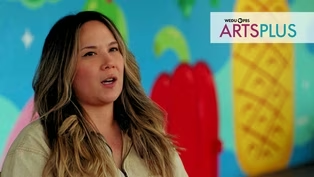
Clip: S14 Ep8 | 6m 5s | Filipina-American artist Jujmo brings color to Tampa Bay with her murals. (6m 5s)
Providing Support for PBS.org
Learn Moreabout PBS online sponsorship

- Arts and Music
The Best of the Joy of Painting with Bob Ross
A pop icon, Bob Ross offers soothing words of wisdom as he paints captivating landscapes.













Support for PBS provided by:
WEDU Arts Plus is a local public television program presented by WEDU
Major funding for WEDU Arts Plus is provided through the generosity of Charles Rosenblum, The State of Florida and Division of Arts and Culture and the National Endowment for the Arts, and the Hillsborough County Board of County Commissioners.