WEDU Arts Plus
1412 | Episode
Season 14 Episode 12 | 26m 45sVideo has Closed Captions
Friendly City Foundation | Visual Arts | Glass-Bead Mosaics | Women-owned Printmaking
The Friendly City Foundation in Bradenton showcases how art strengthens communities by uplifting local artists and fostering meaningful connections. Meet Columbus visual artist Bryan Moss, explore Sabrina Frey’s dazzling glass-bead mosaics in Nevada, and discover how three Cincinnati creatives built a women-owned printmaking and design studio driven by shared inspiration.
Problems playing video? | Closed Captioning Feedback
Problems playing video? | Closed Captioning Feedback
WEDU Arts Plus is a local public television program presented by WEDU
Major funding for WEDU Arts Plus is provided through the generosity of Charles Rosenblum, The State of Florida and Division of Arts and Culture and the National Endowment for the Arts, and the Hillsborough County Board of County Commissioners.
WEDU Arts Plus
1412 | Episode
Season 14 Episode 12 | 26m 45sVideo has Closed Captions
The Friendly City Foundation in Bradenton showcases how art strengthens communities by uplifting local artists and fostering meaningful connections. Meet Columbus visual artist Bryan Moss, explore Sabrina Frey’s dazzling glass-bead mosaics in Nevada, and discover how three Cincinnati creatives built a women-owned printmaking and design studio driven by shared inspiration.
Problems playing video? | Closed Captioning Feedback
How to Watch WEDU Arts Plus
WEDU Arts Plus is available to stream on pbs.org and the free PBS App, available on iPhone, Apple TV, Android TV, Android smartphones, Amazon Fire TV, Amazon Fire Tablet, Roku, Samsung Smart TV, and Vizio.
Providing Support for PBS.org
Learn Moreabout PBS online sponsorshipThis is a production of PBS Tampa St.
Petersburg Sarasota.
[music] Funding for WEDU Arts Plus is provided by Charles Rosenblum.
Hillsborough County Board of County Commissioners, the State of Florida, and Division of Arts and Culture, and the National Endowment for the Arts.
In this edition of WEDU Arts Plus, a local nonprofit that aims to show how art can transform communities.
It was really like the inspiration for a lot of what we were doing.
You know, we don't have an art alliance in Bradenton.
There's just not a lot going on.
So for us, it was a really important thing to be able to create that.
The vision of an artist.
Like I signed up for art classes at Schiller Park.
That's when I discovered and understood that I was going to be an artist.
Glass bead, mosaics.
Glass is such an incredible element to work with.
It's vibrant and it's happy and it's alive.
It has a life to it.
And a women owned printmaking and design studio.
Really, the friendship drives a lot of our ideas because it'll just be us hanging out or talking about something, and then we'll be like, yeah, that's funny.
It's all coming up next on WEDU Arts Plus.
[music] Hello, I'm Dalia Colon, and this is Arts Plus.
The Friendly City Foundation is focused on building more than programs.
They're building community by supporting artists and creating opportunities for connection.
The nonprofit demonstrates how art can enrich the culture in the Bradenton area.
[music] We created Friendly City Flea at the time, which is our art and music market now.
Friendly city Art Festival.
We decided that was a great place to kind of begin.
And so here at oscura, we got 22 artists together, did our first little art festival.
We were so surprised that there were that many artists who even showed up.
We planned it really last minute, but for Bradenton, we could see that there was a vacuum of art in the area, and it was really like the inspiration for a lot of what we were doing.
You know, we don't have an art alliance in Bradenton.
There's just not a lot going on.
So for us, it was a really important thing to be able to create that.
And me, as someone who just loves to gather people.
The community I think is hungry for the arts, but it is very difficult for an artist to survive in this city.
What do we do to make a space for these artists to be able to sell their work that they were excited to present and was a part of who they were?
A great way that we have captured that mission is through art club.
That's a really exciting thing that we've been able to do, is we found that there really was this wealth of community here.
They just didn't have a space.
I think one of the best examples of Friendly City Foundation capturing, like our mission and vision is through, um, Tori Silva.
And she's started as just a photographer coming in.
And throughout the past few years, she's now made photography and film her full career.
[music] Before connecting with Friendly City, I think some of the big challenges that I faced were just finding a community of artists.
Um, it was really, really difficult for me to meet people that were into the same thing that I was.
I think a community like Friendly City is just really, really important, um, in any area.
But for Bradenton specifically, it's Amazing.
Um, it just really, it's really helped out a lot of creative people.
[music] Uh, Bradenton's a really interesting place that, um, it is like a small town.
I mean, there's like, hundreds of thousands of people here.
And I think a lot of times people think of Bradenton and they think it's like a drive through city.
People don't realize maybe how, again, it's large, but it's small.
And so we sit on a lot of committees, whether it's, you know, redevelopment committees or stuff with the chamber, other city organizations, we meet with all of the other creative partners in the city quarterly and just talk through what everyone's doing, what are ways that we can benefit the city.
One of the things that I admire about the organization is the skill that they have at bringing out Gen Z for all sorts of issues, not just the arts, but to really get involved in the community.
So I see them as a connector, but also as an organization that really has the ability to just bring this generation into the conversation when it comes to community issues.
So we collaborated with them.
Last year was our first major collaboration, where we had a Christmas get together from the families in our programs.
The impact for that specific one was really our families being able to get together in person and to build on the community and the strengths in the community by getting together.
I think it would be a shame for, um, local, state, federal government to think about defunding a lot of organizations who are providing essential services to the community.
[music] Um, success for the Friendly City Foundation in Bradenton, I think, really centers on our mission and our in our projects.
Are we really helping people make careers out of their work and as a foundation that we're giving as much inclusion to the different types of art, that no one's excluded from that.
And so whatever people are doing, again, whether it's fine art, digital art, music, poetry, dancing, all of the different things that fall into that is that people are connecting around it.
They're able to collaborate and they're able to actually create and share.
And so I think that's a huge win.
And I think the best thing is when people think about Friendly City Foundation and again, Oscar or Friendly City Art Festival and Art club is that they feel like they have place in community, that the community is really the driver for it because we need people, we need to be in community with other people, and artists need that just as much as anyone else.
[music] To learn more, visit friendlycity.foundation.
Brian Moss is a visual artist based in Columbus, Ohio.
From comic books to large scale murals, Moss art takes on many forms.
Up next, learn about some of his projects.
How many comic books do you own?
[laughter] Okay, let's put it like this.
Um, how many comic books do I own?
[music] I own 20 bookshelves of graphic novels, so I think I might open a library one day.
[music] So I was born in 1981 on the south end of Columbus.
So born and raised.
Now that I reflect back on it, I grew up really poor.
When you say it, it sounds pretty triggering, but actually I learned a lot.
That's how I figured out how to do art through like a grassroots process.
Like I signed up for art classes at Schiller Park.
That's when I discovered and understood that I was going to be an artist.
After that it was more just like drawing, drawing, drawing.
So just nonstop, just obsessed with it.
[music] So when I was like 10 or 11, that's when I discovered comic books, and then that's when it shifted.
So then I was just drawing comics all the time.
[music] The current project I just finished up, and I'm still working on a little bit here, and there is a comic book called Eightfold Path.
It's a 225 page comic.
The turnaround time for the book was six months, so it was a team of us, about 6 to 8 people just working around the clock on this book.
I'm the beginning and the end of it, which means that I approve what goes through and what doesn't.
So it's almost as like a director.
[music] The idea of converting a script into a comic book is actually a very difficult process.
You start with penciling.
We go through this process called thumbnailing, which is where you just literally sketch out the idea.
And then after that you go into like your official pencil, which is like where you're like, okay, this works.
Now let's do the paneling and actually draw it in pencil and make that work.
[music] After that we ink him inking parts kind of like the fun.
It's kind of like the jazz of it.
And then after that, we scan it in digitally, color it.
They'll make this into this Hitchcockian like masterpiece comic.
And you're like, all right, we build it while we fly.
[music] So another project that I worked on that was super awesome, super epic, a dream come true.
White Castle and Coca-Cola called me and was like, oh, would you like to do the art for 100th anniversary?
Would you be interested in designing a cup?
And I was like, yeah.
And then I was like, we should do like three cups.
It's like.
It's like a collector thing.
[music] Now, I don't know about you guys, but I always wanted to design something like this.
And even from when I was a kid, because what I really have a lot of passion about is actually, like making products cool.
And so we developed a narrative from the beginning.
And the original Billy Ingram, the founder, it shows like the diner, the first location with the first gift card looks like.
So yeah, this is all my narrative, all my storytelling I came up with.
And then obviously me there at the end, as any great Renaissance painter would do, which is include themselves into the masterpiece.
So if you get a chance, look for those cups online, you know.
[music] For me, lifting up other people within the community through my work, I would say it's a very critical part of what I do.
[music] The mural I recently completed was one of the one and only Hanif.
It's actually on a law firm on Miller and Main.
[music] Um, Hanif is a writer and he's a famous writer.
Hanif and I went to middle school together.
There's a bit of an age difference, but there's this indirect relationship that we've always had.
[music] With Hanif, the cool thing about it is that he stayed.
[music] That builds up Columbus.
That was my personal goal to I could move, but I choose not to because the idea of building up Columbus.
[music] We end up calling the mural the People's Mural because of how the community got behind it.
The process for the People's mural was to show Hanif as a mosaic.
The reason I wanted to really inject a lot of color in it has more to do with the quote.
There is something about setting eyes on the people who hold you up instead of simply imagining them.
[music] The idea of this is where the characters in the background, and these are people that are in the community too.
I put them all in black and white, and I put an even color, because we realize as artists that we're isolated in the sense we think we're isolated, and it's actually not the case.
We actually have people who support us and that care, but just going through that process, you Process, you get kind of lost and it's pretty exhausting.
So it has a lot of personal meaning when I designed this.
[music] So in the summer of 2020, I moved into Amino Robinson's home through the Columbus Museum of Art.
[music] Now what?
I served as was as the manager.
But there's kind of like a duality to it, which was that Aminah Robinson was my mentor.
I met Amina Robinson when I started at the Columbus Museum of Art in May of 2001, so it had like a higher purpose for me.
It's a curated museum space.
So you're essentially inside Aminah Robinson.
The spirit's definitely there.
The energy is there.
It was probably the least art productive I was, but the most healing process I've had, I was able to slow down and like, actually, like, relax, you know, because of the residency, not having to worry about, you know, the finances and stuff like that.
It's the only space where I can, like, really, like fly where I can, like, just like, do whatever I want.
And, you know, it's like a healing space, I would say.
[music] The one thing Amina said to me that still resonates with me today is keep drawing, don't stop drawing.
And at the time I'm like, don't tell me that I draw all the time.
Like that's absurd.
I'll never stop drawing.
But then what happens is that life happens.
[laughter] Life occurs and then you get older and drawing becomes harder.
So that message, just like keep drawing, has more importance to me now than when she told me that when I was 22 years old.
You know, I mean, that's like a master teacher, right?
So, yeah.
So that's pretty cool.
[music] Discover more at instagram.com/strangethingmoss.
In Minden, Nevada, Sabrina Frye uses thousands of glass beads to create eye catching, tactile mosaics with inventive techniques.
She transforms these beads into landscapes, flowers, animals, and much more.
[music] I love buying beads.
Beads are an addiction.
They're beautiful and they're tactile, and glass is such an incredible element to work with.
It's vibrant and it's happy and it's alive.
It has a life to it.
[music] My name is Sabrina Frye and I'm a bead mosaic artist, so I use beads like a painter uses paint.
And I create mosaics out of glass beads.
And so from far away they do get mistaken for paintings.
But when you get close up, it's hundreds of thousands of glass beads that make up this image that looks like a painting.
I work out of my home.
Half of my home is my studio in my basement.
We live in the Carson Valley South Lake Tahoe area, so it's very inspiring.
I get to look at the mountains and the sky and nature all day, which is a big emphasis on my work.
[music] There are so many types of beads out there, translucent beads and transparent beads and silver lined, and the beads that I work with are primarily glass.
Sometimes I work with natural stones as well as accent beads, and they're very versatile.
I had some beads left over from a attempted jewelry making stint.
This was about ten years ago.
[music] I wanted to do stained glass, and I didn't have the money or the space to do it.
And so I looked at these beads and things that I had, and I thought, oh, well, these are glass, and I have wire that could potentially look like the black lines around stained glass.
And so I picked up some beads and wire and did my first piece and learned a lot of things not to do.
But it was a good concept.
And so I started playing with it and experimenting more and more.
And then it just grew.
[music] I tend to use repurposed materials for my work.
I will take, say, a repurposed serving tray, and I have to sand it.
I have to prime it.
Otherwise nothing's going to stick to it because it was made for durability and for things not to stick to it.
So I have to do that, and then I'll bring it in and outline whatever I'm going to do on it.
So if I'm creating an animal, I create a very strict outline of what it's going to look like, and then I can start the bead process.
I use very, very pointy, non-magnetic tweezers because a lot of the beads have metals in them, silvers and things.
And if you use regular tweezers, they do magnetize and you won't be able to get your beads off of them.
I wear them out about every six months.
I have to get a new set of tweezers because I've used them all day long.
[music] I think of every bead as a piece of DNA.
We all have a different story in our lives that make up the complete image of what people see from afar, but it's all these little pieces of our lives and our DNA that really make up who we are.
And it's sometimes hard for people to realize what makes up your story and how the pieces come together, but they see you as a whole, and that's how each one of these beads is.
They're all very different, but they're coming together to make one complete image.
[music] I get that question a lot.
How many beads are in this piece?
And I did count.
There are 156 size 11 seed beads per square inch.
I'll do a piece, say that's 12 by 16 and it'll have something like 90,000 beads.
Last year when we moved, I had to weigh the beads for the movers.
I had 2,000 pounds of beads, just not attached to boards, just beads.
So yeah, I have I have a lot of beads.
[laughter] [music] I started mixing my own glue mixture that allows me to do what needs to be done, create blends and mixes for each piece, and take as long as I need it to take, and then do the glue after.
And that way it sets and it works with me and not against me.
[music] There's a final touch up phase that I do with the beads.
I seal them with an acrylic glaze so that the glue is protected from the elements.
I create them to be durable, but people's reactions are that it's delicate and we are programed as children.
Don't touch the art.
At shows, I had to figure out a way to give people permission to touch, and I put go ahead, touch me signs up all over the place and it draws people in because people are naturally tactile creatures.
We like touch.
And so giving permission to do that gives so much joy.
Adults, kids, everybody, they come up to the booth and it's just this sensory experience.
They get to feel the trees, they get to pet the birds and they love it.
I love doing shows because I get to see that joy and see that curiosity and the wonder that sparkling bead piece that's on the wall when the sun hits it.
Every day is going to make them smile because it can't.
Not because it's happy.
And so I make happy art to make people happy.
[music] See more at sabrinafryeart.com.
Pull Club Studio is a women owned printmaking and design studio in Cincinnati, Ohio.
Formed by three friends, the group finds inspiration in what's around them and specializes in quality made screen printed goods.
[music] I think we draw our inspiration from our surroundings.
A lot of our things are humorous, but also we really love nature.
It's it comes across in, I think, everything we make, there's usually animals or plants or something like that involved in it.
So really it's it's based on.
Kind of everything and anything from our lives.
History is what we're doing, where we're going.
I'm Linda Winder.
Amy Scarpello.
Chelsey Hughes.
And we're pool club.
I like the way I drew this mouse.
I didn't recreate that in the drawing, but we.
All each have our own, like, kind of drawing and, um, illustration style.
I like to start by actually physically drawing usually.
Um, and I'll do like a little sketch or something like that.
If it's like an idea for a t shirt or a paper print.
Um, and then I will either scan something or I will just go ahead and start drawing in the computer.
At that point.
It's always a collaborative effort at some point.
So whether it's, um, Chelsea makes a drawing, you know, and sends it to us, Linda and I are going to give some input, feedback, like if there's going to be text on it or colors or make it simpler, make it, you know, um, we kind of like will push each other in in that regard, especially when designing for ourselves when we're in the studio late into the evening.
That's where, like a lot of our ideas come from.
Just kind of like joking around with each other.
Really, the friendship drives a lot of our ideas because it'll just be us hanging out or talking about something, and then we'll be like, yeah, that's funny.
That's good enough.
Let's do it.
I think one of the great things about, um, a studio or having some sort of collective is they will push me to do things that I wouldn't have thought to do, or use certain colors or something that I would have never have done on my own.
But it'll push my illustrations to like a new level.
A lot of the time.
So I think that we all help each other do that.
The core of printmaking, it's a process, and one of the things that I enjoy about it is you can't just jump in and do it.
You can try.
You're going to fail and it's not going to work out.
So you have to every single time.
I call it leveling up.
Every time we have a project, every time we try something new or different, you are learning a new skill.
Or even when you run into a challenge like there's something wrong with the screen or.
Or the colors aren't layering the way we thought.
You work through it and you learn, and that's the only way.
And if you're learning, you learn from someone who's really passionate about it and has done it for a long time.
Even a difference between fabric printing and doing the paper prints the screens on a fabric like a t shirt screen or any other kind of fabric screen, or the mesh is more open, so it allows for more ink to touch the fabric because the fabric will absorb more ink.
It's just like the feel of cooling the squeegee through is a little different than when you press on the paper.
It's like a thing you kind of have to learn to feel and do enough times that you're like, I know exactly how much pressure to put on this from doing the run.
So it's really a thing you learn by doing, you say.
I think the special thing about print is the it's being able to do multiples, um, which just lends itself to an entrepreneurial spirit very easily.
[music] I love the limitations of it.
Of the art form.
I love taking an image and being like, how can I?
How can I translate this in the least amount of colors, but still get my message and the feeling across?
[music] For us like this, the whole thing has been just a huge learning experience and also been a great experience for us to use our various skill sets in different ways and and build on those both individually and collectively.
So I think for anyone who has interest in doing that or trying to make something bigger out of like their passions, it's not as scary as it seems.
It's something a little scary.
It's a little scary.
But then it's like, not that bad.
I feel like a lot of pride by, you know, being around for like five years feels like pretty substantial, especially when we were starting out and had no expectation of even being in business.
[music] For more information, go to pullclubstudio.com.
And that wraps it up for this episode of WEDU Arts Plus.
To view more, visit wedu.org/artsplus.
Or follow us on social.
I'm Dalia Colon.
Thanks for watching.
[music]
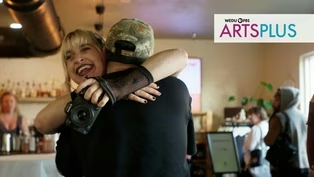
1412 | Friendly City Foundation
Video has Closed Captions
Clip: S14 Ep12 | 5m 10s | The Friendly City Foundation in Bradenton champions local artists and sparks meaningful connections. (5m 10s)
Providing Support for PBS.org
Learn Moreabout PBS online sponsorship

- Arts and Music
The Best of the Joy of Painting with Bob Ross
A pop icon, Bob Ross offers soothing words of wisdom as he paints captivating landscapes.













Support for PBS provided by:
WEDU Arts Plus is a local public television program presented by WEDU
Major funding for WEDU Arts Plus is provided through the generosity of Charles Rosenblum, The State of Florida and Division of Arts and Culture and the National Endowment for the Arts, and the Hillsborough County Board of County Commissioners.