
4/18/23 | Bouncing Back
Season 14 Episode 14 | 28m 41sVideo has Closed Captions
1414
On this episode of HIKI NŌ on PBS Hawaiʻi, watch stories from Hawai‘i’s New Wave of Storytellers that exemplify the resilience and determination of HIKI NŌ student correspondents and the people they profile in their communities. EPISODE 1414
Problems playing video? | Closed Captioning Feedback
Problems playing video? | Closed Captioning Feedback
HIKI NŌ is a local public television program presented by PBS Hawai'i
4/18/23 | Bouncing Back
Season 14 Episode 14 | 28m 41sVideo has Closed Captions
On this episode of HIKI NŌ on PBS Hawaiʻi, watch stories from Hawai‘i’s New Wave of Storytellers that exemplify the resilience and determination of HIKI NŌ student correspondents and the people they profile in their communities. EPISODE 1414
Problems playing video? | Closed Captioning Feedback
How to Watch HIKI NŌ
HIKI NŌ is available to stream on pbs.org and the free PBS App, available on iPhone, Apple TV, Android TV, Android smartphones, Amazon Fire TV, Amazon Fire Tablet, Roku, Samsung Smart TV, and Vizio.
Providing Support for PBS.org
Learn Moreabout PBS online sponsorshipAloha and welcome to this episode of HIKI NŌ on PBS Hawai‘i.
I'm Skye Gussenhoven, an eighth grader at Āliamanu Middle School on O‘ahu.
I'm here in the PBS Hawai‘i studio to host another great episode filled with incredible stories from Hawai‘i's New Wave of Storytellers.
In this episode, you'll be inspired by the resilience and determination of HIKI NŌ student correspondents, and the people they profiled in their communities.
You'll meet students who don't let their vision disabilities define them, and a student who had a close encounter with Pele, the Hawaiian Goddess of fire.
These stories show that it's possible to bounce back, even after the unexpected.
The first student reflection I'd like to share with you is from a student who attends Hawai‘i Preparatory Academy on Hawai‘i Island, where she had a very close brush with Mother Nature.
Madame Pele, to be exact.
Throughout the chaos of the lava flow, panic, and everything else, I realized that you shouldn't take anything for granted and that you should always be humble.
[ocean wave] This is Helly Hughes from Hawai‘i Preparatory Academy on the Big Island, for HIKI NŌ on PBS Hawai‘i.
In 2018, my family heard of a lava flow that was going to come through the south side of the island.
This included where I lived, Kapoho.
We thought if the lava didn't come near us, it would only block the road to our house and wouldn't affect the whole neighborhood.
But we were wrong.
The Civil Defense siren started blaring at 3am, and they told us we had to evacuate.
They gave us three days to leave.
We collected everything we could fit in our car, and I stayed at a friend's house while the lava approached Kapoho.
After three days, we heard that our house was burned down by the lava.
I was having a hard time finding a new school because public schools wanted to put me in a lower grade.
However, eventually I was able to find a new school to go to and I was able to make new friends.
We would have liked to go back to Kapoho, but there was not enough electricity, water, or resources for us to live there.
Two years later, my family started a new beginning.
They began constructing a new house.
We even went over to Kona every weekend to work on it.
It took a while to move our things in, but now we're living in Kona full time.
I'm able to go to school at HPA in Waimea, and I appreciate being able to have a very nice house.
Throughout the chaos of the lava flow, panic, and everything else.
I realized that you shouldn't take anything for granted and that you should always be humble.
I am so grateful for this experience.
The situation wasn't ideal, but it did teach me a lot.
[ocean wave] This next story from our archives is also about finding bright moments of hope after a disaster.
This student reflection comes from a student who attends Waikiki Elementary School and encountered a natural disaster at her home on O‘ahu in 2021.
My name is Rae Sugimoto.
I'm a fourth grader in Waikīkī Elementary School in Honolulu on the island of O‘ahu.
December 2021, there was a big rainstorm, and a landslide disrupted our peaceful Pālolo home life.
It happened on a late Monday night at about 8:34pm.
My sister was doing her homework and I was listening to music and drawing.
Suddenly, my sister and I heard a giant boom bang.
We went outside our room and there was a giant tree branch coming through our window.
I was shocked to see it break our window, and glass was everywhere.
My dad came out of his room to see what happened.
You could see a lot of dirt and mud and dirty water coming through our house.
I realized that Bunny was missing.
Bunny is my year-old floppy rabbit.
We searched for him everywhere.
The worst part was that Bunny’s fur was brown, and it blended in with the dirty water.
Our neighbor came over to help us search and clean our house and push the dirty water out.
But we didn't find Bunny.
The next day we went to the house, which was covered in caution tape.
It felt really weird.
I looked through the window and there were still leaves and branches scattered everywhere.
My dad and I went to the lanai and saw a lot of glass pieces, so we had to wear our shoes.
We looked at the damage caused by the landslide.
My dad surprised me.
He had found Bunny.
I ran to see Bunny and gave him lots of hugs and kisses.
I was so happy my dad found him.
My dad found him floating on a boogie board in the muddy water.
We were so lucky.
I'm so grateful for Bunny and I realized how much he means to me and my family.
I realized that he is such a great pet and we're so lucky to have him.
[ocean wave] Now let's watch a story that comes from Civic Gomes, a student from Konawaena High School on Hawai‘i Island.
He shares his personal journey of navigating a world that isn't designed for vision like his.
My vision hasn't stopped me before, and it won't stop me from reaching my passion now.
[ocean wave] What does a white cane signify?
For most, it is a symbol of someone who is blind.
For me, it is my identity.
My name is Civic Gomes.
I'm a visually impaired senior at Konawaena High School on the Big Island of Hawai‘i.
My vision condition is called optic nerve hypoplasia, which is the underdevelopment of the optic nerves.
I can only see out of one eye, and that eye only has a small field of view.
The world isn't designed for those who are visually impaired, therefore, doing everyday things is a lot harder for us, and for me, especially.
During school, I have to have things modified, such as worksheets and tests, because I can't see them.
On the computer, I have to have certain settings modified so that I can see what I'm doing without causing any eyestrain.
Another challenge I face is P.E.
and sports.
I can't really do P.E., but that's okay.
Uh, I discovered adaptive sports, and I think I would love to try adaptive golf one day.
When I was younger, I had to fly to O‘ahu for some eye appointments, and I loved being on a plane and watching and listening to all the sounds and moving parts.
When I got older, that's when I realized that, um, aviation was more than something that was just cool.
It was more meaningful to me.
That's when I really understood that I had a passion for aviation.
So, my vision does limit how I can express my passion, which is really unfortunate.
But, um, that really led to me being unsure how to connect with aviation since I could not be a pilot.
Now, after some time, I discovered aircraft models and I've been collecting for two years now, and I have over 150 one to 400 scale die-cast models.
[Cane taps stairs] My disability does have setbacks, and I had to learn to not let them stop me.
My disability is part of me, and so is my passion for aviation.
I learned to make them work together, and that made my interest in aviation stronger.
There may be things that I can't do, but that doesn't mean I have to abandon what I love.
My vision hasn't stopped me before, and it won't stop me from reaching my passion now.
This is Civic Gomes, for HIKI NŌ on PBS Hawai‘i.
[ocean wave] This next student reflection from a student at Hawai‘i Preparatory Academy has a similar message.
It's okay to be different.
Let's watch.
So, when I was nine, I moved from O‘ahu to Waimea, Hawai‘i, which meant I was going to be a new kid at a new school, and moving to a new place was scary, especially if you felt different.
[ocean wave] Hi, this is Eddy Brattin from Hawai‘i Preparatory Academy recording for HIKI NŌ, on PBS Hawai‘i.
So when I was five, I was diagnosed with amblyopia.
It meant I had to wear an eyepatch on one eye because the other eye isn't as strong.
I had to do this so that I could see.
The eyepatch felt uncomfortable, made my face feel sweaty, and I really didn't like wearing it.
I knew I looked different.
I was scared of being made fun of because of my previous school on O‘ahu, I was stared at for my patch.
I mostly didn't like the way people stared at my patch or made jokes about it, usually adults.
So, when I was nine, I moved from O‘ahu to Waimea, Hawai‘i, which meant I was going to be a new kid at a new school, and moving to a new place was scary, especially if you felt different.
All of the other kids already knew each other and had their own friends, but I felt left out.
Kids were staring at my patch and asking questions about it that made me feel uncomfortable.
My parents always helped me to build confidence.
For instance, my mom created a company to create more comfortable eye patches with fun designs.
Then I saw how many other kids go through the same thing as I do.
That came in handy when I was meeting kids inside my neighborhood and out of school.
I finally felt comfortable being myself around classmates and new friends who didn't care about what was on my face.
After a while of feeling like I didn't fit in, I felt comfortable to step out and find friends who liked me for who I am.
Now I know that my patch doesn't define me.
Feeling different is okay.
Don't let it stop you from feeling confident.
[ocean wave] There's a young poet on Kaua‘i who uses creativity to battle depression.
Here's his story from the students of Kaua‘i High School who profiled him in 2019.
Time rolls by, but as us humans never stop and realize that our lives are lies built up inside, waiting to truly come alive.
Poetry to me is an outlet.
I love to write and I love to just be able to express myself within writing.
Kaua‘i High School senior Dallas Albao uses poetry to cope with a personal struggle.
I had to go through depression throughout five years and, um, things are always feeling like they're harder than they should be.
Like, let's just say your average late assignment.
It's me letting down the teachers, my family, my friends, and then I'll pile on all this stuff, which makes everything much, much worse.
I focus on others more than I ever focus on myself.
You see, the more we’re making – The way I overcome all of this dilemma would be through poetry, being able to tell them how it is I'm feeling and throughout all of my time, I've always looked for someone that can understand what it is I feel.
Just as you know, weightlifting is an outlet to me, um, all this stuff, it's a way for me to just share my heart out, share all that I'm feeling, my, just every last bit of me, I get to share all within one story.
For Dallas, media class has inspired and generated a new level of poetry.
Recently, I just did the ‘Ōlelo video.
I made sure I took a video of something that really connects to me and will be representative of what it is I'm trying to tell.
So, what I chose was the moon.
Lightness of gas burning all that stands.
Take into mind, I'm a nice guy, doing nice things at the wrong time.
Everyone here sees me as a clown, but never bothered to see what's behind this mask of mine.
So, there's times where you'll see that full moon glisten within the sky, and it will always be there, and it’ll always lighten in your way.
But then there's times where the clouds will roll in and the light will kind of get blurred, but you can still see the light.
Dallas says his own life has been much brighter these days.
Lately, I've been a lot happier.
When I'm talking to one of my friends, um, I'll be talking to them and we'll be having all these different laughs, and it's something that I can feel happy about, that at least I'm getting to do something for them that they get to live a little happier within their days.
Through the tough times in life, Dallas hopes that his words can help and inspire others.
What I plan on doing is hopefully going to school or just traveling the world, sharing my story or telling a tale for people to connect with and grow with.
This is Tiffany Sagucio from Kaua‘i High School, for HIKI NŌ.
[ocean wave] Here's a story of a 2016 graduate of H.P.
Baldwin High School on Maui.
She shares her experience of using creativity to cope with an unexpected diagnosis.
I really love doing art.
It's something that I've done even before my diagnosis, it's really important for me to use as an outlet to express myself.
This one was kind of fun.
Karina Bhattacharya is 17 years old and has been diagnosed with bipolar disorder since November 2014.
Bipolar disorder is a brain disorder that causes mood swings of mania or depression.
My first episode, I wasn't really aware of what was happening.
I thought that I was feeling fine and that other people were acting strange around me.
So, it had been a really stressful day at school, I had a problem with my one of my friends, and that was really bothering me.
And then I just started acting very strangely and erratically.
I felt sudden impulses to do things that I normally wouldn't be comfortable doing.
And, um, I was speaking very fast.
No one could understand me, really, and that kind of frustrated me as well, because I had that block of communication.
Although Karina has gone through negative experiences, she continues her life by finding the brighter side of a dark situation.
For instance, studies showed that there might be a link between bipolar disorder and increased creativity.
I definitely saw it as a shock.
I wasn't really sure what was happening to me, and I wasn't even sure about bipolar was when I first was diagnosed.
But eventually I did see some benefits.
Um, people with bipolar disorder are naturally more creative and intelligent.
So, I found that to be to my benefit.
I could see everything the way it was, and I even started noticing small details.
I know, I noticed that my paintings became more vivid.
I use new colors and I was able to make a positive situation out of the negative one about being diagnosed.
Art definitely represents me as an individual.
I really enjoy painting other people and I like how I express myself.
I noticed that my paintings are very individualistic.
And I've also noticed that in my paintings, I like to experiment a lot, and that just shows another factor in my personality.
By using art as a way to cope, Karina has been able to advance through the difficulties of bipolar disorder and reach new heights.
I'll definitely be creating more art in college.
I noticed that it's a whole new community and a whole new group of people.
So, I hope to be inspired by the people I meet, and I hope that their personalities can be expressed in my artwork.
As Karina prepares for college in the mainland, she copes with her disorder by painting away her thoughts and feelings.
This is Katherine Swor from H.P.
Baldwin High School for HIKI NŌ.
[ocean wave] In this next video, the students of ‘Īao school teach us how to nurse and abandoned baby bird back to health.
In the springtime, it's common to come across the baby bird while having a stroll in the park.
Baby birds will develop in the months of mid-April through September.
If you happen to come across an abandoned baby bird, here are some easy steps to help you take care of it.
First, check the bird for any injuries.
Make sure there isn't any blood or other wounds.
If there is, carefully bring it to a vet or the Humane Society.
Next, determine if the bird is a hatchling, nestling, or fledgling.
A hatchling hasn't opened his eyes yet and hasn't developed any feathers.
A nestling has its eyes open but has very few tube-like feathers.
A fledgling is fully feathered and can walk, hop, and flutter.
It cannot fully fly yet.
Knowing the age of the bird is important so you give it the appropriate food.
After you have determined if the bird is a hatchling, nestling, or a fledgling, carefully place the bird in a container with air holes to take it home.
Make sure to have a home ready for the baby bird.
You can use a wide variety of materials, just double check that the bird has enough room to move around and breathe.
You can create your own nest with old cut grass and a bowl.
The home should be enclosed so the bird doesn't escape.
Go to your local pet store to buy baby bird food.
Make sure to follow the directions on the package.
Use a syringe to feed the bird.
Remember to feed it until it refuses to eat.
Feed the birds every two to three hours.
Once the bird is fully fledged, you can start feeding it mealworm.
When your bird is ready to be fried and can fly, release your feathery friend back into the wild.
This is Penelope Dolin from ‘Īao School for HIKI NŌ.
[ocean wave] As the town of Wailuku rapidly evolves, some local artists are bringing life and color into the changing landscape.
This next story is from students at H.P.
Baldwin High School on Maui.
It's not our goal to change the town in any way.
It's really our goal to help identify the values and the memories and the storytellers that are most important to the town.
[ocean wave] Along the streets of Wailuku, home to many local Maui residents, you may find works of art blending in among the buildings around town.
We really want to ensure because this is about the town’s identity, values and sense of pride, that this is coming from the people that work and live and spend time in Wailuku.
First developed in 2018, Small Town Big Art is a creative art collaboration seeking to celebrate Wailuku through a shared history and culture, especially during a time of disruption within the area.
Initially, Small Town Big Art was developed as a construction mitigation project.
Due to all of the CIP projects, or capital improvement projects, happening throughout Wailuku.
Many, many years in the making, the county approached me to find a way to ensure that the identity of Wailuku stayed intact throughout that construction phase.
A lot of other small towns throughout the nation in the world — when they experience really intensive revitalization projects like this — lose their sense of identity because lots of new vendors come through.
It's a really vulnerable moment for towns that are seeing that kind of revitalization work.
Although the construction of Wailuku town elicited the idea of Small Town Big Art, changing the neighborhood is not the intention of the program.
It's not our goal to change the town in any way.
It's really our goal to help identify the values and the memories and the storytellers that are most important to the town.
So, what we've seen is people coming out more to share their stories and their memories and the history of Wailuku with one another.
And then we engage professional artists to take those stories and turn them into murals or dance pieces or music pieces or plays.
And you just see more and more of the kupuna coming out to ensure that there's accuracy in the stories that are being told.
With over 25 murals around town, Small Town Big Art has led to a change in the community.
It allows people to learn parts of their histories they didn't know through a current day expression.
Having a place here for art to thrive and artists to thrive, show people, particularly the youth, that you can still work towards your dreams in the arts and then you help people.
You can really make a difference with the art you put out there.
Art is controversial.
But what it does, it stimulates people's minds.
It helps them to look at this community and it says at least this community is alive.
And I think that's important.
It might lead to more people asking questions about what they're seeing in the murals and really protecting and preserving the history and culture and sense of place of Wailuku so that it doesn't end up in five or ten years looking like any other neighborhood on Maui.
We want to make sure that whatever Wailuku feels is important to Wailuku is being stated through this artwork and then the questions continue, not just for us to answer, but for folks that are seeing the work and experiencing it to answer and contribute their own mana‘o as well.
This is Mikaela Tirona from H.P.
Baldwin High School, for HIKI NŌ on PBS Hawai‘i.
[ocean wave] To close our show, let's watch this personal narrative from H.P.
Baldwin High School in 2019.
It's a great example of not letting things get in the way of your dreams.
I grew up in the same house, in the same small, confined neighborhood my entire life with an imagination that drove me to believe I could be anything I wanted to be.
But having big dreams in such a small place felt completely out of reach, because I didn't feel like the place I was living in was significant enough for big dreamers to succeed from.
And somehow maybe I would travel far away to a place where dreams came true.
But I was stuck.
Though, I did create my own fun, because I still enjoyed the memories I made with the people I loved.
My younger self always thought that my neighborhood would never change, that my friends that I would be in our own little world forever.
We used to ride our bikes along familiar pathways, but pretended we were on a new adventure every day.
But now, I sit at my desk struggling to complete my homework because I'm staring out of my window thinking about how euphoric my childhood was.
One of the best moments from when I was a kid was when I got a dog.
Dogs see life through a different perspective than humans.
They see the choices we make and not how we reflect on them.
And my dog Avalon always sees the best in me.
She gave me a new perspective, one through a lens.
I started taking pictures of her and sharing them on social media.
Over time, it became a hobby.
And eventually when I was 12, my dad got me my first camera.
From then on, I discovered I wanted to work with cameras for the rest of my life.
I ended up venturing into the world of cinematography and filmmaking where I could tell my stories.
When I was younger, I used to write my own scripts and film terrible videos with my friends using my old computer.
But I never thought anything of it.
Because at that time, working in the film industry was a fantasy.
Only the lucky ones could live in it.
That doesn't matter anymore.
I want to live in that world, too, because we're all stories at the end of the day, and someone needs to tell it, even if it's told by some nostalgic girl sitting at her desk in her same old house, in the same small, confined neighborhood.
That concludes our show.
Thanks for watching these stories of resilience from Hawai‘i’s New Wave of Storytellers.
Don't forget to follow PBS Hawai‘i on YouTube, Instagram and TikTok to enjoy the best stories from Hawai‘i's youth.
You can find this HIKI NŌ episode and more at PBSHawaii.org.
Tune in next week for more proof that Hawai‘i students HIKI NŌ, can do.
[outro music] So, my fourth graders, uh, worked on the HIKI NŌ projects in our language arts class as a writing assignment.
The prompt for their writing assignment was to think about something challenging that was going on in their lives.
Um, we started with our whole language arts class, and each student was, uh, producing their own stories and reflections.
But coming together as the class, uh, on Zoom, um, opened up new and different ways that we could have class discussions.
I’m actually, like, I'm really happy because then I know that, um, there’s actually many ways that you can stay safe.
Our class practices P4C, which is Philosophy For Children, uh, which kind of just gives a really safe forum for our students to pursue different inquiries that they're interested in.
Um, so it kind of just provided them with a place to brainstorm with each other and reflect with each other in a safe environment.
I think the HIKI NŌ process really fits well with, uh, what we're having to do in language arts.
In the beginning, there were certain standards that we were trying to hit, but as we were going along, uh, we were finding that, um, it involves a lot of speaking and listening skills that we had to tie in.
Um, we also looked a lot and spent a lot of time at editing their work when we were doing the writing process, and I think the iterative process of, um, HIKI NŌ, and looking back on your work and improving it multiple times, uh, kind of helped them to learn a little bit more resilience when they were looking back at their work to try and edit and improve it.
I had gone in thinking that we were going to do this unit and, um, mostly fulfilling these writing standards.
But along the way, they were picking up a lot of other skills too, and I think it was really great because it was, uh, it was a real world, hands-on way of, uh, exposing them to the things that they were supposed to be learning, but for them, uh, it was just being able to, uh, tell their own stories in their own voices.
Even though the main goal of going through the HIKI NŌ process with the whole class wasn't them, wasn't for them all to air on TV, two of them are going to.
Um, one of the students, Rae, um, was new to our school and I think, um, for her being able to tell her story, uh, was a way for her to process this big event that happened in her life.
My name is Rae Sugimoto.
I'm a fourth grader in Waikiki Elementary School.
December 2021 there was a big rainstorm, and a landslide disrupted our peaceful Pālolo home life.
The main thing that, uh, our fourth graders learned through this process was, uh, being able to tell their own stories and listen to each other and really, um, practice that listening with empathy and being able to put themselves in someone else's shoes when they were telling their reflections and their stories.
[piano music fades]
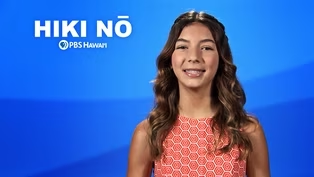
Preview: S14 Ep14 | 30s | Stories that exemplify the resilience and determination of HIKI NŌ student correspondents. (30s)
Providing Support for PBS.org
Learn Moreabout PBS online sponsorship
- News and Public Affairs

Top journalists deliver compelling original analysis of the hour's headlines.

- News and Public Affairs

FRONTLINE is investigative journalism that questions, explains and changes our world.












Support for PBS provided by:
HIKI NŌ is a local public television program presented by PBS Hawai'i