WEDU Arts Plus
1503 | Episode
Season 15 Episode 3 | 26m 26sVideo has Closed Captions
Secondhand Art Supplies | The "Soul Doodler" | Nature-Inspired Furniture | Vacant Storefronts
Artists are rethinking creativity—saving money, reducing waste, and building community through local secondhand art supply stores. Meet Scott Jeffries, the “Soul Doodler.” In Lake Tahoe, Roundwood Furniture crafts nature-inspired pieces, while in Ohio an arts group turns vacant storefronts into vibrant art installations.
Problems playing video? | Closed Captioning Feedback
Problems playing video? | Closed Captioning Feedback
WEDU Arts Plus is a local public television program presented by WEDU
Major funding for WEDU Arts Plus is provided through the generosity of Charles Rosenblum, The State of Florida and Division of Arts and Culture and the National Endowment for the Arts, and the Hillsborough County Board of County Commissioners.
WEDU Arts Plus
1503 | Episode
Season 15 Episode 3 | 26m 26sVideo has Closed Captions
Artists are rethinking creativity—saving money, reducing waste, and building community through local secondhand art supply stores. Meet Scott Jeffries, the “Soul Doodler.” In Lake Tahoe, Roundwood Furniture crafts nature-inspired pieces, while in Ohio an arts group turns vacant storefronts into vibrant art installations.
Problems playing video? | Closed Captioning Feedback
How to Watch WEDU Arts Plus
WEDU Arts Plus is available to stream on pbs.org and the free PBS App, available on iPhone, Apple TV, Android TV, Android smartphones, Amazon Fire TV, Amazon Fire Tablet, Roku, Samsung Smart TV, and Vizio.
Providing Support for PBS.org
Learn Moreabout PBS online sponsorship- This is a production of PBS Tampa, St.
Petersburg, Sarasota.
[music] - Funding for WEDU Arts Plus is provided by Charles Rosenblum.
Hillsborough County Board of County Commissioners, the State of Florida and Division of Arts and Culture, and the National Endowment for the Arts.
- In this edition of WEDU Arts Plus, giving new life to old art supplies.
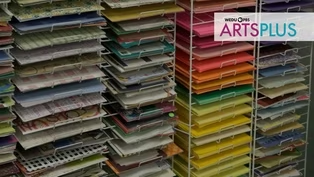
- Second-hand art and craft supply shop where people can trade in leftover supplies and materials that they don't want anymore.
To get store credit to buy the things that they do want.
- Doodling with paint.
- You know, I've been doodling my whole entire life.
These paintings now, this art now is really what I've been doing since I was a little kid.
- A woodworking studio.
- Roundwood Furniture is located on the shore of North Lake Tahoe in Kings Beach, California, and is sort of an art collective of individuals that pour heart and soul into building functional art, predominantly one of a kind artistic furniture.
- And transforming unused storefronts into art installations.
- My vision was to activate empty or disused spaces in downtown Akron, and we are all about bringing more interest to the city of Akron and elevating it through the arts.
- It's all coming up next on WEDU Arts Plus.
[music] Hello, I'm Gabe Ortiz, and this is WEDU Arts Plus.
Art supplies can be pricey, and often an artist or crafter needs only a dollop of paint or a few feet of yarn.
But as we're about to see, the leftovers don't have to go to waste.
[music] [music] - My name is Stephanie Christy.
I'm the owner of Bottom of the Bin.
We have locations in Seminole, Florida, and Brandon, Florida, and it's a second-hand art and craft supply shop where people can trade in leftover supplies and materials that they don't want anymore, to get store credit to buy the things that they do want.
[music] I'm a lifelong crafter and I call myself a hobby hopper.
I'm constantly changing the different hobbies and projects that I'm into, and I end up just amassing so many supplies, I don't know what to do with them.
And so I had an idea to start selling them, and I used to own a clothing store where we would buy, sell and trade used clothing.
So I was like, wow, why don't we do that with art supplies?
I just bought an 80 year old lady's entire craft supply collection, and we're opening it one bit at a time.
- I found this on TikTok.
I was scrolling and I was like, oh my gosh, it's a thrift store and a craft store, which is like my favorite thing ever.
I came in to get a bunch of fabric and stuff because I got my new sewing machine in, and I'm trying to start a brand by the end of this year, so I've been making a bunch of clothes and I'm running out of things to do.
- So the reason someone might prefer to shop here is because you don't have to buy large quantities.
- I needed gold glitter.
I only needed a little bit...came here.
It's three bucks.
That would have cost me, like, 15 bucks.
Got the glitter?
Bring it back.
Somebody else can use it.
It's kind of like I borrow it for a minute.
I borrow just enough of what I needed.
[music] - Creative Clay is an art center that supports and advocates for people with developmental disabilities, intellectual disabilities, and other kinds of neurodivergence.
We are located in beautiful St.
Petersburg, Florida, a city that embraces and celebrates the arts.
So it's a really fun place to be.
We are at the corner of 19th and first Avenue South, and we moved here in 2017 from Central Avenue.
The move here is sort of the reason why we have creative thrift, because that move we realized we had stacks and stacks and boxes and boxes of things stored away and squirreled away in different spots around the building that we were in on Central Avenue.
- Well, when I get here, I always figure, okay, let's see what we need to organize today.
- Everything is donated so we can do this.
Pay-what-you-can model, which works out fabulously because if you don't have it, you don't have it.
But we don't want you to have to have that interrupt your art making.
[music] - This space has a wonderful history.
It was the site of Scrap Topia, one of the first scrap booking stores in Brandon.
And so I knew the space and I was very excited that something was coming in where we could craft again and find supplies.
- I'm going to make a scrapbook.
- I'm just really excited because I have all these pictures that I have accumulated for so long and I can finally, like, do something with it.
And this place is just super cool, has all the things I need.
And that's one of the good things about here.
- Is you can find all kinds of really cool stuff.
- I love all the unique items I find, especially the things that aren't sold in the stores anymore.
- Myself, I've always purchased second-hand.
I like the thrill of the hunt.
I like looking for items that maybe you can't find anymore.
And so seeing the joy of someone who comes in looking for one specific thing and we have it, it brightens my day.
I feel like if you're a crafter, it's all your thing.
- Yeah, one of the things I really love is every day they'll post items that they're going to sell.
I'm in the process of making a little miniature greenhouse, and just yesterday they posted the tiniest little terracotta pots.
So within seconds I'm in my car, driving up there like a mad woman to try to hurry and get it before anybody else buys it.
Somebody is going to grab that for sure.
I love to come in and look at everything that they have in their little organized bins and think, what can I do with this?
What can I make with this?
I love to look at the bead area and say, oh, this little bead can become a coffee cup.
Or I can look at this little paper craft item and say, oh, that would be the perfect picture frame.
So it's also one of the things I love about coming here is it helps open my creativity and helps me look at things outside the box to kind of create things with.
[music] - Most of the people who come to the thrift store are women, but we do have a mix of everything.
I mean, to all ages.
- Definitely a lot of local artists, which is great.
Um, and college students.
I remember when I was in college and couldn't afford art supplies, I leaned heavily on the thrift store.
Even people who might not consider themselves artists, but maybe keep photo books for their kids, or like to have a little more personal of a card that they give.
- I make greeting cards, and I make, uh, kind of like wiry jewelry.
[music] - We never imagined creative Clay would be into this, this kind of line, but it really fits in and supports our mission.
I mean, we save money on art supplies.
We are able to make new friends in the community with other artists, artists who come in here and then spread the word.
Then that increases the possibility for new donors and new new people to come in and support not only buying art, but supporting through buying merch.
Or maybe, maybe they want to be a donor, you know?
So, it is a community maker.
[music] - I think customers who are looking for more sustainable ways to use products is definitely a trend, but it's something that's always been around and probably will always be around.
So people are always looking for ways to save money, reuse things, and I don't see that changing anytime soon.
- Do you need a bigger budget?
- I always end up with a bigger basket or it's super full.
[music] - To learn more, visit these websites.
Scott Jeffries calls himself a sole doodler.
He started doodling from a young age and continues to do so today with his abstract paintings.
He provides a window into his soul and mind.
[music] - I find favorite, favorite faces, you know, and I so I know for I know for a fact I won't touch this guy here because I love him.
[music] My name is Scott Jeffries, and I'm a painter.
[music] I call myself a soul doodler.
You know, I've been doodling my whole entire life.
These paintings now.
This art now is really what I've been doing since I was a little kid.
And I started doodling when I was probably 5 or 6.
And and I do it all through, through elementary school and, and high school and law school.
[music] Because of Covid, I was able to I got I got laid off from my job at a law firm and was kind of like pushed into a dream of being a full-time artist.
And that's I've been doing that for the past 6 or 7 months, and it's been an amazing thing because I've been able to focus on what I've been wanting to do my whole entire life.
[music] I don't create any colors, I just grab, I go to the paint store and I will just grab paints.
People give me paints for for Christmas.
I have old paints that someone gave me, and if I happen to, you know, I just I can it will just be whatever's close, right.
And that will that will be the paint that's available.
[music] My grandmother was a painter, so I painted for a long time.
And, you know, when I was 13, uh, we were at my grandmother's funeral, and my, my mother, um, was we were standing in her studio in her, in her basement in the Bronx.
And I remember my mother saying to, to basically to out loud, what am I gonna do with all this stuff?
All her paint brushes and all her paints and all her, you know, all the materials that she had in the studio.
And I was and I was like, I'll take them home with me.
And I took them home and I started paint.
Started to paint then.
And, you know, from that point on, I was always painting just just to paint it.
[music] But the main thing always is, is try not to have have, um, two colors that are the same next to each other.
That's my only real rule.
[music] It doesn't matter really, if it's if it's perfect.
You know everything.
There are no mistakes in my art.
It's not for somebody else's approval.
It's for, you know.
It's just for enjoyment.
If you like it, you like it.
If you don't like it, you don't like it.
You know, and I think a lot of artists struggle with which I don't struggle with is perfectionism.
Never went to art school.
You know, I went to I went to law school years ago.
And, you know, when when people talk about my art, sometimes they're like, ah, you're such a great colorist.
You know, I never could thought that, you know, that this color and this color could go together.
And for me, I never thought about that.
Thank, thank, thank God I didn't know what the what a color wheel meant.
- And the fun thing will be is that, you know, when I step back and look at it, I was like, hmm, that's interesting.
And I'll scratch sometimes and.
Give it some life.
My art is meant to be fun, you know, and enjoyed and accessible, you know?
And more than anything, you know, I would love people to people.
You know, people ask me a lot.
What does that what does that art mean?
You know, what does that mean?
And I'm like, mm.
What do you see.
That's that's the key.
[music] I draw the black lines first and ultimately just fill in the color.
But no sketching out, no rhyme or reason, just, you know, painting to paint and have fun.
I've been painting these faces my whole entire life, you know.
And the great thing about what?
What I see, you know, and what you see, it's really a mirror of of of of ourselves.
If I'm going to do a face painting, I'm just going to paint faces.
I'm going to paint smiles.
I'm going to paint frowns.
I'm going to paint grins.
I'm going to paint whatever.
Whichever way the brush brush goes.
[music] These paintings lately mean something different than they meant years ago.
You know, someone had asked me, you know, when when, um, you know, when when George Floyd was killed and all these, all these protests were going on.
They wanted me to to give them a diversity painting for their kids.
So something that that something to me, what it meant to me and these paintings all of a sudden started to become like diversity paintings because they showed that the difference in humanity, the different colors that that that are in the rainbow, you know, the reds, the yellows, the blues, the browns.
At the end of the day, these are protests of, you know, protests of smiles.
More than anything.
It just it just was an amazing process for me to sort of think about these things in a deeper, deeper level over time.
And sometimes, sometimes they're just, you know, meant to make you smile.
You know, there's no deeper meaning.
You know, I paint these, I paint these, these, these fish, you know, and they're just they're just fish.
I spend some time with, with with younger people working with them.
And I hear all the time they say, I can't do that, I can't paint, I can't do this, I can't.
And it's like, and I encourage anyone that's an artist to stop with that negative thinking because because you're never going to be satisfied.
You know, I love my art, you know, not my art's not for everybody, you know.
But I know one thing.
It's for me.
[music] - See more at scottyjart.com.
On the north shore of Lake Tahoe is a small woodworking studio called Roundwood Furniture.
For over 20 years, artists have been designing furniture inspired by nature.
[music] - Roundwood Furniture is located on the shore of North Lake Tahoe in Kings Beach, California, and is sort of an art collective of individuals that pour heart and soul into building functional art, predominantly one of a kind artistic furniture.
[music] Functional art, to me, is a beautiful sculpture that functions in a way that you use it every day in your life, as opposed to something that's static and non-interactive.
Something that provides more than just visual enjoyment and has a three dimensional purpose.
[music] The location of the Sierras and Lake Tahoe in general, to me, has felt like a cathedral of Mother Nature's explosive diversity.
And 20 years ago, I was coming out of one backpacking trip, out of Desolation Wilderness and being completely immersed in the visuals of all these different branches and roots and repeatedly looking at a stump that turns into what looks like a couch inspired me to start building functional art furniture out of that stuff.
There's nature's uniqueness in each piece, so the ethos of Roundwood furniture is basically celebrating the beauty in the organic source of wood.
[music] We're predominantly repurposing what's available to us that's sustainable and has a story behind it, because there's a total joy in being able to provide a second life for something.
[music] If if the piece came from a pier in Lake Tahoe, let's say, and it saw 60 to 80 years of bright sun and smashing water and sand blasting from the beach.
It has character, it has nature's tattoo in it, and that makes it absolutely unique to nothing else in the world.
It has its own very identity.
[music] Driftwood is super, super fun to work with because you not only have the piece that's unique, but a drastic, exposed story of what happened.
Well, waves and rocks shaped that piece.
[music] In my beginning years, I actually forged the forests for, um, dead wood and brought that into sculpture.
These days, we're working with farmers down in the Sacramento Valley that are replanting English and Claro walnut from orchards.
So as walnut orchards are being retired and replanted, the 80 year old trees that they're Retiring have so much story and beauty wrought within them that it's a perfect platform for us to try to expose the twisting of the grain and the rolling of the fabric of the wood.
Any character in the wood itself, in the tree, in the slice, in the burl that has a unique fabric to it.
There's these dynamic rarities that we're trying to find that make the piece really draw you in at the end.
[music] There's something that nature does so well with asymmetry, but balance.
I would say that nature driven furniture design is a central core of how I look at designing pieces.
So not just the wood itself and revering the harmonious vibrance of the wood.
[music] With an epoxy pour process, for instance, I have special tricks at different times to trick that epoxy into behaving more like Mother Nature does.
So I want bubbling, molten, different colors.
[music] You've got fire, which is represented by the magma series.
Water, which is the Aqua series.
Astral series takes care of air and then Terra for Earth.
And so you've got all those fundamental properties in Mother Nature again, sort of nature driven design.
I think one of my favorite parts in the creative process is it's all about what I haven't figured out yet.
I usually go in with about a 50% game plan, so I don't mock out to detail anything kind of like building a song.
And you add layers and you step away and you come back in, and I really can lose myself in any thoughts in the world to that process.
And I feel like the vibration in me is its happiest it's ever been.
[music] Every piece that comes out of this studio has a three dot logo somewhere on it, and that comes from the ellipses of to be continued.
So dot dot dot to be continued.
Where that was born from was me realizing that even though this piece is completely done, there's at least three more projects, sister pieces, ideas that were born from building this piece that I'm dying to try.
So this idea is not finished yet.
The piece is done.
The idea grows on.
That's what for me, defines me as an artist.
because that artistic process of learning just never stops.
That's why it's, in my opinion, one of the funnest things you could be doing with your life is creating functional art.
[music] - For more information, go to RoundwoodFurnitures.com.
The organization curated storefront breathes new life into neglected urban spaces in downtown Akron, Ohio.
Storefronts that have gone unused become multimedia art installations for the public to enjoy.
[music] - In the 1961 book The Death and Life of Great American Cities, author and activist Jane Jacobs wrote think of a city and what comes to mind its streets.
If a city's streets look interesting, the city looks interesting.
If they look dull, the city looks dull.
[music] That quote became inspiration for Curated Storefront, an organization in Akron founded in 2016 as an effort to revitalize the downtown area through art.
[music] - My vision was to activate empty or disused spaces in downtown Akron, and we're all about bringing more interest to the city of Akron and elevating it through the arts.
[music] When we started, we had one space at the corner of Market Street and High Street, and that's now been developed into a brewery.
So we felt successful in our first time out, and then we've slowly moved down Main Street south, and we've programmed over 26 buildings since we started.
- The ultimate goal of Curated Storefront is to bring commercial development to downtown Akron.
So far, it's been working.
11 buildings activated by the organization have been redeveloped.
The other objective preserving history.
[music] - And unfortunately, our cities have erased a lot of our history in Akron.
They haven't done as good a job as I think they could have, preserving some of their historical architecture, which if you walk up and down Main Street, there's lots of empty lots where some grand buildings used to stand.
I was born in 1954, in Akron, and growing up, I remember going downtown as a child to O'Neil's and Polsky's.
Just about everything that happened for retail and socially happened downtown.
[music] The Christmas windows were always a big draw, and there was always something lively going on in those windows, so I thought it would be nice to do something in the arts, but also something that would help bring downtown back to-differently-but its former glory.
- As this year's Front Triennial expands its footprint in the Akron area, a partnership with Curated SWtorefront seemed natural and another great way to bring more art into empty buildings.
[music] - In the first edition, the only local Akron location was the Akron Art Museum.
And so it was really important to front that this time there would be a more robust footprint here in Akron.
And so the partnership with Curated Storefront was born because Curated Storefront has this amazing capacity to be spread out across the city and be in all the unusual places.
Quaker Square was the obvious choice for that.
One floor of Quaker Square is devoted to the front presentation, and the second floor is a series of other curated storefront exhibitions.
- In 1932, Quaker Square was built as the headquarters of the Quaker Oats Company.
Its iconic silos were redeveloped in the late 70s as a hotel with offices, shops, restaurants, and extensive model train displays.
Today, it's used for storage and dormitories by the University of Akron, and on the ground floor is where you'll find Curated Storefront.
- This building is such an icon on the skyline of Akron, and it's such a nostalgic place for so many members of the community, so it's really exciting to reactivate it and turn it into a dynamic arts venue and invite everyone back in.
- It's kind of an advantage because we have a blank slate here.
There's so much empty space that we have a lot of freedom to do things that you couldn't do in a in a city where everything's already commercially populated.
- Northeast Ohio is surprisingly vibrant and has a lot of interesting cultural institutions and a lot of energy.
There's so much possibility here and a lot of energy to make it all happen.
[music] - Curated Storefront features several artists in this year's Front Triennial.
Cleveland based Charmagne Spencer uses natural materials to create large scale sculptures and Chakaia Booker from New York uses a rubber city staple used tires to create abstract pieces, which will be on display during the triennial.
[music] - Find out more at curatedstorefront.org.
And that wraps it up for this edition of Arts Plus.
To view more, visit.
Or follow us on social.
Until next time, I'm Gabe Ortiz.
Thanks for watching.
[music] - Funding for Arts Plus is provided by.
Charles Rosenblum.
Hillsborough County Board of County Commissioners, the State of Florida, and Division of Arts and Culture, and the National Endowment for the Arts.
1503 | Secondhand Art Supplies
Video has Closed Captions
Clip: S15 Ep3 | 6m 10s | Giving new life to old art supplies. (6m 10s)
Providing Support for PBS.org
Learn Moreabout PBS online sponsorship

- Arts and Music
The Best of the Joy of Painting with Bob Ross
A pop icon, Bob Ross offers soothing words of wisdom as he paints captivating landscapes.










Support for PBS provided by:
WEDU Arts Plus is a local public television program presented by WEDU
Major funding for WEDU Arts Plus is provided through the generosity of Charles Rosenblum, The State of Florida and Division of Arts and Culture and the National Endowment for the Arts, and the Hillsborough County Board of County Commissioners.