
11/28/23 | Fall 2023 Compilation Show
Season 15 Episode 6 | 29m 11sVideo has Closed Captions
Episode 1506
A special collection of stories from Hawai‘i’s New Wave of Storytellers’ first round of shows this season.
Problems playing video? | Closed Captioning Feedback
Problems playing video? | Closed Captioning Feedback
HIKI NŌ is a local public television program presented by PBS Hawai'i
11/28/23 | Fall 2023 Compilation Show
Season 15 Episode 6 | 29m 11sVideo has Closed Captions
A special collection of stories from Hawai‘i’s New Wave of Storytellers’ first round of shows this season.
Problems playing video? | Closed Captioning Feedback
How to Watch HIKI NŌ
HIKI NŌ is available to stream on pbs.org and the free PBS App, available on iPhone, Apple TV, Android TV, Android smartphones, Amazon Fire TV, Amazon Fire Tablet, Roku, Samsung Smart TV, and Vizio.
Providing Support for PBS.org
Learn Moreabout PBS online sponsorship[intro music] HIKI NŌ, Hawai‘i's New Wave of Storytellers.
Aloha.
Welcome to HIKI NŌ on PBS Hawai‘i.
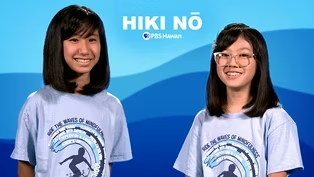
I am Maya Tasaka.
And I'm Miya Tosaka.
We are in the fifth grade at Waikīkī Elementary School on O‘ahu.
We're so excited to be your host.
And as you probably guessed – Yes, we’re twins.
I think we might be making history as the first twin hosts of HIKI NŌ.
We're here to share a special collection of stories from Hawai‘i's New Wave of Storytellers.
In this episode, we'll watch standout stories from the first round of shows this season.
There’s going to be stories about everything from big boulders to wayward dodgeballs.
Stories about taking a swing at tennis, and learning to use a new typewriter.
And the joys of learning about Hawai‘i's culture through dancing hula, and much more.
So, let's dive in.
Our first piece comes from our class at Waikīkī Elementary.
We noticed there were some problems at recess, so we decided to do something about it.
Here's our story.
Hi, my name is Maya Tasaka and I am a fifth grade student at Waikīkī Elementary School.
Waikīkī is a great school, but once the recess bell rings, things can get a little crazy.
Balls fly at you from all directions like nuclear bombs.
Having to run, duck, and hide from flying balls in the air can be exhausting.
Sometimes you get hit by a ball and have to go to the health room.
I saw two people talking, one got hit by a ball and accidentally knocked the other one over.
Another time my friend was walking across the field and got hit on the nose by a ball.
When she looked up at me, she had a bloody nose.
Even though we have this issue, we are problem solvers.
Our PE teacher, Mr. Holaday, set the field and made different zones to separate different groups.
We can also ask other students for suggestions, too.
We can make sure to help our friends and peers.
Recess should be a paradise for all.
[ocean wave] We hope you enjoyed that.
We had fun making it.
The next piece you'd like to share with you comes from a student at Waiākea High School on Hawai‘i Island.
It's a story about taking a swing at a tennis championship.
Let's watch.
Hi, my name is Mari Iwata.
I'm a senior at Waiākea High School on the Big Island of Hilo, Hawai‘i.
Today is August 27, 2023.
And I'm currently filming at my school.
This is my third year playing for my high school tennis team, and it will be my sixth year practicing.
I first started out playing tennis for fun, but then I grew to really enjoy it.
My goal was to make it on the high school tennis team and be a part of something.
When I showed up, I felt nervous because my peers were a lot better than me.
However, I sucked it up, and luckily, I made it on the team.
One day, I, along with a few others, were pulled aside to have a talk with our coach.
He told us we would not play for the league championships; we did not have to go to practice, and we could get a refund on our uniforms.
[Sighs] Although I was on the team, I was not a part of it.
Despite that, I never gave up and still attended practices.
As the season went on, my coach pulled me aside one last time.
With a heavy heart, I prepared for the worst.
To my surprise, he told me I would be playing in the championships after all.
I was shocked, to say the least, but overwhelmed with joy.
While I didn't win, I was grateful for the opportunity.
I'm glad I never gave up and gave myself a chance.
For my final year in high school, I will be the one to serve the winning shot.
Hopefully.
[ocean wave] At Highlands Intermediate School on O‘ahu, students were interested in the story of a man who was recently released from prison.
They look closely at some new science that uses DNA to prove innocence.
Here's their report.
No one wants to see anybody in prison for a crime they didn't do.
When you think of prisons, the justice system as a whole, even, you think of the fairness of the law.
But nothing is perfect, and the justice system is no exception.
My name is Kenneth Lawson, I'm the Co-Director of the Hawai‘i Innocence Project.
Again, our, our case was Ian Schweitzer.
He spent 25 years in prison for a crime he didn't commit.
We freed him because of the DNA.
Ian Schweitzer was serving a life sentence when he was proven innocent and released in January of 2023.
His freedom was thanks to the new advancements in forensic science.
These advancements are changing many lives, not just Schweitzer’s.
Very small amounts of material can make a huge difference.
Like now, recovering a single hair at a crime scene can be a critical item of evidence to, to be studied, used, or analyzed using forensic methods.
Since 1993, since the Innocence Project started throughout the United States, uh, over 300 people that had been locked up, have been freed through DNA testing.
I think it's absolutely exciting and wonderful that they're exonerated.
When these things happen, my, my only frustration is how long this process takes because we knew, we knew for years that they were innocent, but it has to work its way through the whole criminal justice system.
Exonerees of wrongful convictions, even after gaining their freedom, face new challenges reentering society.
When the judge said, “Uncuff that man, he's free.” And they saw it on TV, and they saw him hugging his parents.
Everybody thinks that you know what, now he lives happily ever after.
But when you think about it, um, like I said, he's 51 years old, who's gonna hire him?
You know, is he trained to do, uh, jobs out there now that he's been in prison for 24, 25 years?
Besides Schweitzer, the Hawai‘i Innocence Project has successfully exonerated three other people in Hawai‘i since the nonprofit clinic began in 2005.
They continue to work on the cases of those who believe they've been wrongly convicted.
You know, I think that all of us are here on Earth, that our primary purpose and we're here to be of help to one another, right.
And if we can't help somebody, just don't hurt him.
This is Emma Forges from Highlands Intermediate for HIKI NŌ, on PBS Hawai‘i.
[ocean wave] The next story we want to share with you is a profile produced by a student from H.P.
Baldwin High School on Maui.
In this story, our student reporter interviews his stepfather, a Maui firefighter with a close connection to Lahaina.
I mean, there's no words to describe the fires that, uh, devastated the whole town of Lahaina.
In August 2023, Maui firefighters were called to duty to fight not one, but three fires on Maui.
Ray Watanabe, my stepfather, was one of them.
My role during the Lahaina wildfire, cuz there were three separate fires going on at the same time - my role was, uh, driving a relief truck through the Lahaina area and assigned to the Wahikuli district.
Although he's a current resident and firefighter at the Kahului fire station, his connection with Lahaina is personal and runs deep.
Uh, growing up in Lahaina was awesome.
Um, I had a twin brother.
So, you know, we did a lot of things together.
I came from the old Pioneer Mill area.
We had our little, little rat pack, I want to call it, of guys and gals, girls, and then we just hung out and played and just did, did a lot of things together.
Like normally kids cannot, can't do today.
As you know, Lahaina is a small knit community.
Everybody's pretty close on a daily basis.
This affected a lot of people, including myself.
I don't live in Lahaina anymore, but it, it affected me a lot.
Because I know family and friends still missing, things of that nature.
Since the fires, Watanabe and his colleagues have been a part of another way to give to the community: volunteering in schools.
He says it's been a healing outlet for everyone.
I was, was asked to volunteer and read, read to, uh, children Upcountry, at one of the Upcountry schools.
And that was great because we get a lot of support.
But the kids were really appreciative, um, of the work we did up there and that, it really hits home when they tell you thank you and stuff like that.
Despite the challenges of being a firefighter, Watanabe says he enjoys his job and will continue to support his community throughout his years.
There's always going to be a lot of, um, negative experiences.
But to me, the positive outweigh the negative experiences, especially when you help people and not getting any kind of reward from it.
I just, I just enjoy what we do.
The people that I've run in from Lahaina have been very kind to me, keep on telling us to keep doing the good work that we do.
This is Samuel Paci from H.P.
Baldwin High School for HIKI NŌ, on PBS Hawai‘i.
[ocean wave] Thank you for sharing that story, Samuel.
Now let's watch a report from Highlands Intermediate School that includes a special interview with a woman who narrowly escaped a boulder that crashed into her home in Pālolo Valley on O‘ahu.
When the glass shattered, I kind of stepped back and I, I didn't know what happened initially.
I'm here in the Pālolo Valley neighborhood where Caroline Sasaki had her home hit by a 3,000-pound boulder on January 28, 2023, at around 11 p.m. She says it was scary and shocking, but it hasn't necessarily been a surprise to her community, which has been voicing concern about loose boulders for years.
We were upset even before this happened.
Um, our situation, I've had neighbors who've contacted, um, councilmen, um, representative senators, um, to, you know, look into the situation.
It's been ongoing for many years, um, that the boulders are getting loose and, um, starting to fall.
There's other, you know, other situations where boulders have come down.
There was a landslide on the North Shore where the rocks are falling, and it closed the road.
Um, so, it's an issue that needs to be addressed by, you know, all parties that are involved.
We reached out to Honolulu City Council Member Calvin Say, who represents the district that includes Pālolo Valley, to find out more about the problem.
He says erosion is a growing issue in many communities.
The weather conditions, climate change, the stormy rains that we have, the persistent wind that we have, all of this may have contributed or have contributed to the erosion surrounding that big boulder.
It's also the fact that sometimes in a natural disaster, they have a word they call acta jure, meaning Act of God.
It could, if it's the Act of God, it's very hard to have any form of litigation, because you will never know if your property will be held accountable or liable for a boulder that, you know, falls through one's home.
Councilmember Say says he has heard from many of his constituents about the issue, and the county government is looking into possible solutions.
We have contractors that the state and the county has hired to maintain those boulders where they are at, but it is because you have wire fencing.
Wire fencing, not meaning wire fencing that you just put up vertically, no.
These wire fencing will be at the bottom or at the tip of where the boulder is close to the ground.
What I would like to see is that maybe in the future, and I apologize to other private landowners, that there is no more development on the sides of this mountains.
I think maybe we should have a drone to map out, you know, are there boulders in our property that we had, versus the other side of the property line where other private owners are.
Natural disasters like these pose not only physical harm, but long term mental and emotional harm on people, too.
Sasaki says she hopes her story will inspire others to prepare for the unthinkable.
People have asked me if I have PTSD or stuff like that.
Um, at this point, no, but who knows, you know, it could affect people later.
All my life, basically 65 years, and it's never happened.
Um, but now talking to other people, I found out that it has happened.
It's just not newsworthy because there was no video.
Luckily, we had a video that shows exactly what can happen.
Building fencing and using drones to identify potentially risky boulders will likely take some time.
For now, we can spread awareness to the people of Hawai‘i.
This is Bella Seaman from Highlands Intermediate for HIKI NŌ on PBS Hawai‘i.
[ocean wave] Wow, that's quite a story.
Thanks, Bella.
Now we'd like to take you back to our school, Waikīkī Elementary.
Our school takes part in a cool program called Lucky Labs.
In one classroom, you'll find a unique typewriter.
But do you know how to use it?
Well, let's learn.
Have you ever wondered how people write in Braille?
People use Braille, a system of raised dots for people with blindness or low vision.
In our class at Waikīkī Elementary School, we do Lucky Labs.
Lucky Labs are where we learn different strategies that help us understand the world from the eyes of people who are visually impaired.
We do Lucky Labs and we feel we're the luckiest class in our school.
We are the only class in the school with a visually impaired student that uses a white cane.
We're instructed by Ms. Amy who is a teacher of the visually impaired.
Braille was invented by Louis Braille in 1824 at the National Institute for Blind Children in Paris, France.
He spent years perfecting it.
Here's how to use a Braille writer.
First, write down the message you want to write in Braille, so you don't forget it.
Then slide a piece of special thicker paper into the slot at the back of the Braille writer.
Spin both rollers on the sides of the Braille writer.
Look at the Braille chart to show you how to write individual letters.
Press the keys down at the same time for each letter.
Then when you finish the line, there's going to be a ding.
That means you've reached the end of the paper.
When you reach the end of the line, move the slider to the left and press line space again.
When you're done writing your message, pull the lever to release the paper and spin the rollers away from you until it stops.
Finally removed the paper from the Braille writer.
Congratulations.
Now you can share your message.
Now that you know how to use a Braille writer, next time you have the opportunity, you can try it.
[ocean wave] At Hawai‘i Preparatory Academy on the Big Island, students wanted to shine a light on their kumu.
She teaches Hawaiian language, hula, and so much more.
Let's watch.
[Hawaiian] First and foremost, uh, what is the goal of what I teach and why I teach?
Um, number one, the sharing of aloha is really important.
That aloha is inclusive to all of us.
Aloha does not separate any of us.
Not many of my students come from or are born in Hawai‘i, but they find themselves here; they have a connection to this place.
And so, our job is to give a sense of belonging, give a sense of purpose, uh, give a sense of responsibility to the place that they live, and they thrive.
She's taught me a lot of stuff with Hawaiian culture and hula and how she's brought me up as well, giving me confidence.
When I was in college, my Portuguese family, um, would introduce me as Nicole, who was going to college who was going to be a teacher.
And, um, I actually did not want to be a teacher.
But my grandmother just kept saying, like, one day she's going to be a teacher.
We never know what's ahead of us, and sometimes our kupuna can see a light within us that we don't see within ourselves.
One of my good friends from Hawai‘i Preparatory Academy came to me and said, “You know, HPA is looking for a Hawaiian Studies teacher, and would you be willing to, to apply?” With some hesitation, I said, “Okay, I'll give it a chance.” I did Hawaiian language for eighth grade, and then I also did, um, K-5 Hawaiian studies.
Bringing hula to the school was another way of engaging students more deeply rather than watching video and or listening to lectures, but more engaging them in the physical of what it means to be engaged in the culture.
While performing my first ho‘ike with my hula hālau, I was scared.
Kumu Kuwalu put us in a circle, said a few encouraging words, and then we were onstage.
She helped me find my voice, and now I am more confident in myself.
I've had a student, her name is Healohamele Genovia, and I've had her since she was about second or third grade.
Uh, we decided to do an ‘uniki ceremony, um, for Healohamele to graduate as a kumu hula.
And then it took a one year of intense training, um, of, of creating so that she has the skill, she has the confidence to continue and perpetuate what I've left behind.
Kumu Kawalu in all her magic and aloha is a reminder for me about the kuleana we have as kumu hula to nurture each dancer's spirit.
Hula is really, really important in the sense of generations.
Uh, the word hālau actually means many breaths.
And so, the idea of a hālau actually means for it to continuously thrive and for it to continuously live.
And so, they become more of the seeds of this place, and they sprout even greater.
This is Khloe Nakagawa from Hawai‘i Preparatory Academy for HIKI NŌ, on PBS Hawai‘i.
[ocean wave] HIKI NŌ student reflection projects are cool because we learn what's going on in the minds of other students.
This next piece is from a student who just started her freshman year at Pearl City High School on O‘ahu.
Meet Sophia.
Hi, I'm Sophia, and I really only have one wish: to get out of Hawai‘i.
Don't get me wrong.
I love O‘ahu.
It's just sometimes I feel trapped.
Right now, I'm only a freshman at Pearl City High School, but my master plan was to get good enough at something to take me places.
So, I started doing media.
And I got good at it too.
Over two years, I've done a lot.
Competed in national competitions and won.
My work was even aired on TV.
We're here in Long Beach, California.
Once I stopped to look around though, I realized I wasn't doing as well as I thought.
My friends barely saw me anymore, and I had no free time.
Whether it be school, media, or clubs, I was stretched to my limit.
Every part of me was dedicated to getting out of Hawai‘i, one way or another.
I didn't really stop to look around, spend time with the people who wouldn't be around forever.
Yeah, I still would love to get off the island, attend college and experience something different.
And I'm chasing that dream.
But I won’t get my childhood back.
So, moving can wait a little longer.
[ocean wave] HIKI NŌ on PBS Hawai‘i hosts three contests throughout the year.
This next story is by Hilo High School students who received second place in the 2023 Fall Challenge.
It spotlights a restaurant that has more than pizza on its menu.
Check it out.
Having a safe place where my son and his friends can go and hang out, have a safe place, is huge.
In June 2020, owner Justin Ambagis, with a passion for video games, opened up a small arcade style pizza restaurant in the heart of downtown Hilo, Antics.
So those first video games, they were amazing, you know, uh, just running around, as Super Mario trying to jump over a blob and save a princess, to Duck Hunt, you know, um, that was another game that me and my brother had.
But as time went on, the stigma around video games started to change.
As the years got on with video games, the more I played, the more kind of backlash I got from my parents, and then it started seeing like, it was a very nerdy kind of thing to do.
And if you played video games a bunch, it was cool, but you weren't really talking about it that much.
Despite this new outlook on video games, a variety of generations have been impacted in these new times.
We all grew up playing video games, like even my dad, like, when he was a little older, grew up playing video games.
And these video games are what he played growing up, and there's some here that like, I played growing up, so it's just a good bonding moment between me and him.
And it's like, the first time I've seen him know more about video games than me.
It's super cool to see.
I grew up playing like, Nintendo and that's what we were playing in our booth, and it was fun to play those games with, uh, my kids.
It's, it's funny to look back and see how bad the, um, the graphics and things like that were.
But, uh, it was a, it was great for them to see, uh, what the video games looked like for me when we were playing.
I used to, well, play the, the kind of older games and the newer games, like the ones from like 2000, 2001.
But now I can play the ones from the 90s out here, and it feels a lot better because I get a wider variety.
It's awesome.
But going beyond the present-time stigma of video games, Justin was able to provide a safe place where his son and others can enjoy the realm of gaming in this modern age.
Having a safe place where my son and his friends can go and hang out, have a safe place, is huge.
It's what I wanted when I was, when my son was younger, and I'm glad that I was actually able to provide that at a time when he was able to utilize it because he is 13 years old now, and now he walks down from Hilo Intermediate with a big group of friends and they come and take over one of my dining rooms and just play video games, eat pizza, drink soda.
The unity across a variety of generations can continue to connect through video games and can even make dreams become a reality, just as it did for Justin.
This is Mayo Nakajima from Hilo High School for HIKI NŌ, on PBS Hawai‘i.
[ocean wave] Our world is becoming more connected online.
That's the case in this next story from students at Kua O Ka Lā Public Charter School.
They share some fun facts about their campus in this next story.
Located more than 30 miles south of Kona, Miloli‘i is Hawai‘i's last remaining fishing village.
It has a rich history.
Kua O Ka Lā Public Charter School students are now sharing the beauty and culture of their place through virtual tours like this one.
We live on a slope of an active volcano, Mauna Loa.
Behind me, you can see the lava flowed in this direction in 1926.
Along our coasts, Ho‘opuloa was one of the larger villages with a store, a post office, and a landing for trading ships.
The 1926 lava flow destroyed Ho‘opuloa as well as the bay.
Because many residents of Miloli‘i are descendants of those displaced Ho‘opuloa villagers, the whole region is now generally referred to as Miloli‘i.
A big part of our curriculum is also understanding our place.
Through virtual tours, we could connect our students’ projects like kilo, which is observing our environment, and connecting it to the place that we're learning, specifically here in Miloli‘i.
Students use cameras that capture 360-degree panoramas.
The images they take will become the visual elements for their own virtual tours.
Then they add clickable hotspots to create an immersive interactive experience.
I think a really like, interesting way of, um, to like, express your, like where you're from, and like, you can show other people.
It's just really cool.
Virtual tour enhances our student’s curriculum because they allow our students to share their voice, knowledge and stories of their place through a digitally innovative platform.
This project is a partnership with Arizona State University.
The ASU Center for Education through exploration is developing Tour It, an online platform that students use to create their tours.
The feedback from our collaborations and our use of it together is what has evolved the program itself to make it more user friendly and more accessible.
In addition to capturing images and videos, students must uncover the history, facts, and stories behind these places.
My goal is that virtual tours will be a tool, but the creators will be the one who really make it fly by making the world be able to hear their stories.
Aloha I'm Kumu Pilimai and just here in Miloli‘i to talk about the Noni tree here, also known as the Indian mulberry tree.
Virtual tours are important to place-based learning because it allows our students to tell their story about the history, the mele, the mo‘olelo and the environmental significance of this place, this wahi that we care for.
Students get a deeper understanding of where they live and where they come from, preserve these stories, and share this richness with the world.
This is Ashley D'Ambrosio from Kua O Ka Lā Public Charter School for HIKI NŌ, on PBS Hawai‘i.
[ocean wave] That concludes our show.
Thank you for watching the work of Hawai‘i's New Wave of Storytellers.
Don't forget to subscribe to PBS Hawai‘i on YouTube, Instagram, and TikTok.
You can find this episode and more at pbshawaii.org.
Tune in next week for more proof that Hawaii students HIKI NŌ, can do.
[outro music]
Providing Support for PBS.org
Learn Moreabout PBS online sponsorship
- News and Public Affairs

Top journalists deliver compelling original analysis of the hour's headlines.

- News and Public Affairs

FRONTLINE is investigative journalism that questions, explains and changes our world.












Support for PBS provided by:
HIKI NŌ is a local public television program presented by PBS Hawai'i