
WEDU Arts Plus
1507 | Episode
Season 15 Episode 7 | 26m 46sVideo has Closed Captions
Chef Ryan Steffensmeier | Abstract Pouring | Master Woodcarver | Emmy's Flower Truck
Featuring a student-produced segment by St. Petersburg College in partnership with WEDU on Chef Ryan Steffensmeier of Dunedin's Parlor House Bistro. Plus, abstract pouring artist Tiffany Moyer, master woodcarver Raymond Kinman, and Reno's Emmy's Flower Truck.
Problems playing video? | Closed Captioning Feedback
Problems playing video? | Closed Captioning Feedback
WEDU Arts Plus is a local public television program presented by WEDU
Major funding for WEDU Arts Plus is provided through the generosity of Charles Rosenblum, The State of Florida and Division of Arts and Culture and the National Endowment for the Arts, and the Hillsborough County Board of County Commissioners.
WEDU Arts Plus
1507 | Episode
Season 15 Episode 7 | 26m 46sVideo has Closed Captions
Featuring a student-produced segment by St. Petersburg College in partnership with WEDU on Chef Ryan Steffensmeier of Dunedin's Parlor House Bistro. Plus, abstract pouring artist Tiffany Moyer, master woodcarver Raymond Kinman, and Reno's Emmy's Flower Truck.
Problems playing video? | Closed Captioning Feedback
Where to Watch WEDU Arts Plus
WEDU Arts Plus is available to stream on pbs.org and the PBS app.
Providing Support for PBS.org
Learn Moreabout PBS online sponsorship- This is a production of WEDU PBS, Tampa, St.
Petersburg, Sarasota.
[music] [narrator speaking] [narrator speaking] [narrator speaking] [narrator speaking] In this edition of WEDU Arts Plus, a chef's craft.
- Some of the earliest memories I can have are of food.
Honestly, when I was a kid chopping kiwi and plating it on a plate just for me to sit there and look at and eat was something amazing.
- Art that is fluid.
- I let myself connect to the music in a way that allows me to start picking paints, like the colors that I want to use.
Sometimes there's just a color like purple.
Purple is the color of the day.
And then I start matching colors to that.
- The career of a professional wood carver.
- What I do is called relief carving.
It's an illusion.
There's some things you can do to fool the eye into thinking that it's deeper than it is.
One of those tricks is the use of perspective.
- And a flower shop on wheels.
- When we are arranging a bouquet for a client, we take into account the different colors that they love, where they're going to use it, how big they want it.
And from that, we just do our magic.
- It's all coming up next on WEDU Arts Plus.
[music] Hello, I'm Dalia Colon, and this is WEDU Arts plus.
This first segment was produced by students at St.
Petersburg College in partnership with WEDU.
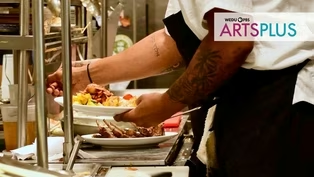
Chef Ryan Steffensmeier started as a dishwasher with no formal culinary training; with perseverance and creativity, he's now the chef and owner of Parlor House Bistro in Dunedin.
[speaking in French] - Good to go.
[music] Table three.
Cooking is my medium, and what I'm trying to say is something that is just self-expressive, something that comes from within me.
It's a passion that I want to share.
Some of the earliest memories I can have are of food.
Honestly, when I was a kid, chopping kiwi and plating it on a plate just for me to sit there and look at and eat was something amazing.
[music] I remember my first day as a dishwasher very, very vividly.
I was 15 years old, new to the industry.
I just really wanted to make money.
I didn't think that it was going to take me anywhere or lead me anywhere.
[music] The very first day I was hooked.
I mean, for a second, I was hooked.
And what really hooked me was the energy of the kitchen.
The hardest part of working my way from dishwasher to chef was just putting in the time.
It was long hours, longer nights, learning the techniques, learning how to work well with people, what my style was.
Prep cook, line cook, chef, sous chef to executive chef.
All those titles I had to work for, they weren't just given to me; I earned them.
[music] The journey has changed who I am along the way quite a bit, honestly.
Um, it's taught me a responsibility.
It's taught me to look beyond the box at what I can consider art on; how I can execute a dish, on what I can do to make something better, what I can, what I can be, how I can be as a better chef.
[music] Inspiration doesn't come from where most people think it comes from.
It doesn't really come from a big bag of groceries.
Comes from within.
It comes from an idea.
It comes from passion.
It comes from memory.
It comes from experience.
I put my entire self out there every time that I put a plate out there.
- You can absolutely see chef's personalities in his dishes.
I would say he comes up with something new and fun all the time, and it's always something a little bit different.
Maybe we'll have something similar to a special we've had in the past if it gets great feedback, but he always tweaks it and makes it just fun and different, something different for everybody that's been coming here for years.
[music] - So there is a lot of repetition in the kitchen.
I mean, you send out hundreds of dishes that are the exact same every time, but that also can fuel creativity by, hey, maybe I can tweak it just a little bit this way or a little bit that way to make it just a little bit better.
- These colorful sauce plates, literally and figuratively um.
[music] You'll see some wild stuff, but it's classic and he puts his own twist on it.
You want a filet?
Great!
But try it with these really different potatoes that you've never had anywhere else.
That's his kind of uniqueness coming into the dishes.
- French cuisine is very special to me.
It has taught me the foundation of my career.
It's taught me to not cut corners.
It's taught me the basics.
I mean, you have to know the five mother sauces, right?
When you first begin fresh tarragon with a heavy dose of red wine vinegar.
You have to know how to properly reduce a sauce or properly make a stock.
[music] Tarragon and red wine vinegar reduction.
[music] And that's what it takes it from the hollandaise to bearnaise the terminology and the techniques and French cuisine really, in my opinion, is the backbone of all modern cuisine.
[music] The part of this journey that I'm most proud of is just really being able to express myself.
[music] Restraint doesn't really play a role in my cooking.
I like to take chances.
I like to go out on a limb and maybe try things that other people aren't trying.
I mean, I want my restaurant to be doing the only thing that this town is really doing.
- I find that Chef Ryan likes to keep things in their original state, but add his little twist to it.
And I think that everybody appreciates that not everything has to go be a crazy entree.
You know, people like just a Chateaubriand as it is prepared.
[music] - So the way I taught my palate is going out on a limb in trying things together, really taking two ingredients, putting them on a spoon and making it one really, and seeing, hey, maybe this needs a little bit more salt or this needs a little bit more acidity or, hey, this subtleness needs to be enhanced by something crunchy.
Sometimes I try and think outside the box and I take two ingredients that may not match, but hey, maybe I'll smoke one of these ingredients and sous vide the other, and they just have a collaboration.
And a lot of the times, risk equals reward.
- It's fun.
- I would say something chef does in the kitchen that I find artistic is it's going to sound strange, but the before prep, like before service starts just taking his time with every little detail.
These dishes don't come out quickly; like they're their prepared hours, days in advance.
And I think the artistry is kind of in the little things.
So the attention and care he puts into tiny little details way before they even see a plate.
- I do consider myself an artist, like a painter would study light or a musician would study chords.
I study flavor, technique, ingredients.
[music] - For more information, visit ParlorHouseBistro.net.
Artist Tiffany Moyer lets paint have a mind of its own as she pours it onto her canvas.
By embracing spontaneity, and abstract work is created that includes colorful, organic shapes.
Visit her backyard studio in Ohio to learn more.
[music] - When I sit down to paint, I try to shut off my head.
I try to shut off all the thoughts that are in my head, and I really try to allow my intuition to guide me throughout the process.
So I sit with my music and I let myself connect to the music in a way that allows me to start picking paints like the colors that I want to use.
Sometimes there's just a color like purple.
Purple is the color of the day.
And then I start matching colors to that.
That I think would complement it and kind of express, I think what I'm feeling or how the music's helping me feel.
And once I have colors selected, I put them all into cups and I mix up like a water medium that I pour into the cups to kind of slowly, slowly add to get to the consistency that I want.
And it's like a constant... like check... is this consistency.
And that took a lot of trial and error.
What is it that I'm trying to achieve?
What's, gonna make all of the paint run off the canvas?
What's going to hold that tighter?
[music] What's going to blend the paint?
So it's a, it's a process of what color do I want to stand out the most in, in this painting?
It's during that time that the energy of the music is going into the paint.
The energy of me is going into the paint through that process.
If I really take my time and focus on what I'm doing, um, that's when I get the best results.
I think it's almost like a meditation in a way.
[music] While I was like really connecting to the music, I would see patterns of colors.
I would see, um, sequences.
And I really fell in love with mixing colors and kind of letting these like images that I had already seen in my brain come out onto the canvas without thinking about them.
And for the first time in my life, I found something I really enjoy.
I'm really, really passionate about it.
And right after I started painting, I got really, really sick and it started in my neck.
It was like a pain in my neck.
Uh, the pain started to go into my back.
I had spasms and this lasted for about a year.
I was in bed in debilitating pain.
Some days just I could not move, but I made a goal every single day for that year to paint something.
No matter how big, no matter how small.
My illness just magically got better one day.
And I think it was pushing through the pain on the days when I was like, I don't know if I can do this.
And I got out of bed every single day and painted.
I was determined to learn through one of the most painful parts of my life because I really I was like, "Ah, this makes me so happy."
In a way I almost feel like this.
This medium especially saved my life.
[music] After I mixed the paint, sometimes I'll go walk around, I'll punch my punching bag to kind of like take some time to let the paint really interact with each other before I pour it.
I have a friend who was trying to teach me to box.
He started to explain that boxing is sort of like meditation in a way, and when you really get lost in the process of like the rhythm of punching you, your mind goes blank.
Similar to art, at the beginning of COVID, I became a punching bag.
I had no idea what I was doing, but I started to really enjoy it sometimes as well.
I if I feel like I'm lacking energy to move the energy around inside of me, I'll start punching the bag.
Just kind of like get loosened up, like break up the energy, like, let's get the creative juices flowing a little bit more.
I had nowhere else to put my punching bag except for in my studio.
So it kind of came together in that way.
And I was like, this is really adding another element to the creative process.
[music] There's a lot of different styles of pouring the paint onto the canvas.
Some people will take individual cups and kind of try to do a design that way.
I think I fell in love with the dirty pour because essentially it's just like taking 4 or 5 colors or however many colors into a cup, and you take that cup and you pour onto the canvas.
I do one cup, and then I start to move the canvas, see how the paint's interacting with each other, pour another cup, see how that's interacting.
And then it comes to life as I start pouring.
So there's nothing ever inside of my mind before I start pouring.
It comes to life as I start pouring, which I really enjoy now.
Before I was like, I really want it to look this way and I can't.
It doesn't do it that way.
This paint has a mind of its own...and I, it's really taught me to accept that I can't control.
There's some things I can't control.
So it's really almost a reflection of the lessons that I'm learning in my own life is how it comes out onto the canvas as well.
[music] I really try to take time out in between every pour to kind of see like, what do I want to add?
What is it that I want to, um, add to this?
So once I feel that the piece is balanced, I stop pouring.
[music] Fluid art is always going to be my passion.
I think what I love the most about this medium is that I can have two artists that use the same colors, and comes out completely different, because every artist, I think, has their their own style.
And I finally found that style and it feels really good.
I don't think society sets people up to believe that they can make a career out of the arts.
And I think I want to prove to people that, yes, you can, you can, you can follow the arts.
You can live your life's dream.
You can live your purpose through the arts.
And it's okay.
It's going to be difficult at times, but it's going to be okay.
You can do it.
[music] - Up next, meet professional wood carver Raymond Kinman of Grass Valley, California.
With a decades-long career.
Kinman has sculpted signs for Disney Parks and is now teaching beginners his craft.
[music] - Playing music is my passion.
That's where I lose my mind.
And in the present moment.
And that's really my thing.
[music] Every musician wants to be a rock star when they grow up, and I figured that's what I was going to do.
I remember I had this conversation with my dad one time.
I was like 14 or something, and I said, dad, I know what I want to be when I grow up.
He's going, oh, what?
I said, a drummer.
[music] He said, well, you know, Raymond, that's great.
You know, go for it.
But you might want to think about having something to fall back on in case the drummer thing doesn't work out.
Thought about it for a while, so I took up the bass guitar as a backup.
[music] I was living in Kings Beach at Lake Tahoe, and Marty, a friend of mine, was going to open a restaurant just off the top of my head.
I said, well, who's going to make your sign for you?
And Mario looked at me and he goes, do you know how to do it?
I told him, yeah, I can carve a sign for you.
And I think about it now.
It's like I had no money, no tools, no woodworking experience.
I'm a working musician, barely making it and a baby on the way, but I was pretty sure I could do it.
You know, when you're young, you kind of that works to your advantage sometimes.
So that's that's how I got my start.
[music] I borrowed 30 bucks from my dad, and I bought my first two tools, which I still use every day, a mallet and a gouge.
The gouge itself used to be about this much longer than it is now.
By sharpening, it's gotten shorter and shorter.
You can just see the soul in it.
[music] My studio's in my home.
When an artist's says, "Studio."
That's code word for "garage."
So I've been working out of my garage for 46 years now.
It's in Northern California, in Grass Valley, nestled in the Sierra Nevada foothills.
[music] Most of the wood I use is a Malaysian hardwood.
It's called.
You ready for this Jelutong?
[music] It comes from a rubber tree in Malaysia.
[music] It's the type of rubber that they use for chewing gum.
So it's hard to find.
It's expensive, but it carves like nothing else.
It's beautiful.
Nice blond colored wood.
So it goes from raw wood.
And then there's a stain slash sealer penetrating oil stain that goes on.
It's just like really a lot of it.
So the wood just drinks this up.
[music] It goes from a drawing to transferring it onto the wood.
What I do is called relief carving.
It's an illusion.
There's some things you can do to fool the eye into thinking that it's deeper than it is.
One of those tricks is the use of perspective.
There's a specific process for doing that.
Cut in your outlines.
Take away the background.
Put in your layers.
Add shapes.
Add detail.
A good composition will have many layers of overlapping objects.
For example, if you look at my chest here as a level, and when I put my arm over my chest, now there's two levels.
Then I put my other arm over here.
That's three levels.
So the more layering that you get, the greater the illusion of depth to the viewer.
Objects that are closer to the viewer are larger and more detailed, and as they get further away from the viewer, they get smaller and fuzzier.
And then to take that into the color stage, which is where it really comes alive, because you can do some things with color that increase that illusion of depth too.
Dark recedes away from the viewer and light comes forward.
My favorite part is the very end.
When I'm putting the color on it, it's like, wow, that looks really good.
It's really magic.
[music] I was getting near my 40s.
I got a phone call.
It was from the senior graphic designer, that top guy at Disney Imagineering.
He saw some of my work at a restaurant, and he got my number from the owner of the restaurant, and that's how I got that lead.
That was a lucky break.
I've done quite a few carvings for Disneyland.
Last time I was there, I counted.
There was 14 still there, so those would include, The Indiana Jones Adventure, Country Bear Jamboree, Country Bear Playhouse, Many Adventures of Winnie the Pooh, Pooh Corner, Splash, Mountain Hungry Bear Restaurant and more.
The work I've done for Disney theme parks have been seen by hundreds of millions of people all over the world.
This is part of people's childhood.
It's a powerful thing.
In addition to the signs that I carved, there's doors, fireplace mantels, doing these serving platters right now.
I recently got into doing Tikis just because I always wanted to try it.
I'm not pretending to be a Polynesian tiki carver, just playing with it.
It's super fun.
I've been doing this a long time, 46 years now.
And, you know, you can kind of look back and learn some things.
So what I learned there was your greatest asset isn't your education.
It's not your ability.
It's not your good looks.
It's not the quality of your work.
It's your persistence.
And here's another one.
Always do your best work because you don't know who's going to see that.
And that turned out to be true.
In my case, everyone is an artist, whether you know it or not.
Part of the human condition is to create.
And when we do that, it really puts us in touch with our core spirit.
And we are.
That's why we're here.
We're born to create.
[music] - For more information, head to woodcarverguru.com.
Meet the team behind Emmy's Flower Truck in Nevada.
Founded in 2020 by Emily MacPherson.
Members of the Reno-Sparks community can visit this flower shop on wheels and take home one of a kind arrangements.
[music] - Flowers can be given any time.
You don't need a special holiday to give flowers.
You can give flowers to lift you up any time for yourself, for your friends, for your kids.
Flowers have a very, very strong effect on people, very similar to music.
It lifts you up, it makes you happy, it changes your mood.
And just giving them to someone brings a smile and makes their day.
[music] My name is Emily McPherson and I'm the owner of Emmie's Flower Truck.
We are based in Reno, Nevada.
Emmie's Flower Truck is a mobile flower truck that travels around town.
We are invited by different businesses to come and park at their business, setting up in specific locations and selling flowers and bouquets.
[music] And this is a mum, and this is a Gerber daisy.
Before Emmy's flower truck, I was a flight attendant at Southwest Airlines for 25 years.
[music] When the pandemic happened, Southwest gave us the option to opt out.
And that meant for the people that were interested in retiring, this was the time to do it.
And they were offering a monetary amount for however long you had worked there.
The money I received, I decided to buy this Volkswagen truck.
[music] It's a 1965 Volkswagen Kombi transporter.
I found it in New Jersey, and this one was interesting to me because of the ability to fold down the sides and fold the sides back up.
- She's absolutely adorable and fun to drive.
We named her Daisy.
She has a vintage looking license plate with the name, "Flower Truck," and she only goes 40 miles an hour.
- We do not go on the freeway, we only go on side streets.
- So it's very fun driving her around town.
She gets a lot of attention.
- I saw people around, not necessarily in Reno, but other towns that had, you know, different kinds of trucks with flowers.
I've always loved flowers, so it's perfect.
And here we are now at Emmy's Flower Truck.
We work with hundreds of varieties of flowers.
[music] Tulips are very big right now and we're doing lots of roses and lots of greenery.
So we do a lot of eucalyptus.
We have it's called Italian ruscus, so whatever we choose is the freshest that we can find and the most current that we can find.
We trim them and make sure we have no bacteria anywhere.
Our flowers last a long time because we do take care of them the way we do.
We do process them in a certain way.
- Creating arrangement involves working with color palettes and color schemes, as well as different textures and flowers.
We want something that's intriguing, has little pops of color or little flowers sticking out every now and then.
I like to call it very whimsical or very boho, and that tends to be our style that we lean towards.
- When we are arranging a bouquet for a client, we take into account the different colors that they love, where they're going to use it, how big they want it.
And from that, we just do our magic.
We have certain ways that we cut our flowers to certain heights.
So you can see all of your beautiful focal flowers, the people that actually build their own, they spend about 15, 20 minutes and that to them is their piece of art.
So it's an art form that they've kind of given to me to perfect.
- I love creating an arrangement or a bouquet.
I find that I can pour my creativity into it, and I love seeing the people's faces when I turn it around, especially out on the truck.
- When I started my flower truck, I never envisioned just how much I would learn about flowers and just how much I would learn from the people that purchased flowers.
Just the love the people bring and the support that people have for the different small businesses and the different business owners.
It's quite incredible.
It really is.
I never knew Reno like I know Reno now and I wouldn't be anywhere else.
- And that wraps it up for this episode of WEDU Arts Plus.
To view more, visit WEDU.org/artsplus or follow us on social.
I'm Dalia Colon.
Thanks for watching.
1507 | Chef Ryan Steffensmeier
Video has Closed Captions
Clip: S15 Ep7 | 6m 18s | Explore the culinary artistry of Chef Ryan Steffensmeier at Parlor House Bistro, Dunedin. (6m 18s)
Providing Support for PBS.org
Learn Moreabout PBS online sponsorship
- Arts and Music

Innovative musicians from every genre perform live in the longest-running music series.





 New Episode


 New Episode

Support for PBS provided by:
WEDU Arts Plus is a local public television program presented by WEDU
Major funding for WEDU Arts Plus is provided through the generosity of Charles Rosenblum, The State of Florida and Division of Arts and Culture and the National Endowment for the Arts, and the Hillsborough County Board of County Commissioners.