
Gilda Snowden, Kresge Film Series, Anne Parsons Passing
Season 6 Episode 19 | 26m 46sVideo has Closed Captions
Gilda Snowden Memorial Exhibit, Kresge Detroit's Film Series, Remembering Anne Parsons
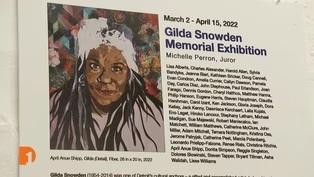
This week's One Detroit Arts & Culture features a look inside the Gilda Snowden Memorial Art Exhibit at The Scarab Club. Then, Kresge Arts in Detroit discusses its KAF21 Film Series discuss this year, spotlighting Kresge Artist fellows and local filmmakers. Plus, revisit Detroit Public TV's documentary "Orchestra Hall - A Centennial Celebration" to celebrate DSO President Emeritus Anne Parsons.
Problems playing video? | Closed Captioning Feedback
Problems playing video? | Closed Captioning Feedback
One Detroit is a local public television program presented by Detroit PBS
Gilda Snowden, Kresge Film Series, Anne Parsons Passing
Season 6 Episode 19 | 26m 46sVideo has Closed Captions
This week's One Detroit Arts & Culture features a look inside the Gilda Snowden Memorial Art Exhibit at The Scarab Club. Then, Kresge Arts in Detroit discusses its KAF21 Film Series discuss this year, spotlighting Kresge Artist fellows and local filmmakers. Plus, revisit Detroit Public TV's documentary "Orchestra Hall - A Centennial Celebration" to celebrate DSO President Emeritus Anne Parsons.
Problems playing video? | Closed Captioning Feedback
How to Watch One Detroit
One Detroit is available to stream on pbs.org and the free PBS App, available on iPhone, Apple TV, Android TV, Android smartphones, Amazon Fire TV, Amazon Fire Tablet, Roku, Samsung Smart TV, and Vizio.
Providing Support for PBS.org
Learn Moreabout PBS online sponsorship- Hi, I'm Satori Shakoor and here's what's coming up on One Detroit Arts and Culture.
A Memorial exhibition for one of the greatest artists in Detroit's history.
A collaboration between filmmakers and artists and honoring a legend.
It's all just ahead on One Detroit Arts and Culture.
- [Announcer] From Delta faucets to bear paint Masco Corporation is proud to deliver products that enhance the way consumers all over the world experience and enjoy their living spaces.
Masco, serving Michigan communities since 1929.
- [Announcer] Support for this program is provided by the Cynthia Essel Ford fund for journalism at Detroit public TV.
The Kresge Foundation - [Walker] The DTE Foundation is a proud sponsor of Detroit public TV among the state's largest foundations, committed to Michigan focused giving.
We support organizations that are doing exceptional work in our state.
Visit DTE Foundation.com to learn more.
- [male announcer] Business Leaders For Michigan, dedicated to making Michigan a top 10 state for jobs, personal income and a healthy economy.
Nissan Foundation and viewers Like You.
(soft upbeat music) - Hello and welcome to One Detroit Arts and Culture.
I'm your host, Satori Shakoor.
And today I'm in the Kayrod Gallery at the head and center in Midtown Detroit.
Coming up on the show, an exhibition memorializing Gilda Snowden at the Scarab Club.
Then Kresge arts in Detroit matches artists with filmmakers.
Following that, we paid tribute to Ann Parsons with a segment from Orchestra Halls Centennial Celebration.
Now let's get into the show.
Gilda Snowden was an educator and mentor to thousands of young artists during her lifetime.
To honor her legacy, the Scarab Club is presenting the Guild of Snowden Memorial Exhibition, now through April 15.
It features the works of local artists.
One Detroit contributor AJ Walker, was there for the opening.
- [Walker] Beauty and passion anode the walls of the Scarab Club.
For an event that is not just an art show, it's a monument to a woman who gave so much to the art world and the community around her.
- She had a tremendous love of her family and her community.
She was in her own right, an amazing artist and a just a very prolific artist.
She was a teacher, a mentor, a colleague and friend to so many people.
Just countless people.
And she always had just a, an enormous generosity of spirit.
- [Walker] The legacy she leaves behind at what is now named the Gilda Snowden Memorial Exhibition, is giving artists a chance to show their work and take a moment to remember the woman who blazed the trail ahead of them.
Before the opening of the exhibition, we stopped by the Scarab Club to meet some of the artists and speak with one of the people who knew Gilda on a personal level.
Trina Flannery Erickson, it's gallery director.
She said this was the perfect exhibition to name in Gilda's honor.
- [Trina] The Silver Medal Exhibition, which this exhibition used to be called, was her favorite exhibition of the year.
And she loved it so much because she felt that it was inclusive.
It was unthemed, all media, a juried exhibition, open to all artists.
It could be anything.
It could be absolutely anything.
She loved the idea that students and their teachers might be hanging in the same space.
She loved the idea that it was emerging artists and established artists.
And that it was an opportunity for artists to have their work seen.
- [Walker] Renowned quilt maker April Anue Shipp made this quilt in Gilda's image.
It's on display at the exhibition.
She was inspired by Gilda, even though they had never met.
- [April] When I started doing this piece, I was free.
I let Gilda tell me what she wanted to have on this quilt.
So I used fabrics and flowers and hand embroidery on it.
There's silk on there.
There's gloss on there.
I just threw everything at it.
I thought she would like that.
Because from what I heard about her was that she loved color.
And so I wanted to honor her with just giving her my all.
Giving her all this be beautiful color.
- [Walker] One of the things Gilda was remembered for besides her beautiful art was her passion for her community.
That's something April and Gilda have in common.
Helping to serve your community through art.
And I know Gilda did that and it sounds like you do that too.
- Trying, trying.
When Flemmer Castile was murdered by the police my first instinct was to sow.
And so I kept a bunch of squares and I was sitting sowing by hand and that gave me peace, right?
I did a quote entitled 'Say Their Names.'
And it has the names of the African American men, women and children who were murdered.
Who unarmed murdered by the police.
And I would invite the community to come and pin the names of the victims on this piece - [Walker] The Gilda Snowden Memorial Exhibition opened during women's history month.
A time when great women like Gilda are being recognized and appreciated in the art world and beyond.
For April, when this exhibition is over and women history month comes to an end, she looks forward to her work continuing to be displayed in galleries like this one.
- This is a great time to be an artist right now.
Most of my friends who are artists are in shows across the city.
This is a great time.
And they're mostly women.
Painters and sculptors, and they run the gambit.
So I think it's a great time to be a black woman and to be a black woman artist.
I'm having a ball.
I'm enjoying my life.
This is, I'm having the time of my life.
Trust and believe.
- [Walker] Trina says she's glad that artists of all genders and races are now having their work recognized.
She says art is a part of the conversation that is opening doors for equality and it should be.
Artist Eno Laget agrees.
- [Eno] It's not so much about the object as a piece of art.
It's about the conversations that may happen.
The opportunity to have the conversations about things that I think are really important particularly now, when we seem to be reliving a lot of the ugliness that occurred when I was a kid.
- [Walker] He created this stencil of Rosa Parks.
Also on display at the exhibition.
But we're standing here.
We're looking at your work that is paying homage to an African American pioneer.
And I just think it all leads to the advancement of women and women of color and just women around the world.
Even though I know we still have so far to go.
- What makes me so freaking happy?
Because, what's the history of this place?
It's you know, more than a hundred years old.
You guys wouldn't have been in here at all.
Or if you were, as Trina said you would've been carrying a tray.
So you know, women weren't allowed in, people of color were not allowed in.
And you know, here we are in 2021 and we have a show that's dedicated to a woman of color.
Who had been very active in the community for many years.
Beloved by many people.
And you know, it's a little piece of a testimony to how things have changed.
But at the same time, it's everywhere.
There's still so much work that needs to be done.
- [Walker] The exhibition named in honor of an African American woman who paved the way for other artists is a part of that work.
Gilda Snowden, who hoped she was making a difference in the world.
- One of the things that she said to me is that we think we have forever, but we don't.
And so we have to identify what are the most important things in our lives and what we need to give our attention to.
And that's what we need to do.
- Next up.
Kresge Arts in Detroit match the 2021 Kresge Artist Spells with filmmakers, to co-create 20 short films.
We chatted with four people involved with the project to get their thoughts on the creations they brought to life.
- [Christina] The beauty of art, is that it can pull you in in a way that can transform a room in a matter of seconds.
- [NA] I'm very grateful for Kresge that giving us the free range creative freedom to have this opportunity collaborate with amazing Detroit artists.
- Kresge is creating a such where artists want to come and work here.
- I'm Christina Deroos, the director of Kresge arts in Detroit.
Kresge Arts in Detroit is generously funded by the Kresge Foundation.
And we are administered by the College For Creative Studies.
And each year there's a film series that happens.
In the past, there's been a short documentary style.
That was really the format of the films for quite a few years.
And it worked brilliantly.
What it didn't allow for however, was the real connection for the creativity of the filmmakers and the creativity of the artists to come together.
For years we heard feedback where artists said the films are fantastic and we'd like to work directly with filmmakers and it showed fantastic results.
Of course last year.
And again this year.
And it's really again just trusting artists.
So saying yes to opening up the genres.
And at the beginning of the fellowship, having the artists who receive fellowships actually select the filmmakers that they would like to work with.
And then we go through a matching process that Donald Harrison and Seven Cylinders handled brilliantly.
In order to make sure that even from the get go those partnerships and those collaborations are also led by the fellows themselves and by the filmmakers coming in saying, "hey, I wanna be a part of this."
- [Donald] Once you do good matching in terms of who you want to collaborate that's setting you off for success.
And we saw that play out throughout the whole production of the series.
- When, Kresge gave us the list of the filmmakers who were participating and links to their work and their websites.
I spent a couple of days going through all of them.
I didn't know what I wanted to do for the film.
I wasn't sure if it was gonna be documentary style but I knew that I wanted the colors to really stand out.
I ended up going with real clever films and they definitely have a sense for color and saturation on screen.
And I also notice in their body of work, as I said a variety of body types and sizes and colors and shapes that they worked with and lit and filmed beautifully.
- My job is basically like listening deeply of all this artists.
Cause Kresge picked them for reasons and they're all phenomenal and really amazing human being.
So just listening and then walk together through you know, filmmaking process.
We talked a lot and because of that freedom given by Kresge we were able to make direction very quickly.
And then we both have very satisfied resort.
And every, each artist was very clear about what the purpose of this video and what they wanna be represented in here and the storytelling process.
Who do they wanna include or not.
So having that free range was really big help.
- One of the, the richest parts of this series was just watching the different ways in which people took this opportunity to do something creative and really take it somewhere interesting.
And I think you ended up with a very creative, very diverse set of films.
I mean, not even format wise.
I was blown away to see like, oh wow!
we have wide screen cinematic format and square going with Brian's the square shape of the photography.
Oxana one of the filmmakers, who did two of the pieces used high eight video cameras from the 80's to create this whole tryptic approach.
- The authenticity really comes through in each of them.
Jasmine and also Jenny's film.
Those two for me, really resonate because of the the experience and the ability to hear such incredible power coming through and authenticity and a call for the world that we all deserve to come forth.
And a real clear calling out of where the falling short is happening now.
- How much Jasmine showed me trust in the very beginning was really really powerful.
When she came to my place and we talked like two hours.
In like she shared her lived experience as a black woman and queer person and mother.
And it touched me very deeply.
So working with her was really healing for me cause she's someone that healing is possible even though what she experienced.
- [Jacob] I will say the one that Graham White created with Toko Shiki was really cool because it's so outside of the box of what an artist's portrait would be.
There's no words, there's no explaining anything.
It's sort of this very strange, surreal vignette playing out and you know Graham, he's a metal worker and sculptor.
And so his work is getting shown in this very unusual world that they sort of created together.
- Did you wanna say like a heartfelt thanks to all the filmmakers who do this because it is time consuming and the budget is small and oftentimes, or at least with my phone crew they went above and beyond.
When people see the films, I hope they get a sense of what Kresge and the artists in this community are trying to build.
- [Christina] The last two years of films have reflected what we were all living through collectively in one way or another.
From our own position, within both the pandemic within a racial reckoning.
And that really shows up in the content of the films as well as so much more.
So continuing to allow Detroiters to tell Detroit's stories.
And that's again really captured in the title, 'Spotlight Detroit.'
It does shine a spotlight on each of the individual artists but it also shines a spotlight on what's happening within the city of Detroit and just in general what happens with artists with creativity.
(soft music) - Sadly, we lost the Detroit legend in March Anne Parsons, was the longtime president and CEO of the Detroit's Symphony Orchestra.
Over nearly two decades, she led the organization through many challenges and brought the DSO to the world stage.
To honor her musical legacy, we share with you the first part of the documentary 'Orchestra Hall, A Centennial Celebration.'
where she speaks to the hall greatness.
She is certainly missed.
(piano music) - [Mark] A great city can't be a great city without great culture and in any great city, those iconic physical pillars of a community are a bit of a compass for those who live here and those who to come and visit.
- Orchestra Hall is one of many stages here in Detroit but it's probably the gem of all those stages.
- [Anne] When I first walked in the door of Orchestra Hall for the very first time.
When our then concert master was playing solo, as she used to do every Monday on the stage, it took my breath away.
- [Stanley] It's a fantastic historical cultural asset.
The orchestra's great.
But it's the whole environment.
It's the ambiance, it's everything.
- [Adrienne] There's been a member of my family in the Detroit Symphony for half a century.
As a kid, I always felt like I was being transported kind of to another world when I would come here.
There's a certain magic that's involved.
When you know you're in a building where great people have stood before you.
- When we play the music of Rock Murnoff for example, you know to think that he once sat at a piano on this stage and gave a recital, it's amazing to me.
And to think that Louis Armstrong performed on this stage.
- [Adrienne] There's a vibration that comes with that.
And it's just such a fulfilling experience as an audience member and as an artist on stage as well.
- [Phillip] There's a reason that people come to Orchestra Hall and it's not just about the music.
It's about the sense of community.
- In some ways this building as a looking glass for what this city used to be, what it became and what it still could be in the future.
Cultural history, economic history, political history.
Our history with race in this country and in this city.
All of that has flowed through this building.
- [Leonard] This hall, has come to symbolize survival.
Survival of the culture of music and the arts in Detroit.
Survival of the orchestra itself and survival of the building which was of course set to be destroyed.
And yet here we are in one of the most glorious buildings for hearing music.
(piano music) - [Announcer] The story of Orchestra Hall is the story of Detroit.
It's been celebrated and sometimes forgotten.
It's been marveled at and left to decay.
But in spite of the many challenges it has faced in 100 years, it still stands today as a testament to the resilience of a city, its people and their hall.
- [Branford] I think Orchestra Hall has made special because Detroit is such a unique city.
The citizens make the history and they make the building and make the moment.
And the it's just a thing that this city has.
That's just.
I've always loved this city.
Even when it was going through its rough times and its barren.
There's an energy here - It is a much storied Orchestra Hall.
Each person has a unique experience at Orchestra Hall.
And the more those come to be heard and thought about, the more that the stories of Orchestra Hall increase.
- I've been fortunate enough to attend concerts in some of the best halls in America and in Europe.
And there's no place that I would rather listen to music than Orchestra Hall.
I think it's the acoustics.
It's the intimacy of the hall.
- [Anne] I've heard Wynton Marsalis literally push the microphone away and wander around the hall and just tell the whole audience this is the best space to play.
- [Terence] It's like when you step on on the stage there's a sound there that's its own character.
And soon as you hit a note, you go (imitates instrument) and then I go (imitates instrument) but the rest of the sound goes (imitates instrument) right?
and it resonates through the room.
And then you go, oh!
- Orchestra Hall doesn't make a sound.
It's the sound of Orchestra Hall that people speak about but it's the silence of Orchestra Hall in which that sound opens.
- A lot of halls soak up the sound.
This hall actually helps create and allows the sound to grow, to linger.
- [Ralph] The hall is kind of an extension of our instrument.
You're never gonna have to push your sound to be heard.
The hall will do most of the work for you.
- You can hear a pin drop in this hall from the very back seat.
It just fills the room.
- [Branford] I'll never forget.
Actually, the first rehearsal I had before I became music director and hearing this sound come off at this stage.
(orchestra music) I was not prepared for it.
I didn't know much about Orchestra Hall and I was totally floored by it.
- [Jiam] Lena Horne is the one that made this statement that she didn't need a microphone that kind situated.
But I saw others.
There was a lot of people that didn't.
Sometimes a microphone.
Everything went out.
The sound left and it continued.
Nobody knew any difference.
- [Anne] I think we sometimes are amazed at Orchestra Hall's acoustics and how they could have accomplished that.
But I think it's just one of those things where the magic of the people coming together just made it happen.
(soft music) - [Announcer] While it's hard to imagine today, there was a time when Detroit was a city still searching for an identity.
There was no motor city or Motown sound.
The automotive industry was in its infancy and early supporters of the arts struggled to convince their community that music was not merely a benefit of life in a thriving city, but a necessity.
While on record as the nation's fourth oldest orchestra by 1911 the city's symphony seemed already too weak to survive and had closed its doors.
- [man] There was a Detroit symphony orchestra before Orchestra Hall.
There had been a iteration of the Detroit orchestra very early, far more than a hundred years ago in the late 19th century.
That iteration died.
And then it was reborn in 1914, as what we think of maybe as our modern Detroit symphony orchestra.
- In 1914, 10 ladies of Detroit, gathering in the music room of Ms. Francis Sibley started - An orchestra again.
They each gave I think a hundred dollars and they got friends involved and they provided a series of concerts in that February.
And then seasons after that - [man] Just having an orchestra after having had it collapse was a victory for the city.
So it existed, but it is fair to say certainly that it was not until Ossip Gabrilowitsch came here that we were a force on the sort of the national scene.
We're talking about one of the world's great pianists who comes out of a long tradition Russian born conductor.
We won the lottery in some ways in that Gabrilowitsch comes here and is intrigued by the city and by the orchestra.
- Gabrilowitsch played and conducted for the 1918, 1919 season.
And they were performing their last concert at the Arcadia ballroom, which was just down Woodward avenue here.
And, the manager, Mr. Harry Syphers was standing off stage at the end of the concert and Gabrilowitsch finally, you know, the applause was just rapturous yelling and everything else.
And he Gabrilowitsch walked off and Harry Seifer said "Maestro, listen to the reaction of this Detroit audience.
Look at them.
Now, you must agree to accept the offer of our board of directors.
To become our next conductor.
And Gabrilowitsch said very simply well, you know the one condition under which I will return.
There is no suitable home for music in Detroit.
So build me a concert hall or I won't come back.
(soft piano music) - [Announcer] In the early summer of 1919, the symphony's board of directors were at a crossroads.
They had escaped extinction and found a world class conductor to lead them but to keep him, they needed a world class venue to play in and had only a matter of months in which to build it.
- I like to thank the Kayrod Gallery for having us here.
In addition to coming to the gallery check out some of their virtual events online.
Well, that's gonna do it for us at One Detroit Arts and Culture.
See you next week.
- [Announcer] You can find more@onedetroitpbs.org or subscribe to our social media channels and sign up for our one Detroit newsletter - From Delta faucets to bear paint.
Masco Corporation is proud to deliver products that enhance the way consumers all over the world experience and enjoy their living spaces.
Masco serving Michigan communities since 1929.
- Support for this program is provided by the Cynthia Essel Ford fund for journalism and Detroit public TV.
The Kresge Foundation - The DTE Foundation is a proud sponsor of Detroit public TV among the state's largest Foundations, committed to Michigan focused giving.
We support organizations that are doing exceptional work in our state visit DTE found and.com to learn more - Business Leaders From Michigan dedicated to making Michigan a top 10 state for jobs, personal income and a healthy economy.
Nissan Foundation and viewers Like You.
(soft upbeat music)

Conducting Greatness: Anne Parsons and Orchestra Hall
Video has Closed Captions
Clip: S6 Ep19 | 9m 18s | The Late DSO President Anne Parsons discusses the importance of Detroit's Orchestra Hall (9m 18s)

Film Series Features Kresge Artist Fellows, Filmmakers
Video has Closed Captions
Clip: S6 Ep19 | 6m 15s | Kresge Arts in Detroit's film series features artist fellows, local filmmakers (6m 15s)
Video has Closed Captions
Clip: S6 Ep19 | 6m 15s | Gilda Snowden Memorial Art Exhibit (6m 15s)
Providing Support for PBS.org
Learn Moreabout PBS online sponsorship
- News and Public Affairs

Top journalists deliver compelling original analysis of the hour's headlines.

- News and Public Affairs

FRONTLINE is investigative journalism that questions, explains and changes our world.












Support for PBS provided by:
One Detroit is a local public television program presented by Detroit PBS