
20 Front Street/Ray Gray
Season 4 Episode 25 | 26m 46sVideo has Closed Captions
20 Front Street/Ray Gray | Episode 425
Stephen Henderson has the story on the legendary Tuskegee airmen marked their 80th anniversary on March 22. An update on Ray Gray, a profile of 20 Front Street, and Yoyo Ma performs at a vaccination site. Episode 425
Problems playing video? | Closed Captioning Feedback
Problems playing video? | Closed Captioning Feedback
One Detroit is a local public television program presented by Detroit PBS
20 Front Street/Ray Gray
Season 4 Episode 25 | 26m 46sVideo has Closed Captions
Stephen Henderson has the story on the legendary Tuskegee airmen marked their 80th anniversary on March 22. An update on Ray Gray, a profile of 20 Front Street, and Yoyo Ma performs at a vaccination site. Episode 425
Problems playing video? | Closed Captioning Feedback
How to Watch One Detroit
One Detroit is available to stream on pbs.org and the free PBS App, available on iPhone, Apple TV, Android TV, Android smartphones, Amazon Fire TV, Amazon Fire Tablet, Roku, Samsung Smart TV, and Vizio.
Providing Support for PBS.org
Learn Moreabout PBS online sponsorship- Hi, I'm Christy McDonald, and here's what's coming up this week on One Detroit Arts and Culture.
Marking the 80th anniversary of the Tuskegee Airmen with a new home for the Tuskegee Airmen National Museum in Detroit.
Also ahead, adapting to bringing musical acts to downtown Lake Orien during COVID.
Then a change in the case of one of Michigan's longest serving inmates who happens to be an amazing artist.
We'll have the latest on Ray Gray.
And Yo Yo Ma gives a free concert in a vaccine line.
It's all coming up on One Detroit Arts and Culture - [Narrator] From Delta Faucets to Behr Paint, Masco Corporation is proud to deliver products that enhance the way consumers all over the world experience and enjoy their living spaces.
Masco, serving Michigan communities since 1929.
- [Narrator 2] Support for this program provided by the Cynthia and Edsel Ford Fund for Journalism at Detroit Public TV.
The Kresge Foundation, Community Foundation for Southeast Michigan.
- [Narrator] The DTE Foundation is a proud sponsor of Detroit Public TV.
Among the state's largest foundations, committed to Michigan-focused giving, we support organizations that are doing exceptional work in our state.
Visit dtefoundation.com to learn more.
- [Narrator 2] Business Leaders for Michigan, dedicated to making Michigan a top 10 state for jobs, personal income, and a healthy the economy.
Also brought to you by the Fred A. and and Barbara M. Erb Family Foundation and viewers like you.
(calm music) - Hi there, I'm Christy McDonald, and welcome to One Detroit Arts and Culture.
Happy to have you with me this week.
Spring is in the air, and what a year it has been in the art scene.
We're slowly seeing more news about in-person concerts and exhibits.
Coming up, the Charles H. Wright Museum of African-American History will now be the new home for the Tuskegee Airmen National Museum.
Plus, a music venue in downtown Lake Orien that's working to bring virtual band performances to music lovers.
Then, new developments in the case of one of Michigan's longest serving inmates whose art has gained national attention.
And how about a concert from the most well-known cellist in the world while getting a COVID vaccine?
It is all coming up.
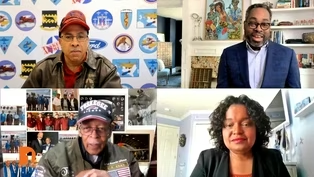
We're starting with the news of the Tuskegee Airmen National Museum moving within the Charles H. Wright Museum of African-American History in Detroit.
The legendary airmen are marking their 80th anniversary this month, and American Black Journal host, Stephen Henderson spoke with Brian Smith.
He's the president of the Tuskegee Airmen National Museum, Pam Alexander the Ford Fund's Director of Community Development and Lieutenant Colonel Alexander Jefferson, an original member of the famed Red Tails.
- This is a big anniversary coming up, 80 and it's hard to imagine that number, but you're celebrating it in part by dedicating a new home, celebrating a new home as well.
Tell us what's going on.
- So the Tuskegee Airmen started March 22nd, 1941.
And we wanted to celebrate that as the beginning of African-Americans in military aviation.
We would like to celebrate that plus announce the opening of our new home at the Charles H. Wright.
So there were folks in the community and the Ford Fund through Pamela Alexander who thought that our old location, which was historic Fort Wayne since 1987, needed updating.
And she was right.
Our exhibits needed updating, some preserving and a body with intelligence was the Charles H. Wright Museum.
They had the curators who were able to do that, so we worked out an agreement for 10 years, and we'll be in their building for the next 10 years.
- Can you talk about the Ford Motor Fund's interest in this and this great idea?
- Well, you know, the Ford Motor Company and the Ford Fund, we've been supporters of the Tuskegee Airmen and the museum for a long time.
You know, we're a legacy company.
We've been around a long time, it's in our DNA.
And so this partnership has been very important to us, whether it's, you know, when the airmen won the gold medal, congressional gold medal, and we did the celebration on the Hill to our documentary on two of the airmen that we are a gracious and blessed to have here in Detroit, Lieutenant Colonel Jefferson and Colonel Stewart.
There's a long history there.
And we have so many treasures in Detroit, as you know, Stephen and everyone who's watching knows.
Ae have the airmen and we also have the Charles H. Wright, so what an incredible opportunity to combine those treasures and bring this history into an amazing facility so that so many people can see what the airmen are about.
They're legends.
People think they know the story, but they don't know all of the story.
So Ford is really excited to be presenting sponsor of this museum inside the Charles H. Wright that will tell their story to so many from around the world.
- Well, Lieutenant Colonel Jefferson, it's hard to imagine how long ago all this happened, but for you, this was a firsthand experience.
Tell us about joining the Tuskegee Airmen.
Well, mainly you gotta understand all me considered for the 99 had to be college graduates.
This is part of the whole training of being a pilot.
I used to tell them, nobody wants a dumdum.
Took all the men who were college graduates, and then they had to take high school graduates and put them through three months of concentrated math and science.
I wanted to be a pilot, but the opportunity was not there because racism and segregation, discrimination denied many of us the opportunity to fly.
Some stayed in the, in the military.
These were the men who were college graduates, no high school graduates, who went through three months of extra training.
And when the war ended, they had an obligation to stay in, and the service allowed them to stay in.
I was kicked out, literally, and became a teacher.
- Brian, Lieutenant Colonel Jefferson's memories of course are part of what you guys are celebrating at the museum.
It's amazing to hear their stories, but it's also really amazing to be able to have them in the way that you do at the museum and to be able to share them with people.
- One of the main reasons, and one of the main reasons for our museum, I'm sorry, it's escaped.
We want to emphasize Blacks in aviation starting with the people who started in Chicago and other Blacks who started.
It's a hard road.
- And the museum tries to cover the history of African-Americans in aviation.
We do start with Bessie Coleman and end up with today's fighter that is Red Tail in honor of the Tuskegee Airman.
The Air Force has named a fighter Red Hawk in honor of the Tuskegee Airmen.
Our mission is to inspire young people to not only pursue careers in aviation, but aerospace science.
We want them to go to Mars.
So having Colonel Jefferson and Alexander, I'm sorry, Harry Stewart around, it's great to get them together and listen to their stories, stories you don't hear in their books.
And it's amazing to have them inspire the young people.
We had a session the other day where we had current commercial airline pilots along with our students here at the museum who are learning to fly.
And to have them talk to the airmen it was an inspiration both ways.
The airmen were very proud of today's commercial airline pilots and today's students who are learning to fly, and of course, all of them hold in high regard, the airman.
We realize we're standing on their shoulders.
- The Tuskegee Airmen Museum within the Charles H. Wright will continue for the next 10 years.
Alright, turning now to music venues and finding different ways to bring performances to fans who can't gather in person.
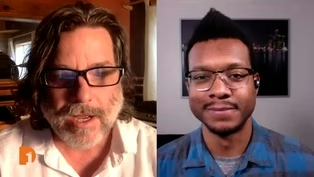
In Lake Orien, there's a place called 20 Front Street.
They've started live streaming bands and different artists performances and found themselves in a perfect spot to keep the music going.
They just received a Stage of Survival grant from the state for their operations.
One Detroit's Will Glover talk with co-owner Scott Loudon.
(jazz music) - [Scott] We are owned, we are six, six families actually that joined together to do this.
I would definitely say from a place of love.
We all have like a passion for artists.
And Alan Getts first had the idea.
He lives in Lake Orien.
He saw that building, and he went on a men's retreat with Kensington Church, and he kept thinking about the building, and so when he got home, he called his mentor and said, Hey, can you meet me at this building?
And they kind of prayed and said, should we do this?
Alan said, you know, should I, should I do this?
And he did.
And the next day I got an email from Alan saying he was interested in working with me on it, too.
And then this other partner, Jay, happened to be at the Getts' house that day, taking voice lessons.
And, Oh, where's Alan?
Oh, he's looking at this building with this guy, Scott.
Oh.
So he came over.
Bam, he was a partner.
And then a few days later, we were in a cafe talking about it and a guy named Mike Link, that guy's name was Jay Richardson.
And then a few days later, a guy named Mike Link overheard us talking about it in a cafe and said, Hey, if you ever need any investors, I'd love to invest.
And then another guy that Alan works with who's a graphics guy and web designer, Brian Lowe, he came on board to do all that stuff.
And then probably like a year later, Kevin who books all of our stuff and does an incredible job, Kevin Bassard, he came on board.
So it was kind of like a pretty organic but very fast assembly of the team.
And then of course, it took a year for us to build it.
♪ I thought I knew ♪ Now I know ♪ Roses never grow in New York City ♪ - Now, you have this lush venue that has, you know, a great light palette and just a wonderful space for artists to perform.
And that really lends to the video production that you guys have going for these performances, which is something that is not only hard to achieve but not often seen quite the levels of production that you guys are reaching.
So tell me a little bit about what made you guys want to pursue this level of production and video producing, and how has that been going so far?
- Yeah, the venue itself is designed kind of like a control room meets an amphitheater.
So it's like the control room of a recording studio.
So it was, the idea was like, wherever you're sitting in there, it's going to sound great.
So there's non-parallel walls in there.
Thee wall's kind of shaped so that the sound kind of woops into the middle of the room, and there's bass traps in the back corner.
So a lot of recording studio principles, but then we had the brick diffuse too, which has a recording studio principle.
So some of the brick sticks out.
And then when you light it up, it just creates this a really amazing dimension visually.
And so in the front of the stage is kind of shaped like an amphitheater.
So it's like almost like the inside of a guitar and acoustically, and the sounds just bowing into the room.
♪ I ran away in December ♪ When the snow was high - [Will] Where do you see 20 Front Street going?
What is the future that you hope for once we are able to be together in a 92 seat venue to enjoy something like this again?
What do you hope for the future of 20 Front Street?
- Gosh, just to be with people again like we were.
You know, it's just that for everybody is very, very hard.
You know?
- Yeah.
- I think everybody's really kind of getting exhausted.
And so, so that first and foremost, to see that come back and see those faces, and just get back into the flow of what it was is a dream.
♪ I pulled into Nazareth ♪ I was feeling about half past dead ♪ ♪ Just need someplace where I can lay my head ♪ ♪ Hey mister, can you tell me - And of course, on the back end, the COVID has been a blessing to the show concept because gosh, we've had no choice.
We've had to, and the amount of energy it really takes to do something like that, you don't really realize till you start spending the time and realize all these steps are very incremental and very small, and you have these little victories.
And so we're on the path of that.
And I'm grateful for COVID for the fact that we've been able to develop this show, and I think it will kind of parallel our live shows, and maybe we'll have another show that'll be like a taping show.
And eventually, you know, we've always looked to Austin City Limits as an inspiration, so I would say like a studio version of Austin City Limits is kind of a defined dream for us.
You know?
So I pray, I pray and hope that that's the future for 20 Front Street, along with, of course, just the basic sitting in front of that amazing person and enjoying them.
(upbeat jazz music) - For more on the music at 20 Front Street, just head to our website at onedetroitpbs.org.
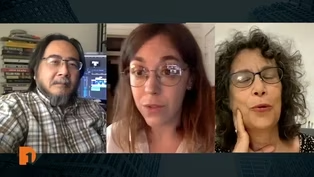
We have some news now about Ray Gray, a Michigan man who is one of the state's longest serving inmates.
He's also well-known for the art he's created while incarcerated.
We did a story on him this fall and the push by the Innocence Project for Ray to be released after almost 48 years behind bars.
Now Wayne County prosecutor, Kym Worthy, says she may be ready for Ray to go free.
Bill Kubota has the story.
- Or welcome if you're just joining us.
We are at the famous Heidelberg Project.
The entire block of Heidelberg Street in the city of Detroit.
One of the more famous landmarks here.
- [Bill] Retired TV reporter, Bill Proctor's mission: freeing innocent people behind bars.
He's hosting an online fundraiser for a man locked away in Muskegon.
- [Bill Proctor] It's the art community and the entire city of Detroit stepping up for a cause today, and that cause is a fellow named Ray Gray.
He is a wrongfully convicted man who has been in the Michigan prison system since 1973.
We're selling our friend Ray Gray's artworks.
We actually have 50 of them.
We're working really hard to find $15,000.
- [Bill] The money to cover legal costs for a new hearing.
Supporters of Ray Gray, now 68, say they've got evidence that would clear him a murder 47 years ago.
- Obviously some of Ray's work is still with him in prison, but his wife is lucky enough to have 70, maybe 80 pieces.
And we've chosen a few, and we're making them available.
- [Bill] What's this one now?
- [Barbara] Blue Madonna.
There's the original.
A man looking inside himself.
The doors represent decisions.
Open one door, and you go certain way.
Open in another, you go another way.
- And I think he's a really good example of how people can actually teach themselves incredible skills.
- [Bill] At the University of Michigan, Nora Krinitsky and Janie Paul are part of the Prison Creative Arts Project, PCAP.
Paul was there from the start 25 years ago.
For a while, we were having a record number of prisoners in general, but that number has gone down.
But have you seen the number of artists go down?
- No.
- Oh no.
- No, no, no.
It's way, it's, it's just exponentially increasing because of the show.
- [Bill] The show, every year, PCAP curates the best art from 28 Michigan prisons.
Thousands come to see.
700 works submitted this time, but this time COVID has stopped the show.
- In the beginning, the work, there was more work that was what you traditionally call prison art, like tattoo related images, girly pictures, motorcycles, things like that.
And then there were a few artists who were doing incredibly unique work that was just idiosyncratic.
- [Bill] Here are examples from this year's exhibition in an online preview.
Not what some collectors are looking for, so called murderabilia, ghoulish stuff by the most heinous of criminals.
Those are not these, and these according to the curators in Ann Arbor, are truly fine art.
Do these works get sold?
Is there a market for it?
- Absolutely.
So that's another really important part of of the annual exhibition.
At the artist's prerogative, all of the artwork is for sale, and the proceeds of every sale go back directly to the artists themselves.
I think that last year the, cumulatively PCAP sold over $25,000 worth of art.
I think the total was closer to 27,000.
- This is the one I was telling you about.
- [Bill] Moving them around makes me- - Nervous.
- [Bill] I think if the DIA curators saw what you're doing here, they wouldn't feel too good.
- Oh.
- [Bill] Barbara Gray first met Ray Gray in the late seventies, part of an arts in prison program even before PCAP came along.
- I had very little talent, but I did have the ability to teach somewhat.
- [Bill] They eventually married.
- Hello, Ray.
- [Bill] They talk every day.
- You're still negative?
- [Ray] Oh yeah.
I've got a thing today.
It was negative.
- Fortunately, we don't have capital punishment in Michigan 'cause he'd be dead.
But right now, he's in Muskegon Correctional Facility that, it's almost like a death sentence because it's a hotspot of the prison systems.
It seems like more people with COVID-19 than without.
- [Bill] Gray entered prison at 21, a boxing champ could have gone pro, when a man he met in passing said to be a drug dealer was shot dead.
Gray was ID-ed, charged and convicted.
To this day, Gray says he's innocent.
50 years, so you were painting before you went to prison?
- [Ray] Yeah.
I was considering to go to art school at that time.
I've been involved in art since I was about five years old.
- [Bill] Really?
- [Ray] Yeah.
My father was an artist.
And my mother.
- [Bill] Does art help you as you go about your day?
Do you do a lot of it on a given day?
- [Ray] Yes.
It's sort of my religion.
It, it helps.
It helps greatly.
I guess you'd call it a form of escapism, but I don't look at it in that manner.
You know, sometimes I paint things that I don't even fully understand myself.
It's so much like a, different entity.
It's as if something else takes over.
It's like a relationship between you and your painting.
- [Barbara] It helps to keep him sane.
At one point, he said it was like he was behind glass, and he was screaming and nobody could hear him.
Now, it seems like he's getting through, and his paintings kind of speak for him even when he can't.
- Well, Ray's been in the show for a long time.
He is highly respected.
He's taught a lot of people.
His work is really skillful.
And I think what makes it exceptional is his sort of incisive critique, like his social critique.
There's a painting of Governor Snyder in a bottle that's about the Flint water crisis.
There's this fish with a gas mask on.
You know, I mean, he's really kind of brilliant at these metaphors where he, you don't really have to say anything.
You just get, get it.
And you feel his conviction behind it.
- [Barbara] Many of his pieces aren't just portraits.
They tell a story.
And I think that's another thing that makes him different.
- [Bill] What about the Ray Gray story?
Will that change?
His supporters want to bring evidence never presented showing he couldn't have done the killing.
They say they know who really did, although that man has died.
How are things going in terms of you getting out of prison?
- [Ray] Well, I talked with my attorney yesterday, and there's some real positive things beginning to happen.
There are some things that are being relooked at.
- [Bill] In the meantime, more paintings wait to be sold for the Free Ray Gray legal fund.
So far they've raised about 2,500 of the $15,000 goal.
- [Bill Proctor] He honed his talent over many years on the inside.
I can only imagine how wonderful his work would be had he had a chance to attend that art school and to flourish on the outside as a free man.
- We just could not substantiate his claims of innocence, and so therefore we denied relief in the case.
That was a recommendation of my team.
But in looking at that and reading over everything myself as well, and my team felt this way as well, we think this is a good candidate for commutation for many reasons.
Chief, it's been, it's been a long time.
It's been, I think, 48 years.
And you know, there are some, even though we couldn't substantiate the claims of innocence, we feel that this is a case where we would be pushing very hard to support any claim of commutation that he chooses to make.
- And we will continue to follow Ray's story.
And for all the reports working on and more arts and culture segments, just head to our website at onedetroitpbs.org.
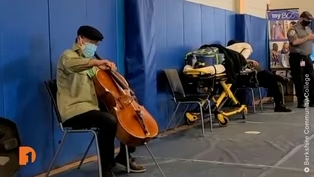
Alright, we are going to leave you tonight with video that went viral of world renowned cellist Yo Yo Ma.
he got his second COVID vaccine at a clinic in Massachusetts last week, and since he had to wait for 15 minutes after his shot before he could leave, he decided to play for those waiting for their vaccines.
Free Yo Yo Ma concert?
Amazing.
So enjoy it, and I'll see you next week.
Take care.
(cello playing "Ave Maria") - [Christy] You can find more at onedetroitpbs.org or subscribe to our social media channels and sign up for our One Detroit newsletter.
- [Narrator] From Delta Faucets to Behr Paint, Masco Corporation is proud to deliver products that enhance the way consumers all over the world experience and enjoy their living spaces.
Masco, serving Michigan communities since 1929.
- [Narrator 2] Support for this program provided by the Cynthia and Edsel Ford Fund for Journalism at Detroit Public TV, the Kresge Foundation, Community Foundation for Southeast Michigan.
- [Narrator] The DTE Foundation is a proud sponsor of Detroit Public TV, among the state's largest foundations committed to Michigan focused giving.
We support organizations that are doing exceptional work in our state.
Visit DTEfoundation.com to learn more.
- [Narrator 2] Business Leaders for Michigan, dedicated to making Michigan a top 10 state for jobs, personal income, and a healthy economy.
Also brought to you by the Fred A. and Barbara M. Erb Family Foundation and viewers like you.
(upbeat music)
Video has Closed Captions
Clip: S4 Ep25 | 5m 42s | 20 Front Street | Episode 425/Segment 2 (5m 42s)
Video has Closed Captions
Clip: S4 Ep25 | 8m 22s | After decades behind bars, could commutation be possible? | Episode 425/Segment 3 (8m 22s)
Tuskegee Airman Move to Charles H. Wright
Video has Closed Captions
Clip: S4 Ep25 | 5m 58s | Tuskegee Airman Move to Charles H. Wright | Episode 425/Segment 1 (5m 58s)
Providing Support for PBS.org
Learn Moreabout PBS online sponsorship
- News and Public Affairs

Top journalists deliver compelling original analysis of the hour's headlines.

- News and Public Affairs

FRONTLINE is investigative journalism that questions, explains and changes our world.












Support for PBS provided by:
One Detroit is a local public television program presented by Detroit PBS