
2022 Election Wrapup
11/10/2022 | 27m 8sVideo has Closed Captions
2022 Election Wrapup
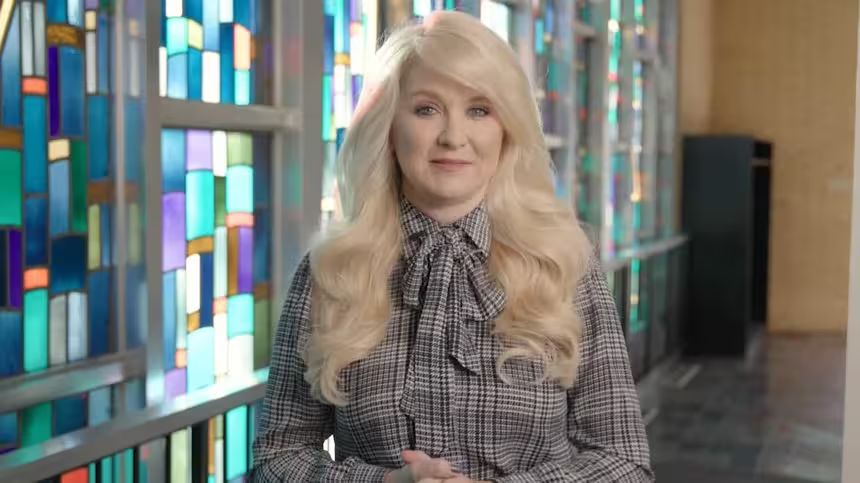
Just days after the 2022 General Election, experts are still waiting and watching for the final tabulations to be announced. Guests Jak Tichenor and John Jackson join Host Jennifer Fuller to look at the impact of the Midterms, and what to expect in the weeks and months to come.
Problems playing video? | Closed Captioning Feedback
Problems playing video? | Closed Captioning Feedback
InFocus is a local public television program presented by WSIU
Support provided by:

2022 Election Wrapup
11/10/2022 | 27m 8sVideo has Closed Captions
Just days after the 2022 General Election, experts are still waiting and watching for the final tabulations to be announced. Guests Jak Tichenor and John Jackson join Host Jennifer Fuller to look at the impact of the Midterms, and what to expect in the weeks and months to come.
Problems playing video? | Closed Captioning Feedback
How to Watch InFocus
InFocus is available to stream on pbs.org and the free PBS App, available on iPhone, Apple TV, Android TV, Android smartphones, Amazon Fire TV, Amazon Fire Tablet, Roku, Samsung Smart TV, and Vizio.
InFocus
Join our award-winning team of reporters as we explore the major issues effecting the region and beyond, and meet the people and organizations hoping to make an impact. The series is produced in partnership with Julie Staley of the Staley Family Foundation and sponsored locally.Providing Support for PBS.org
Learn Moreabout PBS online sponsorship(upbeat music) (upbeat music) - Welcome to a special edition of In Focus on WSIU.
I'm Jennifer Fuller.
The results are in, most ballots are counted and so we're taking a closer look at the general election from 2022.
Our guests on this special edition of In Focus are Jack Tichenor, the host of Illinois Lawmakers on Illinois public television, and John Jackson, a visiting professor in the Paul Simon Public Policy Institute at SIU Carbondale.
Gentlemen, thanks for coming in.
- Thanks for inviting us.
- It's good to be here.
- We still have a lot of question marks over this election, but there are some things that are decided.
Jack, I'm gonna open things up with you.
If we look at things on a national and then on a statewide level, any big surprises?
- In Illinois in particular, I think there were some surprises.
There was a lot of talk both nationwide and locally about a Republican red wave that was just gonna blow the Democrats out of the water.
That did not happen in the state of Illinois.
Democrats carried all of the congressional, excuse me, all the constitutional offices in the state of Illinois starting with J.B. Pritzker.
Tammy Duckworth easily won reelection to her seat in the US Senate.
You go down the list, all of the statewide officers won reelection handily.
The Democrats picked up two congressional seats in the state of Illinois and that Supreme Court race, they won two of the contested races there.
And it looks like at this point, both races are in democratic hands, although one, the Mary K. O'Brien and Ed Burke race is still too close to call at this point.
But that's critical for issues like pension reform and potential for reproductive rights legislation getting to the Illinois top court.
- It's always important to note for voters too that the election will not be certified in the state of Illinois until two weeks after the ballots are cast.
So we're talking about the week of Thanksgiving before we'll know for sure how these races settled out.
John, Jack mentioned that there was this projection of a big red wave.
That's what we typically see in a midterm election.
The party, out of power, surges and many times takes control of Congress.
That didn't materialize this year.
- Well, it was interesting, at the early stages, there was the big red wave prediction then it kind of tailed off in the national narrative, it looked like more and more competitive because of the quality of the candidates and particularly, the Senate races.
But then the last two weeks, that's all you could hear.
The national media went berserk over the red wave thesis and the Republican party of course were egging them on with that.
And it is true that the late breaking votes often break in a kind of a wave because they disproportionately go one way and it looked that would be the Republican boost they needed to go over the top.
Well, that last push didn't happen.
It turned out that the Democrats were well situated to hang on.
They're not going to hang on by much, but likely hang on to the US Senate.
And even if they don't win the House, which I don't think they will, it's gonna be much closer.
It's right now at about 222, 223 for the Republicans.
Kevin McCarthy was talking about 20, 25, 30-vote margin.
He's not gonna get that.
The average since World War II is plus 25 in a midterm election and first-term presidency.
So all he had to do was do the average.
He's not gonna get that.
So it's probably going to be a very divided government with the House somewhat narrowly under control of Republicans and the Senate's still a toss up, but maybe a 50/50 or a 51/49 advantage Democrats.
- Now that certainly slows down President Biden's legislative agenda if not stalls it all together.
What are you looking for in the next, say, year to 18 months before all of these elections spin up again?
- A huge conflict.
The House is, if it is Republican, and I think it will be, is going to go after Biden.
There are gonna be lots of hearings.
There are gonna be lots of investigations.
They've already talked about all the things they want to do and they've got the power now of subpoena and chairing all those committees.
Even with a narrow margin, the House is going to really give Biden fits.
So the question will be, where is the Senate on this?
The conflict has been intense and it's gonna ramp up heading toward 2024.
- Talking about the red wave in Illinois, it kind of failed to materialize because of a number of factors.
The Anti Safety Act rhetoric coming from the Republicans up and down the tickets, pretty well seems to have fallen flat.
It did not seem to resonate too well with the public at large.
There was also a concerted effort on the part of J.B. Pritzker and the other Democrats running for office this time around to focus on the fact that they were the party for reproductive health rights in the state of Illinois after the Supreme Court turned over or overturned Roe versus Wade.
The Anti-Madigan rhetoric that's always been a part of things for the last few years also didn't really go anywhere either 'cause Madigan's left the scene some two years ago.
And so that's kind of where we are with that.
Darren Bailey beating up on Chicago consistently despite the fact that's where most of the state's population lives in that area also did not go over very well.
- Do you see that that issues are now becoming more important to voters rather than specific candidates?
Or is this just an election that we're gonna continue to study and learn from?
- I think John's probably the scholar on that, but I think you're absolutely right.
I think the issues are going to dominate things.
And this brings me to a question, John, Pritzker campaigned on the idea that the state has finally turned the corner on the economy.
We're paying our bills on time now.
We're putting more money into pensions and the Unemployment Trust Fund.
The Rainy Day Fund is also growing.
And there was a sense for years when I was at the Simon Institute and you've been there for a long time, John, that the polling that the Simon Institute always did showed that the majority of Illinoisans up to upwards of what 75% or so said Illinois's going in the wrong direction.
The polling nowadays is starting to show that trend starting to flip over.
- Yeah, you've got to have something to back up your claims of what you're running on.
And the governor was clearly running on his record and it's a record that he could defend and with a great deal of credibility for all the reasons you cited.
As you know, under Governor Rauner, we had a very gridlock dysfunctional state government.
We couldn't even adopt a budget for two years and higher education for example, still trying to get over those years.
So the functioning of the government got a lot smoother under United government and they got a lot of things done and turns out, there were a lot of things that people approved of and believed the governor as he campaigned on them.
- John, if we can get a little bit further into this issue of polling, we saw to years ago and we've seen again this year, polls coming out showing something that we might project and then when the votes get cast, it doesn't really materialize.
So how much impact should we watch for in terms of polling leading up to elections whether it's on public sentiment on an issue or on a specific candidate?
- Well, I've been a pollster, so I usually defend the polls, but let me say, it's getting harder and harder to do.
It's getting harder and harder to set up the sample correctly.
And so the polls have always not done what some people claim, including pollsters they're doing.
And that is a very precise measurement.
It's always been the error factor and what is the margin of error?
Usually plus or minus three or four.
So people didn't listen to that and most of these polls have been in a plus or minus three or four.
So we have oversold how precise we can be and it's clear that it's getting tougher and tougher just to get people to answer their phone is getting tougher.
So take the polling with something of a grain of salt.
Again, with this example last night.
- Let's get a little bit into, we talked about the national parties and how they're going to try and impact government at the national level.
Jack, when you look at the control of the state legislature, it appears, of course, we expected that Democrats would retain control of both the House and the Senate.
You mentioned that they swept the constitutional offices, but what's the balance of power now in the legislature?
- This is where to me, this was with a really big surprise.
I had thought, you know, given some of the polling that and the kind of common I guess, conventional wisdom was that House Democrats may lose a few seats.
They have a 73 vote super majority right now.
In fact, House Democrats won five Republican seats on Tuesday and they lost one seat for a net gain of four seats.
So they're going up to 77 votes in the Illinois House.
In the Senate, It looks like they might possibly lose two of their 41 votes super majority.
Senator Mike Hastings who had an uphill battle because of some of the revelations that came about from some of his divorce proceedings is within a few votes of still leading his race.
But there are still, as you said earlier, Jennifer, we won't have the certified results for another two weeks.
So those mail-in ballots and the early voting that's still a very close one.
There's another one that is also, he was an appointed state senator named Tharp.
He is trailing and it's not likely that he's going to pick up or close the gap there.
So for House and Senate Democrats, it was a big night overall.
They maintained their super majorities.
The House grew there as a bit, I think it was also a very good night for the new House speaker, a relatively new House speaker, Chris Welch.
A lot of folks going into this contest wondered if he could generate the kind of ground game that the former speaker, Mike Madigan, was able to generate for years for Democratic candidates.
There was a kind of a consensus that a lot of the Democrats didn't have to really work that hard because Madigan had such a fantastic ground game.
Speaker Welch on the Illinois Lawmakers Program not so long ago, said, "Well it comes down to this, we're going to have to win, winners do the work."
And he pressed that home.
He also did well in fundraising and true governor J.B. Pritzker did help the house candidates out there and the Senate candidates in fact all up and down the slate, Pritzker was a huge force in terms of providing adequate funding for Democratic candidates.
- Could I just add that I think the other thing people have missed is how closely the governor and the speaker have been working together, how well they've coordinated, how well they get along on when push comes to shove on things like the state party chair.
Chris Welch supported the governor's position on that which was a surprise to some folks and I think that illustrates how much he's taken control of the House.
But I don't think it's the kind of authoritarian at the top decision making that was more relevant to the Madigan era.
- It's really easy to talk about the Democratic Party and its successes in Illinois.
There's been a lot of publicity about how the Democratic Party would organize itself once Michael Madigan was out of the picture.
But what about the Republican Party?
When you see losses like this what will we see from the GOP on the state level?
Well, we're already seeing one thunder bolt this morning in the wake of them losing five House seats.
The House Republican Leader Jim Durkin announced this morning that he is not going to run for reelection as house Republican Leader in the next session of the Illinois General Assembly.
There's been an ongoing battle there in recent weeks with another state representative from northern Illinois, Tim Ozinga, whose family is big in the concrete business up there and has deep pockets of his own.
I believe earlier this week, he came up with a million dollars of his own for Republican candidates and I think at this point, he appears to be the front runner for the House Republican Leadership post.
- What does that mean though, when you talk about a super majority in the chambers for Democrats?
You saw 20 years ago or so a shared government where there had to be a lot of negotiation, a lot of horse trading in order to get these bills passed, in order to get a budget passed.
But with large majorities for Democrats, do the Republicans have a say in these bills?
- It'll come down to issues like a capital bill where there's something for if you will, something almost for everyone in one of those bills.
We did see Republican support for the capital bill that was passed in Pritzker's first term.
There'll be some issues like that that they can find support for.
A good example was the gaming expansion that saw the new casino go to Walker's Bluff here, a good show of bipartisanship there.
You had Jay Hoffman, the Assistant House Majority Leader from the Metro East area, pushed that bill on his side of the aisle.
Then you had Republicans like Terry Bryant.
Dale Fowler, and the like pushing that bill on the Senate Republican side and House lawmakers as well.
- Sure, I wanted to get to the Trump factor when it comes to Republican politics at the state level and then at the national level.
And John, I'll start with you.
There's a lot of talk following this election about whether or not former President Trump had the impact that he hoped to have.
We saw in races like the Pennsylvania Senate Race for example, where his handpicked candidate didn't do as well as he would've liked.
So what kind of impact does Donald Trump still have on the GOP and what do you expect in the next couple of years?
- Well, I think he's still got a very strong hold over the GOP and if he runs, he's probably gonna get the nomination.
But that being said, I think the President was trying constantly to say this is a choice, not a referendum.
And it's not just a referendum on me and my job approval ratings, which he knew were not that great.
And to the extent he and other Democrats were able to get that choice, not a referendum message over, it helped them because every time it's a choice between Joe Biden and Donald Trump, Joe Biden wins and the Democrats win on that.
And it didn't really carry the day, it wasn't certainly not a blue wave last night, but it helped protect the Democrats and by implication helped protect Biden.
And I think the most crucial thing about reinforcing that was 24 hours out in Ohio campaigning for J.D.
Vance, Trump effectively announced that he's running again.
And I'm just gonna tell you for sure in one week which is a week from yesterday.
So all of that sort of subtle reinforcement of the Democratic message came roaring back 24 hours or less than that before the polls opened, which Republicans didn't need or want and the Democrats welcomed.
- Jack, what about on a statewide level?
Does President Trump's impact on the Republican party have a hold and will it continue to dominate?
- Oh, indeed it does.
'Cause a lot of the downstate Republicans certainly Trump supporters, Darren Bailey helped, certainly got some help with that last-minute endorsement by Donald Trump to seal the deal for his winning the Republican nomination for governor.
He will definitely be a force to contend with if he does make in fact make good on that promise to run again.
- Also on the national level, we could see a battle there for the nomination for the Republicans.
In Florida, Governor Ron DeSantis who won reelection this week perhaps challenging Donald Trump.
There has already been words exchanged between the two potential candidates.
And we also see on the national scene that the Democrats may see a candidate from Illinois in J.B. Pritzker.
Is it too early to start talking about all of this?
- No, it starts today, right now.
It even started before the election.
DeSantis could make a run for it and could make it interesting.
I don't see another Republican that could.
So it's either DeSantis or nobody if there's a stop-Trump movement, in my estimation.
On the democratic side, I don't think the Governor will run, certainly not if the president announces.
I don't think Democrats will have an effective challenge in the primaries.
But if Joe Biden decides to step aside it's Katy, bar the door and Democrats don't have any odds on favorite, but I would handicap the governor of California as probably the most likely.
But the governor of Illinois will be in the top five of that list.
- And potentially the vice president herself.
- Yes, she will be in the top five.
- [Jennifer] Sure, sure.
Jack- - There was one unpleasant surprise for House Democrats in Illinois last night and that is in the Metro East area where the Assistant House Majority Leader, Latoya Greenwood appears to be trailing significantly in her race.
Now the ballots are not all counted as we sit down to record this on a Wednesday, but she's got an awful lot of ground to make up there.
And that's also an area where former President Trump did much better in some respects in the Metro East area.
- That's somewhat surprising, Jack, when you look at that area historically which used to be a very strong democratic area.
We see lawmakers like Dick Durbin are from the Metro East originally.
And it always used to be a very powerful part of Illinois's 12th Congressional District as well as others in the outlying areas.
What's changed there?
- A lot of it comes down to the loss of manufacturing jobs, the well-paying union jobs that were always kind of the backbone of the Democratic Party in Southern Illinois and in the Metro East in particular.
- Well, in cultural issues.
- Yes, sir.
- And as a result of all of that, southern Illinois continues inexorable march to the right and to the Republican party.
Just look at Williamson County last night and look at the county superintendent to race.
There's not a standing Republican left in the courthouse in Williamson now, except for the coroner and the commission's all Republican now.
And that's what's happened across southern Illinois.
So we're increasingly out of step with the rest of the state.
- When it comes to the rest of the state though, you look at Illinois on a political map and you see a blue state surrounded by a sea of red.
Does Illinois shift in your mind to something that looks a little more purple or perhaps a little more red?
- Not anytime soon.
It's just southern Illinois and some parts of central Illinois.
But Illinois as a whole is dominated by northeast Illinois 'cause that's where the votes are.
And it's dominated by the urban other cities.
And Pritzker took 15 of those and Durbin took 15 of those when he ran.
And that's a core that the other, whatever that math is, the other 88 can't do enough to overcome.
- Jack, it oversimplifies things.
But elections all come down to turnout.
Who turns out, how much they turn out.
All of those numbers add up to what we get in an election result.
We saw results, at least on the local level this week that averaged anywhere from 40% to upwards of 70% turnout for a midterm election.
That's actually pretty high.
- It is.
And part of that comes down to issues on the ballot like the home rule question in the city of Carbondale, which one, overwhelmingly, you'll have things like that that will drive voter turnout.
You'll have some interesting down the ticket ballot, down the ticket races that'll capture some imagination.
I don't know that the turnout though overall was that high in the state of Illinois when it comes to the overall turnout.
- What do you expect, John, when it comes to turnout?
What do the parties need to do to engage the voters and make sure that they come out consistently?
A spike in one election does not make for a mandate when you see two years later something very different.
- Yeah, political scientists and journalists always say it comes down to turnout at the end and it always does.
It's truism now and getting your people to the polls, terribly important.
Republicans are somewhat better historically at that than Democrats are, but I think the Democrats matched that and probably when the analyses are made, all of that early voting was sort of silently building up an advantage for the Democrats that really wasn't evident but became evident as this thing unfolds.
And so I think that's one reason that it's possible the Democrats may win enough contest to control the Senate.
I just think the early voters are predominantly going to be breaking for the Democrats as it turns out.
And that's what saved their bacon.
- And I think the issue, again, of reproductive health was certainly very strong for women in particular in the state of Illinois.
And that was a message that J.B. Pritzker and the rest of the slate kept hammering home for weeks, if not months.
- Sure, as we have just a few minutes remaining and we look ahead to the next couple of years, two years until the next presidential election, there's a lot of talk of voter fatigue.
People are tired of hearing and seeing all these ads and attacks.
But what do the parties need to do over the next 18 months to make sure that their issues remain at the forefront or are brought to the forefront?
And Jack, I'll start with you.
- Well, in the state of Illinois, Republicans are going to have to get some deep pockets to help them.
After Richard Irvin appeared, headed for a loss in the Republican Gubernatorial Primary to Darren Bailey, Ken Griffin, the multi-billionaire, pulled out his support.
He pulled up stakes and moved his company to Florida as well as a number of folks have done so.
Bruce Rauner, for example, once Bruce Rauner and Ken Griffin left the playing field, about the only man left standing was Richard Uihlein, who is a very conservative activist in the Republican party, pumped millions of dollars into the Republican primaries and the general election effort.
It'll be very interesting to see what Tim Ozinga can do in terms of fundraising overall for the Republicans in the state of Illinois.
- Less than a minute for you, John.
- I think Joe Biden will continue to do what he's been doing.
That is he will try to bargain with the Republicans when he can.
He'll try to find common ground when he can.
Occasionally, they may be able to compromise, but most of the time, it's not going to work.
And we're gonna have more gridlock than compromise.
- Big elections mean big issues to talk about.
I want to thank Jack Tichenor, the host of Illinois Lawmakers on public television, and John Jackson, visiting professor at the Paul Simon Public Policy Institute at SIU Carbondale.
Thanks for joining us on this special edition of In Focus on WSIU.
You can find all of our episodes by going to our website, wsiu.org and find us on our YouTube channel where you can subscribe.
I'm Jennifer Fuller, thanks for joining us.
We'll catch you next time.
(upbeat music)

- News and Public Affairs

Top journalists deliver compelling original analysis of the hour's headlines.

- News and Public Affairs

FRONTLINE is investigative journalism that questions, explains and changes our world.












Support for PBS provided by:
InFocus is a local public television program presented by WSIU