
2022 Legislative Session Week 5
Season 6 Episode 23 | 26m 50sVideo has Closed Captions
The big impact to the future of education funding in Utah, plus other controversial bills.
State lawmakers are changing the future of education funding in Utah through several sweeping laws. Our panel discusses controversial bills that are running out of steam this legislative session, and the ones sprinting to the finish line. Dennis Romboy, editor for the Deseret News; Kate Bradshaw, member of the Bountiful City Council; and Max Roth, anchor for Fox 13 News join host Jason Perry.
Problems playing video? | Closed Captioning Feedback
Problems playing video? | Closed Captioning Feedback
The Hinckley Report is a local public television program presented by PBS Utah
Funding for The Hinckley Report is made possible in part by Cleone Peterson Eccles Endowment Fund, AARP Utah, and Merit Medical.
2022 Legislative Session Week 5
Season 6 Episode 23 | 26m 50sVideo has Closed Captions
State lawmakers are changing the future of education funding in Utah through several sweeping laws. Our panel discusses controversial bills that are running out of steam this legislative session, and the ones sprinting to the finish line. Dennis Romboy, editor for the Deseret News; Kate Bradshaw, member of the Bountiful City Council; and Max Roth, anchor for Fox 13 News join host Jason Perry.
Problems playing video? | Closed Captioning Feedback
How to Watch The Hinckley Report
The Hinckley Report is available to stream on pbs.org and the free PBS App, available on iPhone, Apple TV, Android TV, Android smartphones, Amazon Fire TV, Amazon Fire Tablet, Roku, Samsung Smart TV, and Vizio.
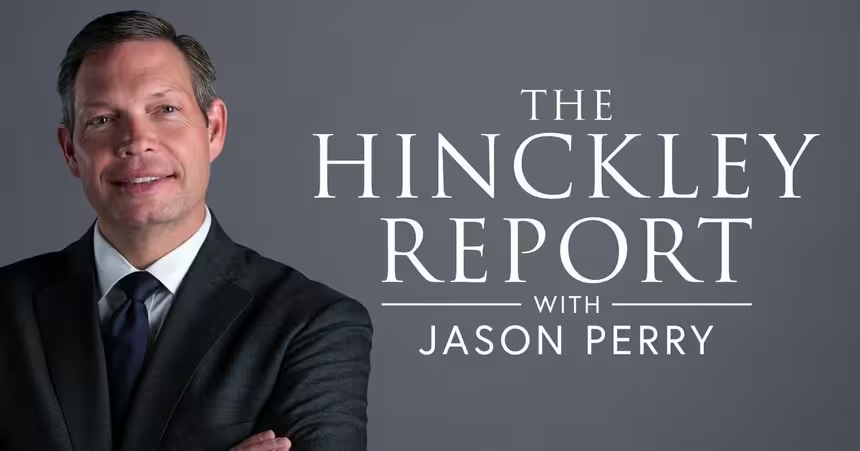
The Hinckley Report
Hosted by Jason Perry, each week’s guests feature Utah’s top journalists, lawmakers and policy experts.Providing Support for PBS.org
Learn Moreabout PBS online sponsorship♪♪♪ male announcer: Funding for the Hinckley Report is made possible in part by the Cleone Peterson Eccles Endowment Fund.
Jason Perry: Tonight on "The Hinckley Report," legislators pass several sweeping laws that will affect the future of education funding in Utah; some controversial bills run out of steam while others are sprinting to the finish line; and through legislation and a failed ballot initiative, election security takes center stage.
♪♪♪ CC BY ABERDEEN CAPTIONING 1-800-688-6621 WWW.ABERCAP.COM Jason: Good evening and welcome to "The Hinckley Report."
I'm Jason Perry, director of the Hinckley Institute of Politics.
Covering the week, we have Dennis Romboy, editor and reporter for the Deseret News; Kate Bradshaw, member of the Bountiful City Council; and Max Roth, anchor and reporter with Fox 13 News.
So glad to have you with us this evening.
We just finished week five of the legislative session, and I think we need to talk about a couple of bills, 'cause some are quite impactful, but of course, Kate, we're gonna start with you, because it all starts with the money.
People don't regularly know that most of the time during the first part of the legislative session we're working on a budget, but we don't know what the actual revenue numbers are, so this is that special day where we see what can really be funded by the end of the legislative session.
So talk about that process for a moment.
Kate Bradshaw: Sure, so you're absolutely right, we are working our way through the session, and we don't yet know what those numbers are gonna be until almost the end of the session.
And what happens is we get the consensus revenue estimates.
So this is when the staff and the governor's office, the staff from the legislature and the state tax commission meet, and they agree to what these projections are, what we expect the state to capture in tax revenue over the next.
Year and until this point, we've kind of been guessing on what we think those numbers are, and so there's some based budgets that go through, but they really hold back the full budget, and they hold back any bills with significant fiscal impact until we know what those numbers are, and then they work fast and furious in these last two weeks to close the budget and hit those those projected revenues so that we know what we have to spend as a state going forward.
Jason: And some of these bills, Max, they hold 'til the end so they can see how far they may get, but the legislature took some procedural steps ahead of time on this and set aside $930 million to echo some of the priorities like for education, for example, was a big one.
Employee compensation was a big one.
What do you make of the fact that they made those policy decisions so early?
Max Roth: You know, I mean, they have to.
They hit the ground running in terms of the appropriations process from the start every year, but I think that--I think this year they knew that they were going to have some positive numbers, and they wanted to, and they wanted to stake their claims to the important things, and it always is going to be education is one of the big ones and those folks who would like to see education spending increased want that on the table before anything else, but it'll be interesting to see how the numbers that we see here at the end of this week will change what's happened.
Like I wonder, Kate, if you have any insight about the tax cut and if the numbers that we see here?
Because it looks like they're already going through pretty solidly.
Kate: Yeah, so the legislature decided that they would pass through an income tax cut, so they're dropping our rate, they added on an earned income tax credit as well.
It's about just over $200 million tax cut, and they sent out through fast.
And it's really interesting that they did that, and I know that there were a lot of groups for instance, like the Utah Taxpayers Association, who wanted them to hold it so that we'd see these revenue projections, and if they were really high, make that tax cut bigger.
So it's interesting that they-- there was quite an effort to send that through early.
It does mean, you know, a tax cut for all of us a little bit, you know, just over $120 that we might each see in terms of that income tax cut, so there are some interesting discussions about whether there would be additional returns of revenue to residents through different tax cuts or to businesses or whether they'll then take what we think will be some really good revenue projections and put them into public education, into the Great Salt Lake, you know, is a particular emphasis this year, or other types of programs.
Dennis Romboy: I think you can argue about how, you know, how to spend and how to use that money, a tax cut, go to education, other social service programs.
The thing, the bottom line is it shows that we do have a pretty healthy economy here in the state despite the pandemic and everything that's going on, supply chain issues and all of that.
Utah's weathered that pretty well, and for the legislature to be able to have some money to put in certain places and extend a tax cut is really, you know, kudos to them for being able to do that kind of thing.
Jason: As we're talking about these tax cuts, and Kate mentioned, too, that you have an income tax, you have some tax credits, Max, one of the interesting things that people are talking about is this, is income tax is tied to public education, and Utah's public education, higher education, and thanks to some voters in our last election also for some social service programs.
Talk about the implications of that, because you start reducing income tax, you start maybe potentially hitting education fund.
Max: You definitely hit education funding, and it's some--that's been whittled away over the years anyway, because it wasn't always higher education is a part of it, and then as you mentioned adding in some social services, and so the idea of putting that into the state constitution was was basically that Utah is a state with a whole lot of kids, and it's hard to fund education when you have the youngest population in the United States and by far.
And so it's--so the more that you split that up--and there's even the talk of rebranding.
The legislature's talking about calling the income tax fund the income tax fund rather than the education fund just so that people think about it differently.
You know, I mean, it is entirely possible to spend the same amount of money even though you have different options, and it could come from different piles, but what you say reflects your priorities, you know, and it seems like that you wouldn't make those changes without having some intention of splitting the money.
Jason: Talk about implications that, Dennis, that change that Max was talking about, 'cause we're so used to calling it the education fund, we know where the money goes, as voters we've heard about it for a while, but this is Jerry Stevenson who's saying maybe we shouldn't even be calling it education fund anymore.
Let's call it the income tax fund.
Dennis: It's still the education fund.
I guess call it what you will, but with that kind of name on it, the income tax fund, I think it does open the door to maybe find other uses for that money.
Maybe there's other constitutional amendment down the road to try to to splinter that off a little bit to other issues, other programs, you know, I don't know, but rebranding it income tax fund does change the outlook for that in the future.
Kate: You know, Jason, that speaks to kind of a policy discussion we were having before the pandemic, you know, in the way before where the state was talking about tax reform, very broad tax reform, and the fact that they felt like the pillars of our tax tool had become unbalanced between sales tax, income tax, and property tax, and the ability to do things-- it seemed like it was disproportionately falling on sales tax.
You were seeing sales tax exemption, sales tax credits, whereas anything in income tax sector always faced this hurdle of, well, it's about education, it's about the kids, but that was the pillar that was growing dramatically and growing faster than the sales tax fund and the general fund.
And while they're both growing, you know, there was--we were having this great debate before the pandemic.
We obviously hit pause on some of these discussions.
It seems like with this bill and this effort to rebrand, it's signaling maybe we're coming back to some of those discussions broadly about how we structure our tax system, how we structure our budgets, and rebranding might be part of that.
Jason: Max, implications of this one more time into public education found in a bill that's been sponsored, it's called the Hope Scholarship bill.
Some people have some memories of vouchers or backpack funding or the scholarship, talk about what's happening there, and then I want to talk about whether or not we think this'll pass.
Max: Well, it was it was here at KUED that the governor just yesterday said that he would veto that bill.
It was a surprise to a lot of people.
I think it cost a lot of consternation up on the hill, but it's the Hope Scholarship bill, which we generally refer to as a voucher bill, because that's the way the broader public understands the meaning of the government providing public education money to individual parents in order for their kids to get some form of private education.
It looks like it's doing well in the legislature, but the governor's threat is real and probably would bring it to a close.
Jason: Well, Dennis, it's so interesting, because we didn't expect the governor, particularly this early.
We have some senate supports making its way through the House a bit, but that's a pretty big gauntlet thrown down.
Dennis: Yeah, it'll be interesting to see how much weight the governor carries on this issue.
I think it does have some momentum in the legislation.
It kind of hung up a little bit and barely passed out of committee, too, so, and I know they're tryin' to tweak to build a little bit.
Can they get a super majority to pass it and then have this showdown with a possible veto?
You know, I don't know if it has that kind of weight to do that or not.
Jason: So curious if we can get that veto-proof majority, but Dennis, I'm kinda curious because the state has dabbled with this in the past, actually passed a law that was overturned by the people.
Have things change substantially in the state of Utah where maybe the public sentiment is more in favor or something like this?
Dennis: It seems to be so.
It'd be interesting to do some polling on that again and find out really what the sentiment is.
The voices are loud about that though, about having school choice.
Whether it's a minority or not, the voices are very loud on that issue.
Max: In looking at this issue, I dove into the statistics, because I had the feeling growing up and living in Utah that we don't have a real culture of private education in Utah.
Looking at the statistics, that's absolutely true.
Utah, there are only two states that have fewer--that have a lower portion of students in private schools.
Those two states are Alaska and Wyoming.
That makes complete sense 'cause they're rural, and so it just wouldn't make sense for private schools to pop up.
Utah is a very urbanized state.
We live in a densely-populated area, the vast majority of Utahns, so if there were a culture of private education, the population is there to support it, and there just is not.
We are though a culture of charter education.
We're one of the top states in terms of the percentage of students in charter schools, and so sometimes it's a little confusing to me why vouchers are such a big issue when where are the kids gonna go?
I mean, there's not a place.
Dennis: It's so expensive, too, right?
I mean with the number of kids that we have and a lot of families, I think it's hard to send your child to private school.
The cost is enormous.
Kate: You know, one of the interesting components of this bill is we talk a lot about vouchers going to private schools, but you could take this money under this bill and use it for home schooling, and that is a significant change that wasn't envisioned when we had this debate earlier.
I did find the governor's comments very interesting.
I'm the spouse of a public school teacher, so that system of education is near and dear to my heart and my family's heart, and so his comments about kind of what teachers have been through in the last two years and kind of the the stress we have placed on them and, you know, whether to be a teacher is to labor in poverty for your whole career and subtract money out of this system and send it to either private school or to a home school setting where they're not going to necessarily have the numerous regulations and oversight and accountability that the public system has while at the same time teachers are feeling very under-appreciated and very stressed and overwhelmed, it seemed like the governor was saying, you know, maybe there's a debate to have here, but is this the time to have it?
And it's something that very much resonated in my home where public education has been something that has been very hard as a teacher for the last two years.
Dennis: And he made it clear that he's--he favors school choice, but only when teacher salaries are increased, starting salary's at $60,000 I think is what he said, you know, then that's the time to have that conversation when teachers are paid better.
Jason: One more thing on education, Max, all day kindergarten.
Max: Okay.
Jason: We have a bill, Representative Waldrip, think this could happen?
Max: I don't think so, no.
I mean, it's--I really think it's about money.
I don't think that--I mean, all of the--and there's also-- there's always been a side of the debate in all day kindergarten that says, oh, we already surrender our kids to the system too completely, too young, and this would just be moving that a year earlier.
But it's--but it costs a whole lot more money to put kids in all day kindergarten even though any study that you look at it says that it is a good investment, that all day kindergarten--especially in areas that are lower income, where kids are more at risk, all day kindergarten really helps them get a leg up.
Jason: We'll watch this one someone closely.
I know money's starting to be set aside potentially for this as well.
Dennis, let's talk about a bill that we--you've been on the show a couple of times here, on the death penalty.
We've been talking about whether or not this was the year when it ends.
The death penalty bill was up this week and didn't get out of committee.
Talk about there, because it was a very emotional hearing.
Dennis: Yeah, you had people on both sides, families who have dealt with--have been victims of these heinous crimes over the years and have had to go back to court years and years through appeals, others who just want to get this over with and have that person executed, the murderer.
So, yeah, it was a very emotional hearing.
You remember, like, I think four years ago the House speaker was in favor of abolishing the death penalty, and it didn't pass that year.
This year we have House leadership, and I think Senate leadership opposed to it, to abolishing death penalty, and it's not surprising to me that it is not going anywhere.
Seemed like a couple of years ago there was some momentum among Republicans nationwide to try to overturn death penalties around the country, but I don't think that's there anymore.
Jason: Kate, we've had this discussion for a little while now, tell us what you're hearing kind of behind the scenes on this bill.
Committee didn't like it, is it over?
What might happen next?
Kate: You know, I think there's still some play in this issue.
It's clear that for some there have been--there's been this evolution of their thought process on it.
Representative Lowry Snow who's the bill sponsor, he's talked openly about his own kind of personal journey from changing his policy view to thinking we should do away with this and his legal career starting as a prosecutor, and so I think you're seeing some of that.
I think we maybe because of the pandemic we took this two-year pause on the policy evolving, and I think the sponsors are kind of aware of that, obviously, based on the committee outcome, and so I think probably what you'll see is an effort to say, okay, what more can we do to study, to increase conversation, should there be a group who's commissioned to look at this to find numbers we agree on in terms of what the costs are, the true costs in the system, the true impacts on families on all sides as they go through this process?
So I think we may see the bill evolve in that direction in the last two weeks of the session.
Max: I like the term you're using with an evolution in the process, because it seems like that's how this conversation has been re-framed is the notion that there seems to be a cultural momentum towards getting rid of the death penalty, and some of that has to do with moral issues or issues of it being applied unfairly, and some of it has to do with issues of economics and just the fact that we pay a whole lot more money to put someone to death than we do to imprison them for the rest of their lives.
Jason: What one bill that has evolved over the last couple of years, Dennis, is on transgender athletes.
We talked about on our program last year.
A bill is sort of a sweeping bill, little less now, a bill that was--that just came out this past week, which essentially establishes a commission that will look at these issues for a person who wants to play on a team for a gender that doesn't match their birth certificate.
Dennis: Yeah, that's a difficult issue no matter how you come at it.
And you know, was it last year Governor Cox said, you know, let's pull back on this.
I haven't heard him take a position on this current iteration of that bill, but it's a difficult issue.
I'm not sure if there's a way through it or not.
It did pass the House, though, hasn't it?
So we'll see how it does in the Senate.
I really don't have a good gauge yet on where that's going.
Jason: We'll continue to follow that one.
One more that interesting, connected to covid, the--what they're calling the vaccine passport amendment.
So interesting, Kate, I wanna hear--maybe as an elected official you might hear about this, too, the legislature saying private businesses cannot require proof of vaccinations for customers or employees.
Kate: This was a big bill up on the Hill this week to the point where, you know, it had a packed committee hearing, the overflow was packed.
You know, haven't seen that many people at the Capitol in two years, so it was a very large crowd.
It is one of those where, you know, the legislature took up this issue as recently as the November special session and put some parameters in place, and this bill would remove those and change that system again.
I think, you know, businesses from what I'm hearing they feel absolutely whip-sawed.
They think they just cannot win no matter what industry they're in, no matter the size of their business, the rules change on them, their ability to, you know, protect employees on, you know, that have compromised immune systems are at stake, their ability to hire is at stake, consumers are upset, business feels I think like honestly let us just have the flexibility to manage what we need to do on a business by business case, and that's what they're asking for.
The public clearly feels like the pendulum needs to swing the other way and in favor of personal freedoms.
You know, at the local level I have almost no control over this issue, but I do get emails on it because it is so deeply and viscerally felt.
Max: That's some really interesting comments there, and I I also--the question comes to mind, and I have no idea what the answer is, but there are a lot of people who have already left workplaces that have required this.
If it suddenly becomes illegal to require this, is there anything retroactive to those folks who lost their jobs or left their jobs because they decided I'm not going to get vaccinated and my employer's requiring it.
It's an issue that you say whip-sawed 'cause that's part of it.
Kate: It's an interesting one because the legislature in the November special session said you can have a deeply held personal belief and that can be a reason not to get vaccinated, and so what I find in this debate at the state Capitol is that mix of what's happening at the federal level versus what's the law on the ground in Utah get conflated, and so you know, there should not for instance have necessarily been a huge outflow of employees who if they were able to state that deeply held personal belief would've been let go from their job, but it is clear that it is deeply felt no matter which side you are on.
Jason: Dennis, talk about that for a second, because our businesses are saying what are we supposed to do now?
'Cause there has been sorta this principle in Utah you kinda don't tell businesses what to do.
Dennis: Yeah, that's been typical, like deregulation, right?
Not more regulation.
This is business regulation in a different way, but it's regulation nonetheless, and I think as a whole, our legislature and a Republican-controlled legislature wants less regulation on business, except for when it's an issue that they seem to care about like this one, and it has a lot of public sentiment about this as well.
Jason: Yeah, I want to talk about a little, an infrastructure bill, just 'cause I think it's so interesting, 'cause when I've been dealing with legislature for a while and with state government, you talk about all of these electric vehicles, which is so interesting, 'cause we, you know, technically we pay tax when we buy fuel, when we put gas in our cars, and for a long time people have been saying, well, you know, people who have electric vehicles are not really paying their fair share of the road upkeep.
Well, there's a bill to address that.
This is from Representative Ray Ward, the vehicle registration amendments.
Max, talk about this--kind of what this may give a signal for for the future.
This is $120 fee that goes when you register your car each year for--if you have an electric vehicle.
Max: This is one of those, too, where it's an issue that becomes a much bigger deal as electric vehicles are adopted more and more.
You see a whole lot more Teslas and Leafs and all these things on the road, because when this was initially proposed, I think a lot of people reacted and thought this is--that's unfair these people are paying more for cars because they want to be environmentally friendly, and they should--there should be some reward for that, but at this point what they would do is you'd either pay right up front with your registration an extra fee in order to--if you have an electric vehicle, and that's meant to offset what you will not be paying in gas tax.
The idea being that you use the roads as much as those other cars, and the gas tax is what pays for those roads.
So there's some sense to that.
And then there is an alternative where you could pay, what is it, three cents a mile or something like that?
If you don't drive much, you can say I don't drive much, and you can keep track your miles and just pay that amount, and that would replace the gas tax.
I think there's more of a consensus that some kind of mechanism has to exist in order to pay for roads.
Jason: Connected to the environment, Kate, I thought there's interesting conversations this last week about the outdoor retailers show.
You remember, 2017 they left, there was an issue, there was some disagreement about the management of public lands, for example.
It's so interesting, just this week we get into this issue again, whether or not they would come back to the state of Utah, and the governor even weighed in on this.
Kate: Yes, it is interesting that they, you know, they've been hanging out in Denver.
You know, they've discovered what we always knew, right, as Utahns that you can get to our outdoors faster.
You know, Salt Lake is closer to the airport.
Max: Salt Lake is what everyone thinks Denver is.
Kate: Exactly, I have landed in Kansas and then had to go to Denver, and so the outdoor retailers has discovered this in their in their sojourn to go find other places that they felt aligned, that the venues are hard to get to if you're into outdoor sports and you're tryin' to showcase your gear, so it looks like they might be considering coming back, but they want us to know it's like we've had this bad break up but then they decided, you know, like that they could come back, and they're like we're coming back, but we're still upset about these things.
And the governor I think gently reminded 'em, hey, if you want to come back and be part of that conversation, then you're in a spot to be part of the conversation.
Max: Was it gentle?
Kate: We're still going through the breakup.
Dennis: He said we don't miss you, but we desperately want you back.
We didn't miss you, but please, you know, come back.
Kate: He did say both of those things, and that was kind of an interesting mixed message.
I think the overall the state would say, yes, come back.
Our life elevated brand is about the outdoors, and you fit with us, and you can fit with us and have this discussion, and honestly, you might be surprised if you come back.
We are having interesting conversations about the Great Salt Lake and about water and about conservation that we weren't having when you left.
Maybe you want to be part of that conversation and maybe that opens up doors for you to have conversations you want to have about Utah's views on federal land.
But if you're not here, it's certainly hard for us to have these conversations.
Dennis: There's some bottom line issues here, too, for these outdoor retailers.
I think it's less expensive to be here in Salt Lake City than it is for Denver, to put on your show, to show your wares, so there's the money aspect to this as well.
Jason: True.
I want to spend our last couple of minutes, Dennis, talking about election security, because we had some some events this last week that have kind of given indication where people feel--how Utahns feel about it and whether or not they want to keep vote by mail, for example.
But we've done some polling together, the Deseret News, the Hinckley Institute of Politics.
Talk about that for just a minute what we're finding about how Utahns feel about election security generally.
Well, our last Deseret News/ Hinckley Institute Politics poll showed that I think is 80% of people think elections in Utah are accurate and fair, fairly conducted, and so I don't see any reason to try to alter what the state's been doing here.
It's been working, vote by mail has been popular, it has been fair, it has been accurate.
It makes it convenient for people to vote.
I think most Utahns like that option and would want to keep it.
Jason: Well, it seems that way.
Max, there's a ballot initiative try to get rid of that vote by mail, you know, with some of these securities at the heart of that.
That failed without getting enough signatures this week.
Max: Yeah, you know, it's just one of those issues that feels like a solution in search of a problem.
That vote by mail has worked really well in Utah, and it's gotten smoother as time's gone on.
But there's a--there's been this national campaign largely fueled by the former President Donald Trump to say that vote by mail is in essence--it brings up the increased response--or increased possibility of fraud, and that point has been pounded home pretty hard, but it doesn't seem to, and I'm glad for your research.
It doesn't seem to have been pounded home well in Utah.
Jason: We still have a remaining bill in our last 30 seconds, though, Kate.
Kate: There's a bill to, you know, look at some of these underlying issues.
It's obviously being strongly protested by our lieutenant governor, Deidre Henderson, and the fact that her office is over state elections.
You know, I think the broad feeling of the majority of the legislature is comfort with the election system and its comfort with the mail-in ballot system, and I think it's--they feel that comfort because they're informed by their residents who also are not feeling this underlying concern about election security, and we were completely comfortable with mail-in voting before the pandemic and then saw the absolute wisdom of it as we watched other states struggle to implement it, you know, while we were in crisis mode.
So, you know, I don't know that this issue is probably going to get traction this session.
Jason: Gonna have to be the last word on that one.
Thank you for breaking down the session for us, fascinating as always.
And thank you for watching "The Hinckley Report."
This show is also available as a podcast on PBSUtah.org/HinckleyReport or wherever you get your podcasts.
Thank you for being with us, we'll see you next week.
♪♪♪

- News and Public Affairs

Top journalists deliver compelling original analysis of the hour's headlines.

- News and Public Affairs

FRONTLINE is investigative journalism that questions, explains and changes our world.












Support for PBS provided by:
The Hinckley Report is a local public television program presented by PBS Utah
Funding for The Hinckley Report is made possible in part by Cleone Peterson Eccles Endowment Fund, AARP Utah, and Merit Medical.