
2022 Politics, Redistricting Update, COVID Longhaulers
Season 5 Episode 48 | 26m 42sVideo has Closed Captions
2022 Politics, Redistricting Update, COVID Longhaulers | Full Episode
One Detroit's Christy McDonald talks with contributors Stephen Henderson and Nolan Finley about the trajectory of Michigan's politics in 2022. One Detroit's Will Glover gets an update on the Redistricting Commission's new maps. Producer Bill Kubota looks at the long-term effects of COVID-19 on people still ailing from the virus. Plus, a celebration of Christy's work at DPTV for the past 10 years.
Problems playing video? | Closed Captioning Feedback
Problems playing video? | Closed Captioning Feedback
One Detroit is a local public television program presented by Detroit PBS
2022 Politics, Redistricting Update, COVID Longhaulers
Season 5 Episode 48 | 26m 42sVideo has Closed Captions
One Detroit's Christy McDonald talks with contributors Stephen Henderson and Nolan Finley about the trajectory of Michigan's politics in 2022. One Detroit's Will Glover gets an update on the Redistricting Commission's new maps. Producer Bill Kubota looks at the long-term effects of COVID-19 on people still ailing from the virus. Plus, a celebration of Christy's work at DPTV for the past 10 years.
Problems playing video? | Closed Captioning Feedback
How to Watch One Detroit
One Detroit is available to stream on pbs.org and the free PBS App, available on iPhone, Apple TV, Android TV, Android smartphones, Amazon Fire TV, Amazon Fire Tablet, Roku, Samsung Smart TV, and Vizio.
Providing Support for PBS.org
Learn Moreabout PBS online sponsorship- Hi, I'm Christy McDonald and here's what's coming up this week on "One Detroit."
As COVID numbers keep climbing, we take a closer look at the lasting effects of the virus and how doctors are trying to treat long COVID.
Plus '22 promises to be a big political year in Michigan.
Nolan and Stephen weigh in on what to watch.
And then the legal challenges to the new legislative and congressional maps.
It's all ahead this week on "One Detroit."
- [Female Announcer] From Delta Faucets to Behr Paint, Masco Corporation is proud to deliver products that enhance the way consumers all over the world experience and enjoy their living spaces.
Masco, serving Michigan communities since 1929.
- [Male Announcer] Support for this program is provided by the Cynthia and Edsel Ford Fund for Journalism at Detroit Public TV, the Kresge Foundation, Community Foundation for Southeast Michigan.
- [Female Announcer] The DTE Foundation is a proud sponsor of Detroit Public TV.
Among the state's largest foundations, committed to Michigan-focused giving, we support organizations that are doing exceptional work in our state.
Visit DTEfoundation.com to learn more.
- [Male Announcer] Business Leaders for Michigan, dedicated to making Michigan a top 10-state for jobs, personal income, and a healthy economy.
Also brought to you by and viewers like you.
(light upbeat music) - Hi there and welcome to "One Detroit."
I'm Christy McDonald.
Thanks so much for joining me.
We have a lot coming up this week as the COVID numbers continue to climb and we settle in for a Michigan January.
We are facing the highest number of cases yet in the pandemic.
And while the Omicron variant is believed to cause milder illness, the long-term impact of COVID is still unknown.
Coming up, we're taking a closer look at long haulers, the patients here in Southeast Michigan who continued to have lingering and many times debilitating after-effects of the disease.
Doctors and patients are sharing their stories with us.
Also ahead, Nolan Finley and Stephen Henderson joined me to talk about the political year coming up in Michigan.
And then, the legal challenges to the new legislative and congressional maps.
Bridge Michigan reporter, Sergio Martinez-Beltran fills us in.
It's all coming up.
Almost two years into the pandemic, thousands of people are still suffering from COVID.
They're called long-haulers, dealing with lingering symptoms many months after catching the virus.
Medical research is ongoing, but what do we know now and what more is there to learn?
"One Detroit's" Bill Kubota has been talking with some of the experts here in Southeast Michigan about long COVID, along with patients who are still trying to shake an illness that has attacked their bodies in some very different ways.
- [Bill] Long COVID, the affliction suffered by those who pulled through the initial infection, estimated to be one of every three or four sickened by the virus.
- We've had multi-millions of cases of COVID in this country.
I mean, let's do the math, and 20% of those individuals, we're talking about millions of individuals who have long COVID and those individuals are really impaired.
- I was a healthy young woman, had no troubles whatsoever.
And then this happened, all of a sudden.
- You've got people with anxiety and depression and different mood disorders because of what has just happened in their life.
- We don't have people that are, that have the same exact symptoms.
And everyone's recovering at a much different recovery rate as well.
- The minute I see someone and I don't immediately know what they have, it's a strange symptom, I'll think this is probably another case of COVID and it almost always is.
- [Bill] Last month, The National Institutes of Health announced it would do a population study of long COVID cases, nationwide.
The website says, "Progress takes people like you.
"Learning comes from listening."
- The most common things we see are generalized fatigue, brain fog, not being able to return to work, not being able to complete their activities of daily living.
What we find is they can have fluctuation or changes in their blood pressure.
- Dr. Eva Feldman, a Neurology Professor at University of Michigan Medicine, she's found much of the body's nervous system can be affected by the virus.
- It's such an interesting virus.
It's like a chameleon.
It can do almost anything.
- In Ann Arbor, they're checking long COVID blood samples for markers indicating inflammation, along with the examination of vital organs.
- Talk to me about how things are going, in general.
- [Bill] Henry Ford Health System Speech and Language Pathologist, Anjli Lodhavia, is working with long COVID patient, Jackie O'Connell, who's struggling with memory issues.
- When I have everything set out, it's there and I do it, but when it's something I have to actually think about, that's when I... - It's almost like your brain shuts down.
- Yeah.
- [Bill] O'Connell got COVID this January.
She lost her taste and smell, but no congestion.
She'd been a case manager for a healthcare provider, but she's not working now.
- Today, I'm going to introduce you to some acronyms and walk you through different memory strategies that you can use.
With Jackie, she stayed at home for two weeks, returned to her job and realized, whoa, like I'm...
I can't do this.
Like I can't even look at the computer screen without freaking out.
What did that stand for?
- I don't remember.
- Take a second.
Even if you're like, I have no idea.
I'm drawing a blank.
Take a second.
What things are you going to do to help yourself remember?
I think the surprising thing for me is that all of the patients I'm seeing with brain fog were not hospitalized and they had mild cases.
- Lodhavia sees people with strokes, brain injuries, Alzheimer's, that sort of thing.
Add long COVID to the list.
- It just makes sense to have them go through this cognitive rehab program that we've been doing for other patients before COVID to help treat some of these long-haul patients.
- Like, I even had to do a resume for the disability.
And I'm like, it didn't make sense.
It all threw me.
- Was it more helpful after you went through it with your sister?
- Yeah, I'm going back over there this evening and she's filling out all the papers with me.
- They're not able to remember some of the conversations that they're having.
You know, if you look at these people and you run into them on the street, you don't see any physical impairment from COVID.
- And we, as physicians, can help them symptomatically.
We're doing like diet, exercise, occupational physical therapy, but we don't have any magic pill or cure for this, so it's affecting a lot of people.
- Physical Therapist Carolyn Brierley, with the Detroit Medical Center's Rehabilitation Institute of Michigan.
She too has been seeing a lot of long-haulers.
- Nothing about how to treat this prior to it hitting.
And now we're, it's gonna be a constant learning on what we can and cannot do, what is best practice for our patients.
- So I got COVID in the beginning of May.
I luckily enough had a mild case of it, so it was kinda like a bad cold, essentially.
- Detroiter Kennedy Robinson, age 23, getting ready to graduate from college and getting physical therapy three times a week at the Rehabilitation Institute of Michigan.
- I have never felt so tired in my arms ever.
So you don't really realize how much of your muscles you use until they're taken away from you.
- For some of our long-haulers, we're seeing them in physical therapy for sometimes four to six months because they're so de-conditioned when they come to us that we now have to build that back up.
We have to build muscle strength.
We have to build coordination.
We have to teach them how to breathe properly again.
- So in Kennedy's case, what's occurred, it's affected what are known as her peripheral nerves.
As well as, likely, possibly her muscles.
- I couldn't do like basic things such as dressing myself, feeding myself.
- Robinson had no cognitive issues to report.
It was nerves to her legs and more so her arm.
- As you clearly see, I struggle with getting my hands up.
They did lots of blood tests, did MRI scans, CT scans, and everything came up negative.
Everything came up clear, like nothing was wrong with me.
Every time I would do things for them, they would look at me like I was, like I was faking it.
- [Bill] Not an uncommon experience for some long-haulers.
Robinson found another opinion from Dr. Feldman at Michigan Medicine, a diagnosis, just part of the challenge.
Paying for it can be a problem, too.
- I have patients who filed for disability and they're not getting approved for it because they're able to wake up in the morning and make their cup of coffee and, you know, drive to the doctor and those things.
Those things are fine, but when it comes to doing their cognitively taxing job, they are not able to do that.
Are you making lists?
- No, right.
No, I honestly haven't been.
- Okay.
We just don't know what's happening, whether this is, you know, partly psychosomatic, this is actually something going on in the brain, whether it's a component of both, which is probably the likely case.
I think we all just want to know more about it and look at the patterns across patients to try and figure out the best way to treat them.
- [Kennedy] Now I've progressed a lot comparing from how I was back in June, where I could only lift about maybe up to here with my arms in June.
Now I can go all the way up to here.
My boyfriend has asked me multiple times about how long this would last.
And I always tell him, like, I honestly don't know.
It just really depends.
Honestly, if recovery time would be, could be from either six months to almost three years.
- So as we began to better understand that this was a real syndrome and really happening after COVID, that's happening in parallel with the patients, you know, really forming support groups and beginning to collect their own data so we can understand the symptoms that are occurring.
- [Bill] Patients conferring with each other online.
Detroit area physical therapist, Ted Dechane, got COVID early on, March last year.
His initial sickness passed.
Then came a persistent fatigue.
- It wasn't until I connected with a few other therapists on Twitter who were experiencing the same thing, that we kind of realized that this was more than just our acute COVID infection.
We were having something that was continuing beyond those two weeks that we thought we were better.
- Dechane's online connections led to a support group Long COVID Physio, 200 members, now, all physical therapists with long COVID from around the world, talking about things that turn up in the media months later.
- What have you learned from some of these online conversations that maybe is a little even ahead of the curve of some of the medical establishment?
- Yeah, we were really fortunate to kind of connect with some people who had suffered from post-viral illnesses prior to COVID-19.
You know, we've seen these kind of similar things happen after Epstein-Barr infections and after the first SARS virus in Toronto, after Ebola.
So we connected with a lot of people early on who were already experiencing those kinds of post-viral illnesses and used what they knew worked to kind of help our treatment, so... - Dechane's group finds a physical rehab regimen not so useful, in many cases, cases like his.
Finding it's a matter of resting a lot more.
A year and a half later, he's at about 85% strength of where he was before he got the bug.
- But I just don't know if the government is really monitoring the amount of burden this is placing on our society as a whole.
And if the U.S. knew the burden that this could cause then they might be doing a little better job about trying to get a handle on it.
- [Bill] The economic damage from long COVID so far?
Hard to say.
The NIH has about a half billion dollars to do their population study.
Add that to more than a billion dollars for other studies over the next four years.
- It's clear that not everyone gets over post-COVID syndrome, at least not that we're seeing yet, but again, the disease is new, right?
This is all very new and young.
- You're gonna meet other people that are coming in with these exact same problem that I'm having.
And again, they're probably thinking like, oh, well this is new.
We don't know what's going on.
And actually yes you do, because I am that person that was dealing with the exact same thing.
It's like essentially like, learn from me.
- For more on long COVID and the reporting that we've done, just head to our website at OneDetroitPBS.org.
While the first weeks of '22 have already been interesting in Michigan politics.
You can bet with statewide races, we're going to see a lot of money and competition over the next 10 months.
I met up with our "One Detroit" contributors, Nolan Finley of the Detroit News and Stephen Henderson of American Black Journal to talk about what's ahead.
- Well, I think the Congressional races, if you look at the start of last year to where we are today, Republicans have made a remarkable comeback in their prospects.
I wouldn't have given them much hope at all coming into the 2022 midterms a year ago, but they're well poised this year to, I think, exceed the average gains parties can expect in a midterm election.
Michigan, I think, it's not gonna be as good a year for Republicans, overall, as it will be in the rest of the nation.
They just don't have a slate of candidates to match up against incumbents.
- Stephen, what about you?
What are you watching?
- I am absolutely fascinated by the new lines here in Michigan, of course.
And what they mean, what they won't mean and who will even try to run for these seats.
Some of them look so different.
- Yeah, What are you hearing, right now?
- You know, I think we're gonna have a lot of new candidates.
I think we're gonna have a lot of people who sat out for a long time thinking, well, I don't really understand what that district is that I would be running in, who have a clear picture.
You know, we also will have, of course, one fewer person in Congress.
I think on the national level, I think it's really early to be saying the things that Republicans are saying about their prospects in November.
If you look at what was happening toward the end of the year, the President's poll numbers started to bounce back up just a little.
- One thing I think that we can all agree on is the amount of money that is going to be thrown around the country.
And it feels like, Nolan, every year, we say it's the most money that's been spent in an election year.
(chuckles) - And it will be again while the most expensive race in history in Michigan, The Governor's already starting out with 10.4 million.
She's already got more money raised than races used to cost for the whole session.
And she's not done yet.
The Congressional races are going to draw in a ton of money, as are the legislative races, because of the new boundaries and new people running in both parties.
James Craig, a candidate I like, supported his entry into the campaign, hasn't caught fire.
I don't think the Republicans have a good Secretary of State's candidate against the candidate who should be vulnerable based on the long lines people have experienced in Michigan since she took office.
They've got a better Attorney General candidate, Tom Leonard.
I think he's got a good chance, but you know, those races tend to go like the top of the ticket goes and I think it's gonna be a struggle for them here.
- Oh, I mean, the money always grows, right?
Like Nolan said, this will be the most expensive Governor's race, but the last one was the most expensive, and the one before that was too.
And that's just the direction we're headed that, you know, in order to compete in these races, you have to raise ridiculous amounts of money and that's because the rules allow it.
And so that that's the game and I'm not mad at Governor Whitmer, you know, the Democrats, for playing that game effectively.
I mean, historically, at least, they were not as good at it as Republicans.
And that is because there's not a great candidate.
James Craig, look, whatever you think of him personally, this is not a guy with any sort of record to recommend him to be the Governor.
Meanwhile, the Governor will be continuing to just stockpile money and she'll be able to run on a record.
I think Secretary of State Jocelyn Benson is probably more unbeatable than the Governor.
Dana Nessel could be vulnerable against the right candidate.
I don't know that Tom Leonard is that person.
- All right, we're gonna have to leave it there.
Appreciate the insight, gentlemen.
And I will see you soon.
Part of the change up in watching those races comes from the new maps for legislative and Congressional districts.
The Redistricting Commission released the maps at the end of '21, but the new legal challenges are just beginning.
Will Glover talk with Bridge Michigan reporter, Sergio Martinez-Beltran about the latest developments.
- Can you just briefly give us an idea as to where we are in the process now?
- Sure, well, we have maps, right?
The commission a few weeks ago, approved the three different maps, State House, State Senate, and Congressional maps that are supposed to remain in effect for 10 years, once they are published.
And that could happen any time between now and March.
We also know that the commission has also been sued by a group of black lawmakers, most of them residents of Southeast Michigan, particularly Detroit, because they say that the maps the commission passed, they violate their voting rights and that they further dilute their voting power.
- Right, and so when it comes to the maps further diluting the voting power, I know it had something to do with the fact that there are less majority minority districts, but the reasoning from the commission is that even though there are less, it's still kind of broadens the, I believe the word "clout" is what they were saying.
- What we've heard from experts from the commission, is that doing that actually dilutes the voting power of black voters because you're putting them all in one district instead of spreading them around so they can influence the election results in other districts, right, in other Congressional races.
And so that's what we've seen in the past.
And so commissioners, taking in the advice from their voting experts and their voting rights attorney, they decided to lower the percentage of black voters in many of the districts in the Detroit area, right?
So what we know is that in the past, we've had 17 majority black districts in the state legislature.
That number comes down now to about five with a population over 51% black.
Now the commission also created additional districts where they they're calling opportunity districts, which are districts where the minority population is not over 50%, but it's around 40 to 50%.
And they say that that could still allow them to elect their candidate of choice.
So that's the whole issue here, right?
It's you have in one side the commission saying we did the right thing because we're actually creating more opportunity districts and potentially creating more opportunities to have people in Lansing and the legislature that represent those communities.
But then you have black leaders in Detroit and black voters in the Detroit area who are saying, wait a minute, you might actually dilute our voting power here by doing this, because now it's not certain that the candidate of choice of the black voters is gonna get elected.
- Where do we go from at this point in the process?
- So we have to see how this lawsuit plays out.
Truly, they're asking a couple of things.
One of them is for the Supreme Court to say that these maps violate the Constitution or violates the Voting Rights Act.
And also that this, the Supreme Court, ask the commission to stop what they're doing and go back to the drawing board and redraw the maps to create additional majority black districts.
So that's in a summary, right, what this lawsuit is trying to get and as part of the lawsuit, if the Supreme Court were to side with the plaintiffs, it would also stop the implementation of these maps.
And so it could have big ramifications, right?
As we know, the commission is truly still in a tight timeline here, because if they want these maps to be used in the 2022 election, they have to be published pretty soon.
And they also have to start getting into effect pretty soon, again, around March.
- Christie, you're wrapping up your time with us here at Detroit Public Television and both Nolan and I want to say a really sincere thank you for your professionalism, for your elegance, for all of the things that you've done for us as a host, as a partner and as anchor on "One Detroit" and other programs.
We will miss you.
We will never be able to replace you, but we want you to know how much we cherish all the work that we did together.
- And, Christie, we also want to thank you for being such a long suffering referee between Steve and I.
We know we tested your patience and it wasn't always easy.
As you move to the next chapter, we do want to wish you and your family health and happiness, and take a few minutes now to celebrate your amazing work for our station.
- Welcome to "My Week."
We're glad that you're with us.
I'm Christy McDonald.
This morning, Emergency Manager, Kevin Orr announced the Chapter Nine municipal bankruptcy filing.
Governor Snyder says this is a new beginning for the city.
Gentlemen, thank you so much for joining us on "My Week."
Welcome to "American Graduate Community Town Hall."
The American Graduate initiative is a National Public Media commitment to help communities find solutions to the high school dropout crisis.
- Now, how Detroit is tackling a staggering amount of blight with some unusual help.
Christy McDonald has this report.
- [Christy] Detroit' new mayor is focusing on the demolition of the tens of thousands of houses stripped beyond repair.
And what kind of speed are we seeing and what are the numbers that we're seeing?
Welcome to the Gubernatorial Town Hall.
Now, let me introduce the candidates for Governor, Governor Rick Snyder and Congressman Mark Schauer.
And Flint residents who can't drink their tap water are picking up bottled water that has been brought and donated.
- This is like the second or third time that we've actually came and got water.
- [Man] Yeah, these were not typical guns.
- I don't think that we can have, hang on, we can have this gun debate and just look back at the most recent mass shooting, A DACA recipient who came to the U.S. at the age of one, undocumented, - But that's all in danger.
- Have people said, Juan, stop talking?
Like, you're going to get yourself into trouble, or are they saying thanks for talking because I don't feel like I can.
Hi, there and welcome to "One Detroit."
I'm Christy McDonald.
It's our first show.
Guys, we're out on the road in a little something new this time around.
A subtle sign of change in Island View.
Beyond the counter, you realize The Commons isn't just a coffee shop.
So where did you have to go before to get your laundry done?
What are the main issues that you're thinking about.
- Me?
- Yeah.
- The character of our President.
- Hey, "One Detroit."
It's Christy.
I'm coming to you from my basement.
I'm sure a lot of you are working from home now.
Governor Whitmer, it's good to see you.
How are you doing?
- I'm fine.
I'm hanging in.
- Thank you for having us.
- And that is going to do it for our "One Detroit" Virtual Town Hall.
That's gonna do it for "My Week."
And for all of us at Detroit Public Television, I'm Christy McDonald.
Be safe.
Take care.
(light music) How are you guys?
Thank you for that tribute.
So many different hairstyles, huh?
It is my last weekly show with Detroit Public Television.
It has been a privilege to join you each week for the last 10 years, to give you the context with the news, share stories from around our area and have some fun along the way.
"One Detroit" is in solid hands with its tremendous staff.
I thank you for your trust and your support.
I'm staying put here in Detroit, where I've grown up and where I'm raising my three kids.
And I'll continue to moderate important conversations and elevate the voices of the amazing people who make Michigan unique.
New beginnings are truly great.
And I'll be sure to see you again.
Until next time, I'm Christy McDonald.
Take care.
- [Female Announcer] From Delta faucets to Behr Paint, Masco Corporation is proud to deliver products that enhance the way consumers all over the world experience and enjoy their living spaces.
Masco, serving Michigan communities since 1929.
- [Male Announcer] Support for this program is provided by the Cynthia and Edsel Ford Fund for Journalism at Detroit Public TV, the Kresge Foundation, Community Foundation for Southeast Michigan.
- [Female Announcer] The DTE foundation is a proud sponsor of Detroit Public TV.
Among the state's largest foundations, committed to Michigan-focused giving.
We support organizations that are doing exceptional work in our state.
Visit DTEFoundation.com to learn more.
- [Male Announcer] Business Leaders for Michigan, dedicated to making Michigan a top-10 state for jobs, personal income, and a healthy economy.
Also brought to you by and viewers like you.
(light upbeat music)
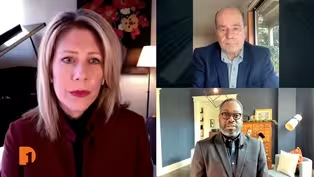
2022 Politics Roundtable: Looking Ahead in Michigan
Video has Closed Captions
Clip: S5 Ep48 | 4m 9s | Christy, Stephen and Nolan discuss the trajectory of Michigan politics in 2022 (4m 9s)
Celebrating Christy McDonald's Impactful Work with DPTV
Video has Closed Captions
Clip: S5 Ep48 | 3m 41s | A highlight reel of Christy McDonald's work at Detroit Public Television (3m 41s)
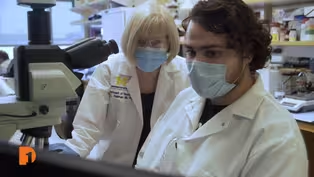
The COVID Long-Haulers: Patients Still Impacted by the Virus
Video has Closed Captions
Clip: S5 Ep48 | 10m 28s | Bill Kubota learns how COVID continues to impact patients months after having the virus (10m 28s)
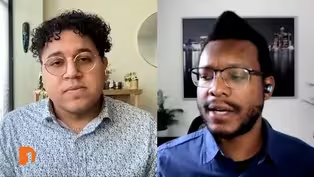
Michigan’s New Redistricting Maps Facing Challenges
Video has Closed Captions
Clip: S5 Ep48 | 4m 3s | Will Glover hears an update on the Michigan Redistricting Commission's new maps (4m 3s)
Providing Support for PBS.org
Learn Moreabout PBS online sponsorship
- News and Public Affairs

Top journalists deliver compelling original analysis of the hour's headlines.

- News and Public Affairs

FRONTLINE is investigative journalism that questions, explains and changes our world.












Support for PBS provided by:
One Detroit is a local public television program presented by Detroit PBS