
2023 Legislative Session Week 2
Season 7 Episode 20 | 27m 2sVideo has Closed Captions
The debate over education funding and controversial issues impacting Utah kids heats up.
The debate over teacher pay and education funding heats up as Utah lawmakers take decisive action on controversial topics impacting Utah children in Week 2 of the 2023 legislative session. Journalist Sean Higgins joins Democratic Representative Brian King and Republican Representative Candice Pierucci on this episode of The Hinckley Report with Jason Perry.
Problems playing video? | Closed Captioning Feedback
Problems playing video? | Closed Captioning Feedback
The Hinckley Report is a local public television program presented by PBS Utah
Funding for The Hinckley Report is made possible in part by Cleone Peterson Eccles Endowment Fund, AARP Utah, and Merit Medical.
2023 Legislative Session Week 2
Season 7 Episode 20 | 27m 2sVideo has Closed Captions
The debate over teacher pay and education funding heats up as Utah lawmakers take decisive action on controversial topics impacting Utah children in Week 2 of the 2023 legislative session. Journalist Sean Higgins joins Democratic Representative Brian King and Republican Representative Candice Pierucci on this episode of The Hinckley Report with Jason Perry.
Problems playing video? | Closed Captioning Feedback
How to Watch The Hinckley Report
The Hinckley Report is available to stream on pbs.org and the free PBS App, available on iPhone, Apple TV, Android TV, Android smartphones, Amazon Fire TV, Amazon Fire Tablet, Roku, Samsung Smart TV, and Vizio.
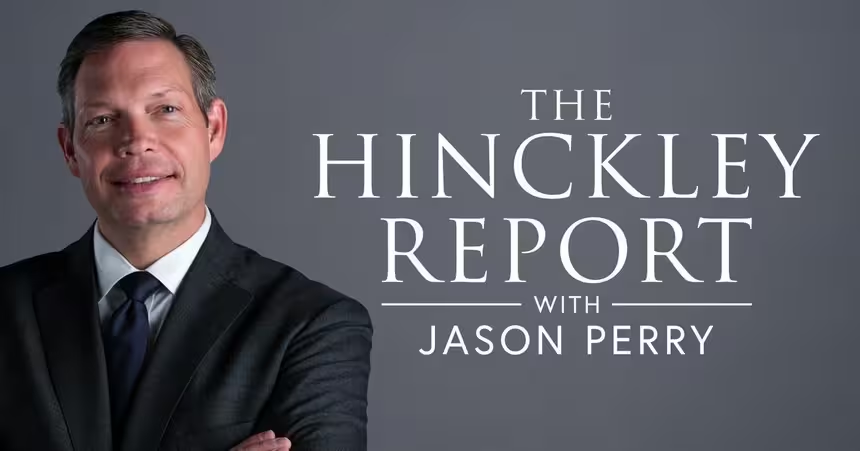
The Hinckley Report
Hosted by Jason Perry, each week’s guests feature Utah’s top journalists, lawmakers and policy experts.Providing Support for PBS.org
Learn Moreabout PBS online sponsorshipannouncer: Funding for "The Hinckley Report" is made possible in part by the Cleone Peterson Eccles Endowment Fund.
Jason Perry: Tonight on "The Hinckley Report," legislators cast their votes on high stakes issues, the debate over teacher pay in education funding heats up as advocates on both sides make their voices heard, and Utah's leaders take on big tech and the impact social media has on children.
♪♪♪ ♪♪♪ Jason Perry: Good evening, and welcome to "The Hinckley Report."
I'm Jason Perry, director of the Hinckley Institute of Politics.
Covering the week, we have Republican Representative Candice Pierucci; Sean Higgins, political reporter with KUER; and Democratic Representative Brian King.
I'm so glad you're all here.
I can't believe we're at the end of the second week of the legislative session.
Candice Pierucci: It feels like week six.
Jason Perry: It does, feels like it's been a little bit longer.
Big, big issues in the first two weeks of the legislative session.
I wanna jump right into one because it was one of your bills, Representative Pierucci.
It's House Bill 215, called "Funding for Teacher Salaries and Optional Educational Opportunities," includes the Utah Fits All Scholarship.
A lot of time in the press about this one and a pretty significant vote this week.
Talk about what this bill does, and then we'll go into what will happen next.
Candice Pierucci: This bill does two important things.
The first thing it does is it increases teacher compensation by $6,000, so that will be an increase in benefits and pay for teachers across the state.
And the second thing it does is it creates the Utah Fits All Scholarship Program, and this is a huge win for parents and students.
It's a program that will empower them to be able to customize their kids' education in a more tailored way for what their kids' learning needs are.
So, they can take this scholarship money and use it for micro-schooling costs, homeschool costs, or private school tuition.
Jason Perry: Sean, it's interesting, because there's been an evolution of this issue since 2007 when we first saw it.
It was in the form of vouchers.
Talk about what's happened a little bit over that period of time and maybe why we see a little bit of sentiment changing, particularly in our legislature.
Sean Higgins: Well, I think the world has changed so much.
Representative Pierucci, you and I were both in high school when--in 2007 when this was all happening.
I think the big thing is the pandemic.
It really kind of turned education on its head.
Lots of parents decided they really wanted a hands-on approach to how their children are being educated, and I think we've just seen a shift over the last couple of years on this issue.
Candice Pierucci: If I could just add, COVID-19 absolutely has accelerated support for school choice across the country.
We saw Iowa's governor just signed this.
Red and blue states are looking at school choice programs in a new way to try and put the focus back on student learning.
Jason Perry: Representative, talk about the proposal from your side of the aisle too, because we had a lot of people on the hill this week.
It was hard--it's hard to park any time on the Hill, but particularly this week, you had a lot of people both sides of this issue on the Hill talking about the impacts for their districts and maybe for those private schools and home schools.
Brian King: Yes, there were a lot of people who were interested, and we got a lot of email.
With all due respect to Representative Pierucci, who I have great respect for, and she's worked very hard on this bill, but it has some real problems.
I think all the Democrats were on the same page in feeling that taxpayer funds shouldn't-- simply shouldn't be used for private purposes and education in this way.
The projections are that the great majority of these funds are going to go to individuals who already have their children in private schools, and so that's a concern.
But another huge concern from my perspective is you can't--you shouldn't be using taxpayer funds for private schools until you've also come up with a method of effectively evaluating how responsive those private schools are going to be to the needs of their children and how well the children are going to do in those programs.
We don't have an effective way in this bill of measuring the achievement of children in these private schools that are going to be getting these vouchers, and that's a real concern to me.
Candice Pierucci: Well, obviously, I'm gonna have a couple of thoughts on that.
First off, I sound like Sandra Bullock on "Miss Congeniality," but it's true, this is not a voucher, this is a scholarship program.
And what--why that's a significant difference is a voucher goes directly from the state to a private school, that's it.
A scholarship program, it's an ESA, an education savings account, similar to an HSA, where you're able to log into a portal, see approved educational providers and expenses that you can use that scholarship money for, so that's an important difference.
We don't anticipate that this will go to people who are already in the private school system because we have directed the program managing entity to prioritize income, and so students who are in low income brackets and low middle class brackets are prioritized, and right now paying for private school isn't an option for them.
We also anticipate that the majority of people who take this are actually gonna be micro-schoolers, homeschoolers; that's become wildly popular through the pandemic.
And then on the final point, we absolutely have measures in place to make sure that we're being accountable for these monies.
There's auditing, regular reports the program managing entity has to do, but also the scholarship recipient will need to submit a portfolio that demonstrates their work and achievements over that academic year, and if a parent would rather, their student can take an assessment, a state RISE test or a national norm reference test to be able to gauge where their kiddo's at.
Jason Perry: Representative?
Brian King: There's no real-- those aren't objective measures.
Look, vouchers have been tried and found wanting recently in Ohio and Indiana, in Louisiana.
Unless you have a way of effectively and significantly, specifically, measuring the achievement of the student, we should not be going ahead with this way of spending taxpayer money for private systems.
Candice Pierucci: And the research on ESAs, which this is an education spending account, shows, and this is out of John Hopkins University, Dr. Angela Watson has reviewed 29 of these programs across the country, and 25 of those 29 show that students both in the scholarship program and the public education program improved because there is competition in the market now, and you're going to find that districts and charter schools are being more responsive to try and compete with what's going on with the scholarship program.
I'll also point out that the left has been very alarmist and cried doomsday on this.
It is $42 million out of over a $7 billion education budget.
It is less than half a percent of our education budget, and just 5,000 kids are gonna be able to qualify for this.
That's roughly less than four kids a school.
So, it isn't fair to say this is gonna gut public education.
The system was set up for our children, and it's time that we get back to a student-focused system and approach to education.
Jason Perry: Sean, you've done some great reporting on this, and you looked into it closely.
I wanna talk about that money for just a second to see what people are saying that you're interviewing and you're reporting on.
So, to those dollars, Representative Pierucci, so it's a $6,000 increase in salary, which is a combination of salary and benefits, so $1,800 in benefits and $4,200 salary, and then $42 million for the scholarship itself.
These two things are tied together.
Talk about your reporting and your conversations.
Sean Higgins: Yeah, I think with the people I've talked to and then everyone here at KUER, it's--the big controversial thing with this was the linking of the pay raise with this scholarship program.
I think we heard arguments from Democrats all over the last couple of weeks that these things are completely separate issues, should have been voted on and debated on that way, saw the Utah Teachers Association come out against this, and, interestingly, the state school board, which is majority Republican, issued a statement saying that they don't really support it as it was written.
But I think, like Representative Pierucci said, they made a compelling argument enough for the legislators that this was a linked issue, it is education funding writ large, and where that money goes and how it gets spent is certainly something we'll be watching.
We heard Senator Cullimore talk about some of the things that will be implemented over the next few months and years to really get that oversight.
But I think Democrats like Senator Riebe in the Senate made interesting arguments that there needs to be oversight, strong, strict oversight on where this money goes and how it gets spent to make sure it is not spent in an improper way that is not related to education.
Candice Pierucci: And the bill files opened up as an education funding bill, so it is absolutely appropriate that we put two--the two most important pieces of education, our teachers and students, in the same bill.
This is something that I've worked on over interim.
Our drafting attorneys actually review bills, and they let you know if they see any constitutional issues with it.
That was never flagged in this, so I think that is just a way to try and parse out these two.
I did think it was interesting to hear some of my Democratic colleagues who have never supported school choice say, hey, I might actually support school choice if you were to split this.
But I'll tell you, I think, you know, historically we've tried to increase teacher pay and it didn't get through.
This was a way to be able to make sure we increased teacher pay while also getting an important scholarship program on the books.
Jason Perry: Representative, love your response, but also if you would take a moment, like, put on your lawyer hat a little bit as well.
Interesting thing that we've talked about is in 2007 the bill passed, and then there was a referendum on that bill.
It's a different bill than this one, but that referendum passed pretty widely in the state.
But what's interesting about this particular vote here is you had over two thirds of the vote, so this is veto-proof, and it is not subject to a recall by referendum.
Brian King: That's right, we have referendums only when a bill passes; we put that--if a bill passes the legislature, we can put that on a referendum and have the people of the state of Utah weigh in on it, but only if the vote in the legislature is something less than two thirds of a majority.
The only thing that is left to use to challenge this bill is a citizen's initiative, much as we did with medical marijuana and with redistricting, but that's a very difficult process.
It's cumbersome, and the legislature over time has made it even more difficult for citizens in the state to access, unfortunately.
But that is still out there, and it's something that if people got to work immediately, could end up on the ballot in 2024.
Jason Perry: Sean, just one last piece on this too.
So, it's not--it's veto-proof in any event, so the governor doesn't have that opportunity, but he's also said that he would sign this bill.
Any comment about that, anything we're hearing from his office?
Sean Higgins: Not that I've heard personally.
I think--I did think it was interesting that the governor made no mention of school choice in particular--in the specific issue of school choice in his state of the state address.
But if he said he will sign it, he will sign it.
Jason Perry: One more comment, did you have something, Representative?
Candice Pierucci: Just that I've been working with the governor over interim as well, and his team to make sure that we're in a place where the governor can support this bill, and he is supportive of the school choice piece.
He's very supportive of the teacher pay piece.
So, I anticipate he'll be signing the bill very soon and that we'll be able to get this implemented.
Brian King: Jason, I think one thing that the last couple of years have revealed, the first state of the state address we heard from Governor Cox, we heard, "Well, I'm gonna--you're gonna see more vetoes from me than you saw from my predecessor."
We don't hear that anymore.
And I think that one of the things that has become clear is that the legislature is in charge in the state of Utah vis-a-vis that relationship between the legislative and the executive branch.
Jason Perry: You think that change happened through COVID?
Brian King: I think that it happened in large part because of the trans athletic bill that passed last year and was vetoed by the governor.
It was passed initially at non- veto-proof numbers, and then Governor Cox vetoed it, and when it came back, there was whipping by the President and by the Speaker of the body in a way that--and there were some changes to the bill too, in all fairness, that created numbers above the veto threshold.
And we overrode the veto, effectively, of Governor Cox.
Candice Pierucci: I think what you're seeing is a legislative branch that is asserting their equal authority.
I mean, the executive branch is--you know, we have three coequal branches in government, and so I don't think that this is--I think the government genuinely believes in this.
I think that the past few years have shown that a one-size-fits- all approach doesn't work, and I can tell you that I have heard from many families, teachers, parents who are frustrated, and they want additional options, and that's what this bill does.
It gives them additional options.
And I view it as a release valve on the system.
I've actually talked to several teachers who have said, you know, "I've got a couple of kids in my class who this would be perfect for, that no amount of time I spend--I've got 33 kids in a class, and this just would be a great fit for them."
So, I view that--I think this is going to be very successful, I think it is incredibly popular, and to look at the 2000 bill, that's a very different issue, and our whole demands as a society and how we learn and grow are very different from 15 years ago.
So, I view this as a separate issue.
This is a different approach to school choice in Utah.
Jason Perry: I wanna talk about one more tuition bill.
And, Representative, maybe you can explain this one a little bit too.
This is House Bill 163.
Actually, you probably should talk about this one right here.
Religious attire in sports.
I guess we'll talk about that one and then one more on tuition.
Talk about what this one is, because I think this one has broad support; we're gonna get something that has broad support for just a moment.
This is one, gives students more options for uniforms in school.
Talk about this one; this is your bill.
Candice Pierucci: So, this bill is a follow-up to a resolution I ran last year.
I've been working with the Utah Muslim Civic League on this bill, and I was so surprised to find there are young women in our state, Muslim young women, who are being told you cannot wear your hijab while playing a sport, and they were told that they could either choose between practicing their religion or participating in athletics, which is incredibly wrong and inappropriate.
So, this bill says to districts, it says to charters, it says to individuals and sports clubs-- excuse me, club sports that rent public spaces that you need to accommodate people's religious headwear, religious wear, and personal standards of modesty.
And I think this is a big move in terms of being more inclusive, but also when you look at our state's history, it's crazy we're having this issue.
We should be especially aware of religious freedom and religious persecution, so I have had-- since introducing this bill I've had more members of the community reach out.
I've got two young men in my district who reached out who are Sikh, and they went to go play in a basketball tournament, and the ref came over and said, "Take those--" I'm using his quote, he said, "Take those towels off your head."
And they said, "This is part of my religion.
You know, I can't remove this.
I'm not going to remove this."
And the ref said, "You need to forfeit the game."
And their coach defended them, but that is absolutely unacceptable.
So, this bill works to protect those religious freedoms and rights of those students so they can participate in sports while wearing religious clothing and headwear.
Jason Perry: Sort of a related bill that I referenced a little bit, Sean, is House Bill 102.
Representative Jordan Teuscher is allowing immigrants and refugees that have asylum status to receive in-state tuition.
Another effort from the legislature to try to get to this particular group.
Sean Higgins: Yeah, I think it's an important step forward.
I think there's been a lot of attention paid to especially asylum seekers, not just with what's happening at the southern border and people fleeing gang violence in South and Central America, but also the war in Ukraine as well.
A lot of people coming into the country seeking asylum from a terrible war, so I think it's encouraging to see the legislature move in this direction.
Jason Perry: One more, this is also a big week on votes, Representative King, on transgender issues, in particular gender affirmation surgery, puberty blockers, and hormone therapy.
Today is Friday; this afternoon--today we're going to have a final vote on this bill that started with Senator Kennedy.
It was changed in the House on Thursday.
Talk about what those changes are and what you see going forward on that particular bill.
Brian King: Well, this is a bill that started in the Senate, passed overwhelmingly, and there were some changes that were made.
It came over to the House, we debated it just yesterday, and it illustrates that we want to make sure that parents have control, except when we want to control parents and children.
And this is sort of the schizophrenic way that the legislature handles some of these issues, that in this situation, we want to bind parents and we want to bind their children to a one-size- fits-all sort of an approach.
Up until the age of 18 children and their parents can't make these kinds of decisions about going through processes that may be recommended by doctors, that may be absolutely essential in the minds of parents and their children to the mental health and welfare, emotional well-being of the children.
We're going to say you can't do that.
Reasonable minds can disagree about this in the sense that science and medicine are not as clear as I'd like them to be about these things, but in the end, I'm much more comfortable saying that parents, their children, and their physicians should have the final say about what children need in their own lives for their mental and emotional well-being, and I find it very troubling what we're doing up at the legislature on this issue.
Candice Pierucci: So, the bill does two things, and I don't think that's an entirely fair assessment.
I've served on Health and Human Services for over three years, and we've studied this issue for over three years, and I think that Senator Kennedy, who is also a family doctor and the House sponsor, who is a practicing nurse right now, trying to take a very thoughtful approach to this.
And so, it is--it does prohibit top and bottom surgeries unless you're 18 and older, which is an age that we have set in law where you become from a minor to an adult, right, and able to make big decisions.
And then it puts a pause on puberty blockers.
That said, what I think is important about it is it does not interfere with kids right now who are currently being treated with puberty blockers, because other bills that have been proposed would have completely stopped that treatment while they're already in the middle of it, so this is putting a pause on future use of puberty blockers until the science is reaching consensus on whether or not this is a good approach.
Jason Perry: Sean, two parts on that as a follow-up.
One is one of the additions on Thursday was allowing a minor to withdraw their consent up until the time they turn 18.
So, they're in treatment of some sort, and they can withdraw that consent at some period of time.
Talk about that particular part of it and what Representative Pierucci just mentioned too, is efforts to get more research, more data around these issues.
Sean Higgins: I think it's an interesting piece, when you talk to the families of these children and talk to some of these children themselves.
You can't just walk to a clinic and say, "Give me hormones," and they don't just write a prescription.
It takes years of therapy, years of doctor's notes, and I think, for example, I think we spoke to someone who said it took over two years from the time they started this process to when they had any sort of medication at all.
So, I think talking to these families, they really say it's not quite what some people are portraying it as.
But I think when it comes to some of the language in the bill, this is wanting more research.
We saw a substitute that was adopted in committee earlier this week that did have a sunset date on it.
I believe it was four years from now.
We saw that sunset date removed yesterday.
I think it's interesting to call it a pause when you remove a sunset date, that seems like a full stop to me, but like we said, it's still there, still up in the air.
Jason Perry: Representative King, the legal ramifications of this withdrawal of consent passage?
Brian King: Well, the bill says that physicians will be susceptible to malpractice suits if they believe that the-- unless they believe that there is no reasonable prospect for the child to change their mind before the age of 25.
Well, look, physicians aren't in a position where they have a crystal ball, and to talk about whether a 16- or 17-year-old child or even a younger child may change their mind before the age of 25, no physician in their right mind is going to say, "I see no prospect of that happening."
And so, what you're doing is opening up physicians and providers to malpractice suits, potentially, and I think the effect, if not the intent, of that provision is going to be to really chill the likelihood that providers, physicians are going to feel comfortable engaging in this kind of medical practice at all.
And as I say, there may be some thinking on the part of some legislators that that's exactly what they want to see.
Candice Pierucci: I will just say we have had--for the past three years, we have studied this in Interim Health and Human Services.
We have had many individuals on both sides of this.
It's a very sensitive topic, but we've had now-adults come and share their regrets of having transitioned while they were a minor, while they were a youth.
And this extension to being 25 is to encourage doctors to be really thoughtful and judicious when they are doing this kind of treatment, but also giving those kids who will then be adults the opportunity to seek recourse if needed.
This will also be something we review regularly as the science and data changes and we get more information on this.
Brian King: The best information we have from physicians that I have confidence in is that this is going to cost lives, because you have many of our adolescents who are going through the process of transgendering who are struggling with their mental and emotional well-being to the point that they are taking their own lives in numbers that are not insignificant.
And it's very, very concerning from that perspective.
Candice Pierucci: I think it is important if I can add, though, Representative Eliason has spearheaded suicide prevention efforts for years.
He's one of the nationally recognized legislators who's led out on this issue, and Utah has done more in the past five years to try and address suicide prevention.
We have the SafeUT app.
Representative Eliason spoke to this bill and how we are making sure that we have special and targeted resources for LGBTQ youth, so I don't think it's fair.
And I think that's a pretty aggressive statement to say people are going to die over this.
I really do think that we need to be more thoughtful about this and making sure that these students and kids know they're loved and supported and we want what's best for them.
Jason Perry: Let me get to another issue that is related, but we might not have thought about it initially.
Talking about this bill, it's a joint resolution from Brady Brammer about amending the rules of civil procedure.
We talked about this on "The Hinckley Report" before, but some things have happened this week that have been very interesting.
And Representative King, I want to talk about--have you talk about this for just a minute.
Remember this was viewed through the lens a little bit on the abortion issue, whether or not this would address or impact the trigger law that was in place.
The court used a standard like this where it said the issue before them had merits and should be the subject of further litigation, sort of the standard there.
The judge looked at the case and issued an injunction.
This resolution would change that to someone who had to prove a substantial likelihood of success.
We talked about this to the abortion lens, but it may get into some of these other issues, including potential lawsuits on gender and transgender.
Brian King: What you're talking about here is an effort to make it more difficult for people in the judicial process to be able to obtain preliminary injunctions or temporary restraining orders.
And that's something that bears some similarity to other turf wars that we have.
I mentioned earlier sort of the separation of powers between the executive and the legislative branch and how the legislative branch has gained more power in my judgment in the last two years, vis-a-vis Governor Cox.
The same thing is going on here in the sense that the legislature is saying to the judiciary, we want you to make-- to defer to what we're doing to a greater extent.
We want to make it more difficult for parties in litigation to be able to put in place these preliminary injunctions about a state law that's been passed by the legislature.
So, you know, it is aimed without question at the trigger ban dealing with abortion after the Dobbs decision, but, as you say, it could also have an impact on the transgender bills, it could have an impact on other bills that are challenged for constitutionality, it could have an impact on redistricting, for example, which has a constitutional challenge.
Jason Perry: Interesting; Sean, one piece on this one too, because the Utah State Bar doesn't often come out on the hill to talk about piece of legislation, but they did this week.
Sean Higgins: Mmhmm, yeah, I think, like Brian said, this raises an interesting separation of powers question.
I mean, I was always taught that the judicial branch was a check on the legislative and the executive, and this seems to me to put the finger on the scale a little bit in the favor of the legislature.
But I think it's interesting to see almost unified opposition from the legal profession on this.
Like, we just heard it would kind of turn a lot of cases on their head.
You have things that needed to be refiled, to say nothing of the suit by Planned Parenthood of Utah, but it could have ramifications in many different areas throughout.
Jason Perry: Representative Candice--gonna switch gears for just a moment, 'cause I wanna make sure we get to one issue we're going to see this week.
Give us your comments first.
Candice Pierucci: Okay, so, I mean, the bill that you're-- we're discussing, the resolution we're talking about, Utah was unique in having two of these different standards in place.
By removing one, we're becoming aligned with what the federal government does, so I don't see it as a massive shift-- Brian King: You all know how important it is that we align ourselves with the federal government.
Candice Pierucci: You know what, we can debate that later, but in terms of good legal practice, that is something we were looking at.
And the legislature crafts and has been designated with the role of creating laws; that applies to the executive and the judiciary.
And so, I think it was absolutely appropriate for us to weigh in on this issue.
And I think you'll see this gets support in the Senate as well.
Jason Perry: Okay, in our last minute, Sean, maybe you hit this one: the federal government and our state legislature taking aim at social media companies.
Why, and what are they going to do?
Sean Higgins: Well, we heard from Spencer Cox speaking quite forcefully against the dangers of social media.
I think pretty bipartisan support on kind of the beating of the social media giants these days, and certainly a lot of security concerns with companies like TikTok being owned by China and data sharing there.
I think we've talked a lot about youth mental health up here today, and I think that is also another aspect of that that really needs to be addressed.
Whether that will come to fruition in the shape of a lawsuit or legislation I think is yet to be seen.
We heard Spencer Cox and Sean Reyes talk about, every time that there is laws being made, you see high-power lobbyists come in and maybe try and water that down, so we we'll see how that turns out.
Jason Perry: Watch it close.
Thank you for your great insights this evening, and thank you for watching "The Hinckley Report."
This show is also available as a podcast on PBSUtah.org/HinckleyReport or wherever you get your podcasts.
Thank you for being with us.
We'll see you next week.
♪♪♪

- News and Public Affairs

Top journalists deliver compelling original analysis of the hour's headlines.

- News and Public Affairs

FRONTLINE is investigative journalism that questions, explains and changes our world.












Support for PBS provided by:
The Hinckley Report is a local public television program presented by PBS Utah
Funding for The Hinckley Report is made possible in part by Cleone Peterson Eccles Endowment Fund, AARP Utah, and Merit Medical.