
2024 Election Results
Season 9 Episode 10 | 26m 43sVideo has Closed Captions
With a contentious election now over, we examine what the results suggest about voter priorities.
With a contentious election now over, our panel discusses who won and why. We evaluate what messaging resonated with voters, which demographics played a decisive role, and what the results tell us about the priorities of Utahns. Political insiders Scott Howell and Thomas Wright join journalist Saige Miller on this episode of The Hinckley Report with Jason Perry.
Problems playing video? | Closed Captioning Feedback
Problems playing video? | Closed Captioning Feedback
The Hinckley Report is a local public television program presented by PBS Utah
Funding for The Hinckley Report is made possible in part by Cleone Peterson Eccles Endowment Fund, AARP Utah, and Merit Medical.
2024 Election Results
Season 9 Episode 10 | 26m 43sVideo has Closed Captions
With a contentious election now over, our panel discusses who won and why. We evaluate what messaging resonated with voters, which demographics played a decisive role, and what the results tell us about the priorities of Utahns. Political insiders Scott Howell and Thomas Wright join journalist Saige Miller on this episode of The Hinckley Report with Jason Perry.
Problems playing video? | Closed Captioning Feedback
How to Watch The Hinckley Report
The Hinckley Report is available to stream on pbs.org and the free PBS App, available on iPhone, Apple TV, Android TV, Android smartphones, Amazon Fire TV, Amazon Fire Tablet, Roku, Samsung Smart TV, and Vizio.
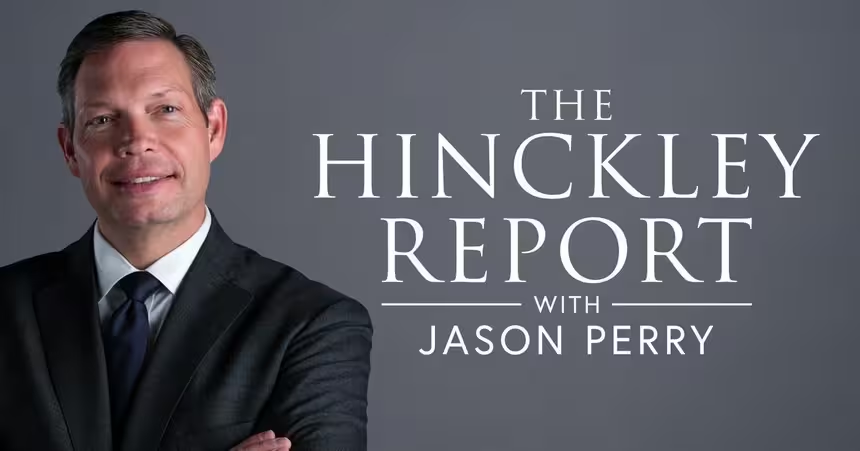
The Hinckley Report
Hosted by Jason Perry, each week’s guests feature Utah’s top journalists, lawmakers and policy experts.Providing Support for PBS.org
Learn Moreabout PBS online sponsorship♪♪♪ male announcer: Funding for "The Hinckley Report" is made possible in part by Merit Medical and by contributions to PBS Utah from viewers like you.
Thank you.
Jason Perry: Tonight on "The Hinckley Report."
After a tumultuous and historic election, our panel discusses who won and why, what messaging resonated with voters, which demographics played a decisive role, and what do the results tell us about Utahn's priorities?
♪♪♪ ♪♪♪ Jason: Good evening and welcome to "The Hinckley Report."
I'm Jason Perry, director of the Hinckley Institute of Politics.
Covering the week, we have Thomas Wright, Utah businessman and former leader in the Republican Party.
Saige Miller, politics reporter with KUER; and Scott Howell, former Democratic senator.
Thank you for being with us on this very important episode of "The Hinckley Report."
We just had our political Super Bowl here in the United States.
We were watching closely, I know all four of us were watching very closely into the night.
I wanna talk about this historic presidential election.
Some of the lessons learned, observations that we all have, particularly you who are so connected to the campaigns and to the parties themselves.
I wanna start with clips as the, you know, the speech from President Trump as he received the nomination, the--that he was going to win and also from Kamala Harris and her concession speech.
I know you all were close.
I wanna watch these clips and let's get some reactions.
Donald Trump: We're gonna help our country here.
We have a country that needs help and it needs help very badly.
We're gonna fix our borders.
We're gonna fix everything about our country and we made history for a reason tonight and the reason is going to be just that.
Kamala Harris: So, let me say my heart is full today.
My heart is full today, full of gratitude for the trust you have placed in me, full of love for our country, and full of resolve.
The outcome of this election is not what we wanted, not what we fought for, not what we voted for.
But hear me when I say, hear me, when I say the light of America's promise will always burn bright.
Jason: Okay, let's break down this a little bit and let's talk about the victory speech first for president-elect Trump.
Thomas, he won every battleground state.
We were watching this very closely, this blue wall we talked about, he won in those states.
Break down for us why that was the case.
Thomas Wright: You know, I think looking back for me this week, it's about three things.
It was about unification, it was about transparency, and it's about results.
And what I mean by that unification is President Trump was able to build a coalition of people, former Democrats, RFK, he was able to bring people together and bring different factions together.
And I think that was a big reason why he won.
Second is, you know, the results, people look at the four years of--under President Biden, they look at the four years under President Trump, and they care about results.
They don't feel safe.
The world is not as safe--as safe a place as it was.
The border has been a huge issue.
The Democrats chose to run more on abortion where President Trump was talking about the border.
People want to feel safe and they want an economy that works for them and under President Biden, the economy really fell apart.
Unemployment was at a really high level and inflation was crushing Americans pocketbooks that are living, you know, hand to mouth and they were just ready for a change.
And then, I think transparency was the big one for me, the third one.
And that is, you saw a lot of uncut podcasts, you saw President Trump and JD Vance out there.
I didn't see president--or Vice President Harris as much and maybe I just didn't see them.
But these long uncut podcasts where they're really talking about the issues, this transparency, voters crave it.
They wanna see authentic politics and we finally saw it instead of these 30 second sound bites.
Jason: Scott breaking down the Democratic side.
I know you were close to the Harris campaign.
Maybe had a view that very few have had.
Scott Howell: Well, for me, let me give you a timeline.
I knew this campaign was over on Thursday, June 27th.
That was when the debate happened.
And everyone, if they're being honest with themselves, saw a Joe Biden that had aged and his cognitive skills were not there.
And from that point on our party started to lose all vision.
We had people fighting saying, "No, Joe's the right guy.
He just had a bad night."
That is so much baloney.
It--and it really concerned me of what happened at that debate.
Jason, you know, we held the vice president debate here and we had, Pence and we had Harris.
They flew in, both of them came in a week before, and Harris had the Marriott hotel, and they set it up as the stage, and she practiced all the time.
So, when she walked on the stage up here at the theater, she knew what that stage was gonna look like.
They drilled down on her and I hosted her all over the state.
She was breathing the air, she was here.
What the handlers did to Joe Biden is one of the worst things in the world.
They have him come home from a NATO meeting.
He flies into Atlanta where the humidity and the heat is overwhelming.
He's out there in a crowd speaking to them and then he has to go in and debate.
His handlers were so bad.
They showed the worst thing about Joe Biden you could ever imagine.
And then, the next thing that happened was July 13th, Saturday.
Trump gets shot.
And so, he's up there saying, "Fight, fight, fight!"
And all of a sudden things really turn bad and then we move on and the Democrats can't find a candidate.
They're arguing internally.
I'm getting calls all the time to say, "Are you still with us?
Are you still with us?"
What I wanted to say is, no, I'm not because he's not, he's not, he shouldn't be the candidate.
But you gotta be a team player as Thomas knows and I'm sure Saige, and then what happened after that was the worst thing is on Sunday, July 21st, I'm sitting in church and I'm getting all these texts and he's out and the White House says, "Call us now."
And the message was, "Yeah, he's gonna drop out, but we've got this worked out."
And I'm going, what do you mean worked out?
And then, Jason, you and I went out and did Fox that night.
We--I was with Gary Herbert, and I'm sitting there and I say, "There's gonna be a red wave.
There will be a red wave in this country like you've never ever seen before."
And Gary says, "No, Scott, you're wrong.
It's gonna be a blue wave."
And I go, "Gary, no, it's not."
And I think the dynamics of what happened on that and then you have the convention, the convention was she didn't get tested, she did not get tested.
Thomas has run for office before.
In primaries you get tested and you should be.
And then she had three months to run a pres--four months to run a presidential campaign.
These are the people been campaigning for the last four years and nobody's surprised.
I mean, you shouldn't be surprised.
You should not be surprised.
Our message was so bad.
It was the worst message.
James Carville had it right.
It's the economy, stupid.
Jason: Can we break that a little bit because you mentioned that Thomas and Scott did too.
But Saige, talk about how this resonated people.
You did great reporting.
You talked to so many people.
You know, we had a couple of big issues, the economy and the border.
Those seem to be things we're talking about.
Talk about where maybe we missed it on or some may have missed on that economy.
Saige Miller: Well, I think with the economy, I just don't think the Harris campaign really had sound policy or policy really at all, I think they tried to say, oh, we're going to, you know, give child tax credits or we're gonna try and help first time home buyers.
But that wasn't really as solidified as people are living through the tumultuous times of the economy now and not having a really direct message of how that's going to change the moment that she gets into office.
You have these grandiose plans, you also have to work with Congress on that, and they weren't doing very good job, but also securing the House and securing the Senate in order to get those policies passed.
Whereas we saw on Election Day, they lost the Senate, the Democrats lost the Senate.
That already makes it significantly harder to get any policies through the finish line.
And then you have, we haven't really called the House races yet, but that's looking like it's going to go towards the Republicans as well.
So, I do, I think there was just, people didn't really know where exactly Harris stood when it came to the economy.
In places like Utah where you do have, you know, a pretty high income ratio, but people still can't afford to buy a house.
We're like, how is that going to help us in the long run?
I will say that Harris did perform better in Utah this year than Biden did last year and has performed better than any Democrat has since Utah voted for a Democrat, LBJ, back in like the sixties.
Scott: So to Saige's point on the economic.
Gen Z are smart.
You're gonna get $25,000 for a house, but guess what?
Who pays for that?
We're gonna burden you with the taxes and the deficit for the next 20 years.
Saige: And I think that's another really good point.
Scott: Every single policy that she said, no one said, "Let's balance the budget.
Let's go balance the budget."
No one said.
No one said.
Thomas: And I mean, I feel Scott's anger in the loss, right?
The Democrat Party, I mean, no, just frustration.
I don't mean to label you, but just the frustration and it was Vice President Harris got put in a really difficult situation.
There's no doubt about that.
For months, the people in President Biden's inner circle protected him and didn't tell Americans the truth and it caught up to him.
And unfortunately, Vice President Harris was the unfortunate person that had to be put forward to run a campaign on limited time, but right out of the chute, she made a bunch of terrible errors.
The interview on "The View" was played in battleground states.
I was in battleground states and I watched it, her defending the Biden economy, trying to make a case for the Biden economy, while you have Americans that are suffering, that can't pay their bills, and the inflation is just crushing to them, and it was so disconnected.
It was so-- It was so Washington DC establishment that voters just didn't see any authenticity in it.
Saige: You need to play more offense, right?
So, she need to say, "Here's what Biden did correct and here's how I will build off and change," right?
But that's not what she did.
There was an immense amount of loyalty towards President Biden, which I understand, she has been next to him through this entire fight.
But you do need to forward the narrative and at some point, she didn't even have a narrative.
And to your point when it comes to Gen Z, I will say with a lot of the reporting that I've done with Gen Z, and with younger Millennials or--yeah, younger Millennials, it's that they genuinely do care about policy, right?
Part of the reason why they're not so turned on to Trump and maybe they have more so this year is because of the policy aspect.
They don't necessarily want to hear the mumbo jumbo when it comes around social issues very much.
They want to know how you are going to get me in a home without asking my parents for a down payment.
Scott: Let me tell you one thing about the Trump campaign.
This was amazing.
So, I come from a tech background.
Bringing on Elon Musk was brilliant.
My Democrats were out on the ground game.
They're out knocking on doors.
They're doing a hell of a good job.
In fact, they do 2000 doors a minute is what it averaged.
I sent a team out of Utah to Brooks County, Pennsylvania and they give me a daily report.
They ran their satellite office.
What does Trump do?
He goes on Rogan.
Has 48 million listeners, 48 million.
You cannot knock on that.
And this is what I was saying.
This is the-- Thomas: Voters, this is the cycle where voters want the uncut podcasts.
You're gonna have to go on and talk about the issues for 45 minutes to an hour without an adviser, telling you what to say, without reading a teleprompter.
And that, and up until now it's been sound bite politics.
You go on TV, and you talk your sound bites, and you tell everybody what your advisers told you to say, and what polled well in a focus group.
And that's why I said that in the intro, that that's what changed here.
And Vice President Harris did not get out and do that.
So, now Republicans have a really serious challenge because President Trump broke the coalition.
I mean, he broke the coalition.
You've got women voting for Trump, which really decided the race.
Latinos breaking in unprecedented numbers.
And if Republicans can figure out a path to make good on the promises of the reasons why they voted for him.
The Democrat Party has a serious problem because it was more than just a Trump victory.
Trump built coalitions and broke the Democrat coalition.
Scott: So, I have a bellwether, his name's Adam, and then I have another one named Renee.
And I asked them all the time.
What's the issues?
They said, "Scott, okay, we get abortion.
We believe that there should be reproductive rights.
But that's all we hear, that's all we hear.
Abortion, abortion, abortion, abortion."
Thomas: And that's because, Scott, they couldn't talk about immigration.
They left the border open, they got millions and millions of people into the country.
How do you talk about immigration when your policy was the policy that everybody is concerned about: the safety and security of the country.
Saige: She did not talk about the border.
Thomas: And so, they just had nowhere to go.
And that's why in the intro also talked about results.
They were contrasting four years of President Trump with four years of Biden-Harris, and they looked at it and they said, "That four years does not work for me.
It's not working for my family.
I'm going back to where we were."
Scott: So, Adam and my friend, he is a great bellwether for me.
He's got five little kids.
Well, I guess they're older, some of them are in their teens.
And he said, "The other thing is I understand LGBTQ rights and transgender, but I don't want my kids going in the bathroom with a woman or vice versa."
And he said, "That issue for me is personal."
And then I said, "Well, what is your neighbor feel and what are you doing out there?"
He said, "We respect and we want every citizen to live their full life, but when you come down and you have policies that you wanna change, and anyone can go in and have reassignment that is offensive to me."
And the other thing on that abortion, I had LDS friends who would say to me, say what you want about Trump, and he's pretty foul.
He's pretty rough when he talked about Arnold Palmer, I thought that was the end.
I thought that nobody is going to vote for that guy because it was so gross and so crass when he talked about his privates.
But people laughed and the people behind him, men and women were laughing at what he was saying, and I thought that would be the one issue that would change for the LDS voter.
They dismissed it because of his policy on abortion.
Jason: I want to talk about how this impacted turnout in the state of Utah, Saige, because the numbers was low.
It was lower than we have seen that when you talk about active registered voters, there's not all eligible voters is the active registered voters.
It looks like about 73% turnout this time as opposed to 2020 where it was 90%, 2016 which was 82%.
Take this dialogue, we just had, and put it in context of what happened with voters in the state of Utah.
Saige: I think people stayed home.
And I also think that young voters did not turn out to the polls.
We've got some AP voter cast data back that showed that middle aged folks and 65 plus to the people that turned out to vote, which is pretty normal.
That's been the kind of the dialogue for a very long time.
But I don't think again, either candidate really spoke to the younger populous.
I also think that there is some foreign policy happening, right?
The war in Ukraine and the war in Gaza that has turned off a lot of young voters of not wanting to even very much so even want to be in the dialogue when it comes to politics.
And I think that they feel kind of disenfranchised, right?
When we talk about young voters and Gen Z and Millennials wanting to hear about policy, how their lives are going to be better, and no candidate is really doing that.
Maybe Trump is doing it more so than Harris, but is not necessarily always speaking to young voters.
And we've heard this before, Thomas, that the GOP is struggling with trying to secure young votes as it is.
So are Dems, even though Dems are more likely to garner that support.
I just don't think that there was really much that people wanted to show up to the polls for.
Scott: Saige to your point, young voters, they care about the climate action, affordable education, and social justice.
Neither candidate really talked about that.
But that's what they were saying.
And you never heard, you never heard the vice president talk about climate, and it would have been such a natural, I mean, and that would have attracted.
And not to be so far to the left on that, that, you know, it's whacked out policies and all that.
Everybody's gonna have a bicycle, blah, blah, blah.
But that's one thing, that's the way you energize and engage that group.
You talk about what they're interested in, but they didn't.
Thomas: They didn't talk about it a lot, but that's because I think voters were looking, saying I can't pay my bills or I'm struggling economically and I'm worried about my safety from the border and in these wars around the world, I don't feel safe and I can't pay my bills.
And when people feel like that, that is what they're gonna vote on.
And Vice President Harris had nowhere to go on those issues because the war started under their watch.
The border was left open under their watch.
They defended leaving the border open when everybody begged them to close it.
They owned those issues so they had nowhere to go, Scott.
And, and so, yes, it was partly that Vice President Harris got put in a really tough spot and she didn't turn out to be a great candidate, but it was also the situation she got put in with this--the issues of the Democrat Party.
The Democrat Party turned their back on the big issues that Americans cared about and they voted them out because of it.
Scott: And Thomas, on that very point on the economy, it's about supply and demand.
Biden--Trump had it great.
Gas was at its lowest price.
Groceries were the lowest price, restaurants were lower and everything.
Yes, they were because nobody was going out, nobody was driving.
And so, when the economy turned around, it all goes up and grocers, I promise you right now, they said we're gonna make up for this, and we're raising the price of Frosted Flakes.
We're gonna go up $5 because during the pandemic, you didn't come in here and shop.
And so, the economy was such a good one and the Republicans does such a great job to say, oh, it was all because of our policy.
No, it was because of COVID.
Thomas: Inflation didn't happen because people were only price gouging.
I'm not saying that price gouging didn't occur.
I don't know enough to say that.
Scott: That's true because-- Thomas: Inflation happened because of all the bailouts and the reckless government spending that happened.
Scott: The Reduction Act.
Thomas: And that's why we have high interest rates right now.
We're gonna have high interest rates indefinite these higher 6 1/2 to 7 1/2 permanent interest rate environment because the Fed has $9 trillion on its balance sheet under President Biden.
It's come down a little bit, but that needs to be 4 or 4 1/2.
Scott: But see, that's my very point.
That's what both candidates should been focused on is not putting that burden of the deficit on my kids, your kids, and your grandkids.
Jason: Let's talk about some local races for just a minute.
What is--I just kinda wanna get some of the people who won in the state of Utah.
Saige, talk about Congressman now senator-elect John Curtis.
Saige: Very popular man.
He's a very popular man.
I think right now he has over 60% of the vote compared to Caroline Gleich, who is the Democratic nominee for that position.
And something that I find incredibly fascinating about this race while Harris and while Trump was not talking about climate, those two were.
And in Utah, climate is a very interesting and very--a priority topic here in the state because of our ski industry, because of our public lands, whatever it may be.
People really care about climate here.
And so, I do think what this also means with a Curtis win as he started was like the co-chair of the Conservative Climate Caucus.
Yeah, and that has helped and he even said it himself.
He's like, I think a huge success is having 85 Republicans in a room no longer denying climate change is real.
And he's like that a huge win for us to even start to begin to understand the conversation of how we combat climate change through a conservative lens.
So, we have that in the bucket for him.
But additionally, I think that people really did appreciate Mitt Romney, Mitt Romney's pragmatism in the Senate, and that is now being replaced with Curtis.
And if you hear Curtis talk, he says I'm not going to be a Mike Lee and I'm not going to be a Mitt Romney.
I'm going to be a John Curtis.
And so, but I do think that he's going to carry on some policies over to the Senate in some of the coalition building that he has already occurred.
So, I think when it comes to Utah's position in the Senate, you're not gonna see much of a difference between him and Mitt Romney.
And I think it's gonna be, I think it's gonna be a lot of the same.
I don't know if either of you guys.
Scott: Well, to Caroline, I have to say she's a great candidate.
She is a wonderful person.
She's an achiever.
She's 38 years old.
Don't think the doors closed on her.
Saige: It's not-- Scott: For me personally, I grew up by John Curtis.
We've known each other forever and I was the Democrat that got him to run for the State Senate down in Utah County.
So, when that guy, whoever he was debating kept saying he's a Democrat, I wanted to raise my hand and said, yeah, I recruited him.
I'm the one that did that.
And you know, John only lost-- Thomas: Don Corleone of the-- Scott: John only lost like by 55 votes.
And it was really interesting, but John Curtis will represent and do a great job for our state.
Thomas: John is gonna be a fantastic US senator.
He's a consensus builder.
He's likable, he works hard, he understands the issues.
He is a great brand of Republicanism where he's fiscally conservative.
He understands those issues, but he's also willing to talk about issues that Democrats have previously said these are our issues and Republicans weren't willing to talk about him.
So he's a--he's gonna be a fantastic senator.
He's a great addition to our delegation and I'm just gonna be more thrilled-- Scott: Thomas makes a really important point here to our people.
Those people that are in that Republican party used to be our people.
That's the middle class, hard working, that's the union person that's out there sweating away.
And for somehow we have lost them.
We have abandoned them.
It's like Thomas said earlier, it's a very elite clique back in DC.
That it was giving direction to come because-- Saige: The Democrats have an identity crisis like the Republicans did in 2020.
Like y'all got to figure it out.
Thomas: Well, look at the electoral map.
It's blue on the edges and it's red in the middle.
Like they don't understand what's happening in this country.
Saige: Every single state has shifted red, every single--during this election, almost every single state has shifted more to the Right than previously seen.
Utah was actually an interesting phenomenon where we didn't.
We essentially stayed the same.
We shifted probably a little bit to the Left.
Thomas: The turnout was a little lower.
Saige: Turnout was a little bit lower and Salt Lake County is getting more blue.
Scott: Yeah, turnout was lower because I don't want to go stand in the cold in Utah County for five hours with this guy--what, I don't know who that guy is shouldn't be in whatever, whatever his name is.
I mean, that was crazy.
Thomas: But that was my point earlier, Scott, is the Republicans have done a great job in the selection of building coalitions.
They're getting union voters.
They're getting a disproportionate amount of Latinos.
Latinos are coming home to the conservative policies that have made this country great.
Women were voting for Republicanism because they're not able to buy their groceries and do the basic things that they need to do in their life and they don't feel safe.
Scott: I had a conversation with some of our labor leaders and they said, "Scott, we work with all the Republicans here because Democrats can't do anything."
And it's a sad commentary.
And when you look at who they supported.
It was just, it's a reality.
You are both absolutely right.
We have to have some soul searching and we've got to get back.
Jason: But I want to get to two more races really quickly.
I want to talk about the congressional races except we do have a new member of Congress, Mike Kennedy has taken the spot of John Curtis.
Blake Moore, Celeste Malloy, Burgess Owens, all won with pretty serious margins.
Saige, let's talk about the governor's race really quickly.
Right now, Spencer Cox leads at 56%.
Brian King at 30, Phil Lyman at 9% with 88,000 write-in votes.
Saige: Yeah, Phil Lyman won the GOP convention vote but lost in the primary to Governor Spencer Cox.
And he has won--he has ran quite the write-in campaign on social media, a lot of lawsuits to try and make sure that Spencer Cox didn't win.
And there was some polls indicating that Phil Lyman was going to garner almost 20% of the vote, not even close.
So, I think that maybe that's another point that perhaps polls are sometimes also out of touch.
But I will say that we have this idea that perhaps because Phil Lyman was riding the write-in campaign that was going to siphon votes and maybe help Brian King.
That didn't at all, the Democrats didn't move.
It's essentially the exact same percentage that we've seen in other governors races in the state of Utah.
I do think that this shows a fraction within the, maybe, perhaps the Utah GOP and perhaps dislike from Spencer Cox.
And even though he won, he's not going to one--he's not going to win by the margins that he did in 2020.
And I don't know what that really looks like for him moving forward with his campaign and with his tenure as governor.
But I do think that he's gonna try his best to try and stay with the unification that the Republican Party has coalesced this past election.
Jason: Talk to us, 30 seconds-- Thomas: He did win with 56% of the vote.
That's a significant amount.
Whenever you live in a state that's as conservative or liberal, which it's, when it's controlled one party, you have different factions and the race becomes an interparty race.
And that's what he was dealing with, but I thought he navigated it well.
I thought he did his best to represent himself, and be true to what he believed in while simultaneously trying to reach out to other people.
And I'm just glad that it's over, like, truthfully.
Scott: I want to say one thing about Governor Cox, he made this statement, "If you just chalk Vice President Kamala Harris's laws up to inflation, you're missing the message that should come out of this election season that this is the people are tired of being told they are racist, or misogynist, or homophobic."
Jason: That's going to have to be the last word on that one.
That was the governor's comment on why the votes went the way it did.
Thank you all.
Sorry, we're gonna have to keep this on another time.
Thank you for your insights.
It was so fun and thank you for watching "The Hinckley Report."
This show is also available as a podcast on PBSutah.org, YouTube, or wherever you get your podcasts.
Thank you for being with us.
We'll see you next week.
announcer: Funding for "The Hinckley Report" is made possible in part by Merit Medical and by contributions to PBS Utah from viewers like you.
Thank you.
♪♪♪ ♪♪♪

- News and Public Affairs

Top journalists deliver compelling original analysis of the hour's headlines.

- News and Public Affairs

FRONTLINE is investigative journalism that questions, explains and changes our world.












Support for PBS provided by:
The Hinckley Report is a local public television program presented by PBS Utah
Funding for The Hinckley Report is made possible in part by Cleone Peterson Eccles Endowment Fund, AARP Utah, and Merit Medical.