
2024 Legislative Session Week 3
Season 8 Episode 21 | 26m 56sVideo has Closed Captions
The legislature dives into a tight budget & polling shows Utahns' opinions are shifting.
As the third week of the legislative session wraps up, Utah's legislature dives into a tight budget year. Our panel discusses new polling showing how Utahns' opinions on major issues are shifting. Plus, big developments in sports are making news in Utah. Republican State Senator Todd Weiler, politics reporter Saige Miller, and political insider Jeff Merchant join host Jason Perry on this episode.
Problems playing video? | Closed Captioning Feedback
Problems playing video? | Closed Captioning Feedback
The Hinckley Report is a local public television program presented by PBS Utah
Funding for The Hinckley Report is made possible in part by Cleone Peterson Eccles Endowment Fund, AARP Utah, and Merit Medical.
2024 Legislative Session Week 3
Season 8 Episode 21 | 26m 56sVideo has Closed Captions
As the third week of the legislative session wraps up, Utah's legislature dives into a tight budget year. Our panel discusses new polling showing how Utahns' opinions on major issues are shifting. Plus, big developments in sports are making news in Utah. Republican State Senator Todd Weiler, politics reporter Saige Miller, and political insider Jeff Merchant join host Jason Perry on this episode.
Problems playing video? | Closed Captioning Feedback
How to Watch The Hinckley Report
The Hinckley Report is available to stream on pbs.org and the free PBS App, available on iPhone, Apple TV, Android TV, Android smartphones, Amazon Fire TV, Amazon Fire Tablet, Roku, Samsung Smart TV, and Vizio.
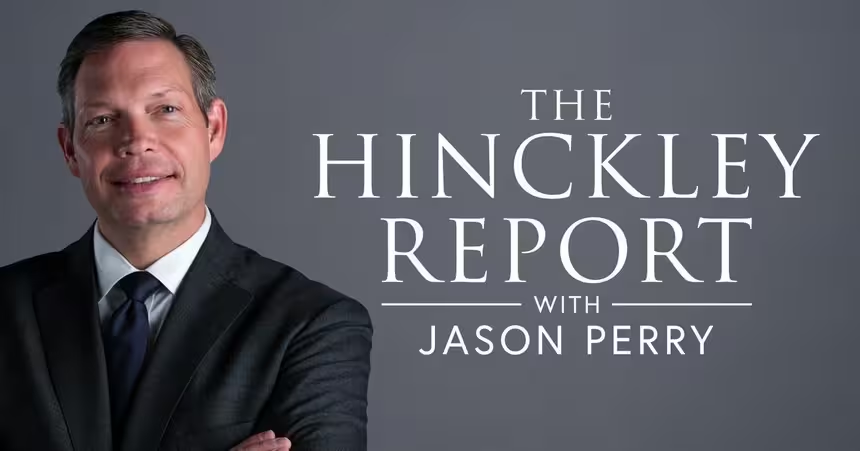
The Hinckley Report
Hosted by Jason Perry, each week’s guests feature Utah’s top journalists, lawmakers and policy experts.Providing Support for PBS.org
Learn Moreabout PBS online sponsorshipannouncer: Funding for "The Hinckley Report" is made possible in part by the Cleone Peterson Eccles Endowment Fund.
Jason Perry: Tonight on "The Hinckley Report" legislators wrap up debate on contentious bills and dive into a tight budget year as funding requests pour in, new polling shows how voter's opinions are shifting on major issues, and developments in world sports may push Utah into the big leagues.
♪♪♪ ♪♪♪ ♪♪♪ Jason Perry: Good evening and welcome to "The Hinckley Report."
I'm Jason Perry, Director of the Hinckley Institute of Politics.
Covering the week we have Republican Senator Todd Weiler; Saige Miller, political reporter with KUER; and Jeff Merchant, Executive Director of Alliance for a Better Utah.
So glad you're all here.
We've just finished week three of the legislative session, might feel a little bit longer.
We just finished week three.
We have so much more to do.
But what I think is interesting about this week, we'll start with you, Senator, is, this is the week of the RFA, the request for appropriation and the list is long of those coming in.
Talk about what those are, how this process works for a moment.
Todd Weiler: Yeah, so the great thing about the Utah legislature is every legislator is involved in a budget committee that's kind of unique to Utah.
And then anybody can come up and ask for money.
They need to have a legislative sponsor and it's called an RFA and then they'll get four or five minutes in front of an appropriations committee to make their pitch.
Most of them are not funded.
And this year we've made the whole process a little bit more transparent.
So for the first time in my 13 years, I've seen the RFA's on social media and people criticizing the legislators for even sponsoring it, but just because you sponsor it, we're just giving someone four minutes to pitch their idea.
Jason Perry: Yeah, Saige, talk about that because there are over 1000 of them that have come forward and there's people with all sorts of things they would like to be funded.
I know I was one of them working on the presidential debate, for example, but talk about how the kind of the public can engage with this process and actually see what is being asked and what actually ends up getting funded.
Saige Miller: Governor Spencer Cox is asking for a ton of money in his budget proposal.
And a lot of the times the the legislators like Todd Weiler over here will decide kind of where, how they want to divvy that money that he's asking for.
And sometimes the governor doesn't even get what he wants and with the people who are going in and kind of giving their two cents about why they should get funded.
But thankfully they do stream these, right, at the utah.ledge.com--dot gov.
Yeah, and so you can engage and actually watch them live as they're happening to figure out what people are pitching, how much money they want, and how lawmakers are responding to it.
We don't really know just as of yet, like how much lawmakers are going to divvy up that money and who's going to get what.
Todd can probably talk more a little bit about that process of what happens behind closed doors rather than in the public.
But yeah, it's the one thing that I will say about the Utah legislature is their transparency when it comes to what's happening right now on the ground, it's pretty strong and the website for lawmakers, for people to engage is pretty user friendly.
And so, I do think that if you just spend a little bit of time on the lawmake--on the legislative website, you'll be able to kind of figure it out.
You can see kind of the status of everything as well.
And, but yeah, we are going into that big money period and we'll probably talk about this a little bit later, but the ability to kind of focus more on budget by getting the controversial issues out of the way first.
Jason Perry: I do want to talk about that.
But maybe for a moment, Jeff, talk about sort of the interplay here because you've got a lot of requests from community organizations, groups, government entities.
You have the governor who's presented a budget and you ultimately have the final decision from the legislature, including the very influential executive appropriations committee.
Jeff Merchant: Yeah, I mean, certainly the Executive Appropriations Committee is gonna be making a lot of these decisions.
A lot of huge decisions impacting the budget through the entire rest of the fiscal year.
But I actually fully agree with what's already been said.
This is a relatively transparent process and it's one that seems more democratic than many of the other things that we see happening at the legislature.
A lot of people involved, a lot of people can voice their opinion and their thoughts, and it really is rather transparent and I think that a lot of people deserve a lot of credit for that.
I love the idea that everyone is on these committees and everyone gets a say, whether that's positive or negative about all of these different RFAs.
Jason Perry: Yeah, absolutely right.
Now, talk about the budget just for a moment, senator, because right now you're kind of hearing requests, but we don't actually know what the revenue is going to be.
Talk about what that is like.
Todd Weiler: Well, we get our final revenue numbers right around Valentine's Day and it's basically a guess of what Utahn's are gonna spend in the next 16 months.
So we are projecting in the future.
And we have a couple of PhDs that are really good at that.
But we know that sales tax is a little bit down.
And it's probably gonna be a tight year.
And remember, Jason, the last three years, we've had extra COVID money to spend and a lot of programs that wouldn't have gotten funded have gotten--have been funded.
But now that COVID money is dried up.
And so a lot of these people are back this year saying, hey, you got to keep on funding us, but we don't have all of the money to do that.
Jason Perry: Yeah, it's easier when there's no money or when there's a lot of money.
Todd Weiler: It's actually easier when there's no money because we can say no to everybody.
Jason Perry: Very interesting.
Saige, I know you've been following the news here about potential tax cuts because you look at, we have maybe a declining revenue coming to the state of Utah, but also some interest in our legislature to cut some taxes.
We have one in particular, Senator Chris Wilson, this Senate bill 69 income tax amendments is looking to lower the income tax or to eliminate the income tax.
What are you hearing about potential places to fill that void if income tax goes away?
Saige Miller: Honestly, I haven't heard much to fill the void, which is why this is kind of interesting.
I know that Republicans and it's an election year and focusing on taxes usually kind of ramps up and gets kind of the base ready to want to vote for you, especially if we're going into a sticky primary in a lot of places.
So that, that does kind of help give you a little notoriety if you want to focus on this issue.
But I really don't know, especially when we are already projected to have a budget shortfall, how cutting taxes in this form would be recruit-- recouped in any way.
And I know that some people have issues with income tax, but something that I need to look into is that who exactly would this benefit if we were to cut income tax?
And is it, is it the people that need it the most?
Jason Perry: So the Hinckley Institute of Politics did some polling with The Deseret News asking Utahn's, how they would feel about eliminating the state income tax and it was 59% of Utah said that they would support it; 27% oppose; 14% don't know.
But of course, Jeff, the next question is the harder one is, is what should happen if it does go away?
Given your lens with the Democratic Party, particularly when you were leading it for a very long time, talk about these tax cuts generally as a principle through the legislative session.
Jeff Merchant: Yeah, I mean, look at a certain level kind of an unfair question, right?
Like who's gonna say that they want to be taxed?
Most people don't.
I know there might be a few Democrats that do.
I'm not one of them.
I think that not having taxes is a wonderful idea.
The problem is, is that then you get millions of dollars in RFAs that are coming in and you want to fund those, right?
My personal view is even the smaller tax reduction that the legislature is looking at seems relatively silly to me, given that, you know, I can go and buy a latte or something for that extra 10 bucks.
I'm gonna say when that $10 that everybody's contributing can do a lot of really great things for the state.
I think that if we really want to look at tax cuts where we should be looking at is at something like a sales tax cut or eliminating the sales tax if we're gonna eliminate something.
And the reason why is because that does affect everyone in a more equal way than income tax.
Income tax cuts help people that have a lot of money, a whole, lot more than people that don't have a lot of money.
And I think that a sales tax cut would be a far better approach despite what might be some of the hurdles that we might have doing that.
Saige Miller: And would they increase property taxes to recoup that money?
Which is something that people are already complaining about are spiking at too much of a rapid rate that they can't keep up with.
Todd Weiler: Well, prob--I mean, those are fair questions because Utah's tax is built on a three legged stool.
One leg is income tax.
One leg is sales tax and one leg is property tax.
So if you cut off one leg you probably get the other two legs are gonna be is all that's left.
And so it's gonna have to be property tax or sales tax.
But I just want to point out that when you cut income tax, you know, I always hear the Democrats say, well, that doesn't help the poor.
The working poor in Utah do not pay income tax through the income tax credit.
And we base our tax rate off of what the federal government does.
The working poor do not pay taxes.
So if you're not paying income tax and we cut income tax, that's true, it won't benefit you.
But we are with income tax, we are punishing people for the harder they work and the more they earn.
And the question is, is that a good tax system or should we be taxing people for what they consume?
That's more of a sales tax.
Jason Perry: We're gonna be watching this one closely because I know there's a lot of conversations about the potential avenues there.
I wanna talk about social media for a moment because we had some legislation last year and I wanna get some with you, senator, because you're running some of this legislation.
But there was a bill, it was Senate Bill 89 that was already passed, already signed, from Senator Kirk Cullimore who delayed the implementation of some legislation that went into effect last year.
They did a couple of things.
So Jeff, I wanna talk to you to you about this one in particular.
This is what it did.
Parents must get permission for a minor to open a social media account and platforms have to verify by the age.
There's a state mandated curfew on social media 10:30 p.m. to 6:30 a.m. And money was even set aside for potential challenges and we did get that challenge from net choice in particular.
So this bill just delayed implementation while they try to work through some of these issues.
Talk about it generally from the approach of, I guess, particularly both sides of the aisle because it seems like social media is clearly in the spotlight.
Jeff Merchant: Yeah, you know, look, I think that this is actually a good idea.
I think and as somebody who has three teenage or has had three teenage daughters, the one that's not a teenager anymore will be very upset that I just said she was.
You know, look, this is a challenge that I think a lot of parents have and it's a challenge that is very, very difficult to overcome on your own.
And maybe some people think this is a form of government overreach, certainly social media companies think that.
But I think that as we saw this week in the Senate, social media companies aren't quite doing enough and we need to be doing more on the federal stage, right.
We have seen this lead to a lot of problems.
The governor has talked about this.
Numerous people have been talking about this and the fact of the matter is, is that something needs to happen and frankly, social media companies probably ought to be held accountable for some of or if not all of that in my opinion.
Jason Perry: Saige, I wanna play a quote from the governor who's been talking about this very issue.
It seems like he's been discussing it more and more, more vocally and along with our legislature.
And this is what he said when it comes to social media.
"Rates of depression, anxiety, loneliness, suicidal thoughts and behaviors have increased in recent years.
It's undeniable that social media is harming our children's mental and physical health, brain chemistry, self-esteem and more."
Saige Miller: So, I think the first part of that quote is correct, the CDC put out a report which a lot of this legislation has been kind of centered around the CDC report.
However, they did not directly link those increased rates of depression and suicidality to social media specifically.
There has been other studies done from various institutions, both academics and think tanks, that do create this link.
But I do think that exactly what Jeff said that a lot of parents specifically are very concerned and the landscape of social media has changed so much.
I grew up in the age where when I was a kid, I did not have social media, but as I entered into middle school and high school, it became more prevalent.
And so it's something that we're still learning the landscape of and especially with new social media apps popping up.
But from kind of the lawyers that I've talked to who are representing, not necessarily representing but are suing on behalf of social media companies, do question the constitutionality of this.
And I think Utah was kind of throwing some things at the wall seeing what would stick because the federal government said we do need to address this, but we don't know how or we're not going to, but we are going to make a point that it's an issue.
And so Utah I think is trying to lay that groundwork, be the leader on it.
Will it pan out?
Well, all of the wishes that Mike McKell wanted last year and Governor Spencer Cox are continuing to push for now.
Will they all come to fruition?
Will they get everything they want?
Most likely not.
But I think that they're happy to get something instead of nothing.
Todd Weiler: Jason, if you--if I showed you a chart of emergency room admissions for teenage girls in Utah over the last three decades, it would look like a hockey stick.
It's all level until 2009 and then it goes shoot straight up.
What happened in 2009?
That's when a lot of Utahn's were joining Facebook and social media.
And it is undeniable.
There's nothing else that happened in 2009 that would change that trajectory.
It's been the same, pretty much parallel since the '70s and then 2009 through 2023 it just shoots straight up and it's also teenage boys, but it seems to have a--and the CDC found this a much harsher effect on teenage girls.
Jason Perry: Talk about your bill for just a moment, the Children's Device Protection Act.
Todd Weiler: Yes, Senate Bill 104 would--so let me start off this way.
Last year, Apple gave thousands of phones to schools for free, which is great and they they turned on the filter on everyone.
So they knew that they were giving these phones to a kid.
So they turned the filters on.
Most people don't know if you buy an iPhone 15 tomorrow, there's already a filter installed, but it takes like 22 steps to activate it.
Most people don't know about it.
They don't know how to turn it on.
So we're asking Apple and other companies when you're selling a phone and the child activates it, when you activate an iPhone, you put in your date of birth.
So if they know you're 12 years old that IOS would then turn on the filter for you.
That's what we're asking those companies to do.
Be good corporate citizens.
Saige Miller: Would that just only apply to phones getting sent to Utah though?
Or would this just be sweeping?
Todd Weiler: I would be happy if Apple would turn on the filters for everyone's phones worldwide and let the adults turn them off.
But this, I can't legislate for Delaware.
So this law would only applied to Utah.
Jason Perry: Interestingly, we did ask a question of Utahns about how they feel about social media about whether they make the state of Utah better off, worse off, makes no difference, don't know.
13% of Utah said better off.
48% said worse off.
26% says makes no difference.
I think as far as we see those numbers, we see why this discussion continues with our legislature.
Jeff, can we talk about sports for a moment?
Jeff Merchant: Let's do it.
Jason Perry: Wow, so we also did some polling about what, how Utahns feel about sports teams.
33% of Utahns said they would love to have an NFL team here in the state.
31% said this is in order, a major league baseball team, 10% national hockey league, 18% national women's soccer league, 9% women's national basketball league.
Just to kind of show you where the interest is here.
Because this week in the legislature, we saw a couple resolutions, one, a concurrent resolution supporting major league baseball in Utah.
Jeff Merchant: I mean, I think that the idea of bringing national sports teams to Utah is a great idea.
Obviously, everyone's really excited about it.
I think there are a couple of things that we need to think about.
One of those is how do we pay for that?
Because often times these teams come in and they want us to help out, right?
As taxpayers.
I think that the second thing that we need to really think about is what's the ultimate purpose for bringing these folks in?
I think sometimes as a state, we wanna seek this sense of legitimacy and I think that we're pretty legit without having to have a whole bunch of sports teams here.
I did think it was interesting that the Tribune reported this morning that Salt Lake is the number two worst sports city according to a National Basketball Association Fans or I think maybe it was people visiting, visitors.
So we might have a little bit of work to do on that as well as we bring in people from other parts of the country to Utah to watch major league baseball or probably even the Utah Jazz for now.
Jason Perry: Go ahead.
Todd Weiler: Yeah, so, I'm just gonna push back on that.
So, if you read that poll they're basically criticizing Utah because we don't have casinos downtown.
And we don't have enough bars.
I mean, we have plenty of bars based on our population.
But, you know, I don't think, first of all, I don't think a lot of people are traveling and, you know, from New York to watch a Jazz game unless they're gonna be here anyway.
But second of all, I think imagine Salt Lake without the Jazz or Utah without the Jazz.
I'm really excited.
I'm not sure that we're gonna get an NFL team in my lifetime or a hockey team, but I think we could have major league baseball here in the next two years.
And that is very exciting to me.
Jason Perry: Interestingly, Saige, we had Steve Starks from the Larry H Miller Company, the President CEO.
He said we will see something from Big League Utah soon about potential renderings for baseball.
And the A's are apparently going to do at least be in the state of Utah for a couple of years while their stadium is being built in Nevada.
Saige Miller: I think that will give us like a nice groundwork to see if there's an appetite for these big league sports teams to come to Utah.
I do know that the Utah Jazz has a very loyal base here.
A question of growing that or even moving the arena somewhere else.
I know it's going to cause a lot of contention.
But Utah loves college sports and I'm very curious if that would, if that would hop over to national leagues.
Because I think people love the localized feeling of a college sports team.
There's not as much risk associated with it and people are mostly doing it for the passion of playing the sport rather than for a paycheck.
And so, I mean, I think, I mean, it's gonna be an experiment but there is a question of, yeah, exactly what Jeff said, who is going to pay for these updates to the stadium?
Where's it gonna go and who's gonna benefit most from it?
Jason Perry: Just to be thorough too on hockey, Senate Joint Resolution 12, the Senate Joint Resolution supporting a National Hockey League.
So that did come up.
So you got baseball and hockey this week.
Ryan Smith joined President Adams on the dais.
You were there for that, right?
Talking about the potential.
Todd Weiler: His wife, Ryan's wife was there with him too.
It was great to have them there.
Jason Perry: Yeah, absolutely right.
Let's have-- Jeff Merchant: The most important thing though is what we're going to name these teams and that will probably be the single most controversial element of all of this.
Who cares about how much it costs?
Who cares how we're gonna pay for it?
But boy, if we have the Salt Lake Seagulls, people are gonna be mad.
Todd Weiler: Salt Lake Alliance with Z's on the end.
Jeff Merchant: That's right.
Jason Perry: They should leave it to us to the name apparently I want to get to a couple more bills.
Jeff, let's start with you on a bill from Senator Keith Grover, youth service organizations.
What's interesting about this one is it will require youth service organizations to search the Utah and national sex offender registries before they employ or use a volunteer.
And these groups include sports leagues, athletics, churches, religious organization.
If you've got 25 or more kids and they're being supervised, you have to run the name of who's leading them through these registries.
Jeff Merchant: Yeah, I guess that my question is why we haven't been doing this for a long time and why we're limiting it at people 25, you know, more than 25.
I mean, to be perfectly honest with you, we've got people that are looking and working with these kids and we ought to make sure that they're, you know, safe.
I mean, most of these folks hopefully are perfectly fine and I don't, as a parent, if I was coaching my kid's baseball team or hockey team or whatever other kind of team, there was in hopes that they would one day join the Salt Lake, you know, professional league that we're gonna get.
Of course, I would submit to that.
I think that's a perfectly reasonable thing for people to be asked to do.
And I mean, hopefully there's not any opposition to something like that, but certainly that's something that we should be doing and frankly we ought to be thinking about doing it anytime someone is gonna be working with kids.
Todd Weiler: Yeah, I'm supporting that bill.
I was fortunately not molested as a child, but I remember when I was about 13 years old, I went to a boy scout camp in Wisconsin because I grew up in Illinois and I was at the rifle and shotgun range and I was the last boy there.
And I was helping the leader clean up and shut down for the day.
And he asked me if I could, if he could take a picture of me.
And I said, sure.
And then he said, well, do you mind taking your shirt off?
I'm like, no, I don't mind.
I took it off and he took a picture of me.
And about five years later, I'm like, what the heck was that all about?
Nothing else happened fortunately to me.
But I do think that people that are maybe interested in children do gravitate sometimes to these organizations.
And I think we can't take enough steps to protect our kids.
Jason Perry: If this bill passes, everyone has to be run through these two databases.
A couple of the other bills I want to get to, Saige, talk about one that's dealing with the constitution in particular.
So House Joint Resolution 14 would amend the constitution require you have to get 60% threshold.
This is for people who want to impose a new tax on this day.
So if I was a citizen and I wanted to go out and get signatures to force a tax increase, for example, this is going to raise that level, talk about the sort of the background on that a little bit as to why this is Jason Kyle, Representative Jason Kyle, would want to increase some of these thresholds.
Saige Miller: That's actually a really good question.
I don't know why specifically he would want to increase the threshold, but I do know that maybe having more of a majority on increasing something that would take that would deduct from your paycheck wouldn't necessarily be a bad thing.
I do know that it's also pretty difficult to change the constitution in this measure.
We know that there's happening one with, you know, repealing state sales tax for in return for removing the earmark on education.
But I do know like we've talked about, people are kind of hesitant about increasing taxes.
They would rather you decrease them.
So if you are going to increase them, maybe having more of a majority rather than, you know, 50 or so percent would be more palatable.
Todd, do you have anything on that?
Todd Weiler: Well yes, so Utah is one of about 25 states that has the Citizen Initiative and Referendum process, but our constitution says the right of the people at the ballot box is equal to the right of the legislature.
So if you're gonna try to make it harder for the people to do something without making it harder for the legislature, I don't think that's gonna pass muster.
Jason Perry: I mean, the, the words are co equal as they say, Jeff, is what it comes with these initiatives versus the legislative powers.
Because a companion bill to this is House Bill 284 that would also would raise the threshold for ballot initiatives that raise taxes to 60%.
Talk about that because some legislators talk about, well, we don't wanna be legislating like they do in California, which is sort of budget by initiative is by proposition.
Is that kind of the idea?
Jeff Merchant: I mean, well, first we haven't seen that happen in Utah.
I think we have plenty of other safeguards in place to make sure that things like that don't happen.
But this idea of increasing the threshold to 60% to me just reeks of anti-democratic.
You know, it's just a terrible idea I think.
One of the beauties of this initiative process is that at the end of the day, the people get to decide and just like with the legislature where you need 50 plus one, I think that should be the case with initiatives to be perfectly honest with you.
I really feel like the 60% idea is a way for certain lawmakers to be able to protect themselves when things happen that they don't like.
I mean, we saw in 2018, not one, not two, but three propositions get passed and then the legislature almost immediately alter all three of those.
And the fact is, is that a lot of people didn't like that.
A 60% threshold gives a lot of, a lot of protection to legislators who don't like the people coming up with ideas and passing them on their own.
Todd Weiler: Just to remind you that all three of those became law.
And that's why we have legalized marijuana and Medicaid expansion and-- Saige Miller: And they were altered by the legislature.
Todd Weiler: They all became law.
So people's will was respected.
Saige Miller: They were altered.
Jeff Merchant: Kind of respected, right?
Because that certainly wasn't the case with gerrymandering.
Jason Perry: Okay, we're gonna leave this one for a moment.
Just think about that one for a moment.
I wanna talk about just a couple of elections really quickly because some polling has just come out and of course many of us in the state of Utah are watching the United States Senate race and I wanna talk about some polling that just came out.
Just give us a little bit of context here as well.
These are people polled.
These are Republicans who said they would be voting in the primary.
Top of the of the right now is John Curtis, was at 18%.
Brent Orrin Hatch, son of the late Orrin Hatch was at 14%.
Brad Wilson, 8%.
Trent Staggs, 3%.
I'm gonna give those right now.
Saige, give us some of this context right here because these are some names that in the political circles we tend to know pretty well.
Saige Miller: Yeah, I do want to know how Brad Wilson is doing just like mentally and physically right now because he seemed to be kind of the front like the front leader when we found out that Mitt Romney was not going to run for re-election and then there was kind of some whispers about if Representative John Curtis was going to run and he end up is running for Mitt Romney's seat.
And so those numbers have kind of shifted and I know that John Curtis is more of a moderate Republican.
I would argue so is Brad Wilson, but he has more name recognition.
He understands the interworkings of Congress probably way more intimately than Brad Wilson does.
And he, I think he's--I think John Curtis is probably really tired of the antics of the House and maybe wants something a little less chaotic in the Senate.
I will say with Brent Orrin Hatch, his dad is a legacy in the US Senate.
Longest serving senator, right, I believe from Utah before he passed away.
And so he also does have name recognition and he can also kind of lean on his father's legacy to help amp up a base and Republican voters to get by.
I do think it's gonna be very interesting at the caucus convention though, how that goes down.
Jason Perry: Yeah, that's, that's true.
Jeff Merchant: I think that, I think this is kind of tapped on the reality of this poll, which is the people that, that are known whose name is known best are the ones that are at the top.
I think that, you know, it's a real challenge for Wilson in the sense that I think that as the speaker, he thought that he had a lot of name recognition.
A lot of people knew him and some people do, but I don't think that nearly as many as he may have thought.
Meanwhile, you have someone who's relatively unknown, and yet because of his last name, Hatch is pulling in at second place.
So I think there's a lot of stuff that's gonna happen over the next few months.
And, I mean, if I were a Republican in this race, I'd certainly be getting signatures because it's gonna be a very interesting convention.
Jason Perry: That's gonna have to be the last comment tonight, very insightful.
Thank you everyone and thank you for watching "The Hinckley Report."
This show is also available as a podcast on PBSutah.org/hinckleyreport or wherever you get your podcasts.
Thank you for being with us.
We'll see you next week.
♪♪♪ ♪♪♪

- News and Public Affairs

Top journalists deliver compelling original analysis of the hour's headlines.

- News and Public Affairs

FRONTLINE is investigative journalism that questions, explains and changes our world.












Support for PBS provided by:
The Hinckley Report is a local public television program presented by PBS Utah
Funding for The Hinckley Report is made possible in part by Cleone Peterson Eccles Endowment Fund, AARP Utah, and Merit Medical.