
2024 Legislative Session Week 7
Season 8 Episode 25 | 26m 40sVideo has Closed Captions
Utah lawmakers wrap their 45 day session as Utah voters prepare for Super Tuesday.
As the legislative session draws to a close, our panel examines the significant bills passed, and how lawmakers prioritized funding in the final budget. Plus, Utahns gear up to cast their votes as Super Tuesday approaches. Journalists Sean Higgins and Ben Winslow join political insider Aimee Winder-Newton on this episode of The Hinckley Report with Jason Perry.
Problems playing video? | Closed Captioning Feedback
Problems playing video? | Closed Captioning Feedback
The Hinckley Report is a local public television program presented by PBS Utah
Funding for The Hinckley Report is made possible in part by Cleone Peterson Eccles Endowment Fund, AARP Utah, and Merit Medical.
2024 Legislative Session Week 7
Season 8 Episode 25 | 26m 40sVideo has Closed Captions
As the legislative session draws to a close, our panel examines the significant bills passed, and how lawmakers prioritized funding in the final budget. Plus, Utahns gear up to cast their votes as Super Tuesday approaches. Journalists Sean Higgins and Ben Winslow join political insider Aimee Winder-Newton on this episode of The Hinckley Report with Jason Perry.
Problems playing video? | Closed Captioning Feedback
How to Watch The Hinckley Report
The Hinckley Report is available to stream on pbs.org and the free PBS App, available on iPhone, Apple TV, Android TV, Android smartphones, Amazon Fire TV, Amazon Fire Tablet, Roku, Samsung Smart TV, and Vizio.
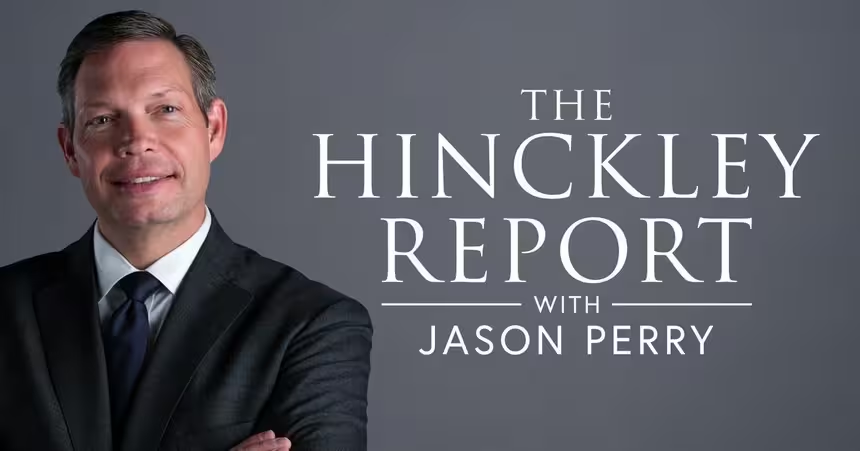
The Hinckley Report
Hosted by Jason Perry, each week’s guests feature Utah’s top journalists, lawmakers and policy experts.Providing Support for PBS.org
Learn Moreabout PBS online sponsorship♪♪♪ announcer: Funding for "The Hinckley Report" is provided in part by the Cleone Peterson Eccles Foundation Fund, Merit Medical, and by contributions to PBS Utah from viewers like you.
Thank you.
Jason Perry: Tonight on "The Hinckley Report."
As the legislative session draws to a close, lawmakers race to pass significant bills.
And as the budget is finalized, our panel examines where lawmakers prioritize funding and what was left on the cutting room floor.
And Utahns gear up to cast their votes as Super Tuesday approaches.
♪♪♪ ♪♪♪ Jason Perry: Good evening, and welcome to "The Hinckley Report."
I'm Jason Perry, director of the Hinckley Institute of Politics.
Covering the week we have Sean Higgins, political reporter with KUER; Aimee Winder Newton, member of the Salt Lake County Council; and Ben Winslow, reporter with Fox 13 news.
So glad to have you all with us tonight, the last day of the legislative session.
Ben Winslow: But who's counting?
Jason Perry: Yes, some of us are, right, Ben?
Four hundred and thirty-five bills passed so far just as of last night, so a lot's going to happen today.
The record, 575 in a session.
That was last year.
So, we're watching very closely because there are a lot of really big bills on the board.
I wanna talk about some of those tonight, but also some that we sort of teed up last week.
I wanna start with you, Ben, for just a moment, because baseball on the agenda.
We have resolution, what did they decide?
Ben Winslow: So, they passed the bill, they passed it out.
And it's an interesting way where there's taxes, but they're not taxes.
It's this weird netherworld where you created a special district, and the negotiations ended up where you've created this district that any money from the Larry H. Miller Company's multibillion dollar development plans across from the Fairpark, any taxes generated from that go right back in to funding a state-owned stadium that the state controls, and if the team leaves, they owe, like, $900 million to the legislature.
They got rid of the hotel tax that a lot of southern Utah lawmakers didn't like because they were saying, "Why should we in Washington County have to pay for a stadium in Salt Lake City?"
Even though it doesn't-- it kind of sort of helps pay for it, but doesn't really, this is all the really interesting, like, tax journey that we went on with this.
And that finally made it through.
They also carved out, though, the legislature giveth, the legislature taketh away, they carved out this exemption or this earmark in the sales tax for-- or in the taxes for rural Utah emergency medical needs, something that rural Utah lawmakers really wanted.
But sort of, well, if we don't do the hotel tax statewide, then we're gonna take that out too.
The car rental tax remains in there too, so if you do rent a car, you are gonna see it go up there.
Jason Perry: One point five percent.
Go ahead.
Aimee Winder Newton: I was just gonna say, it was so interesting to hear from rural commissioners on this, because so many of them were frustrated, saying, "Why are we in Washington County, for instance, paying for an additional sales tax on those tourism items?"
And luckily, that's been taken out.
I think that's good.
I mean, that's-- it was very frustrating.
So, it was a good compromise there.
Sean Higgins: And the way this bill has evolved over the past week or so has been really interesting too.
We heard that there was a lot of behind the scenes negotiations going on before the bill was made public, things started moving incredibly fast once we did have language on the bill, and, like we were just talking about, a lot of pushback from people off of the Wasatch Front on why we are paying for this thing that doesn't directly affect us.
There was that carrot of the EMS money that is now out of there in exchange for getting rid of this transient room tax.
But there are a lot of strings attached to this.
I believe that it's left in that none of these-- or a good number of these provisions don't actually kick in until and unless a franchise is awarded to Utah.
I believe the time is 2032 on that.
Ben Winslow: Something like that, and yeah, none of this exists until we actually have a team.
Aimee Winder Newton: What will be interesting to see is how they're messaging this, because I think the general public, when you hear of subsidies for stadiums and all of these things, after a year that we've heard, oh, it's really tight, like social services, I mean, it's gonna be a tight year, a tight budget year up at the legislative session.
Like, that's gonna be an interesting thing for the legislature to message.
Sean Higgins: And I think just looking at-- to see a bunch of fiscal hawks in the legislature advocate so strongly for a tax increase has just been a fascinating dynamic as well.
Jason Perry: One last comment before we leave this, Ben.
What was interesting to me at least is you had a lot of members of the legislature from the west side of Salt Lake that stood up to support this, saying this was the investment-- Democrats in particular, yes.
Ben Winslow: Yeah, this is one because they've said their community wants this, and West Side community leaders have definitely been wanting economic development and improvement, and it's not just necessarily about the stadium, but it's the investment that the Larry H. Miller company is making to create this power district on the Rocky Mountain power land and the land across from the Fairpark, and it spills over into the rest of the neighborhood.
And people that my station have gone out and talked to in the community are largely supportive of this.
They want to see improvements, developments in this neighborhood.
Aimee Winder Newton: And we're hearing this, a similar sentiment, on the city center improvement bill too.
So, those westsiders in Salt Lake City are really hungry for the investment.
Yeah, so this is-- this give-- this defines an area in the city where there could be improvements made.
It will be through tax increment financing, and so that's going to be interesting to see how that progresses as well.
Jason Perry: Some of the discourse in Salt Lake City is related to this hockey-- potential hockey team, right Sean?
The hockey team, but maybe this district here, this entertainment district which may involve a lot of moving of buildings, a lot of bonding, and maybe a sales tax increase.
Sean Higgins: Yeah, and we actually heard a lot of this talk during the mayoral campaign with Erin Mendenhall really pushing for the downtown core to be a cultural center for the city of Salt Lake.
And I think this kind of checks a lot of those boxes when it comes to that.
It would, if things go according to plan, it would keep the Jazz, at least the Jazz long term in the downtown core.
There was some rumblings that they could maybe move out of Salt Lake City with the Bees getting a new stadium in Daybreak next year.
And I think there's a lot to like if you are a official in Salt Lake City when it comes to this.
There's a lot of infusion of money coming in to revitalize a well used part of the city right now.
But again, like baseball, there's no guarantee that an NHL team could come.
Things could fall through.
I believe neither league has said they have active plans to expand as of right now, but they're open to those conversations.
So, we'll see where this one goes.
Aimee Winder Newton: And there's the sales tax increase potentially in Salt Lake City too, 0.5%.
Jason Perry: Talk about that, particularly through your lens as a member of the County Council about these discussions that are happening about where investment should be.
Aimee Winder Newton: Yeah, well, I mean, the good news about this bill is there's potential for improvements related to public infrastructure.
So, the Salt Palace, for instance, or some of those areas, that may be a good thing which I think when you're taking tax dollars and utilizing them in a public facility like that, that ends up usually becoming a better source of revenue down the road for taxpayers.
Jason Perry: You all want to make a call on this one?
It's on the board today, we'll hear, is it gonna pass or not?
Ben Winslow: Totally passing.
Jason Perry: Okay, I hear us going with pass.
Okay, very good.
I'll talk about money for just a little bit longer with our budget in particular.
We talked on the show a couple of times about the income tax reductions.
Ben, that bill passed.
It's a state income tax reduction from 4.65% to 4.55%, about $170 million revenue.
This one's already through.
Ben Winslow: It is already through, and this is something that legislative leaders have wanted.
They continue to argue that this is economic stimulus, that this gives something back to families.
It is modest though.
Let's be real, that when a middle class family opens up their paycheck, they're getting maybe if you make upwards of just shy of $100,000, you're getting, like, $67 back a year.
You know, that's-- it's not a lot, but they argue that it is the pattern that they have enacted year after year after year after year, bringing tax cuts and doing this.
Now, on the flip side, the minority caucuses have argued that this money would be best spent elsewhere, that there are a lot of unfunded needs, childcare issues, you have social service issues, the Division of Services for People with Disabilities waitlist.
There's just a lot of other things that they say that that money would be best used to fund, so you have a philosophical difference there, but it has passed.
It is part of the budget.
You have a $28 billion budget that will be voted on by the legislature before the session ends.
Sean Higgins: And you have to wonder where the tipping point on some of these tax breaks is.
We've seen revenue estimates from the state, they're expecting it to go down to what they call more normal levels.
All the COVID relief money is not available anymore.
And you have to wonder how many years in a row can we get tax breaks before we start have to making some really hard decisions on what we are funding when it comes to social services, other important needs throughout the state?
Jason Perry: There was one more issue related to this.
This is a child tax credit.
So, Aimee, this one I know you were following very closely, a $1,000 income tax credit for children under 4.
Aimee Winder Newton: Yeah, so last year this bill passed to cover children one to three, and then this original bill was to cover four and five-year-olds.
It got cut back in the Senate, so it only covers four-year-olds.
So, now one to four will get this tax credit for people-- usually incomes around or under $53,000 will be able to qualify for this tax break.
Jason Perry: Just to show the variety of this session too, Ben, psilocybin, mushrooms, magic mushrooms.
I was wondering if that would be the title.
Yes, so there's a bill dealing with magic mushrooms, psilocybin, and other drugs this session.
Ben Winslow: What's interesting is this is a bill that talks about psilocybin and MDMA and similar type drugs, but doesn't actually explicitly say them.
It creates a pilot project with University of Utah Health Intermountain Health Care where people could try them under clinical supervision, and this is actually much more controlled than even our medical cannabis program.
You can't take the drugs home with you, you have to go in, you're monitored, and that's where it is.
And they use it for research purposes as well.
And this bill has quietly made its way through the legislative session.
It won widespread support in the Senate.
It has a final vote in the House.
We'll see where that goes.
But it's been an interesting journey to just watch how lawmakers's perceptions have changed over time.
You know, and you think about even with medical cannabis at a time years ago when it was a very controversial topic, lawmakers wouldn't even touch it.
Now, they're pushing bills on psilocybin.
Sean Higgins: And psilocybin, I mean, even last year we had a bill from Senator Escamilla that dealt with psilocybin that went absolutely nowhere.
And we're talking 12 months later, we're seeing real movement on this.
So, I think some of it can be attributed to the focus on homelessness and the mental health crisis that largely contributes to chronic homelessness and people not being able to get the care they need.
So, even though we're gonna talk about the budget soon, but there's been a little-- some fewer investments as far as financial resource into those programs.
But programs like these pilot programs that deal with alternative treatments could be another way of tackling that issue.
Jason Perry: So, Aimee, to that point, this is something Senator Collamore, who's sponsoring that bill, said this is a mental health bill.
You know, this-- it's aimed at helping that particular group.
Aimee Winder Newton: Yeah, no, I mean, I-- we know we need more mental health resources.
We know we don't have enough therapists to fix everybody, right?
So, we've got to either start looking at proactive measures to prevent that or some of these other alternative measures, which I think, you know, may have some merit.
It will be interesting to see.
Jason Perry: It will be.
One more, let's get to the press a little bit too, because a bill that got a lot of headlines has to do with the Government Records Access Management Act.
Particularly, can we see the calendars of elected officials?
Ben, this bill, it's passed already, and the answer is--.
Ben Winslow: And it is law, and the answer is no.
The law now as it stands is that a public official's calendar is not a public record, so we rely on the graces now of elected officials choosing to release their calendars.
The governor and lieutenant governor have historically done this.
Attorneys general prior to Sean Reyes did this.
And so, but what you had was a legal battle over whether Sean Reyes's calendar should be public.
A judge ruled that it was, lawmakers viewed it.
Some lawmakers, I should say, viewed it as no, that it's always been a protected record.
But they further clarified this in the law.
That court ruling came down saying his calendar ought to be public on the same day the House voted, so it got through very quickly.
I think a lot of lawmakers, it seems, were really concerned about having their lives flayed open potentially for the press.
And so, they did that.
On the flipside of this bill, it did do some good things for the media.
It gave us if we prevail-- or anybody, anybody who uses public records laws, prevails after a long protected fight, you get a little more money with attorneys fees.
So, you know, there was at least that in the bill.
Aimee Winder Newton: I'm just so sad about this, because I just think it's not that hard.
I mean, I have a state calendar, a county calendar, and a personal calendar all in one.
And if somebody needs to see what my county calendar looks like, I can easily send that to them.
I just don't think it's that hard for public officials to separate that, and I think the public should be able to see what's on our calendars and what we're doing, you know, in our elected positions.
I don't know, shaking my head on this one.
Go ahead, Sean.
Sean Higgins: I mean, I think the access to know what our elected officials are doing with our tax money is incredibly important, just for the mental wellbeing of the electorate, and also to guard against malpractice.
I mean, with no offense to elected officials, that we in the media seem to have-- be of the mind that when powerful people, they think no one's paying attention, they tend to do bad things.
And putting these calendars, who's meeting with who, are there lobbyists involved, are you going on all expenses paid trips to wherever?
I think the public has a duty to know, or has a right to know those things when it comes to taxpayer money and the people they're electing.
Jason Perry: This one's on the governor's desk.
Ben Winslow: He already signed it.
It's done.
Aimee Winder Newton: And I will say, I love that the governor and lieutenant governor are so good at putting out their public calendars every week, they are-- Jason Perry: Governor has done that for quite some time.
Let's get to a couple more, because we talked about on the show a little bit too, because we're getting to election time and ranked choice voting.
Aimee, this is something you know well about.
So, there was about to, you know, there's a bill to sunset that, to end the experiment early.
That bill actually failed.
It's going to continue.
Aimee Winder Newton: Well, I think--.
Jason Perry: At least until 2026.
Aimee Winder Newton: The debate's up on whether ranked choice voting is a good thing or not.
But I really think that should be left to the local governments to decide if they want to have that as part of their election.
I mean, that may save-- it can save cities a lot of money if instead of having expensive primaries, you do ranked choice voting.
Now, I know not everybody loves it, but I do believe in local control, and I think the local government should make that decision.
Jason Perry: Go ahead.
Sean Higgins: I was gonna say this was a very narrow vote in the Senate.
This was only a couple of votes either way.
So, it's the last day of the session, coming down to the wire.
There could be a reconsideration on this.
We really don't know, but when it comes to a vote that was not that close in the House and then goes in the Senate the other way so closely, we'll wait and see.
Jason Perry: Okay, we will watch that one closely.
Let's get into elections a little bit.
So, this is a big week coming up, Ben, right?
We've got Super Tuesday.
People are going to caucuses.
But what's interesting on this particular one is what's happening with the presidential-- what you-- sometimes we had a presidential primary, this time we have a presidential preference poll.
Talk about what that means.
Ben Winslow: So, what that means is this is the party delegates, party members who-- people who go to the caucuses get to say this is our preference.
It's non-binding, it just says this is our candidate, our preferred candidate.
So, it's a little different than the primary election, which the Democrats are doing, where, you know, you actually vote on who this is or, you know, to advance that.
So, yeah, it's different.
It is meant to bolster participation in the Republican party's caucus system.
And the people who go to caucus night also become delegates, they go to the state convention, and then they choose the candidates for all the other races as well.
So, it's going to be-- this actually has a lot of things going for it.
But even though the end result of the preference poll isn't really much.
Jason Perry: We're one of the 16 states here on Super Tuesday.
Will you talk about that for a minute, Aimee, about those caucuses in particular, because if you want to participate in the poll, Republicans, you're gonna have to register.
Talk about registering and then casting a vote.
Aimee Winder Newton: So, people can show up to the caucus meeting, register there, vote, participate, but you also can pre-register, and I think the party has done a great job of putting out their pre-registration link.
I went on the other day and did it myself.
All you do is either have your voter ID so that they can pull up, you know, that you're able to vote or put in a little bit of information, and it pulls up your voter ID, and then you pre-register.
It tells you exactly where your caucus meeting is, so I think they've done a good job of helping to get that information out.
There's also an opportunity for people to do absentee ballots.
And so, they can-- they don't have to say why they aren't even going.
If they want to stay home and watch their favorite show, they can do that and send their ballot with somebody to the caucus meeting and still vote that way too.
So, I mean, I know some-- we're getting spoiled, right?
We're used to having ballots right in our mailbox, and it's so easy, and you drop it back in.
So, yeah, this is a little bit more effort, but, I mean, I think back to the olden days when we used to only go to the local elementary school to vote, and this is not that different from that.
Jason Perry: I wanna talk about where voters are, because they'll be participating.
But, Sean, you participated in an event recently where you got with Republican voters to talk about their options about some of these events.
Maybe tell us about what that was, and then I wanna talk about Nikki Haley, first of all, because this is one of the questions you asked about.
Why don't you tee this up for us?
Sean Higgins: So, KUER and PBS Utah compiled a panel of six Republican voters, ranging in ages from late 20s to early 40s, and we tried to mirror the most recent polling on this as far as who is supporting Trump, who is supporting Haley, who was supporting undecided.
And there were some really interesting responses that kind of go against some of the common narrative we see, certainly in national media, when it comes to the Republican primary.
And Nikki Haley was just here in Utah this week, and we had some Haley supporters on the panel, and they had some really interesting thoughts on whether Haley should stay in the race long term.
I know there's a strong push from people who are supporting Donald Trump for Haley to get out and just coalesce behind one candidate, but Utah has a complicated relationship with President Trump.
And here is what one Haley supporter said.
Jason Perry: Let's watch this first one to your great question.
Sean Higgins: What are your thoughts on Nikki Haley staying in the race?
Trisha Loveless: Smart.
With Trump facing all of his legal challenges, I-- and how old he is, all she has to do is stay in.
Like, she doesn't have to perform at all.
If anything goes wrong before the national convention, she'll be the only option if anything happens, like-- Sean Higgins: Anything legally.
Trisha Loveless: Yes, yes.
If there's anything that happens that prevents him from taking that nomination, she's the one just sitting there.
So, as long as she has the financial backers, I see no reason for her to get out if she's willing to put up with the headache of staying in forever, with losing.
Nicki Brammer: I love that she stayed in, because she's talking about important policies.
You know, we need more discussions, we need more talk about the policies and less soundbites.
I hate the idea that we've decided who our presidential candidate is and it's February.
You know, and so, you know, we need somebody to stay in.
I know that funding is part of the problem, but I-- the fact there hasn't been a debate between the top two candidates and there might not be, I think that's very problematic for our voters's education.
Jason Perry: Let's break this down for just a moment, because I understand you are a Nikki Haley supporter.
Aimee Winder Newton: I am, yeah.
Jason Perry: So, talk about that analysis right there where at least, you know, some Republican voters saying they're glad she's staying in.
Aimee Winder Newton: Yeah, no, I think it's a-- I mean, here's a guy who's-- he's old, and he's got a lot of things going against him, and you just never know.
So, I mean, she could be playing her cards right on that, for sure.
I do think too, I mean, as a member of the Republican Party, I love having somebody go in and talk about Republican principles.
Fiscal discipline, local control, less government.
Those are things Nikki-- Nikki is actually talking about the Republican platform, whereas we don't hear that from Donald Trump.
And so, as a Republican, I love that somebody is in there helping to help-- helping to educate people on what a Republican is.
Jason Perry: Your comments about what might happen this week is we have a lot of states that will be doing our, you know, preference polls and other sorts of polls.
She's not won any of those yet, but it seems to be a group of Republicans who are still looking for her to stay in.
Ben Winslow: Yeah, and look, Utah has had, to Sean's point, a complicated relationship with President Trump.
He hasn't performed as well as past Republican presidential candidates.
So, that being said, you can't help but wonder if the outcome is going to repeat itself where Trump wins the preference poll here, Biden wins the Democratic primary, and this plays out.
But there is an advantage for Haley to stay in the race, because we got a long way to go between here and November.
There's a lot that can happen.
Sean Higgins: And I think one of the most surprising things of the discussion was how frustrated voters are with the lack of choices.
Like, we're barely a few months into this process and we are for all intents and purposes down to one candidate right now that, barring any legal developments, will be the nominee.
So, there's just some frustration universally right now.
Jason Perry: Let's talk about that frustration for a second, because I wanna show this next clip, because the question kind of is, you know, how far will you go if you believe in a policy or you want a policy as opposed to what you might get to get that policy?
You asked that very question.
So, maybe you give some analysis after we watch this clip.
Spencer Roberts: Trump is not somebody that reflects my personal values of how I like to live my life.
At this point, I'm like, can you just implement the policy that I want and you can be a trash person?
Like, I'm not expecting you to be a good person.
And I think that in that case, it's like we should build incentive structures that plan on the politicians being bad people.
Aaron Bullen: I even said that I'm leaning towards Trump.
I don't like the guy.
He wasn't my first choice in the primary, and, like Spencer said, I wouldn't wanna hang out with him.
I don't think he's a good person.
But then again, I don't think Joe Biden's a good person either.
So, is that gonna be polarizing in Utah?
Yes, it's going to, I believe, make him underperform in Utah, but he's still going to take the state handily.
Yemi Arunsi: I think that a lot of what people have seen is that the ability within the executive branch to sort of, you know, that quote unquote "drain the swamp" or the perception that that happened, right?
And I think that's what's winning a lot of people over, right?
That perception that he's gonna buck the system, right?
And people can't let go of that.
Jason Perry: Okay, Sean.
Sean Higgins: This speaks to that complicated relationship we were talking about.
Donald Trump did not even get a majority of votes in 2016 when we had Evan McMullin on the ballot as a third party choice, underperformed in 2020 compared to past GOP candidates, and in hearing the voters talk about why they are actually supporting Donald Trump, I think nationally there's a lot of attention paid to that 20% to 30% who are diehard Trump fans.
And then you look at the primary results, and you go, well, if he's such a controversial figure, how is he getting these margins in these Republican primaries?
And hearing people like Spencer and Aaron talk about the reasons why they're actually supporting Donald Trump, they don't like him as a person, they would never have him over to dinner in their home, but they like the policy.
They like things like Aaron talked about the remain in Mexico policy, how he was a big fan of that, and some policy that was enacted over his term that they are really a fan of, but they're not a fan of the person.
Jason Perry: Aimee, talk about this, because you hear from both sides on this one.
It's kind of through what you hear, how are people resolving this maybe sometimes internal conflict, sometimes not so much?
Aimee Winder Newton: Yeah, first of all, I think it's devastating that we feel like that we can support candidates who we consider trash or that we don't have higher expectations for our elected officials.
I mean, to me, that's just mind blowing.
But I get it, I mean, we've got a border crisis right now, and I think, you know, if there's anything that's gonna tip the scales for Republicans to plug their nose and support Donald Trump again if he's our nominee, I mean, that's one of them.
Biden's not fixing that.
So, there are policies that people see as very immediate, and we need to take a good hard look at at what those are to get our country back on track.
And so, I get that, but man, I just still am shaking my head.
Seventy-seven percent of Americans don't want a Biden-Trump rematch, and yet these are our-- these potentially could be our candidates.
And it's just sad to me.
Jason Perry: That's gonna have to be our last comment.
Thank you so much for your insights this evening.
And thank you for watching "The Hinckley Report."
You can find the full voter panel discussion on the PBS Utah YouTube page.
Thank you for being with us.
We'll see you next week.
announcer: Funding for "The Hinckley Report" is provided in part by the Cleone Peterson Eccles Foundation Fund, Merit Medical, and by contributions to PBS Utah from viewers like you.
Thank you.
♪♪♪ ♪♪♪ ...

- News and Public Affairs

Top journalists deliver compelling original analysis of the hour's headlines.

- News and Public Affairs

FRONTLINE is investigative journalism that questions, explains and changes our world.












Support for PBS provided by:
The Hinckley Report is a local public television program presented by PBS Utah
Funding for The Hinckley Report is made possible in part by Cleone Peterson Eccles Endowment Fund, AARP Utah, and Merit Medical.