
2024 Mackinac Policy Conference: Collaborative conversations across partisan divides
Season 8 Episode 48 | 56m 46sVideo has Closed Captions
Business leaders, policy makers and others gather at the 2024 Mackinac Policy Conference.
This week on “One Detroit”: Business leaders, policy makers and others from across Michigan and the nation gathered at the Detroit Regional Chamber’s 2024 Mackinac Policy Conference. This year’s conference and its theme, “Bridging the Future Together,” addressed Michigan’s social, political and economic challenges with an emphasis on collaboration across partisan divides.
Problems playing video? | Closed Captioning Feedback
Problems playing video? | Closed Captioning Feedback
One Detroit is a local public television program presented by Detroit PBS
2024 Mackinac Policy Conference: Collaborative conversations across partisan divides
Season 8 Episode 48 | 56m 46sVideo has Closed Captions
This week on “One Detroit”: Business leaders, policy makers and others from across Michigan and the nation gathered at the Detroit Regional Chamber’s 2024 Mackinac Policy Conference. This year’s conference and its theme, “Bridging the Future Together,” addressed Michigan’s social, political and economic challenges with an emphasis on collaboration across partisan divides.
Problems playing video? | Closed Captioning Feedback
How to Watch One Detroit
One Detroit is available to stream on pbs.org and the free PBS App, available on iPhone, Apple TV, Android TV, Android smartphones, Amazon Fire TV, Amazon Fire Tablet, Roku, Samsung Smart TV, and Vizio.
Providing Support for PBS.org
Learn Moreabout PBS online sponsorshipOne.
Detroit is on Mackinac Island for the Detroit Regional Chamber's 2020 for and Mackinaw Policy Conference.
This year's focus is bridging the future together.
Just ahead, we're going to bring you some of the important conversations on the island about the critical issues in Michigan and the importance of collaboration to move our state forward.
A special hour long one.
Detroit starts right now.
From Delta Faucets to bear pain, Masco Corporation is proud to deliver products that enhance the way consumers all over the world experience and enjoy their living spaces.
Masco.
Serving Michigan Communities since 1929.
Support also provided by the Cynthia and Edsel Ford Fund for Journalism and Detroit PBS Duty Foundation is a proud sponsor of Detroit PBS Among the state's largest foundations committed to Michigan, focused giving We support organization that are doing exceptional work in our state.
Learn more at DTI Foundation, Macomb.
We help organizations find their voices through what they do and who they impact.
We are veekay PR and Creative, a Detroit agency telling the stories of critical issues affecting the big picture and the small moments stories at Skyline Heights and on the ground influence.
We lead with relationships first solutions always and with diversity as our compass, BTK, PR, and Creative Hope, Nissan Foundation, and viewers like you.
When the state's mental health system fails, people have psychotic breaks.
You know who deals with them in this state?
It's your police officers.
People think Detroit is coming back.
They think the state is doing great.
And part of it is because you have people from outside of Detroit who have invested money here, who go around talking about how great that investment was around the country.
You're never going to have a city do great if it's just the downtown doing great in the neighborhoods are not doing great as well.
So maybe you look at a city and you build it from the inside out like we're doing.
Let's build a bridge to the future and create more innovative, prosperous and strong Michigan.
I know together there's nothing we can't do.
Policy makers, business and community leaders and academics have come together once again for the Detroit Regional Chambers Mackinac Policy Conference.
Welcome to this special edition of one Detroit.
I'm Stephen Henderson, a one Detroit contributor and host of American Black Journal.
We're coming to you from the Grand Hotel on Mackinac Island.
This is our 14th year bringing you coverage of this event from the conference sessions to the individual conversations right here at the one Detroit desk.
Over the next hour, we're going to share some of the highlights.
We're going to hear from Detroit Mayor Mike Duggan and Police Chief James White.
Plus, Governor Gretchen Whitmer is going to talk about the state's future.
Then, the conversation with businessman and philanthropist Dan Gilbert also had an update on the Detroit Public Schools Community District Superintendent Dr. Nikolai Vitti.
And we'll look at the role of racial equity in growing Michigan's population.
That's all coming up.
But first, I'm joined by one Detroit contributors, Nolan Finley, who is the editorial page editor at the Detroit News, and Zoe Clarke, who is the political director for Michigan Public Eyes.
Welcome to the island yet again.
Welcome to the mess.
All right.
So what is the what's the headline this year on McKinney?
What is it that we're trying to get done during this?
Three days of horses and fudge and taffy?
Well, you know, I think one of the things we're trying to get done is translate the policy ideas that people are kicking around up here.
You know, in the actual legislation.
And I think there's a lot of work being done to get the lawmakers, the legislative leaders who are here to actually and the governor to sit down together and come up with some sort of consistent strategy.
So we're not every few years throwing out everything and starting over.
I think there's an appetite amongst the business and community leaders up here for some consistency.
And I would say consistency is the key word of this.
So so if you're a business leader, you're up here.
What is it that you're looking for the legislature to get done?
What what what are the issues that that you want them focused on?
Yeah, some consistent policy on business attracts, you know, some consistent policy on on workforce training, fixing our schools, some ideas for housing and addressing this this housing crisis.
We have too many people who make decent incomes still can't afford housing in this state, particularly younger people.
These are things that are going to show up and slow down in our growth over the next 20, 25 years.
We don't get out of head up today.
Zoe, The legislature has not even finished the budget yet.
They hear that which used to be a big issue up here sometimes.
I mean, there would be this crisis because you got to get it done way in the Mackinaw because, well, they're not around most of the summer and then you're up against it in the fall.
Right.
It doesn't seem to be as much panic this year about it, but they are behind it.
So it feels very prescriptive this year.
Right.
Like both the House sort of how things work.
The House votes on their budget, the Senate votes on their budget.
The governor, of course, gave her executive recommendation back in February of what she would like to see.
And now what needs to happen is the three sides need to come together and figure out what the plan is.
Now, statutorily, they're meant to have it done by July 1st.
Yeah, and you know, people who have a fiscal year that begins July 1st would very much like to know whether you're a school or a teacher.
You'd like to know how much money is coming in.
So certainly, though, there are conversations that will happen on this island vis a vis the budget.
And again, as we were talking about, whether it's this innovation fund, whether it's, you know, the SOAR fund that are going to play into all of the political machinations in Lansing downstate.
Yeah, people back home in Detroit sometimes say, well, you know, these people go upstairs, upstate and jawbone for three days and nothing happens.
Yeah, we do, but.
Well, let's talk about some things that actually happened here.
You've done some really important things done in the state.
Don't dismiss that jawboning aspect of it, because there are.
You're saying that that's the point?
I didn't say it's a point.
I said it's not it's not a distraction.
I think it's one of the points because you come up here, you meet a lot of people, you get to spend some real time with with folks talking about things.
Relationships get built.
We've seen a lot of deals get done on the porch over the years on some major, major developments happen so that getting the people together, whomever get together anywhere else, is not a insignificant piece of it.
Yeah.
Yeah.
So what do you think?
Well, people are approving it.
And look, you know, there's things like we've talked about before happening here, the Gordie Howe Bridge, the the bankruptcy, I mean.
Right.
I mean, these were big sort of novel ideas that happened politically speaking.
I can tell you right now from my view.
Well, you two are talking, so I'm looking at a possible gubernatorial candidate out the window meeting with a possible thunder outside candidate.
Could that be what they're talking there now?
So but now you said that you've got to say who that is.
Part of what you're seeing happen on this island is the connections that are being made for the future of this state.
Whether you like that or not, that's what happens.
Yeah, yeah, yeah.
What about successes that we have in the state that we should be building on right now?
I mean, when we think about Detroit, of course, we've got a streak of wins going on that we haven't seen in a long time.
And I talked with the governor Wednesday more our new mayor I'm sorry, Wednesday morning.
And, you know, he is sort of basking in the glow.
I mean, he talked about right now right.
He took to talk about his first appearance at back out as mayor 11 years ago, walked up the hill and we were in the middle of bankruptcy.
And he wasn't really in charge of Detroit at all, as you know.
And it was all, my God, are we going to get to this?
Yeah, well, we're well through it now, 11 years later.
And he is sort of kick it back and forth and basking in it.
You know, I think he's very pleased with himself.
And I think Doug, in speeches at this conference since that first woman after they have been at bay.
Right.
And also we should like know how he'll do it with just like notes on a notepad.
I mean, people come now and sit in these sessions to watch him.
And I'll also be clear, not everybody's coming for all the sessions.
Right.
Right.
Again, a lot of folks as they are, but people come in and they come and watch it.
And I think it can't not be noted the fact that, again, as we've been talking about population growth and the city of Detroit and all the work that Duggan has done vis a vis the census, to say, I don't agree with these numbers.
Yeah, that Washington Post Washington Post editorial yesterday said the mayor of Detroit is right.
I talked to about that.
He said it was the last thing he ever expected.
He's got it pasted across.
This is he just became a subscriber to I hear the site and subscriber to The Washington Post.
All right.
Quick question.
Fudge Taffy.
fudge.
fudge.
Cranberry from.
No, you're not.
I ask you Taffy.
Cranberry, if I just go.
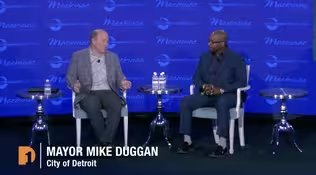
So let's start with Detroit Mayor Mike Duggan's appearance right here at the conference.
Each year, the mayor updates city and state leaders on Detroit's progress and his goals.
The mayor and the police chief, James White, talked about the challenges that are facing Detroit and Michigan.
For those of you who come to see the annual PowerPoint, it's going to be a little different this year.
And we call that addressing Michigan's greatest challenge.
And of course, when the mayor and the police chief are here talking, you know that we're talking about the state's mental health system.
Right.
And we really are.
Because when the state's mental health system fails, people have psychotic breaks.
You know who deals with them in the state?
It should police officers every single day.
And in Detroit, Chief White's actually built a mental health division within the Detroit Police Department because it's what he had to do to cope.
The drug shootings, the gang shootings have dropped dramatically.
But, you know, the violence we're dealing with today, last week, two brothers arguing over who the best performing artist said gets so heated, one shoots and kills the other.
Couple days ago, 72 and 75 year old woman sitting at the table, longtime friends arguing gets overheated.
One of them grabs a knife and stabs the other.
What we are seeing is a level of violence which, you know, we sit with.
You are officers, your command staff, who say no number of police officers in the world could have prevented that crime.
And so talk about what you face now, because this is a different challenge for the Detroit Police Department.
You know, it really is.
I joined in 1996.
I came on the job like I said, I would be a traffic cop, wanted to reduce crime, wanted to do those things, but I could not anticipate the impact of the mental health system on policing and what we're dealing with and what we're up against.
When you look at that 15,990 calls, those are people who call.
What about the other several thousand that didn't call?
And that's still, you know, representative of, you know, double digit responses to mental health crises on a daily basis.
So calls for mentally ill and violent, almost 25, 30 calls a week that somebody is mentally ill and violent, nearly always armed that you are handling.
And so let's talk about this.
Is this Detroit or as you talk to chiefs around the state, what are they saying?
They're seeing an uptick.
You know, nothing good came from COVID.
But what COVID did tell us and show us is the impact on isolation and and how it impacts a person's mental health.
Now, we can't unsee the crisis of mental health in our communities.
Every chief that I've talked to has gotten an increase in numbers.
Nothing like Detroit.
But but certainly they're seeing in their communities an uptick of violence.
Even in Farmington Hills recently, a brother shot a brother.
We see it over and over again.
We had a, like you said, the two seniors that got into an argument and the impulse decision making and the inability to resolve conflict that's resulting in homicides.
So we're in a meeting with the Chiefs leadership and a couple of his leadership folks are talking about these murders violently mentally ill people and say, you know, it's been like this since Lafayette Clinic was closed.
The meeting ends and you know, this is to me is an attitude of helplessness.
The chief walks into the office with me and says they closed Lafayette Clinic 30 years ago.
We need to stop talking like this is a new problem.
He said, I want to start a mental health division within the Detroit Police Department.
I want to stop complaining about the problem and recognize the fact that we are the front line.
Will you support me on the funding to create something within DPD?
And this was I mean, I was just astonished.
what Police chief wakes up and says, I'm going to create a mental health department within a police department, but that was your plan.
Talk about what you were thinking.
Well, you know, we see it every day.
And, you know, we I said often, you're not going to rest your way out of crime.
We know that there are things that impact decision making.
We know when someone shoots someone because of road rage, that's not something that you can talk someone out of.
There's something going on.
We know when we're averaging a barricaded gunman a week and someone is isolating themselves in a home with a gun threatening to kill themselves because your girlfriend or boyfriend broke up with them, that we've got a big problem.
So we needed to look at ways that we could safely handle these runs and B, get the officers the training that they need because we know we're losing officers.
We've got officers that have been shot.
We've had officers that have been killed by people who are in mental health crisis.
And so this was just a pathway to do something different.
The mayor also participated on a panel about the housing crisis in Michigan.
As we look to grow the population, state, regional and local partners are all working together to address the affordable housing shortage that we have.
It's a top concern for agencies that are trying to create safe and healthy communities.
What are some tools that policymakers and I particularly think about this conference where you have them all on an island together need to hear right now.
When we talk about affordable housing, when we talk about those who are unhoused.
Right.
So so one one perfect example about how policy and poverty about poverty is the policy choices.
The child tax credit.
Yeah, we increased the child tax credit during COVID, childhood poverty, what was cut in half.
We let that lapse and big surprise, child poverty skyrocketed.
And so there are significant policy choices that we make that make affordable housing more difficult.
It's really a two pronged issue.
We have a supply issue.
We have 40% of renters in Michigan have high burden housing boarding costs, meaning the rent that they're paying is more than 30% of their total income.
And we also have significant economic security issues.
You know, we have high rates of poverty.
And so people, frankly, can't afford the housing that's there in our state.
And so we need to do things, one, to make the supply side more accessible through things like investments in the community, housing development Fund, as well as boosting economic security by boosting wages, addressing things like paid family leave, things that really make sure that a family has the resources, which is frankly, cash available to pay for housing.
KELLY In a separate commentary you wrote this year, you noted that affordable housing is not a one size fits all solution.
Talk to me a little bit about that and all of the different than solutions that you have to think about and sort of the puzzle of putting them into place.
Yeah, well, everybody's situation is so different and some of the things you were just talking about, the different situations and families that that we're working with as, as a state don't fit into that same that same type of affordable housing situation, whether it's multifamily or single family home triplexes duplexes, you know, and working with general density, it is very different depending on the family situations.
And what we also know is it's not always just about housing, it's the housing and the resources that you can surround somebody with to make sure that they're on a road to self-sufficiency and have the independence and dignity of homeownership, or at least a comfortable housing situation.
If it is rental.
But we're seeing, you know, family sizes are different.
That used to be a 4.2 person average.
Now it's 2.1.
That by itself is going to greatly increase the need for affordable housing.
And the other part that's surprising me is how many people don't understand who qualifies for affordable housing and what affordable housing is.
It's not something that's concentrated poverty, which I hear on a regular basis.
It's not it's not at all.
And when you're talking about average median incomes from 30% to 120%, that is a broad stroke of who qualifies.
And so a campaign we're working on is neighbors, not numbers campaign to bring awareness to what affordable housing is, what it is not who qualifies.
Because I think people would be surprised.
It's your server's it's your local bank teller.
It's your pair pro and your kids school.
It's a number of people that have an important role in society that impacts our daily lives, that cannot afford affordable housing.
Last year, Governor Gretchen Whitmer announced the creation of the growing Michigan Together Council here at the Mackinaw Policy Conference.
Since then, the Council has identified several strategies to reverse the state's really long term population loss.
One of the conference sessions this year looked at the importance of making racial equity a priority in all of these proposed growth plans.
2018.
The Kellogg Foundation produced report titled The Business Case for Racial Equity and talked about the racial wealth gap that we have in our state, and that is costing our state $92 billion, and that if we close that gap by 2050, the state stands to gain that amount of money.
So our role at the Black Business Alliance, we really took that report.
You know, the report not only stated the facts, but also gave a road map to how do we actually do that work.
And part of it is access to capital for minority entrepreneurs.
It's business development in underserved areas.
And so our organization is trying to do that across the state.
And I think it's important to understand that if we are a state that wants to grow and develop, then we have to take a hit on the racial equity issue and we have to take on just a different lens and perspective to how we are shoring up opportunity for black businesses, small businesses, generally.
People want to live in a place where they are as walkable with thriving commercial corridors.
And absolutely how we treat small businesses as a state, how we deal with racial equity, will help determine whether or not we get to where we're trying to go.
Thank you, Dr. Perry.
So much to what the first question, particularly with your national lands, how are others addressing this moment and what have you seen in this work?
Well, first of all, thanks for having me.
And this is a great crowd.
Beautiful crowds packed.
So a lot of excitement.
What I tried to do with the national landscape is remind people, particularly during political seasons, that the work to maintain or even grow populations go beyond a political season, that this is establishing a policy agenda that enhances job creation, creates better schools, creates housing opportunities, increasing ownership, business ownership in particular.
And when you focus on the agenda, you can then you realize what it will take to maintain population and grow population here in Michigan.
You have a lot of the building blocks for those things to happen, but like a lot of states, it ebbs and flows.
With political season, people either build up an agenda that is maintained in the next administration, tear it down.
What I think is important for this room, and I think what's important for Kellogg is for the people in this room to understand these are the building blocks that we're going to impress upon whoever is in office, and we're going to maintain this.
We're going to hold you to that.
To that fire.
What you'll see in the report is a recognition, for example, that Michigan has a chance to really make up that median income gap that can drive prosperity with investments, for example, in our entrepreneurship and innovation ecosystem.
Michigan's already a top ten state for patents.
Michigan already has the preeminent black tech ecosystem in America, arguably in things like black tech SATs, for example.
But what we see is our entrepreneurs, who we have tons of folks who have Michiganders, have driven innovation in this country and around the world for a long, long time, unfortunately, struggle to get capital, for example.
And then when they're about to hire their first hundred folks, maybe you'll see capital flight.
So things like the innovation fund that's in the governor's budget or what have you, our attempts to make sure that we're investing in our entrepreneurs, keeping them here, capitalizing businesses, building intergenerational wealth, and closing meeting income gaps to help drive growth.
Charity to you as well to on that question and hearing this.
How do you see these strategies, you know, being beneficial and do you see the opportunities for engaging and building on are there parallel in support of the work you're undertaking at the Michigan Black Business Alliance?
Yeah, I'll say this.
The last 2 to 3 years have been really good for black businesses.
We still have a racial wealth gap, though, right?
So we still have a very long way to go.
But we have seen innovation and we have seen growth in Michigan.
Right.
And that is a result, a direct result of a number of things happening all at the same time.
Right.
So you've got the pandemic that happened that really highlighted what we already knew, the disparities that were already there, but provided an opportunity.
We had leadership at the federal level, state level that were really intentional about how are we directing resources to help black businesses.
But I am very nervous.
Things could change like this.
And all of the the growth that we've seen over the past couple of years, you know, could be taken away.
And this is why I think to Dr. Perry's point, it can't be a political issue and this is why we have to be unapologetic about calling out the disparities that exist.
This year's conference covered themes critical to Michigan's future, such as attracting businesses and jobs, workforce readiness, strengthening infrastructure and leading with innovation and equity.
Governor Whitmer talked about moving the state forward in her keynote address two years ago.
On this stage.
I talked about Michigan in the year 2100 and what we need to do now to set up future generations for success.
Last year, I spoke about how we can strategically grow our economy and our population and establish an aptly named council to create a state strategy to meet our population goals.
The theme of this year's conference.
Thank you.
Suzanne, is Bridging the future together, which is fitting for an island in the sight of the mighty Mack.
The bridge is a living symbol of the promise of our state.
It is a million ton monument to what Michiganders can do when we put our minds together to solve a difficult problem.
And that's what I want to talk about today.
I want to talk about the three C's of innovation, culture, capital and creativity, and unveil new tools to build on our economic development record and unleash Michigan innovation.
The truth is, entrepreneurs need all three of these things to survive and to thrive.
They need to feel represented in the culture and capital to make audacious, audacious bets on their ideas and fewer barriers to creativity.
So first, culture.
We must build a culture of innovation and make Michigan a place where innovators and entrepreneurs feel seen and heard.
Today, I'm pleased that we are going to announce a new team member at the MDC who will be serving Michigan's chief advocate and first point of contact for entrepreneurs.
Ben Mershon will be Michigan's first ever Chief Innovation ecosystem officer.
Ben is going to help build a community of innovation in Michigan, where every founder and dreamer knows they have a voice in state government.
Second Capital.
Ask any entrepreneur what they would do if money were no object and you'll get an earful.
Every entrepreneur knows their next big idea.
But access to capital can spur innovation like nothing else.
And that's why last January, in the state of the state, I proposed an innovation fund to invest in high growth startups and create thousands of jobs.
Today, I'm excited to announce Pitch Me, Pitch Me will be a statewide Shark Tank style competition, freshwater style, helping innovators address the biggest problems facing Michigan.
Pitch me Well.
Identify a challenge that Michigan innovators will rise to meet the state in partnership with leading organizations will host a public competition to solicit pitches and then invest in the most innovative startup.
That startup will then be able to take the capital and make a real difference.
Finally, creativity.
Today, let's start building out what I'm calling the infrastructure for innovation right here in Michigan.
Earlier today, I signed an executive directive instructing state agencies to catalog technology, equipment and facilities all across our state and work with the owners to make it available to innovators who need it.
Just this morning, thanks to the Biden-Harris administration, we announced an expansion of Project Diamond, a partnership between automation Ellie, Oakland, Macomb and Wayne Counties.
They'll be using federal funding to connect manufacturers with a network of 3D printers.
We'll also enter a memorandum of understanding with the Department of Military and Veterans Affairs to make infrastructure like a chassis dynamo ometer at the US Army Ground Vehicle Systems Center accessible to Michigan innovators.
This ammo you are the first of many to come, expands access to talent testing facilities and equipment.
I want to recognize an incredible partner in this work, our Adjutant General, Major General Paul Rogers.
Michigan is going to be the first state in the nation to get this done and the only one to take such a strategic, proactive approach to open the infrastructure for innovation.
Together, these three actions will strengthen our comprehensive economic development strategy university research corridor, and plays a key role in revitalizing the state's economy and in attracting businesses and talent to the region.
It's a collaboration between Wayne State University, Michigan State University and the University of Michigan, and it focuses on research and innovation.
We have a $24 billion impact on the state.
The university said almost $3 billion of research.
The start up activity is enormous and we have more employees than GM or Ford.
And so I think the universities are going to be the sparkplug for the economic engine for the state of Michigan.
So, Kevin, you are new to Michigan.
Tell me a little bit about when you heard about the university research corridor.
What piqued your interest and where do you want to see it go in the future?
So I'm on a 48 Stop Listening and learning tour on our campus.
Just about finished.
I got about six stops left.
I've done that all about 12 weeks.
And one of the questions I've asked each of the deans and senior leaders is I've been on that tour is how can each of your colleges or schools on the campus contribute to the university research corridor in a partnership with the University of Michigan and Wayne State?
Because we each bring some unique talent to the to this, we're focusing on four primary areas around artificial intelligence, sustainability, health sciences and advanced manufacturing.
And and so I'm glad that we have four areas of focus right now.
And and so I'm excited about the ways in which we're going to contribute collaboratively with the three great research universities to, you know, have an influence and impact on the economy of Michigan.
Well, let's talk a little bit about that collaboration.
You know, sometimes universities can be siloed.
Right.
So talk to me about what it looks like aside from just, you know, the corridor and having meetings.
I mean, what does collaboration look like between these three universities when we're talking about this research?
I can tell you that over the past almost two years, the three institutions have really been working very hard to identify those areas of focus.
And we have major grants now.
For example, the space grant that supports all of their universities in terms of artificial intelligence and the our allies already apparent, we're getting collaborative, collaborative grants and the magnitude of those grants is doubling almost every other year.
And so I think it's sort of a doubling in the next three or four years.
And it's extraordinary.
And that's going to be the economy of the future.
And it requires that we work together because no single institution has all of the research assets that are necessary to give back to the ecosystem.
And I'm so excited about what's happening in Michigan.
But I'm curious what more universities need to do to get folks at the table having these conversations.
President No, I'll start with you.
What's remarkable right now is that the stars are aligning.
I have never been in this state where the governor, the state legislatures, the mayors, the cities are all coming together.
And we're developing plans together with business leaders of Michigan to grow Michigan together.
Council has some bold recommendations that we're implementing.
And so I'm really bullish about what's going to happen in the state of Michigan in the next five years.
Agreed.
And I think those four areas, those four sectors that I mentioned earlier, that the university research corridors decided this is where we bring great expertise and we're going to even be better when we collaborate more.
And it's identifying ways it will attract new businesses and companies to the state of Michigan that's going to help with the grow Michigan Together, Grow Michigan Together Initiative two to help with population growth.
And we want to be sure that we're I'm proud of the fact that we place so many of our graduates back in the state of Michigan to help drive the economy and especially in the in the health care area.
As you well know, that there's a shortage of health care providers.
And the three universities in among the university Research quarter placed more graduates in those health care fields, and especially in nursing than any other state in the country.
Improving education outcomes for K through 12 students is important to our future here in Michigan.
Detroit Public Schools Community District Superintendent Dr. Nikolai Vitti gave us an update on the district's efforts to prepare students for success in higher education and in the workplace.
What are the biggest challenges that you're facing right now, whether it's short term or long term, as you look to the future?
Well, I think to answer that question, I'll talk externally and internally, externally equal and equitable funding.
You know, I think Governor Whitmer and and the current legislature have made strides in improving per pupil funding, increasing more grant funding, concentrating funding on at risk students.
That has helped.
But we're still talking about a formula that's outdated and unequal.
And I think that it has to be solved.
I mean, we cannot go to another conference.
We can't hear another get another report about Michigan funding still being inadequate when it comes to public education.
So not only is the funding generally still low when you look at comparison to 50 states, but it's still unequal.
So the formula has to change by not relying on local funding to initiate the funding process and then getting that equitable where we're funding students in need at higher levels so that they have more resources.
If we don't fix that problem, then DPS will always be challenged with facilities not having enough money to deal with special education, not enough funding to deal with transportation costs, and really not enough funding to create equal opportunities.
When you look at poverty and the history of race internally, chronic absenteeism.
You know, we've improved, but, you know, our data is clear.
If a student misses nine or fewer days, they're 3 to 5 times more likely to be at an above grade level.
State assessments and college ready on tests.
And so, you know, and beyond that, just I would say the other challenge is just continue to improve climate and culture.
You know, we have schools that are fantastic.
You can feel the energy.
You know, we do something with students called Math Challenge in Prepared.
And we have students take a survey where they answer questions about whether they feel love, challenge and prepared.
And we have schools that are above the national average.
And then we have other schools that are significantly below the national average.
And it's just chipping away and getting the right leader, developing the right future leaders, you know, recruiting and retaining teachers to make every school where students still love, challenge and prepare to above the national average.
And that doesn't happen overnight.
So that's why the sustainability, I think, in my leadership, in the board's leadership is important.
So you can just chip away at the problem and scale excellence.
You made some news this month.
You sent a letter to Governor Whitmer, Mayor Doug, in some other state and city officials.
It addressed your concerns about marijuana use, particularly edibles and vape pens among students.
What's going on?
Like, why?
Why did this become such a big deal that you needed to to send this message?
Well, just didn't feel like a lot of people were even aware of the problem.
So, you know, one one reason for the letter was to gain create more awareness.
From a policy level, state and you know, city locally, but also use the media to talk directly to families so that they could be more aware of this problem that's happening.
Obviously, we inform parents when we have an incident like edible or vape pen, more edibles.
So, you know, the feedback has been positive that, one, parents have greater awareness of the problem, talked to some, talked to the governor's staff and some city council members about maybe rethinking the state law around marijuana and maybe thinking differently about ordinances.
But and I said we're definitely supportive of the legalization of marijuana.
I think it's just about evolving and understanding.
What are the new challenges that were created with legalization.
And I think maybe the letter sparked more different conversations and greater awareness about what we could do differently moving forward.
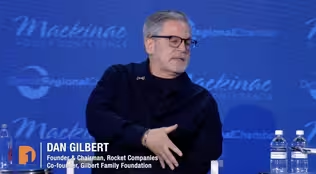
Businessman and philanthropist Dan Gilbert spoke at this year's conference about building equity and economic stability for Detroit residents.
He talked about the importance of increasing access to opportunities for the community and inspiring others to invest in Detroit.
I think that we're never going to have a city do great if it's just the downtown doing great and the neighborhoods are not doing great as well.
So maybe you look at a city and you build it from the inside out like we're doing, but the neighborhoods are coming along to their credit as well.
And I think that when you have a city, a lot of the jobs in urban core or a lot of jobs, the cities are in the urban core.
So if there are jobs downtown, then hopefully a lot of people in neighborhoods are going to fill those jobs.
That's a big part of it.
But everything's connected to everything else.
As I said earlier, just like you invest, you're asking about the private investment.
I mean, just Henry Ford having that huge investment is just going to spawn off so many things, not just tending to restaurants, other things is to I mean, it's going to it's going to recruit high paid doctors and researchers to Henry Ford, who will pay taxes to the mayor's office, and he'll pay taxes and he'll do good things with it.
I mean, it just everything is connected to everything any way you look at it.
And I think that making big investments is very important.
We have to, as Detroit, make big bets.
I mean, what would Ford Motor Company and Bill Ford is doing at the train station?
That's a big bet.
General Motors moving to the Hudson site and then revisioning the Renaissance Center big that what we're doing at Hudson's is a big bet.
I mean, we need some big vans and we also need small bets as well.
But big bets at least get the they get things going and they get the capital moving to the city.
They're creating a lot of jobs.
I think we just need to think big in Detroit and Michigan for that matter.
The governor's Commission on Population reported, I think that which most of us already know, that growth is stagnation.
We're losing population still the state of Michigan.
Detroit, under the mayor's leadership, had a modest increase for the first time, I think, since 1957, and that's in large part to the work that you're doing.
I'll give you some more stats in the population.
So if you haven't read this for the 20 year period between 2020 20, Michigan grew the population 1% total.
The nation on average was 18%.
That's another thing that's got to we got to really work.
We've got to bring people here.
And I think starting with the retaining our own kids is the is the first place.
But there's other places as well.
So from a policy perspective, we've got a room full of policymakers and policy influencers.
Hear what needs to happen from a policy perspective to to allow that to hasten and catch up since we're so behind.
I think the the big three things that we have to look at are and again, I'm going back just to the young people.
So we've done all kinds of surveys on what they want and why would they move to one city versus another city.
I mean, affordable housing is key and it's not that's just not for young folks.
That's for everybody.
And we need to have a affordable housing.
We need to have you mentioned a few times we need to have a vibrant, dense, populated urban area where where there's action, where they can have fun and do their thing, whatever they do at night.
I'm not going to comment on what they do, but leads a lot of a lot of options, you know what I'm saying?
Yeah, I'm not going.
The third one is transportation.
I think all of them want transportation.
What specifically?
What kind of transportation?
All transportation.
I mean, I think we need transportation to and from the suburbs to and from the airport to and from Ann Arbor maybe to and from Chicago.
Eventually, we've got to have transportation everywhere.
The Mackinaw Policy conference is known for bringing in prominent speakers.
U.S. Secretary of Commerce Gina Raimondo was a special guest this year and the former U.S. Speaker of the House, Paul Ryan, talked about politics and his experiences in Congress.
Plus, NBC News chief political analyst Chuck Todd sat down for a conversation on the main stage and so did the CEO of the Barack Obama Foundation, Valerie Jarrett.
There's a lot at stake right now in this kind of polarizing toxic climate, political climate in which we're all trying to survive and thrive and I do think that the strength is on the ground.
And I think that one of the things that I have observed here in Michigan and I said this earlier, your reputation outside of Detroit, outside of Michigan, is great.
People think Detroit is coming back.
They think the state is doing great.
And part of it is because you have people from outside of Detroit who have invested money here, who go around talking about how great that investment was around the country.
So kind of drink your own Kool-Aid a little bit and appreciate how great this is and talk about it and broadcast it.
And I think one of the one of the qualities that we try to instill in our young leaders is to make an impact.
And how do you take a great idea to scale?
And I know if you look around Michigan, there is so much that is working.
And the question is how do you take those best practices from serving 50 people or 100 people or 1000 people and take it to scale?
And what are the evidence based strategies that, you know, work?
And that's again, where I know you fund a lot of these organizations that are just doing that work, and then you've got to talk about that work and you've got to market it and you've got to convince people that this is an evidence based strategy and people want to be associated with what works.
They want to feel like they're big, they're making an impact.
They want to know that their resources, their time, their energy is well spent.
And I think right now it is so easy to recoil into your own kind of comfortable place, because to come out of it can be really uncomfortable.
Believe me.
I know having been out there, you face a lot of incoming.
If you say, you know, the sky is blue, somebody is going to disagree with you.
Right now.
And so you have to have a tough skin and you have to get comfortable being uncomfortable.
And I think this is some place where philanthropy and government can be very helpful.
When I worked in the Obama administration, we had a lot of contentious issues, to say the least.
And I would invite people in who would call me one on one and scream and yell about somebody else, and then the next person would scream and yell about the other person.
But when you put them all in the room together and you say, these are the rules, this this is we're going to these are our rules of engagement, if you will.
And they're actually looking at the person who they were trash talking the day before.
They're not as likely to do it.
And so what you want to do is appeal to people's better angels and the better angels are in all of us.
And I think, unfortunately, just so much of what we see in media and social media is so negative that you lose sight of the positive.
And so my advice is accentuate the positive.
Don't be Pollyannish about the challenges, but go forth with the strength.
And there is so much strength in this state.
My goodness, I've never been to Mackinac Island before.
How could that be?
I'm from Chicago.
It's right next door.
And you know, from tourism perspective, come and get the people.
And I would go back and tell everybody how great this is.
And that's kind of the attitude that people who come here need to have a good experience.
And I don't mean just here, I mean in the state.
And then they get to go out and talk about it and that's how change happens.
And Detroit PBS made some news here at the conference.
As you may have already heard, the station is moving back to Detroit in a building in the Milwaukee Junction neighborhood.
Now, the ERB Family Foundation has announced it is going to gift Detroit PBS with a $7.5 million challenge grant to help with the renovation of the site.
Their family has issued a challenge for us and says we're going to put $7.5 million on the table.
Hey, Detroit.
Hey, Detroit PBS.
Let's find the other half.
Let's get this done.
And I think, you know, I remember when I took this job, there's always a sense with John Rich, this is hard work, but you're going to get it done right and we're going to get it done.
And so now the hard work begins of building out the rest of the funding for for the project.
We walk in meeting the Arab standard with the endorsement of this incredible family.
So hard work relentlessly, and we're going to get it done.
And the excitement around the Paquette operation and what we're going to build on this campus just grows and grows.
We're just so thrilled to support Detroit.
PBS, and we've been supporting Detroit PBS for many years through Great Lakes now, and that reflects our stewardship grantmaking that we make for Great Lakes and how do we all be good stewards of this magical place that we love with these wonderful, huge bodies of water?
John talked to me a little bit about legacy.
What kind of legacy is this project going to have?
You know, I think that the legacy of the project is really, you know, firstly is the involvement of the ERB family and my parents.
But it really is the legacy of the station and what the station has provided the city to Detroit, the community of Southeast Michigan, and also its broad tentacles that it has all over Watts Great Lakes.
Now it's seen by 20 to 2020 stations across the entire basin.
Every every station across the basin carries the monthly show daily content around the future of the Great Lakes Basin.
I mean, that's amazing.
That's amazing.
Truly, That is exciting news.
We look forward to the future Detroit PBS Campus.
Now let's bring back No.
One.
Finley and Zoe Clark, to talk about what happens after the Mackinac Policy Conference, what we go home with.
Well, that's always the big question, Steve.
I mean, what we do with all of these fine ideas and this, you know, fancy talk and that goes on up here, what do we do when we get home?
Hopefully, you know, we go back with some sort of sense of mission, hopefully go off back with our lawmakers and policy makers more aligned with what needs to be done over the next few months.
But, you know, it is always that's always the real question, right?
I mean, what do we what do we specifically go back to that go back to is election 2020.
Well, all right.
Yeah.
I mean, let's not forget that all of these conversations are not happening, you know, in a vacuum.
And we're already talking about election 2026 up here.
I mean, there are folks I know Mark Hackel said he was going to run for governor.
You've got two other people out.
Your news.
I mean, that's something I didn't really anticipate coming up this year.
We've all known that Mike Duggan is somebody who's thinking about running for governor.
Jocelyn Benson is the senior state.
I didn't know about some of the other folks who kind of say, well, looking at it, you know, there's there's it's an open seat.
Yeah.
And obviously there are some big well-known challengers in the race.
But on the Republican side, you don't really have anybody yet, which is fascinating when you consider historically the way Michigan votes should be a Republican.
Right.
I go back and forth.
It reflects the broken aspect of the party.
You know, they can't cultivate candidates because at this point they're still trying to put the party back together.
I expect that will change.
But they really are letting the Democrats get off to a head start.
What did you hear up here that you think we take back in terms of collaboration and conversation, maybe policy making?
So this is let's talk policy, those politics.
Look, talk policy.
One thing that I'm hearing a lot about is affordable housing.
Yeah.
Yes.
I just my talking it feels like that is just you know, I mean, we've always talked about housing, right, in Michigan.
But I think about it when we're talking about these two parallels of wanting to grow our population and wanting to get people to stay here.
We've got to find a housing and affordable housing for people to like.
We're starting families to be able to afford.
And I think they're going to divert some of the shore money for that 500 million a year comes into that fund for a business attraction developer and the lawmakers are some lawmakers who want to dip into that for housing, for transit, for a lot of other programs.
You not moving it away from corporate welfare into infrastructure development.
Yeah.
And social service.
And that's also talent retention, right?
I mean, hey, what's interesting to me is that the way we use that phrase now, affordable housing.
Yeah.
Typically you say that people think about poor people and their access to housing.
And of course it means that and from the federal perspective, it will always mean that.
But I get the sense that increasingly we were talking about something even bigger than that, which is, you know, people just being able to afford housing in general and to become part of the housing economy.
You're talking about young couples looking for their first job harder with the interest rates and you inflation.
I mean, the home prices over the last two years have just gone through the roof.
Yeah.
You know they're back to pre pre bubble era and you know that's not good news for a lot of these people who are already hit with 24% inflation over the last two or three years.
Yeah, it's a real crunch and it's a it's a statewide issue.
That's the other thing, right?
If you go to Grand Rapids, you go to Muskegon, a little town.
But it's just so fascinating to me because sitting around this table years ago, what were we all talking about?
Infrastructure, transportation, don't get me wrong.
Still hot topics, still talking about fixing the damn roads, still talking about mass transit, and, you know, metro Detroit, which we'll be talking about for the next 150 years.
Yeah, but I mean, affordable housing, again, goes back exactly to what we're talking about, placemaking and low.
I mean, low cost housing for every income group was always one of the draws of Michigan, particularly in metro Detroit.
You can buy that's gone now.
It's gone.
You can buy a house here cheaper in almost any place, any major metro area in the city.
And now you're seeing here like how much you ask for that house.
Yeah.
Last subject, Detroit's winds give us an opportunity that I think do more things.
But this problem with the Riverfront Conservancy that is still somewhat in the dark but but growing, it worries me this may be turn out to be one of the bigger embezzlement scandals we've seen in this area in a long, long time.
And it's it could be crushing.
And my concern is the faith that that it shakes that people have had the riverfront right.
And the enjoyment, this excitement and that it was for everybody.
Yes.
And it was sort of the darling organization.
I mean, Mark Laws has done a fabulous job.
You hate to see him go, but, you know, I mean, how it changes going forward could change not just the riverfront and how we think about this, but lots of cooperative efforts that we need to have, that we need to have take place.
That's the risk.
And because this was the perfect example of that was we did it right.
It seems like that's the story here in Detroit, something always kicks you off the rails is why we can't have nice things happens over and over.
Right?
It's it's it's like a curse.
All right.
I'm going to give you guys one last chance.
Fudge.
Fine.
Okay.
You're both wrong.
Never mind.
I am not inviting you guys here next year, and you can go down here.
Give me about £3 for.
All right.
That's going to do it for us here at the 2024 American Policy Conference.
You can see the sessions and interviews on demand.
That one, Detroit, PBS North.
We want to thank our partners at the Detroit Regional Chamber for hosting this important gathering of decision makers.
And as always, Detroit.
PBS is proud to bring this conference to residents all over our state.
Stay with one Detroit for in-depth coverage of the issues that matter to you.
For all of us at Detroit.
Yes, I'm Stephen Henderson.
Take care and we'll see you next time.
Yeah.
Okay.
From Delta Faucets to Bare pane, Masco Corporation is proud to deliver products that enhance the way consumers all over the world experience and enjoy their living spaces.
Masco.
Serving Michigan communities since 1929.
Support also provided by the Cynthia and Ethel Ford Fund for Journalism at Detroit PBS.
Duty Foundation is a proud sponsor of Detroit PBS.
Among the state's largest foundations committed to Michigan, focused giving.
We support organizations that are doing exceptional work in our state.
Learn more at DTI Foundation, Macomb.
We help organizations find their voices through what they do and who they impact.
We are Veekay PR and Creative, a Detroit agency telling the stories of critical issues affecting the big picture and the small moments.
Stories at Skyline Heights and on the ground influence.
We lead with relationships first solutions always and with diversity as our compass, VK, PR and Creative for Nissan Foundation.
And viewers like you.
Businessman and philanthropist Dan Gilbert on investing in Detroit
Video has Closed Captions
Clip: S8 Ep48 | 3m 23s | University Research Corridor shares efforts to attract businesses and talent to Michigan. (3m 23s)
Detroit Mayor Mike Duggan, Police Chief James White share the city’s progress and goals
Video has Closed Captions
Clip: S8 Ep48 | 4m 34s | Mayor Mike Duggan and Police Chief James White share Detroit’s progress and goals. (4m 34s)
DPSCD Superintendent Dr. Nikolai Vitti talks challenges, efforts to prepare students for the future
Video has Closed Captions
Clip: S8 Ep48 | 4m 3s | DPSCD Superintendent Dr. Nikolai Vitti shares efforts to prepare students for the future. (4m 3s)
Erb Family Foundation gifts $7.5 million to Detroit PBS for its move back to the city
Video has Closed Captions
Clip: S8 Ep48 | 1m 51s | The Erb Family Foundation gifts $7.5 million to Detroit PBS for its move back to the city. (1m 51s)
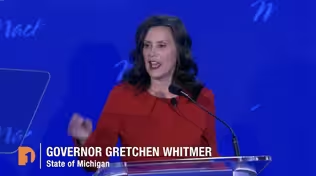
Gov. Gretchen Whitmer gives 2024 Mackinac Policy Conference keynote address
Video has Closed Captions
Clip: S8 Ep48 | 4m 28s | Michigan Gov. Gretchen Whitmer discusses her vision for moving the state forward. (4m 28s)
Key political leaders talk about partisanship ahead of the 2024 election
Video has Closed Captions
Clip: S8 Ep48 | 3m 42s | Key political leaders talk about partisanship ahead of the 2024 election. (3m 42s)
Michigan’s affordable housing shortage
Video has Closed Captions
Clip: S8 Ep48 | 5m 11s | Community leaders talk Michigan’s affordable housing shortage and its impact on residents. (5m 11s)
University Research Corridor shares its efforts to attract businesses, talent to Michigan
Video has Closed Captions
Clip: S8 Ep48 | 3m 52s | University Research Corridor shares efforts to attract businesses and talent to Michigan. (3m 52s)
Providing Support for PBS.org
Learn Moreabout PBS online sponsorship
- News and Public Affairs

Top journalists deliver compelling original analysis of the hour's headlines.

- News and Public Affairs

FRONTLINE is investigative journalism that questions, explains and changes our world.












Support for PBS provided by:
One Detroit is a local public television program presented by Detroit PBS