
2024 Year in Review
Season 9 Episode 17 | 26m 45sVideo has Closed Captions
From the presidential election to policy shifts at home, we examine 2024's top political stories.
2024 has been a busy year in the world of politics. From a tumultuous presidential election, to the retirement of Senator Mitt Romney, and a split-focus on division and unity in our country - our expert panel dives into the major headlines and their impact. Political insider Maura Carabello joins journalists Doug Wilks and Max Roth on this episode of The Hinckley Report with Jason Perry.
Problems playing video? | Closed Captioning Feedback
Problems playing video? | Closed Captioning Feedback
The Hinckley Report is a local public television program presented by PBS Utah
Funding for The Hinckley Report is made possible in part by Cleone Peterson Eccles Endowment Fund, AARP Utah, and Merit Medical.
2024 Year in Review
Season 9 Episode 17 | 26m 45sVideo has Closed Captions
2024 has been a busy year in the world of politics. From a tumultuous presidential election, to the retirement of Senator Mitt Romney, and a split-focus on division and unity in our country - our expert panel dives into the major headlines and their impact. Political insider Maura Carabello joins journalists Doug Wilks and Max Roth on this episode of The Hinckley Report with Jason Perry.
Problems playing video? | Closed Captioning Feedback
How to Watch The Hinckley Report
The Hinckley Report is available to stream on pbs.org and the free PBS App, available on iPhone, Apple TV, Android TV, Android smartphones, Amazon Fire TV, Amazon Fire Tablet, Roku, Samsung Smart TV, and Vizio.
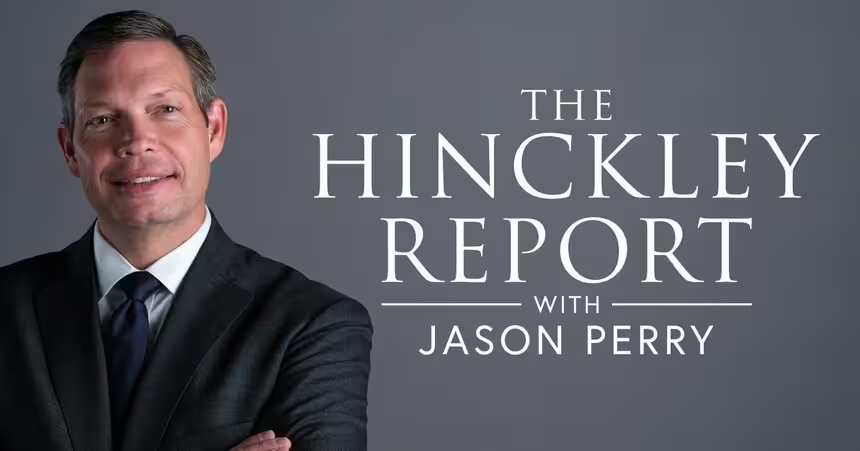
The Hinckley Report
Hosted by Jason Perry, each week’s guests feature Utah’s top journalists, lawmakers and policy experts.Providing Support for PBS.org
Learn Moreabout PBS online sponsorshipannouncer: Funding for "The Hinckley Report" is made possible in part by Merit Medical and by contributions to PBS Utah from viewers like you.
Thank you.
Jason Perry: On this episode of "The Hinckley Report:" after a tumultuous year of political firsts, historic elections, and decisive policy shifts, our expert panel reviews the major headlines, who made an impact, which events were the biggest surprise, what lessons were learned, and what will the new year bring?
♪♪♪ Jason Perry: Good evening, and welcome to "The Hinckley Report."
I'm Jason Perry, director of the Hinckley Institute of Politics.
Covering the week we have Maura Carabello, president of the Exoro Group; Doug Wilks, executive editor of the Deseret News; and Max Roth, anchor with Fox 13 News.
Thank you for being with us on this special episode of "The Hinckley Report."
We're gonna break down the stories of this past year.
They're going to give us a lot of indication about what might be coming in this next year as well, so I really want to just kind of go through each one of you for just a moment.
Let's talk about what you see as one of the top stories.
We'll make it to a few of those.
Maura, do you mind if we start with you?
Maura Carabello: I'd love to.
So, my top story is--I'm gonna cheat, it's not gonna be a story.
The most consistent headline and the spirit I heard of the biggest story is emphasizing divisions, not unity.
So, we relished this year, I think, in pointing out what we disagree with each other on and where our differences were, and that was a headline story I saw repeated over and over again.
Jason Perry: So, Doug, that's an interesting point right there.
Sometimes you give people something to vote for, sometimes you find something just to vote against.
Doug Wilks: Yeah, I mean we can get into that.
I think people were tired of the divisions, and then the unity, there's a desperate want for that, so maybe that headline leads to a better solution.
I think there's obviously tremendous political headlines, but a couple of things that are really going to launch us for the next ten years are, one, the Olympics coming back to Utah, the National Hockey League coming to Utah, and that's gonna--that's leading to billions of dollars of investment on both the east side and west side of Salt Lake City, so that's gonna jumpstart a lot of different things, and that was a big deal this year.
Jason Perry: Okay, Max?
Max Roth: You know, I--mine is a little bit thematic too, taking off of Maura's idea, but not so much about division, but about in Utah politics this pendulum that swung back and forth.
We had the Tea Party oust Bob Bennett.
Then it swings and we have Mitt Romney coming in as something of a moderating figure.
And then swing back to him being completely on the outs with the state Republican Party.
And Utah, the Utah majority, conservative majority, trying to figure out what it is, essentially, because we also-- that same theme would take us from Governor Cox being pretty definitely not supporting President Trump to apparently reading the tea leaves and deciding, "Yes, I need to endorse."
And we had those things kind of changing, and along with that change we had our senior senator go against our junior representative in terms of Mike Lee and Celeste Maloy, so so many things happening that have the Republicans in Utah trying to figure out who they are.
Jason Perry: Really great headlines for us to talk about.
Let's break some of these down just a little bit.
Maura, this idea of this unity case, so give us a little bit of some examples.
We did see that in the headlines.
It doesn't seem like unity was what everyone was really trying to push for, necessarily.
Break that down in terms of how it relates to the presidential election, because certainly that was a big, you know, one of those big stories.
Maura Carabello: I'm gonna start where Max ended, because I think that that--he let out really well on what we're responding to right now, and I do think, I think when you ask an individual, they'll always tell you they want unity, they want to get something done.
When you really look at what motivated folks this year, it was pointing out what we're different about and sort of really these rally calls for tribalism and who we are should be defined by our tribe.
We're not looking--I didn't see as much individuality in issues.
You didn't see people splitting tickets.
Now, Max set up why this is very interesting in Utah, is Utah has often been, well, Utah's all-- for the past future has always been a reliably red state, but we sometimes defined our Republicanism very much by moderation.
You go back to this phrase that's used over and over, the Utah way.
The Utah way is a euphemism for getting along, reaching out, reaching across the lines.
That still exists, I think, as a culture, but I do think when we look ahead, if we look at.
2024, it was really about seeing leaders who had previously been moderates sort of moving to a more firebrand style, and really I still see even looking ahead, which we may talk about later, looking ahead, you still see our top leaders putting forth sort of these firebrand notions.
And so, I count those among how we're going to exercise improving the immigration system, how we're going to deal with other social issues.
But even growth and economy in Utah, how we're approaching those, are we approaching those from sort of bring everyone to the table?
This past year has not seen this.
I think this year has really been led by I have more votes than you, I have more power, and I'm going to use fear-based persuasion, and I think it worked for the elections, for sure.
Jason Perry: Doug, give us a comment, please.
Doug Wilks: I think I disagree, with all due respect.
I mean, there was--fear did lead, but it led for both parties.
The Republican, you know, the Democrats said, "If you vote for Donald Trump, it's gonna be the end of democracy."
And then the Republicans said to the--you know, "If you vote for a Democrat, it's gonna lead to the end of democracy."
One was on this--one was on free speech, one was on character.
Okay, I think the voters totally rejected all of that.
I think they want to be able to have dinner with their family, they wanna be able to get taught good things in school, reading, writing and arithmetic.
They want the simple notions.
They come out of COVID, they come out of incredible inflation, and those things, inflation didn't go away.
I mean, those--if you're paying X amount of dollars for a burger, and that's still sitting up here or for cereal or for milk or for eggs, those things stick with people, and they want a simpler life.
Life is extremely complicated.
Housing is very difficult.
So, I think at the end of the day, they say, "Look, we just want a little calm, we want the rhetoric to die down."
But I don't think the vote is driven by hate.
I don't think the vote is driven by any notion of conflict.
I think they want the opposite, and I think the election kind of showed that a little bit, and both parties have to reset.
Max Roth: I think--but there's a difference between being driven by hate and being driven by fear, and I think that fear was a primary driver, and I think that fear was--there's a general sense of things not going well for a lot of people, and a lot of that is because of the economy, because of the economic picture, exactly what you said.
Inflation doesn't go away, it's just that you hope over time it moderates because wages go up.
But the fact is that wages, you know, have been going up like this while inflation has been, you know, it goes up like that.
And so, the two have kind of met in terms of starting it in the year 2000 and getting to where we are now, but you feel a whole lot more pain when inflation spikes quickly then you feel success at wages gradually creeping up.
Doug Wilks: Well, if I can just say, the politicians and the media, being a member of the media, thought that the fear was the end of democracy on either side, but that wasn't where the fear was.
The fear is, can I make a living?
Can I have a job?
Can I feed my family?
And those issues almost always, the economy almost always rules the day, and I think it did here too.
Max Roth: I wonder though, I, feel like those social issues, when you feel like everything's going wrong, you're looking for what's happening, what's changed.
And I think that, along with going through all of these typical tectonic forces of the economy, there's--we've seen a sharper change in terms of the way that things are communicated to us and in terms of the way that certain social issues have changed so quickly and dramatically.
And I think about gay rights and the trans issues becoming such a big and probably disproportionate part of the conversation in this campaign that we had this year.
And I think that those things are--people look at those things, and they think, "Well, that's what's changed, so that must be part of the problem."
Jason Perry: So, Maura, talk about this from sort of your political, you know, strategy perspective.
Because if you talk about what were the priorities for Republicans going into this election, and you talk about the priorities for the Democrats, there wasn't a whole lot of overlap between the two of them.
In fact, you know, as you start looking at the ones that are polled across the country, they're not the same at all.
Talk about that as it relates to some of these social issues, particularly when maybe what it seems like the Republicans were pushing was what I guess all of you were saying a little bit too, it was those economy--economic issues.
Maura Carabello: Yeah, I mean I think that is--I'm gonna create that as the opportunity for the future, because I think what we saw, again, what I saw in 2024, both sides sort of retreated to their extremes with no attempt to overlap.
I think you saw election results being decided by a very few undecideds who are looking at slightly different issues, but I thought the sides entrenched themselves in intentional nonproductivity for the election cycle.
And I think Utah has an opportunity--I'm gonna differentiate.
Where I'm the most optimistic is in Utah.
One of, frankly, the side effects of having a supermajority is that often you relax into policy, because politics has a different kind of cadence here.
I hope we do.
I've seen our leaders start taking on more and more national issues.
I think that's a mistake for Utah.
I think Utah being Utah, I think Utah being focused on, as Doug suggested, what is most important, is the closer it gets to my dining room table, the more it should come up for my politic--for my political elected officials.
Utah has had a history of doing that.
We've seen some flags this last election, though, that are local Utahns I felt like were tilting at national windmills that they don't need to.
I hope they come home and focus on housing, growth, quality of air, you know, air quality, and then we have a lot of room.
I mean, one of the secrets of being inside and in the back room is that your agreement overlap is really large on most issues, so it's a political choice about whether you're going to discuss the 60% to 70% that you agree on, or whether you're going to go out waving your flags on the 30% you disagree on.
Jason Perry: Doug, talk about whether or not, you know, these candidates, you agree that these candidates, a few of them are sort of moving farther to the right than they might need to through the lens of, you know, a lot of the country, as it turns out, took--everyone didn't become Republicans, but there was a little bit of a step to sort of the right on some of these issues.
Talk about why, if that's the case, so many seem to be going to the other extreme.
Doug Wilks: Both people on the right and on the left said that there was a rejection of sort of the conversation about woke America, right?
The extremes are not appealing to your average American, in my opinion.
I think Donald Trump won all seven swing states, okay?
He won a strong margin of the electoral college.
Now, the actual number of votes is pretty narrow, right?
He can claim a mandate.
Democrats can say it's not a mandate.
But he can now govern, and he can govern in extremes or he has people in his cabinet, he can let Elon Musk say something or Vivek Ramaswamy say something, and he can be more moderate if he wants to.
The one thing about Donald Trump now is the first time he came into office, I think he legitimately was not necessarily anticipating being there, and so it was a much slower start for him.
Now he knows what the office is, and he's looking to see what he can do with it, and I think, yeah, on day one there are gonna be many executive orders, and we're gonna see what the priorities are from his point of view, and we're gonna see how Congress is gonna respond.
But for the average American, they're still worried about getting through traffic to get their kid to soccer.
We don't--we hear on TV, we hear in the newspaper, we hear everywhere about the Republicans and the Democrats, but I don't think people--I don't think they live that way, at least the people I talk to, the stories we try to do, they wanna know that they can feed their children, they wanna know that there's an opportunity for the future.
Jason Perry: I want to talk about a couple of other candidates who were sort of big headliners, and you mentioned a couple of them, Max.
I wanna talk about Senator Romney.
That was a big announcement this past year, that he's not going to run again.
Talk about that, the implications of him not being on that--in that space, and his-- the person that's gonna be filling his seat in John Curtis.
Max Roth: It's--that is fascinating, because the implications of him not being there, there's really too much to say, but the thing that comes to mind most significantly is that he was completely dismissed, or even there was a certain degree of vitriol against him from his--the base of his own party, and there was serious doubt that he would even--he wouldn't get through a convention certainly, and whether he would win a primary would have been up in the air.
So, doesn't run.
I don't know that he would have run anyway.
I mean, he's had a long career, and I think he probably does look forward to not having to work so hard.
But John Curtis comes in, and he's considered, even before sworn in, as one of the Senate moderates, one who might vote against a cabinet post, against a Matt Gaetz, who's no longer a concern, but a Pete Hegseth or RFK Junior.
And so, you wonder how big a switch this really is.
We just kind of have a younger moderate senator there.
Maura Carabello: I think history will be kind to Mitt Romney.
I think the writing of what he did and what he chose to do as an individual during tumultuous times will be kind to Mitt Romney.
Max is absolutely right, it's a fascinating branding, a political branding exercise to watch two senators who are probably navigating to a very similar vote record, but they're going to be perceived very differently.
The one thing John Curtis should be applauded for over and over again, and I hope this happens for him in the Senate, is he has one of the strongest track records of passing bills, and to be able to say that in a modern Congress, I mean, he knows how to build coalitions around effective legislation.
He knows how to choose effective legislation, and I think that is an enormous asset for Utah.
Jason Perry: Doug, talk about his approach, because, you know, people are talking to, is he just going to fill that role that many saw Mitt Romney having right there, just kind of, you know, maybe not necessarily going with just with the President of the United States, maybe taking some shots from time to time.
How is he building his own brand even now through the--certainly through these cabinet appointments, but also through votes like even when it comes to the budget itself?
Doug Wilks: I think it's a mistake to look at any politician as a brand.
Politicians will tell you in one-on-one conversations, some are showponies and some are workhorses, right?
I think Curtis is absolutely his own person.
He's--I don't think it's right to look at him through the eyes of either of the senators, Mitt Romney, who's outgoing, or senior senator Mike Lee.
John Curtis does have that track record.
I think that's impressive.
He does build coalitions.
He built the climate caucus with dozens and dozens and dozens of House members trying to say, look, this doesn't need to be a political issue.
Let's talk about the climate in reasonable ways.
Let's talk about self-sufficiency, let's talk about preservation of natural resources.
We're living in Utah, it's an amazing state with amazing national and natural resources.
So, he is his own person.
I think he's reasonable, I think he wants to be reasonable.
Through this initial process he hasn't even been sworn in yet as a senator, people tried to assign him a position, and they did that with some of the cabinet appointments where he very deliberately said, "Look, I'm not even--not even spoken with these candidates," so it's exciting to kind of see what he can bring, because he's a different person than Mitt Romney.
But I do think history will be kind to Mitt Romney.
I do think there's a large number of Republicans that supported him in Utah.
He won the election, he had a Senate term, he tried to bring his brand of politics, he tried to focus on the things that were important to him, but he's also not afraid to draw a line in the sand, and he's done it in speeches up here at the University of Utah several times, both in 2016 and also, you know, more recently.
Max Roth: It's interesting though, because his kind of line in the sand is about behavior and is about, well, character, yeah, you--character, that's a good word to use, yeah.
And that's where he draws that, and that is--that's interesting, because it's not policy, and so that suggests that at least he believes character is significant.
It's not just--and that kind of perception of how our democracy works is significant.
And I think that's a contrast that Curtis has brought.
One thing that you can think of with a certain brand of Utah politician, and you could see it in Mike Leavitt, probably Spencer Cox as well, and in John Curtis, is the happy politician, the Ronald Reagan optimistic.
You picture them with smiles on their faces.
And then there's the other brand of the angry, and I think we saw more angry this year in Utah than we typically do.
Jason Perry: An interesting point to this is sort of--not really the headline, but an interesting observation is you talk about some of these sort of these happy politicians, talking about, like, Cox or Curtis, these are not people that won at convention.
I'm kind of curious what you think about that particular part of the story, Maura, because we still sort of have that divide.
You're talking about unity, I'm talking about this little interesting, you know, preference for candidates, the people coming out of the convention versus the people who seem to be winning by pretty good margins.
Maura Carabello: This is an enormously relevant issue, because it's going to carry over into the next year.
We have a legislature that's incredibly interested in looking at the political process and the granular one, the party process, if you will.
And we protected this process by having an alternative to the party system, which would be a signature gathering, so this insurance that you can get.
Now, I will say, I think that Cox's team would tell you that they did surprisingly well at convention in many ways for someone who hasn't leaned on being a firebrand that way.
But Max set this up at the beginning of the show, this interesting thing going on right now or who the Republicans are going to be.
And you don't have to be one thing, you can be several, but who's swaying those votes?
Who's going to sway the zeitgeist of the Republican Party?
We've really been traditional, optimistic, bread and butter moderate with--some people don't like that word, but mainstream Republicanism.
Creeping in is sort of more we've flirted in the past with the Tea Party, and we have a far right movement, MAGA is considered further right than most Utahns.
But this issue of are we going to keep an alternative open?
Now, here's the thing though, it's what you said.
Who gets to make the decision?
If you make decision-making lie among the 4,000 Republican voters and that who get--is who gets to screen all the choices, or yeah, the delegates, that's who screens all the choices for all the registered Republican voters, that's going backwards in my mind quite a bit in Utah.
But I think you're gonna see that discussion about should we strengthen the delegate process again this year?
Should we continue to keep it open to all Republicans registered?
Doug Wilks: I think the--I think Utah is an amazing place.
I spent most of my life in California, Utah is an amazing place.
People identify more as a Utahn, and we have pioneer values, self-sufficiency, we can take care of our own, we have strong values in terms of volunteering to help our neighbor, and I think that supersedes whether you're a Republican or a Democrat.
So, you see great investment in the state, you see people working together.
You're gonna look at this kind of north star as the Olympics in 2034.
So, what are we gonna do in the next ten years to get to that point where the Olympics and the whole world returns to Utah?
I just think that's such a strong ethic of being a Utahn that it can overcome some of the division.
And we talk about the Utah way.
I don't think it's dead.
I think it gets battered and bruised a little bit, but people want economic vitality, they want strength.
There's going to be a big, you know, there's going to be quite a discussion in January about education, right?
Higher education, that you're probably in the thick of, you know.
What is the purpose of the University of Utah versus Utah Valley versus Utah Tech?
It's a healthy discussion to have if you can have it in a levelheaded way and you don't get into politics.
Maura Carabello: I don't disagree with that at all, Doug, but I will say that Utah has changed and diversified, and that could--diversification may have happened among native Utahns, but I do think that if we keep relying on--we should lean on the spirit of the past, we should absolutely continue to evoke those who came before us, but if we use that as a trope, if we don't actually look at our current population and we just do a cut and repeat, I think we're not going to see the Utah we want, because I do think we're a changing population.
Max Roth: If I could--a concrete example that I see of this conversation between you two is what we're seeing in schools right now and how people are approaching schools in Utah.
Public education in Utah has always been strengthened by the fact that we have buy-in from the public.
So, the the education systems that fail around the country are those where the rich and the privileged flee and they go to private institutions and they abandon the public system, out of sight, out of mind, and so even if the public system is integrated and all of these different things and good things are supposedly going on at the same time, it loses that neighborhood buy-in.
And in Utah we're beginning to see a little bit of a shift in that, because people are reacting against school districts, against school boards, against policies that they see as being too socially engineering.
And so, we have the scholarship program, we have charter schools proliferating as well, and what does that do?
That--we--that spirit of togetherness, community spirit, if that goes away from this community institution.
Maura Carabello: And affordability, affordability becomes one of the biggest community and political drivers, and you could say economy too.
But affordability, it's been so quick that Utah went from affordable to unaffordable.
It feels so fast, and we're all paying attention.
It's--it wasn't through want of focus, but it's happened.
We're unaffordable, and we're still growing, and all of this is a wonderful opportunity.
I'm not sort of down about it, but I do think that we are seeing all the low-hanging fruit has been picked, and we're up for the challenge, but we are now at a challenging and blessed time, because we have some affordability issues, we have growth issues, we have these amazing dynamic worldwide opportunities coming our way that we need to prepare for, but I do see it as a moment of extra need.
It's a time for us to level up and rise to the occasion.
Doug Wilks: I'm incredibly optimistic.
I think Utahns are amazing.
Maybe it's because I, you know, came from California, born in New Jersey, I've been on both coasts, and now, you know, here, I'm living here.
But, I mean, we have Zelenskyy coming from Ukraine to Utah.
That's one of the big stories of the year, we haven't even gotten to that yet.
We have a global faith, the Church of Jesus Christ of Latter Day Saints, whose leader is 100 years old and goes into the office to work to try and see what we can do.
Brigham Young University has-- gonna to do a medical school, why?
Because they want to help Africa.
This is a unique place, and it should be championed, and if we forget that, whether it's in the legislative 45 days or elsewhere, then we're gonna lose this shine.
And I didn't expect to be Pollyanna today, but I'm happy to play the role.
I just think it's an unbelievable opportunity.
It's been a remarkable year.
There's great things on the horizon, and I think Provo, Salt Lake, the legislature, Park City, and Escalante or Escalante, whichever--we didn't determine what that is.
Maura Carabello: Don't leave out Ogden.
Doug Wilks: Yeah, well, I, yeah, and I don't mean to, Ogden, or even up to, you know, to Logan with Utah State and what they're doing.
Amazing opportunity, and I'll shut up.
Jason Perry: That was a really nice way for us to end the show, because we're watching this very closely.
Certainly on the national stage, Utah continues through sports and otherwise to really lead the way.
Thank you so much for your insights on this very interesting year.
And thank you for watching "The Hinckley Report."
This show is also available as a podcast on PBSUtah.org, YouTube, or wherever you get your podcasts.
Thank you for being with us.
We'll see you next week.
announcer: Funding for "The Hinckley Report" is made possible in part by Merit Medical and by contributions to PBS Utah from viewers like you.
Thank you.
♪♪♪ ...

- News and Public Affairs

Top journalists deliver compelling original analysis of the hour's headlines.

- News and Public Affairs

FRONTLINE is investigative journalism that questions, explains and changes our world.












Support for PBS provided by:
The Hinckley Report is a local public television program presented by PBS Utah
Funding for The Hinckley Report is made possible in part by Cleone Peterson Eccles Endowment Fund, AARP Utah, and Merit Medical.