One-on-One
2025-2026 NJ Teacher of the Year highlights creating trust
Clip: Season 2026 Episode 2906 | 9m 58sVideo has Closed Captions
2025-2026 NJ Teacher of the Year highlights creating trust
Senior Correspondent Jacqui Tricarico sits down with Gillian Ober, 2025-2026 New Jersey State Teacher of the Year and ESL Teacher at Freehold Borough School District, to discuss advocating for students who often go unheard, emphasizing the importance of fostering relationships and trust in the classroom.
Problems playing video? | Closed Captioning Feedback
Problems playing video? | Closed Captioning Feedback
One-on-One is a local public television program presented by NJ PBS
One-on-One
2025-2026 NJ Teacher of the Year highlights creating trust
Clip: Season 2026 Episode 2906 | 9m 58sVideo has Closed Captions
Senior Correspondent Jacqui Tricarico sits down with Gillian Ober, 2025-2026 New Jersey State Teacher of the Year and ESL Teacher at Freehold Borough School District, to discuss advocating for students who often go unheard, emphasizing the importance of fostering relationships and trust in the classroom.
Problems playing video? | Closed Captioning Feedback
How to Watch One-on-One
One-on-One is available to stream on pbs.org and the free PBS App, available on iPhone, Apple TV, Android TV, Android smartphones, Amazon Fire TV, Amazon Fire Tablet, Roku, Samsung Smart TV, and Vizio.
Providing Support for PBS.org
Learn Moreabout PBS online sponsorship(upbeat music) - I'm so pleased to be joined now by Gillian Ober, who is a ESL teacher in Freehold Borough and the 2026 New Jersey State Teacher of the Year.
Congratulations.
- Thank you.
I'm still letting that sink in.
- Still absorbing the information.
Well, it's funny because I know the NJEA is notorious for surprising their state teachers of the year.
So bring us back to that day.
It was just a few months ago.
- Yeah.
- Even last month.
What was that like finding out that you were selected?
- It was incredible.
I was just like teaching a lesson in my classroom and my superintendent, she has a really good sense of humor, she comes in, she's like, "Excuse me, you know, I heard, so there's something happening in here.
There's loud noises.
Like, is everything okay?"
And I'm like, "Oh no, we're good, we're good."
And then all of a sudden the commissioner walks in, everyone from the DOE.
- Did you know right away when you saw those faces or were you still confused?
- I like had the moment of like, what's happening?
And then I was like, "Oh my God, this is it.
It's happening."
- Oh my goodness.
Okay, so you find out and then what do you realize right after that?
What is your next steps as New Jersey State Teacher of the Year?
I know you're gonna be, go on a sabbatical.
- Yeah.
- I know you don't know what that looks like quite yet, but what are the next steps?
What does it really mean to be the state teacher of the year?
- I think it's just, like in that moment it dawned on me like the opportunity that I'm gonna have this year.
And like, I think what's so important about this role is that I got chosen, but like, I'm gonna be the voice for all of these teachers in New Jersey that I know are doing amazing things.
And that's really like, that's the responsibility I feel.
I feel like I have to represent everyone and my students because a lot of my students don't have a voice and they need it to be amplified, or they have voices, but I want to make them heard.
So I'm just so excited.
I have no idea what opportunities are gonna present themself, but to be the one to be able to kind of catapult things for multilingual learners, for immigrants, I'm just really lucky to get to have that microphone.
- Talk about that, talk about your students.
You're in seventh grade now teaching seventh year classroom.
Talk about the students that you're seeing every day.
What kind of challenges are they facing?
- So I work with a lot of our newcomers, so those are students that just came to the United States.
- First generation.
- Yeah.
And a lot of my students have interrupted, like formal education are, you know, they're navigating a new language, a new culture.
So I always, what I say about my students who I'm always just like in awe of them, is they have to be so brave every day.
Like all of our students in New Jersey are amazing, but these kids have to come to school every day and have that bravery to try to learn a new language.
Like that takes a lot, it's scary.
And they're navigating things outside of school that a lot of adults haven't gone through in their life and they're 12, 13 years old.
So they just really, they inspire me.
They're amazing.
- And New Jersey is such a melting pot.
How are you able to really like take each student individually, because like you said, they're coming from all different walks of life and really make sure that you're able to connect with them individually to help with their specific needs?
- Well, what I say is, you know, like I think when you're working with multilingual learners, the biggest thing you can do is you have to build like, relationships with your students.
Because if I don't have their trust, the learning's just not gonna happen.
In multilingual education, we talk about the effective filter, and it's essentially if your anxiety is high, it's impossible to learn a new language.
That language acquisition, it's not gonna stick.
So getting your students to trust you and just feel safe, like if I've done that, I'm like, okay, the academics can come, it's important, but for my students that they feel a connection, that they feel that they have a place they can come to and be themselves, then, I feel like I've done my job.
- Give us one of the biggest challenges you've had to face as an educator and how you were able to overcome it.
- I think the past few years, what's been really tough for a lot of my students is just the immigration experiences that they're facing outside of school.
I've had a lot of families that are in our extremely complicated court system, you know, trying to get residency or green cards, and that's a lot for a kid to be navigating while also just trying to be a kid.
So I try to advocate for my students.
I try to help with that outside of school, if I can help families in any way, you know, during their experience with immigration court.
You know, I always, I'm not a lawyer, but I've done a lot of work to try and help families know their rights and just feel like they're supported and they're not alone in it, 'cause that can be a very isolating experience.
It can be scary to ask for help.
It's scary to navigate a system that's very complicated and that oftentimes families feel like the world is working against them.
- How do you personally not take all that home with you?
We know teachers are not just, your job's not done when you're out of the classroom and there's so much that goes into it.
How are you able to also think about yourself and your own mental health and wellbeing?
- That is a work in progress, because if you ask my family, it's really hard not to take it home because a lot of these kids become like my babies.
Like they, I feel like they're my family that's in my classroom.
With my co-teacher when I was in fifth grade, we would always say we're a family, somos una familia, and you know, that is kind of our guiding principle throughout the year.
Like, we don't all have to be best friends all the time, but we're gonna love and respect each other so that learning can happen here and we can support each other every day.
And it just, I don't know, when you have that at the base of your class, things that happen are very cool and inspiring.
- You have done a lot with the STEM fields too.
I know that's been a passion of yours.
And Fort Dix especially, there was a program that you did at Fort Dix.
Describe that program because I found it really interesting.
- Yeah, so my superintendent, one of her very lifelong friends is actually the director of STARBASE.
And it's a lab that they have on the military base.
It's basically a STEM lab for fifth graders and they come and do a series of field trips.
So I was our fifth grade team leader.
So Asia Michael, my superintendent came to me, and she's like, "Let's make this happen."
And it was actually, it ended up being 40 field trips throughout the school year because each of our fifth grade classes got to go five times.
- Wow, what were the takeaways for those students being able to see something like that hands on?
- Well, I think something that, like, what I noticed was it gave the opportunity to some of my students that might not have traditional success in the classroom.
My students that are struggling readers, my students that might have interrupted formal education, they could do the hands-on experiments and labs.
Like we were doing coding, we were doing robotics, and it was a really great opportunity for those kids that might not always shine in the academic sense.
They were rock stars when we were there.
Like it was so cool seeing them have that moment of like, they were the ones getting the coding and then explaining it to their classmates.
It was really amazing.
And the director also worked with us.
We had some engineers come in and some of them were multilingual learners, so it was really cool for my students to see people that looked like them, people that sounded like them, that spoke another language in this job where they're, you know, helping defend our country and doing all of these crazy engineering projects.
That was like a powerful thing to see.
- Opening their eyes to so much more outside of the classroom.
That's wonderful.
Lastly, your, some of your colleagues have said things like, "You're fun loving.
You recognize the various types of learners and really are able to hone in on that and you build strong relationships with your students."
What has it felt like for you to have this recognition, the spotlight on you and your work and you as an individual?
- I think I'm still getting used to it a little bit.
I'm not used to the spotlight, but I think it's been really humbling to have that support around me and it just kind of validates what I've been doing.
I'm just gonna keep doing what I'm doing and making those connections.
But I think that's what's been really beautiful about this whole experience is people commenting on, like, it's the connection that I make with the kids because that's what matters the most to me.
So the fact that other people are seeing that and it got me here to state teacher of the year.
- Yeah.
- I'm like, you know what?
The universe has a plan for me and I'm just gonna keep being me and being my authentic self, because I think that's what makes me, when I come as me to my students, it gives them the freedom to also be themselves.
- Well, you're doing incredible work representing so many great teachers across our state.
Thank you for joining us and good luck on this next journey, this sabbatical for you.
- I know it's gonna be great.
- It really is.
We can't wait to catch up with you afterwards.
We'll be right back after this.
- [Narrator] One-On-One with Steve Adubato is a production of the Caucus Educational Corporation.
Funding has been provided by The Russell Berrie Foundation.
Holy Name.
NJ Best, New Jersey’s five-two-nine college savings plan.
Kean University.
PSE&G.
EJI, Excellence in Medicine Awards.
A New Jersey health foundation program.
The Fund for New Jersey.
Horizon Blue Cross Blue Shield of New Jersey.
And by The Fidelco Group.
Promotional support provided by NJ.Com.
And by BestofNJ.com.
- (Male narrator) Ready for anything?
That ought to be our state motto.
All hustle, no nonsense, never backs down.
So when it comes to strengthening the grid and uplifting our communities, we do it our way.
Because storms don’t care what exit they hit, and talking doesn’t fix the grid.
Fixing it does.
Around here, we make our own future.
Because ready is who we are.
PSEG.
 New
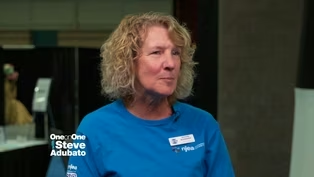
NewAdvice to fellow educators about teacher collaboration
Video has Closed Captions
Clip: S2026 Ep2906 | 9m 2s | Advice to fellow educators about teacher collaboration (9m 2s)
 New
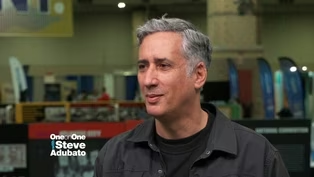
NewHow this non-profit is reducing waste, one book at a time
Video has Closed Captions
Clip: S2026 Ep2906 | 8m 11s | How this non-profit is reducing waste, one book at a time (8m 11s)
Providing Support for PBS.org
Learn Moreabout PBS online sponsorship
- News and Public Affairs

Top journalists deliver compelling original analysis of the hour's headlines.

- News and Public Affairs

FRONTLINE is investigative journalism that questions, explains and changes our world.












Support for PBS provided by:
One-on-One is a local public television program presented by NJ PBS