2026 Illinois 16th Congressional District Candidate Forum
2026 Illinois 16th Congressional District Candidate Forum
10/7/2026 | 52m 48sVideo has Closed Captions
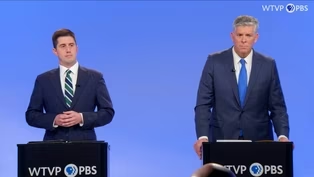
Darin LaHood and Paul Nolley discuss the issues in Illinois’ 16th District race.
Republican Darin LaHood and Democrat Paul Nolley discuss Social Security, health care, energy, tariffs, immigration and other issues in the race for Illinois’ 16th Congressional District. Presented by WTVP and the League of Women Voters of Greater Peoria, the forum is moderated by Mark Welp and Chris Kaergard, giving voters a chance to hear directly from both candidates.
Problems playing video? | Closed Captioning Feedback
Problems playing video? | Closed Captioning Feedback
2026 Illinois 16th Congressional District Candidate Forum is a local public television program presented by WTVP
2026 Illinois 16th Congressional District Candidate Forum
2026 Illinois 16th Congressional District Candidate Forum
10/7/2026 | 52m 48sVideo has Closed Captions
Republican Darin LaHood and Democrat Paul Nolley discuss Social Security, health care, energy, tariffs, immigration and other issues in the race for Illinois’ 16th Congressional District. Presented by WTVP and the League of Women Voters of Greater Peoria, the forum is moderated by Mark Welp and Chris Kaergard, giving voters a chance to hear directly from both candidates.
Problems playing video? | Closed Captioning Feedback
Where to Watch 2026 Illinois 16th Congressional District Candidate Forum
2026 Illinois 16th Congressional District Candidate Forum is available to stream on pbs.org and the PBS app.
Providing Support for PBS.org
Learn Moreabout PBS online sponsorship(lively music) - [Announcer] From the WTVP PBS Studios on the historic Peoria, Illinois Riverfront, it's the Illinois 16th Congressional District Candidate Forum.
This forum is produced in partnership with the League of Women Voters of Greater Peoria.
- Good evening, I'm James Kerr, Chief Officer of Content and Digital Media at WTVP.
Our mission is to serve Central Illinois with stories and conversations that help us better understand our community and the world around us.
That includes giving voters a chance to hear directly from the people seeking to represent them.
Tonight, in partnership with the League of Women Voters of Greater Peoria, we welcome the candidates for Illinois' 16th Congressional District: Republican Darin LaHood and Democrat Paul Nolley.
Here's how tonight's forum will work.
A drawing determined who will give the first opening statement.
From there, the candidates will alternate speaking order.
The candidate who speaks first in the opening statements will answer the first question second.
Each candidate has two minutes for an opening statement, 90 seconds to answer each question, and two minutes for a closing statement.
League members will keep time and display countdown cards visible to the candidates and the moderators.
The moderators will enforce the time limits and may interrupt when needed to uphold the ground rules.
Now, please welcome our moderators: Mark Welp, host of WTVP's "At Issue," and Chris Kaergard, president of the League of Women Voters of Greater Peoria.
- Thank you very much, James.
Paul Nolley won the drawing and will give his opening statement first.
Mr.
Nolley, you have two minutes.
- Good evening, everyone.
My name is Paul Nolley.
I'm a 37-year-old lifelong Illinoisan.
I am a proud father to two amazing kids: a six-year-old daughter, a four-year-old son, who I am raising alongside my high school sweetheart and wife, Andrea, an amazing and talented special education teacher.
Today, after 15 years of helping seniors and working parents get ahead, I run an organization where I help local workers and local businesses, and I help young people get into good-paying, blue-collar apprenticeships where they can lift themselves up.
I'm running for Congress because our government has lost touch with us and our leaders are enriching themselves.
And I want to do something about it.
I was raised by working-class people and I've voted for both Democrats and Republicans, and I've seen how government has failed regular people like us.
This will only change when regular people like us stand up, fight back, and change our government to serve us, not a small number of elites, protect our families, not the entrenched political class.
My opponent here is a career politician.
He's been running for office since before Barack Obama was elected president.
He's been in Congress for over a decade, in the majority for most of his time.
On his watch, the national debt has doubled.
Our country is more divided than ever.
And now he's voted for the tariffs in this trade war.
He's voted for the Iran War six times.
These decisions have cost your family thousands of dollars.
On top of that, Darin LaHood hasn't held a town hall with us in almost a decade.
Yet, like many politicians, he feels secure because those big corporate checks keep rolling in.
See, this system will never change if we wait for this entrenched political class that he represents to change it.
It's time for regular people like us to take our power back for my kids, for your kids, and the entire next generation.
- Thank you.
You have two minutes, Mr.
LaHood.
- Well, thank you.
I would first want to thank the Greater Peoria League of Women Voters for putting this on.
I want to thank Chris and Mark for serving as moderators here today, and I also want to thank WTVP for this opportunity.
I'm the only member of Congress from the state of Illinois that's participating in a debate by the League of Women Voters, but I think it's important to do that.
That's why I'm here today, to answer tough questions.
I think it's important for our democracy to do that.
I am proud and honored to represent the 16th Congressional District.
I have 750,000 bosses throughout 21 counties, and what I've tried to do over the time that I've been in Congress is to best represent my district.
Three important parts of this job: voting, going to Washington, D.C., and voting on behalf of my constituents.
Doesn't mean that everybody agrees on every vote that I take, but I try to be transparent and open and upfront on every vote that I take.
Secondly, good constituent service.
Regardless of your political affiliation, when you call our office, we're going to help you.
We're going to assist you.
Whether you're a veteran, whether you're a senior citizen, whether you're a farmer, whether you're a small business owner, we have a track record second to none on helping people with good constituent service.
Thirdly is being a cheerleader for this district, standing up for the people of this district.
It's one of the largest ag districts in the country, going to D.C.
and helping our farmers, helping our folks in law enforcement, helping our manufacturers.
That's what we have a record of doing, and I'm proud of that.
We've also brought back $270 million over the last six years to help people and constituents throughout this district.
A couple examples of that: $4 million for Trillium mental health facility here in Peoria, helping our police in Rockford, Illinois, helping to build a new YMCA in Morris, Illinois, helping to build out a new nursing center at ISU.
Those are a few examples of being a cheerleader for this district.
When I take a vote on something, I have a yes button and I have a no button.
I don't have a perfect button.
But what I'm proud of is helping to protect the American Dream, helping to represent those 750,000 constituents, and I look forward to earning the trust of the voters again this election.
- Thank you very much.
Mr.
Nolley gave his opening statement first, so Mr.
LaHood will answer the first question first.
And again, we want to remind you each candidate will get 90 seconds to respond.
The first question, Mr.
LaHood: Social Security is facing a long-term financial shortfall, and without action from Congress, the program will not be able to pay 100% of promised benefits.
What Social Security reforms, if any, do you support?
- Well, when we think about Social Security, we're $40 trillion in debt, and we're going to run out of money with Social Security by 2032 or 2033.
There's a couple proposals that have been put forth from a bipartisan standpoint.
First of all, we shouldn't touch Social Security for anybody that's 55 and older.
We have a contractual obligation to those people that paid into the system.
They've done everything we've asked them to do, so we shouldn't touch Social Security.
However, as we think about what we can do in a bipartisan way, think about what's happened over the last 40 years.
Republicans and Democrats alike have refused to change Social Security.
We have to look at new ideas.
So when you're new coming into Social Security, you're 18 to 24, we ought to look at a different system and tier that up moving forward.
But this has to be solved in a bipartisan way.
One other thing that's been suggested that I'm supportive of is a debt commission that focuses on how do we appropriately reform Social Security to help fix our debt long-term and save the solvency of Social Security.
Social Security has worked well.
We need to keep it intact, but it's going to take tough political judgment and decisions to make that happen.
I'm committed to doing that.
- [Mark] Mr.
Nolley.
- Social Security is the crown jewel of our domestic policy achievements, and it has lifted millions of people out of poverty.
It actually lifts over 20 million people out of poverty every single year.
You know, what you just heard from Mr.
LaHood is a suggestion that he wants a new system.
This is the same old playbook that we have heard out of Washington, D.C., for as long as it's been proposed and enacted in 1935.
The wing of the party that he is from wants to attack Social Security.
They didn't ever want it to pass.
They don't want it to succeed, and now he's suggesting eliminating it for young people.
What we need to do instead is lift the income cap on our FICA taxes for people making $250,000 a year and on capital gains at that level.
That will shore up the trust fund for 75 years.
That means not only our seniors today will be taken care of with Social Security, but our children coming up right now.
It also allows us to have a window of time to get a major reform going on this program so that it's there for the long term.
We have to protect Social Security, not cut it down, not make it more complicated, make sure that we're doing something.
And a commission is just another way to say he doesn't want to do anything about it, doesn't want to take a tough vote.
We also must refuse to increase the age because I come from working-class people, and I will never ask a mechanic or a tradesperson to work longer and work harder to get those benefits that they have earned.
- Thank you.
- Thank you both, gentlemen.
Move on to our second question, which starts with you, Mr.
Nolley, and then to Mr.
LaHood.
The construction of data centers in Illinois has become a hot topic, with proponents saying that the centers will bring jobs and property tax revenue, while opponents are worried about rising electricity bills, environmental issues, and industrial blight.
What are your opinions on data centers, and should the federal government have a role in regulating them?
- Well, AI and data centers are a very serious issue, and I've been traveling around this district for 19 months, holding real town halls, meeting with people from all backgrounds, and that's a top concern that people have in communities: rural, urban, and suburban.
We have to get our arms wrapped around this issue.
A big reason why people are really worried about data centers is because they are anxious about what artificial intelligence is going to do, and they understand that data centers are the way that they are facilitating the rise.
They need that compute power in order to have artificial intelligence, superintelligence, recursive self-learning, all of that.
On data centers themselves, we have to pass federal legislation.
The federal government must do this to make sure that our energy costs are not going up.
They need to bring their own energy generation.
We need to make sure that we are not giving them a single dime in federal taxpayer dollars.
We also need to make sure that when there's water use, when there's water discharge, when there are, you know, any things that's going on like that, the people in those areas have to know.
There has to be transparency, and local communities need to be in charge of what facilities are built in their area.
- [Chris] All right, thank you, Mr.
LaHood.
- Thank you for the question, Chris.
When we think about data centers and we think about AI, a couple things come to mind.
One is any decision that gets made at a local level needs to be made by local officials.
That could be a village board, that could be a city council, that could be a county board.
It should not be made by elected officials at the state level or the federal level.
Full transparency needs to be laid out for any data center that would go into a local community.
We need to have information on the water use, the electricity use, the noise that comes from there, has to be done at the local level and there needs to be full transparency.
Secondly, when we think about AI and quantum, we have to win the strategic competition against China.
It is existential for the future of this country that we win the AI and quantum race, but it has to be done the right way.
The right way is working with locals to get that done.
Just last week, I voted on the Ratepayer Protection Act in the Congress, a bipartisan bill that says that when any data center is built around the country, any electricity costs cannot be put on the constituents or the people in that district, the citizens.
It has to be paid for by the utility companies.
That sends a strong message, puts into law that these companies can't be taken advantage of.
So those are the things we have to think of.
The bottom line is we have to win the strategic competition.
AI gives us tremendous promise, but also peril.
We have to do it the right way.
- [Chris] Thank you.
- Our next question is for you, Mr.
LaHood, to begin with.
Since 2015, three rural hospitals in Illinois have closed.
Recent numbers from "Becker's Hospital Review" show that of the remaining 79 hospitals, 16 are at risk of closing and eight of those are at immediate risk.
Much of the financial strain is attributed to Medicaid cuts and low reimbursement rates from private insurance companies.
The question is, what would you do to help keep these facilities open?
- Thanks for the question, Mark.
Well, we've already done enough.
We already did enough last year in terms of the tax bill.
We created a $50 billion fund for rural America and rural healthcare in last year's bill, and I was proud to support that.
That's money that goes to our rural areas.
Make no mistake about it: in a district like mine where we have 21 arguably rural counties, healthcare is important.
That fund, that $50 billion goes directly to help those rural areas.
That's number one.
Number two, we have to work to lower the cost of healthcare.
We have to work on consolidation.
Obamacare did not work.
All of the promises of Obamacare: you're going to have more options, it's going to bring competition.
None of that came to fruition.
We have to bring more competition into the system.
I recently just voted on a bipartisan bill called Lower Healthcare Premiums for Americans Act.
Again, a bipartisan way to work on bringing down those premiums, particularly in our rural areas.
The other point that I will make, and I've been very supportive of the funding to help behavioral health and mental health in our rural communities.
I've supported that funding that will go there.
We have to continue to work with our hospital networks to sustain what we have now, use that $50 billion fund to give directly to those hospitals.
- [Mark] Thank you, Mr.
Nolley.
- Well, the Medicaid cuts, the largest cuts in Medicaid that our country has ever seen, about a trillion dollars, are, as the moderator just said, about to devastate our rural hospitals.
And these are facilities and systems that have been devastated for years.
I know if you're out there in a rural area right now, you've probably seen services reduced.
You've probably seen your facilities close.
It's hard to get talent to come out to those communities and provide care to patients.
So you're already struggling.
And then Mr.
LaHood votes to cut Medicaid in the largest amount.
The CEO of the Illinois Hospital Association just said, "The decision Mr.
LaHood made is going to devastate us.
It's going to require closures, reduction of facilities."
And the hospitals themselves are on the hook.
See, the thing is that the hospitals are mandated to provide these services.
So that means that this is going to be... They're going to have to find cuts somewhere.
So what we need to do as a solution is reverse the cuts that Darin LaHood voted for.
We need to bring back those Obamacare subsidies.
I've met people who have to drop their health insurance because they can no longer afford it.
This is shameful.
This is not the direction we need to move, and there are a lot of things that we can do to expand access to healthcare.
But right now we're in a crisis, and it is because of the decisions that Donald Trump and Darin LaHood just made over the last year in the One Big Beautiful Bill.
- [Mark] Thank you.
- All right, next question, starting with Mr.
Nolley, then to Mr.
LaHood.
The state's Climate and Equitable Jobs Act mandates reaching 100% carbon-free power by 2050 in Illinois.
Looking more broadly at the federal level, do you believe more renewable energy sources like wind and solar are benefiting Illinois, or should we return to fossil fuel-powered plants like coal and natural gas, as the president is pushing for?
- Well, we absolutely need to be moving to a renewable energy economy, and of course solar, wind, and of course our nuclear generation facilities are tremendously beneficial to the people of Illinois.
If we didn't have these renewable energy sources right now, our energy costs would be even higher than they already are.
And I know you all out there are feeling these high energy costs.
Mr.
LaHood voted at the federal level to reduce the investments in clean energy, which is going to drive up our costs.
It's also going to put us behind in the race right now against China.
They are kicking our tails right now when it comes to renewable energy.
And if you care about the automotive industry like I do, and UAW and the good jobs that those produce, you need to be moving in the direction that the entire world is moving into, which is electric vehicles.
I'm a car guy.
I drive an internal combustion engine, but I understand the modern economy is going to be based off electrification, EVs in this next phase.
So yes, we need to continue to make those investments, and we have to do it relatively quickly while also making sure that the unintended consequences are not borne by the working people of this country, of the state, and of our district.
- [Chris] All right, Mr.
LaHood.
- Well, energy is vitally important to this district.
It's vitally important to manufacturing.
And I'm very proud that the largest trades union in this district has endorsed me in this race; that's Local 150, that builds a lot of energy and is involved in energy.
They've looked at my record and they're supporting me over my opponent.
Beyond that, the National Federation of Independent Business has looked at both our records, has endorsed me, so has the Chamber of Commerce.
They're very involved with this energy.
The bottom line is we need to have an all-of-the-above energy approach, and that's what I've advocated for in Congress.
We need to use our biofuels.
That's why I've supported E15 ethanol, 15% year-round, and voted and advocated for that.
Secondarily, we ought to have wind, solar, hydrogen, fossil fuels, an all-of-the-above approach.
I have three nuclear plants in the northern part of my district.
Last year in our tax bill, we incentivized the buildout of nuclear.
Eventually we're going to get to modular nuclear, but these folks, whether it's the union folks on the labor side or whether it's the business folks on the Chamber side, have endorsed my candidacy because of our plan for an all-of-the-above approach to bring down energy, build out our nuclear facility, focus on renewable fuel.
You know, we have nine ethanol plants that touch my district.
E15 is important to bring down the cost, but also to help our farmers, and I'm proud to support them.
- Right, thank you.
- Mr.
LaHood, Medicare is undergoing some big changes, as we all know.
Medicare Part B monthly premiums and deductibles are up from last year, and they are expected to rise next year.
Rising care costs, Medicare Part A depletion, and privatization are also impacting the future of the program.
What do you think the government should do to address these issues?
- Well, Medicare works very well for most of our citizens, but it doesn't mean we shouldn't be looking for waste, fraud, and abuse in the system.
We have been focused on the Ways and Means Committee, where I serve on, on going after waste, fraud, and abuse.
We have a task force that's set up that is looking at billions of dollars that were inappropriately spent in Medicare, and we got to continue to focus on that.
Just as an aside, we saw what happened up in Minnesota with the abuse of our healthcare system by almost $2 billion.
There's been 30 people charged in federal court with fraud based on that.
We need to continue to focus on that.
That's one way to help with Medicare.
The second thing is figuring out: how do we make it more efficient, more effective, more accountable?
How do we hold drug companies accountable, which is legislation that I've supported?
Going after insurance companies, we had all five of them under oath before the Ways and Means Committee.
We asked them the tough questions.
There's two grand jury investigations going on with them; I support those.
So it's a combination of things to help protect Medicare, but it starts with getting rid of waste, fraud, and abuse.
- [Mark] Thank you very much.
Mr.
Nolley.
- Well, the first thing we can do is tackle the fraud that exists in Medicare Advantage.
This is a privatized part of the system, which never should have been passed in the first place, and we need to tackle that fraud that exists.
People are making billions of dollars off of the system that has been privatized as far as Medicare.
In the long term, we need to move to a national health insurance program that will defragment this entire complicated system that we have of health insurance, where some people are on Medicare, some people are on Medicaid, private insurance, the ACA exchanges.
It is one of the most complex, expensive, and inefficient systems that we have, or that exists in the entire world.
We need to move to a system that covers everyone under an expanded Medicare program that's not connected to your job, that will allow greater efficiency in the system, access.
Independent studies have shown it'll save trillions of dollars while also making sure that no one falls into medical debt and that we actually can have stabilized payment rates to our providers, make sure that we're not shutting down our rural hospitals, making sure that people have the access that they need, and again, a much more simple system.
I don't know if anyone's been on the phone calling the insurance company, seeing what your coverage is, seeing if this facility is covered under this plan, if you get a wrong billing code.
This is a mess.
If you think that complicated system is working for you, maybe here's your guy, but if you want a better, more efficient, and more equitable system that works for everyone, this is the policy you should support.
- Thank you.
- All right!
Moving on to the next question, Mr.
Nolley: Tariffs levied by the current administration have raised costs for the average Illinois household by more than $2,200 according to the Midwest Economic Policy Institute.
The National Taxpayers Union Foundation says the economic impact here is the fifth worst in the nation in Illinois, with more than 40% of the agricultural production from the 16th District going outside the country.
What steps would you support to address the tariffs and their effect on Illinois residents, particularly on farmers?
- Well, step one to address these tariffs is to end this reckless and chaotic tariff and trade war that my opponent here has supported.
Donald Trump does not have the power to do tariffs.
That is Congress' power.
They have ceded power in all sorts of different ways, including on tariffs and trade to the executive branch.
It's shameful, it's not what the founders of our Constitution and our republic wanted.
So Congress needs to take back the powers and needs to end these reckless tariffs.
Tariffs can be used in a strategic way in certain instances, in certain cases.
You know, Darin LaHood recently kind of insinuated that Democrats sometimes support tariffs because labor unions support tariffs.
You know, those are some of the most strategic tariffs to protect our auto industry, protect industries like that, that protect jobs, manufacturers, and workers.
We need to be using those precise tariffs like that to protect our critical industries, our industrial base, not this chaotic ChatGPT-produced tariff regime that is driving up prices by thousands of dollars.
And again, Darin LaHood has not done anything to address this.
- [Chris] All right, Mr.
LaHood.
- Having a district with a lot of agriculture, and you mentioned, Chris, about 40% of the corn and soybeans produced in this district goes somewhere else around the world.
I've been very vocal from the very beginning: tariffs ought to be used in a strategic and tactical way to go after bad actors like China, like Iran, like Russia, like North Korea.
But I think we have to be more nuanced when it comes to our allies: Japan, South Korea, Indonesia, Australia, Canada, for instance.
And so tariffs ought to be used in a strategic and tactical way to go after bad actors and not necessarily our allies.
I've been a strong proponent of that.
In every interview that I do, I talk about changing the tariff regime.
I was supportive of the Supreme Court decision by Justice Gorsuch, a 6-3 decision that said you can't predicate blanket tariffs on national security.
I was one of the first people to speak out against that, and continue to advocate for a more nuanced approach.
Just recently, I authored a letter that went to the president asking for the tariffs on Morocco to be taken off so that the fertilizer can flow to Morocco.
That was done because of my letter.
I'll continue to advocate for reduction of tariffs in certain commodities and industries that will help agriculture, help manufacturing, and help the people that I represent.
- All right, thank you both.
- Mr.
LaHood, U.S.
military action in Iran and supportive military action by Israel has proven divisive in our country.
Two questions here: What is your threshold for whether to cast your vote to support continued military action in Iran, and what's the right role for Congress, which is supposed to exercise approval and oversight of ongoing military action?
- Mark, thanks for the question.
Make no mistake about it: Iran is a terrorist entity and has been that for 50 years.
Just recently, they killed 50,000 of their own people because they were protesting for freedom and opportunity.
Presidents for 50 years have said they're going to go after Iran.
They're ruled by religious zealots and mullahs.
They have a theocracy that calls for death to America, death to Israel.
That's who they've been for 50 years.
There are no moderates in Iran.
They only know strength and power.
I'm happy today they have no more ballistic missiles.
I'm happy today they have no more nuclear capability.
I'm happy today they don't have any more hypersonics.
Their navy has been destroyed.
The cancer they are in the Middle East is gone for now.
Are there consequences to that?
Of course, the Strait of Hormuz has been closed down.
That's hurt energy prices, but it doesn't take away from the fact that they will be worse off because of the action that we've taken.
So I support the president's effort in going after that.
I'm happy they don't have a nuclear weapon and capability, and we got to continue to move forward.
This is not a traditional war like we had in Iraq or Afghanistan, where we lost 8,000 people on the ground.
We've lost way too many with 19 of our service people, but this is something that presidents for 50 years and politicians for 50 years have talked about doing.
We're doing it now and the world will be safer.
- [Mark] Mr.
Nolley.
- Well, it takes no courage to say Iran is a wicked regime run by bad people, we all know that.
That accomplishes nothing.
What we need to decide is what we're going to do about it.
And what we have done about it under this administration and Darin LaHood's support is a disaster.
We, of course, have the worst of it, which is 19 of our service members killed in a war that has achieved nothing for our country except raise your prices, destabilize the global economy, you know, create greater friction between us and our allies.
That's what it's achieved.
Darin LaHood just said that Iran's ballistic missiles are gone.
That's just not true.
We just had attacks on our bases using ballistic missiles.
Iran controls the Strait of Hormuz still.
They are now a regional power, unlike anything they were before.
We have empowered them.
Meanwhile, our allies are going into China's hands.
I mean, this is a disaster.
You know, we need to learn the lessons of history.
If you look at Vietnam, if you look at Iraq and Afghanistan, what did that accomplish for any of us?
Did that help you?
Did that help your family, or did it only spend trillions of our taxpayer dollars and have the lives of so many of our best people lost?
That's what it's done.
There's a time for war and conflict when absolutely necessary.
This is not the right path.
This is not helping our country, this is not helping you, and this is not helping the issue that we need to address here.
Yes, they're an evil regime, but this is not the way forward, and the vast majority of Americans agree with me on this.
- Thank you.
- All right, moving on to our eighth question.
The way public officials communicate with their constituents has changed in recent years, with fewer members of Congress in both parties holding pre-announced open town halls.
Nevertheless, many voters prefer unfiltered ways to hear in person from their lawmakers.
How will you commit in a modern media environment to doing that if elected?
- I have committed from day one of this campaign to, as the next representative of the 16th Congressional District, to hold open, in-person town halls pre-advertised so you know where they're going to be across the district in regular intervals.
I commit to that now and every day in the future.
Also, of course, through social media and engaging in that way.
But what I've learned from traveling for the 19 months that I've been on this campaign, meeting real people, no screened questions, no blocking people at the door, and of course in-person real stuff, is that people want that access.
We have this, you know, kind of weird society now where we're so disconnected.
Our representatives are just kind of this part of this elite class that we have, and they want to understand what's really going on and have the answers face-to-face.
And that's what I commit to doing.
It's so important, and it's not only an obligation, it's such a privilege to be one of the most powerful people in our country and to not meet with the people for nearly a decade, it's truly shameful.
And the people of this district believe that and understand that, and I'm going to do the complete opposite.
I'm going to go into the spirit of what this campaign has been about: openness, accessibility.
I'm just a regular guy trying to do right by my kids and your kids, and that means listening to you, understanding your needs, addressing your needs.
I'm not in some ivory tower in Washington.
Yeah, I got to go there if I'm getting elected, but I'm going to come back and listen to you, and not just the people who are politically loyal to me like Darin LaHood does.
- Thanks for the question, Chris.
Over the last seven months, I've done six telephone town halls.
Each of them, we called out 60,000 people.
There's no better way to communicate, in my view, than a telephone town hall, but I'm not the only one doing it.
Democrats and Republicans across this country now communicate through telephone town halls.
Reaching 60,000 people on each one of those calls, having 10 to 12 issue areas that we've gone over, has been a great way to communicate with my constituents.
Just last Saturday, I was in front of 400 people in Downtown Peoria for our Alzheimer's walk for three hours.
I've done over 2,000 meetings in the last two years throughout my district.
I come back every single weekend to my district.
I'm going to continue to have telephone town halls.
I'm going to continue to meet with my constituents.
Any protester that comes to my office, I schedule a meeting in my office, whether that's in Bloomington-Normal or Rockford or Peoria.
I'm going to continue to be as accessible as possible.
The issue why Democrats and Republicans are having telephone town halls, or as you said, having creative ways to meet with their constituents, is because we've had way too many security issues in this country.
If you look at what happened to the Democrat elected officials in Minnesota that were gunned down, you look at the president was almost twice assassinated.
You look at what happened to Steve Scalise.
You look at what happened to Charlie Kirk.
This is what we're dealing with as elected officials.
And so if you can certify that you can have the most secure and safe telephone town hall or open town hall, that's important for the future and what we do as a country.
- Mr.
LaHood, the use of automated license plate reader camera systems like Flock have become controversial tools of surveillance.
A bipartisan group of senators is calling for the Department of Justice to establish policies as to how the technology can be used.
The question for you is, should the federal government weigh in, and what limits ought there be on such cameras?
- Well, we're looking into that right now in the House.
As a former state and federal prosecutor for over 10 years, we have to work with our law enforcement on the best way to solve crimes.
I recently allocated and secured $1.5 million to the Bloomington Police Department as they build out their crime center.
They use Flock cameras there.
The use of those Flock cameras has solved many different crimes, including two different murders because of the use of those.
When I listen to law enforcement throughout my district, they support those cameras.
But should there be guidance?
Should there be restrictions?
Of course there should.
Privacy rights, how that information is cataloged, how that's used for the future should be protected.
We cannot be giving out that information, selling it to private vendors.
So I'm in favor of restrictions, but allowing law enforcement the use of these cameras is going to help keep our communities safe.
It's going to help solve crimes.
And I'm going to continue to listen to law enforcement.
That's why in this race, again, the Fraternal Order of Police and every police department and agency has endorsed my candidacy, partly for being a federal prosecutor, but standing up for these issues, supporting law enforcement at every level, and looking out for the safety and security of our constituents.
- [Mark] Mr.
Nolley, your thoughts?
- If you're concerned about us becoming closer to China in our values and the way we conduct things, you should absolutely be concerned about these Flock cameras.
Yes, we need to have tools for law enforcement to solve crimes, just like we always have wanted that.
But the system that is now developing is truly frightening.
I encourage everyone to go on the website where you can look at where the Flock cameras are in your community, and I guarantee you there's probably no way in and out of your community without your movement being tracked.
That's not American, folks.
That is not what people want: Democrat, Republican, anyone.
So we need to get a control on this.
This is not what we need.
This is not what the founders intended: to have every move we make be monitored.
And of course you have all of these examples of people tracking their spouses or girlfriends or different people through the technology.
Now, Mr.
LaHood here said you know, he wants some controls.
This guy is funded by Big Tech.
This is the last guy you want acting like he's going to fight for you to go against Big Tech.
You want someone who's unbeholden to these big players who control so much of our data and our privacy and all of that.
I'm going to take that on.
And yes, there's going to be some use for cameras, but the system we are developing is absolutely abhorrent and no one across the political spectrum wants this to expand.
- [Mark] Thank you.
- All right, our 10th question: A White House ban on CNN, MS Now, and Politico is still being fought in the court system.
In a more partisan media environment for some commercial outlets, are there justifications for these bans despite the First Amendment?
Should there be taxpayer-supported operations highlighting presidential achievements in either party, like the recently created Trump TV YouTube channel?
- Well, the answer to this question is absolutely not.
Again, going back to our values versus an authoritarian regime like China, sadly we're moving in that direction.
We have taxpayer-funded propaganda highlighting a politician while regular working people are struggling to make ends meet.
This is crazy stuff, guys, and this is shameful.
And people like Darin LaHood should be calling this out, shouting from the rooftops that this is not the America we want our kids to inherit.
As far as the media outlets that have been banned, this is petty stuff.
Free speech, the free press: there's nothing more essential to what makes America America than that.
And this administration has no respect for it.
And people like Darin LaHood are too afraid to call it out because they need Donald Trump to support their campaigns.
They need him to stay in power, even though we are going against our basic Bill of Rights and these amazing founding documents that we should all be so proud of.
So no, there's no justification for any of this, and we need to call it out and do something about it right now.
- [Chris] Mr.
LaHood.
- Well, I've spoken out and said that I don't think the White House should be banning media outlets.
I support a free press.
I support the ability for television stations and media outlets to report, whether that's on Congress or the White House.
I may not like in my own district what reporters say or television stations say or other outlets, but I think they ought to be there.
That's part of our fourth branch of government in our democracy, and I'm going to continue to support a free press.
I think it's important to the future of this country and our democracy.
- [Chris] Okay, thank you.
- In June, Congress passed the Secure America Act, which was a $70 billion bill addressing immigration-related issues.
More than half of that money will go to Immigration and Customs Enforcement.
Mr.
LaHood, with all the controversies and criticisms surrounding ICE, do you think the agency should continue to be funded or does it need an overhaul?
- Well, I'll tell you what I'm not supportive of: I'm not supportive of sanctuary cities or sanctuary states like my opponent.
He's been endorsed by the Progressive Democrats of America that call for open borders.
Remember, under the Biden administration, we had 11 million people that came into this country illegally.
He wants to keep that in place.
That's not the right approach.
Thank God that President Trump ran on immigration.
We fixed our broken immigration system.
Border crossings are down 98% at our southern border because of the policies put in place.
We're sending back criminals to their country of origin that commit crimes in this country, and they're going back today, that's happening.
We're enforcing our immigration laws like never before.
So I'm proud to support our ICE agents.
I'm proud to support our customs and border folks to support the rule of law.
Now, it doesn't mean we shouldn't have legal immigration reforms.
I'm a strong proponent of legal immigration reform.
In fact, I'm a sponsor of a bill that would increase legal immigration.
I tell people all the time, if you've never been to a legal immigration system or ceremony, go to one.
They're one of the most unique things we have in our country: people that did exactly what we asked them to.
They went back to their country of origin, they went through a background check, they took a Constitution test, they come here, they end up being our best citizens.
But we cannot allow 11 million people to come into this country and to have resources like $700 million in this state that were spent on illegal immigrants that should go to police officers and firefighters and working families.
- [Mark] Mr.
Nolley.
- Well, just to dispel the lies that you just heard, which you're getting used to, I'm sure, no, I do not support open borders.
In fact, I've been asked in the media: "What is a policy that you think this Trump administration is good on?"
And that is the securing of the border, because immigration and citizenship, I mean, that's a very, very serious thing.
And I don't agree with anyone just being able to waltz in and get citizenship or anything like that, but I also don't agree with these elite folks being able to buy it through this proposed Gold Card that he hasn't said anything about.
So he also didn't address the question, which is: do you support ICE in the radical approach that they have taken under this administration?
This is, again, this is bad policy.
This is a bad approach to immigration.
We have seen, of course, our citizens be shot in the street by a masked federal force.
This should raise alarm bells for everyone across the political spectrum.
In addition, we do have to get at the root of the problem, which is we have not been able to pass comprehensive immigration reform for years.
And it was the Republicans that stopped it in its tracks every single time.
We need to make sure that people who want to do the right thing, are working hard, want to pay taxes, background checks, all of that, have a path to legal residency, and then if they continue on the right path for many, many years, do have a path to citizenship.
We also need to make sure that we're getting the Dreamers and the DACA recipients back into a good status.
That's been totally, totally removed and they are fearful.
They signed up for this list.
Now they don't know what is going on.
Immigrant communities are fearful.
I've met with them, and this is shameful.
- [Mark] Thank you.
- Okay, thank you.
Mr.
Nolley, Congress is debating legislation that would prohibit the president, lawmakers, and their families from purchasing publicly-traded stocks in an effort to limit their ability to profit from insider information.
Do you think elected officials at the federal level should be banned from stock trading?
Explain your answer.
- I certainly do believe that legislators need to be banned from stock trading, and not just members of Congress, but also people in the executive branch.
The money that is being made by Donald Trump and his family and the cabinet and all these people, it's truly shocking, and we're not going to really uncover what's really happening until we take back Congress and have oversight and have subpoena power and are actually able to get to the bottom of what's really going on.
But it's going to shock the conscience of Americans of all different stripes.
Now, Darin LaHood is going to tell you he supports the stock trading ban.
It is a very, very weakened version, and they included a poison pill in that bill.
We need a clean bill to get stock trading bans holding, and for family members, so that they're not passing this insider information to their family who can then make trades.
And I want to add as well, this betting market stuff that we have that people are making trades off of, this is becoming a nightmare for society, not just because of the insider trading and activity that's happening, but because of the addiction that is happening on these markets.
We have to get control of this.
We are seeing young people's lives just being upended by this, in addition to all the reforms that we have to have in this super corrupt system.
You all know it, I know it, and we got to do something about it, and he won't stand up to these, folks.
- [Chris] Mr.
LaHood, your response.
- Yeah, I'm proud to have endorsed, voted for, passed the stock trading ban in the Congress.
And by the way, on the last question, my opponent never acknowledged that he's been endorsed by the Progressive Democrats of America that call for open borders, that call for Medicare for All and government-run healthcare, expanding the Supreme Court, and all this craziness we're seeing across the country.
And I understand why he doesn't want to acknowledge that, but on the stock ban, I supported it because people like Nancy Pelosi have made millions upon millions and millions.
It's publicly reported; it's been reported by MSNBC and CNN.
We can't allow elected members of the House or the Senate to continue to engage in stock trading using inside information to make money on it.
And she's the biggest example of that in the Congress.
So yes, I voted for it.
Yes, I advocated for it.
Yes, I spoke out on behalf of it.
And I'll continue to do that, and we should have that throughout government.
As a former state and federal prosecutor who's prosecuted public corruption cases, that's the highest standard we ought to have is holding elected officials accountable, and where they violated the law, they should go to jail.
- Right, thank you.
- Mr.
LaHood, last week the latest extension of the 2018 Farm Bill expired.
That bill covers everything from rural development and conservation to trade and commodities.
What changes or updates would you like to see in the next Farm Bill that would benefit Illinois farmers?
- Well, people forget that the number one industry in the state of Illinois is agriculture.
The 16th Congressional District is the 10th largest ag district in the country, and I'm proud to represent our farmers.
I'm also proud to be endorsed by the Illinois Farm Bureau, which is made up of small and medium-sized and large farmers throughout the state of Illinois.
They've looked at both of our records here and they've endorsed me because of my work on behalf of farmers, and I'm proud to have that endorsement.
But let's think about a couple things.
In the Farm Bill, what does it do?
It props up and protects crop insurance.
It opens up more markets and customers for our products, particularly biodiesel.
It has E15 in there, which is ethanol 15%.
I mentioned earlier I have nine ethanol plants throughout my district.
I'm proud to support the ethanol industry and our corn growers on there.
Is there more that we can do?
Yes, there is.
There's more we can do on, again, creating more markets and customers.
I was a big proponent of the USMCA trade agreement with Mexico and Canada.
I supported that, I voted on that.
That creates a huge market for our corn going to Mexico.
We see huge increases on our corn production there.
We still have things to do, work on regulation for our farmers, but to allow our small, medium, and large farmers to prosper and thrive.
I would just say this: our farmers are the best stewards of the land.
You know, we need to let them dictate, and this Farm Bill does that along with E15, and it's a bipartisan effort.
- [Mark] Mr.
Nolley.
- There's a lot of great components to the Farm Bill, and we need to make sure that we do get a Farm Bill passed.
The biggest challenge right now that it's facing in Congress is that the SNAP cuts that Darin LaHood voted for are taking food out of people's mouths in the millions in Illinois and across the country.
And people are asking for a two-year delay in this rule change that is going to require states like ours to cover a significant share of SNAP benefit costs.
And organizations that represent cities, counties, states, et cetera, have asked for a two-year delay to get these rules in place to make sure that, for one, the system can be developed properly, but two, that people are not losing food.
People are struggling right now, and rural communities take on SNAP benefits in greater share than urban and suburban areas.
So this is going to hurt our rural people.
This is going to hurt our farmers who are not able to get their food into that supply chain because of that.
So they need to include a simple two-year delay of that rule, and then this bill will get accomplished.
And that's the major sticking point, and they need to do that today.
- Thank you.
- All right, gentlemen, we've arrived at our last question for the day, and I'd like us to end on a high note here.
Traditionally, the holder of this seat has been a public official able to successfully find common ground and work across the aisle.
So let's close with this: identify something, whether it's an issue, a policy, an initiative that you and your opponent agree on, and tell us why you like their idea.
Mr.
Nolley?
- Well, I think that there were elements in the Big Beautiful Bill that Darin LaHood supported to help our manufacturers: expensing of the equipment and the machinery and the expansion of facilities.
Core to my values and my priorities are expanding domestic manufacturing, shoring up our industrial base that has been deliberately de-industrialized for the last 50 years.
And so I think that's a good proposal, and I want to do more of that type of work.
- [Chris] Mm-hmm, thank you.
Mr.
LaHood.
- Well, as I mentioned earlier, I'm proud to have the largest building trades union in this district endorse me.
And I know my opponent has worked in the labor field as a labor organizer, and so his work there, I think, coincides with the work that we're doing in the building trades industry.
And so I appreciate his advocacy for good-paying labor jobs.
I think it becomes important as we think about manufacturing: how do we expand that?
One thing we did in the One Big Beautiful Bill, as he mentioned, was extension of Section 199A, bonus depreciation, 100% expensing, allowing the private sector to flourish by hiring good labor to help build out our country.
I think we established that predicate in the One Big Beautiful Bill, and I think we've seen the growth that's come about from that: good-paying jobs throughout the 16th Congressional District.
- [Chris] All right, thank you both.
- All right, that was our final question.
So now it is time for closing statements.
You each get two minutes.
Mr.
LaHood, we'll start with you.
- Well, thank you.
I take this job very seriously as a member of Congress.
Under Article I of the Constitution, we have an obligation and responsibility to have checks and balances on the executive branch in this job, and I've taken that very seriously.
I mentioned earlier that, you know, when I vote or advocate, I have a yes button when I vote and I have a no button, I don't have a perfect button.
But I've tried to advocate as best I can for this district, and I'm proud of the accomplishments we've been able to do.
I look at my history before I got to Congress: as a state and federal prosecutor, serving in the State Senate and now in Congress.
I've tried to do the best job I can representing this district, representing the values, protecting that American Dream.
And if I'm fortunate enough to earn the trust of the voters this time, I look forward to continuing to build on our record of bringing back $270 million in projects to this district, working with Republicans and Democrats to help this district, but also this country on how we continue to move forward in this country, make this country better, protect that American Dream that in this country, the land of opportunity where we just celebrated our 250th anniversary, that if you work hard and you play by the rules and you have a strong faith in God, that you can make it in this country.
But what worries me is the country changing because of some of this craziness that's going on from the DSA, from the progressives out there: you know, open borders, opening up our prisons, Medicare for All, government-run healthcare, the Supreme Court being taken over and expanded.
That's what's at stake in this country: common sense versus crazy.
And again, if I'm fortunate enough to get elected, I'm going to best represent my constituents: common-sense working families and the values that they stand for.
I'm proud of my record.
I'm proud to be a fourth-generation person from Illinois, proud that my wife and I raised our three boys in Peoria and throughout this district, and I look forward to earning the trust of the voters in this election, thank you.
- [Mark] Thank you, Mr.
Nolley, you have two minutes.
- Well, first of all, I'd like to thank the host and thank the moderators for putting this on.
And I also want to thank the listeners and viewers for watching at a time when the news and politics can just seem so overwhelming and really just kind of soul-sucking.
And that's exactly how my wife and I felt 19 months ago when we started this campaign.
See, we have a political class and a broken system that would like nothing more for us to just be divided, be disengaged, and really just throw up our hands and say, you know, "To heck with it all."
But imagine what the future looks like for our kids if we do that.
We'll have a society that keeps growing divided.
We'll have an economy that brings all the gains to the very few at the very top while the rest of us just fight over the scraps.
My opponent has been in politics for nearly two decades, and he's been in power in the House for most of his time there in Congress.
Do you think his votes have made your life better?
Do you think he's shown courage and leadership at a time that we are so desperate for someone to just stand up to the people in power that are controlling the system?
All while we have $7 diesel, 19 of our service members have died in a war that has done nothing but deplete our munitions and destabilize the global economy.
You have a real choice to make in this election.
Do you want to send him back to Washington where he'll keep cashing big checks from pharma and big oil and big ag and Big Tech, while refusing to hold town halls because he's scared to face the people he's paid to represent?
Or do you want to send someone to Washington who understands your struggle, who isn't beholden to powerful special interests, someone who's held dozens of town halls or actually listened to regular people because I genuinely care about you and your family's well-being?
I never planned a big career in politics.
In fact, I never planned to run for office at all, but I believe if we do not stand up, fight back, we're in for even more troubling times.
Our kids deserve better, all the kids deserve better, and it's time to act before it's too late.
I ask for your vote.
I ask for your trust.
I won't take it for granted.
To learn more about my ideas, go to paulnolley.com.
And to learn about his record, go to darinlahood.com.
- All right, that is our time.
And gentlemen, we appreciate your time and we hope that our viewers and listeners came out of this knowing a lot more about the candidates, and we encourage everybody to get out and vote.
James, we'll send it over to you.
- Thank you, Chris and Mark.
Thank you to Darin LaHood and Paul Nolley for taking part in tonight's forum, and to our partners, the League of Women Voters of Greater Peoria, for helping to bring this conversation to our community.
Most of all, we'd like to thank you for joining us.
Hearing directly from the candidates is one way we can all make an informed choice.
If you missed any part of tonight's forum or would like to review the candidates' responses, you can watch this program on demand at wtvp.org and free on the PBS app.
For WTVP, I'm James Kerr, goodnight.
(lively music) (audience applauding) (lively music continues) (lively music)
 New
NewDarin LaHood and Paul Nolley discuss the issues in Illinois’ 16th District race. (30s)
Providing Support for PBS.org
Learn Moreabout PBS online sponsorship New Episode
- News and Public Affairs

Top journalists deliver compelling original analysis of the hour's headlines.

- News and Public Affairs

FRONTLINE is investigative journalism that questions, explains and changes our world.
 New Season


 New Episode

 New Episode


 New Episode
Support for PBS provided by:
2026 Illinois 16th Congressional District Candidate Forum is a local public television program presented by WTVP