
2026 Kentucky General Assembly Session Wrap Up
Season 32 Episode 29 | 56m 30sVideo has Closed Captions
Renee Shaw hosts a discussion about the 2026 Kentucky General Assembly session.
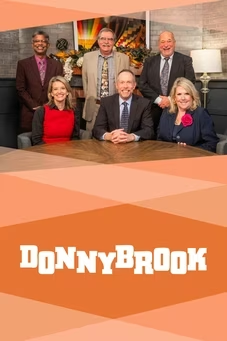
Renee Shaw hosts a discussion about the 2026 Kentucky General Assembly session with State Senator Robert Stivers (R-Manchester), Kentucky Senate President; State Representative David Osborne (R- Prospect), Kentucky House Speaker; State Senator Gerald Neal (D-Louisville), Kentucky Senate Minority Floor Leader; and State Representative Joshua Watkins (D-Louisville), Kentucky House Minority Whip.
Problems playing video? | Closed Captioning Feedback
Problems playing video? | Closed Captioning Feedback
Kentucky Tonight is a local public television program presented by KET
You give every Kentuckian the opportunity to explore new ideas and new worlds through KET.
2026 Kentucky General Assembly Session Wrap Up
Season 32 Episode 29 | 56m 30sVideo has Closed Captions
Renee Shaw hosts a discussion about the 2026 Kentucky General Assembly session with State Senator Robert Stivers (R-Manchester), Kentucky Senate President; State Representative David Osborne (R- Prospect), Kentucky House Speaker; State Senator Gerald Neal (D-Louisville), Kentucky Senate Minority Floor Leader; and State Representative Joshua Watkins (D-Louisville), Kentucky House Minority Whip.
Problems playing video? | Closed Captioning Feedback
Where to Watch Kentucky Tonight
Kentucky Tonight is available to stream on pbs.org and the PBS app.
Providing Support for PBS.org
Learn Moreabout PBS online sponsorshipKentucky.
Tonight, I'm Renee Shaw and we thank you so much for being with us tonight.
The 2026 Kentucky General Assembly's 60 day session is coming to a close tomorrow and Wednesday.
Lawmakers will consider overriding bills vetoed by Governor Andy Beshear.
He's already vetoed 30 bills, with four already having been overridden.
Tonight.
We'll talk about lawmakers actions on the two year state budget, education policy, gambling.
And what about measures on housing?
And will there be an impeachment trial for a Lexington judge in the coming days to discuss all this?
We have an hour Lexington studio for legislative leaders, state Senator Robert Stivers, a Republican from Manchester and Kentucky Senate president, state Senator Gerald Neal, a Democrat from Louisville and Kentucky, Senate minority floor leader state Representative David Osborne, a Republican from Prospect and Kentucky House Speaker and state Representative Joshua Watkins, a Democrat from Louisville and Kentucky House minority whip.
We certainly want to hear from you tonight.
You can send us your questions and comments by X, formerly known as Twitter, at Pub Affairs KET.
You can send an email to KY Tonight at ket.org or use the web form@ket.org.
Johnny Nash KY Tonight.
Or you can simply give us a call at one (800) 494-7605.
Well, welcome gentlemen.
Thank you for being here.
Almost to the finish line.
Maybe, maybe, maybe we're going to start right there, Mr.
President.
So over the weekend, you said in a news interview with Bill Bryant that there is a 5050 chance of a Senate impeachment trial involving Fayette Circuit Judge Julie Goodman.
And just to remind folks and we have talked about it, the Kentucky House Impeachment Committee found that she abused her judicial discretion and authority over six cases, cases in which she presided.
You all had a meeting, I think, the Senate and the House today to talk about where you are, where are you, and will there be an impeachment trial that happens starting maybe the 16th?
>> Well, first of all.
People need to understand the process.
People want to know why this is in effect right now.
Well, it's what the Constitution says should happen for all individuals who hold these types of positions.
The ability to impeach lies with the legislature.
>> And the Kentucky Supreme Court said as much, right?
>> They did.
And and it is within their own articles where they are defined that the right of impeachment is inviolate and stays with the General Assembly.
>> And violet means protected.
>> It is protected.
So our right to do the impeachment process is protected by the Constitution.
And it doesn't matter what else is in the Constitution.
We set the rules, we set the process, and then we determine whether it rises to the level of an impeachable offense.
There were petitions filed against four individuals, at least four, I think.
But there was also a resolution which the Supreme Court got wrong.
They thought that this was a Kelly antimony resolution or impeachment.
It's actually a resolution filed by a House member in the House.
So when the Supreme Court opinion came down, I believe it was blatantly wrong in several positions.
One, they enjoined the General Assembly, which the Senate nor I were ever joined in any litigation.
So when I said that statement with Bill Bryant of the day, we hadn't been able to go through everything.
But we are not in any way going to preclude ourselves from starting sometime after the 15th.
>> Okay.
So does that mean the session adjourns?
>> It adjourns.
If we go forward, it adjourns only to the aspect that we cannot consider any more legislation.
But the Senate can stay in session as long as it takes to do an impeachment.
>> But the House would be adjourned.
>> They would.
>> We had no choice but to adjourn on midnight April 15th.
That said, our prosecutorial committee that will prosecute the impeachment right will remain and prosecute.
And I will tell you that they they are fully prepared to to remain in prosecute the impeachment.
>> So last week, there was a press release sent out from the Senate majority's office that mentioned several dates, and it would start on the 16th and 17th.
And then the judge Goodman could make her defense some days after.
And then by April 24th, there seemed to be almost a conclusion that could be rendered at that time.
Are you still sticking to that schedule.
>> At this time?
We are, but we also know because of work that we've been doing on the budget and other things, to conclude the session, we may have to delay that a few days.
>> And you can decide.
That's right.
And is there a time limit by which you have to determine that you need to be back in session?
I mean, is this open ended.
>> It I think 115 years ago, the last impeachment trial in the Senate lasted a little over 30 days.
>> Okay.
And it can start as late as June, July, August.
>> We we can stay in session for this sole and singular purpose.
>> Is there still pay during that time?
>> It is.
And we have calculated it.
>> How much is it?
>> Around $30,000 a day.
>> Okay, so let me ask this.
>> We knew you would ask that type question.
>> You know me, sir.
Okay.
What do you think?
Louder Neal.
>> Well, I have to see how the process plays out because we'll be sitting as a jury with respect to that.
So it just depends on procedurally what happens.
And we have to see how it unfolds.
>> Representative Watkins, you have said many times on the House floor that you're new to a lot of this, and you had remarked about these proceedings when they were happening in the House.
What's your final takeaway here?
>> I think this is a solemn occasion.
I believe that everyone takes seriously.
If I can just echo the note from the last impeachment trial being 115 years ago, that that lets you know how rare I think these occasions are being in the House.
I think our voice that there were some differences of opinion in terms of what I believe rises to the level of of an impeachment, but the Constitution is the Constitution.
So I just like many other Kentuckians, are going to watch the process play out and then hope, from my personal perspective, I hope that there is a a resolution that allows for all of the unanswered questions to be answered, and hopefully we don't have to revisit such an occasion in the near future.
>> Right?
So given people may be confused because they learned last week about the Kentucky Supreme Court ruling that said this should be halted, essentially these proceedings.
So a trial does not necessarily indicate that she is guilty.
That just means you're working to find out whether or not she needs to be impeached.
>> What what the process is basically is like the House does a preliminary hearing or what some people may consider the equivalent of a grand jury.
They make a potential charge, deliver us articles of impeachment.
And I've said this to Senator Neal and everybody in the chamber, stay away from press stories, newspaper stories, because we are just that.
We are a jury.
I do not know what their proof is.
>> And you haven't seen their.
>> I haven't seen it, haven't heard it.
We stayed away from it.
So we will start that process.
The only thing I know about it is what I've read in those articles that were delivered.
And the court's ruling, which I think was intriguing to say the least.
>> Because they say that one, that the impeachment petition was invalid, that she hadn't committed any impeachable offenses and that she was not afforded Judge Goodman due process.
Mr.
speaker, do you have any comment on this process and where we are now?
>> You know, I am I'm a non-attorney, so I get to to be poorly informed on these on these issues.
But I will tell you that we are confident that we're on sound and, quite frankly, unambiguous constitutional footing in this issue.
As I said, our prosecutorial committee is standing ready to prosecute this.
They believe in the the issue that they have raised as President, Stivers said, you know, the the issue of the petition has been mooted because it was a resolution that was filed, which is what we acted on.
So again, to to Representative Watkins point, there is nobody that seeks that sees any any Lee in this in any way, shape or form.
This is a very solemn occasion, and I think every single member of the.
The body felt that the day that we voted to to adopt the resolution, you could see people that were on both sides of it that were torn, that were were solemn about the fact that we had reached this level.
You know, there's lots of lots of discussion about whether this will become, you know, a more common tool that will be used as political fodder.
And I think that if for those that are watching closely to the the demeanor of the people on the floor that day, the way the committee conducted themselves, the way the Chamber conducted themselves, I think absolutely they understood the gravity of of the situation.
And I think if anything proved quite the opposite, that nobody wants to go through this for any purpose, particularly a political purpose again.
>> And the legal remedies that would be here that are forwarded to the jury who votes to perhaps to convict.
I don't know if vote is the right word.
>> It will be.
>> A vote.
It will be a vote.
Right.
There are two options, right?
Three, three.
What are they.
>> To find?
No impeachment.
And I want to say this to my colleagues.
I have stated I start as a no.
They have to convince me to be a yes because this is we're setting aside an election where potentially setting aside a person's qualifications to hold elected office.
So one is no impeachment.
Two is an impeachment, which is removal from office or impeachment with removal from office and banning the individual from ever holding an Office of Public Trust.
>> So and I'm pardon me if this is in the weeds.
So you talk about a resolution.
It was House resolution 124 that contained six articles of impeachment.
Do you vote on just the resolution or the individual articles?
Does that make sense?
>> Yes it does.
And what we're going to do is what we did and has been done in the past, and we're mirroring what we have seen done at the federal level, which has been upheld by the federal courts as constitutional.
There will be an impeachment hearing committee that is chaired by Brandon Storm.
They will hear this, and then they're going to come back with a recommendation.
And that was the schedule with recommendations.
And there can be a minority report and a majority report, and we can vote it in total or individually, depending on.
And it may be they come back with a recommendation of one, two, three, 4 or 5 or some combination thereof or a recommendation.
No impeachment at all.
Right.
And we've been very clear, we don't know.
We you know, it's we don't know what the outcome will be.
>> So if the outcome is options two and three to to remove from office and to ban from future, is that appealable to the Kentucky Supreme Court.
>> In my opinion, no.
>> Is there a different opinion about that?
>> Oh, there's probably a different opinion.
>> Lawyer leader Neal.
>> Well, I'm not going to speak for the court, but I think there are some separations of in terms of the function of the legislature versus what the judiciary does.
So I haven't researched that particular point.
But if it's ruled that they have separate responsibilities constitutionally, then it could end up being that way.
>> And Renee, if if it is appealable to the court about a member of the court and this is what the Constitution was framed on, is a series of checks and balances.
Why did our initial framers of our Constitution give us that power?
And in the 19, I think, 74 or 76 Judicial Reform Act, it remained in there in that act which established the Supreme Court at the time, which is questionable because it was done by ballot initiative, not by full text, which this Supreme Court has ruled unconstitutional.
You know, that that is it was retained in that that that right, that obligation, that constitutional duty remains with the legislature inviolate.
>> Okay, so final question, because I could go on this the whole hour, the Judicial Conduct Committee or commission, what's the role here with them?
And are you seeking information from that said commission?
>> Just found out about that the other day in the opinion was the first time we questioned, you know, why has the JCC not acted?
And it's kind of interesting.
We understand there may be two petitions.
They have the ability to sanction, remove, suspend, but they've not acted.
And what was very curious to me, and I don't know what prompted it, but I have suspicions that after this came out of the house, numerous attorneys started reaching out saying, well, we want to talk about more with this judge.
Don't know what they want to talk about, but they want to talk about more.
And what we heard was we were afraid to file petitions in front of the JCC, because then we had to go back before this judge.
And that made it very tough.
>> Yeah.
Any other comment on this before we move on?
Just a quick follow up.
Yeah, sure.
>> On the JCC issue, Renee, at several points during the initial testimony that was taken and documentation that was sought in the House impeachment by the House Impeachment Committee, the Judicial Conduct Commission was asked on a number of occasions if in fact, there was anything pending before the Judicial Conduct Commission.
They refused to answer.
And so we had to operate under the assumption that there wasn't because we had nothing to the contrary to prove otherwise.
>> Yeah.
My only comment is that, you know, as been stated, I'm not privy to any of this information.
We're in a position in the Senate.
People like me waiting to see what comes to us.
And what happens on another level happens on another level.
If we're going to sit and we'll sit as a jury and hear the evidence at that time and make a decision.
>> And this would all happen in a committee hearing room, right in Frankfurt, right.
>> Open to the.
>> Public, open to the public.
And KET would would cover that.
Okay.
I just want to last question, I promise on this.
I think.
>> You said that two questions.
>> I said that two questions ago, but I just want to make sure I understand I'm a little slow.
This this session would not be terminated and you would remain in session.
Could you not signee die as regular knowing that perhaps you need a month or two and then you be able, as Senate president, to call into special session for the sole purpose of the impeachment trial.
>> I.
>> Cannot you cannot.
>> I can only extend session.
>> Okay.
All right.
So this is good.
We've had a good civics lesson here.
I think.
>> We had a really good constitutional amendment a couple years ago.
That's right.
Allowed us to do that.
>> Okay, Mr.
Speaker, I'm going to let you pick up on that.
And wasn't that filed again this year?
Was that filed again this year?
>> It was filed again.
>> This year.
So.
So let's tell viewers what you're talking about here.
>> Basically with just allow for allow us to as the way the sessions are structured right now, we have hard drop dead dates March 30th and April 15th, by which we have to adjourn our session sine die.
And and in some iteration, those constitutional amendments would have allowed for us to hit a pause button bank days and say, okay, we need to pause right now, ignore the April 15th date because we need more information, we need more time to do something and then reconvene beyond that.
Unfortunately, those that that amendment was defeated, but I still think it makes for better government to do it.
And and we're going to continue to pursue it eventually.
>> Yeah.
What do you think of that idea this side of the table?
>> I think it works fine just the way it is.
>> You Watkins.
>> You know, I think that any opportunity to provide more clarity on processes and gives us more time to do so is just better for the people of the Commonwealth.
I do want to go back really quickly if I can, because I was a new member.
I'd say that not far removed from being a lay person.
And so I got to participate in these impeachment proceedings.
And one of the things that that still gives me pause and I still think gives a lot of people pause is just this, this understanding of what a misdemeanor in office really means.
And so when I hear misdemeanor, I think of something that is criminal.
And but upon going through these processes, I found out that that is not necessarily the case.
There could be terms like misfeasance and malfeasance.
Those are very subjective terms as to what a person individually thinks.
Here's why I think that.
>> Is, are those things rise to the level of a crime, though.
>> If they.
That's my question.
Do they rise to the level of a crime?
And here's why I think any other administrative process before impeachment is really important.
And I think they're bringing up the Judicial Conduct Commission is exactly that.
I wanted to see some sort of evidence that there were complaints or something given beforehand, and I give pause to hearing the fact that a judge doesn't necessarily want to complain about another judge.
It sounds like to me, at risk of having some sort of retribution.
And if that is the case about our legal system, then I think that is levying a sort of warning to the entire structural integrity of our institutions that I think is a nightmare for what democracy is.
But at the baseline level, if I, as a person who participated, still finds myself confused, and I'm not a constitutional scholar and don't have the benefit of being a lawyer like my colleagues, I think there that most people will probably share that that didn't go to law school.
>> Yeah, I think we can agree on that.
Okay, so let's talk about some of the governor issued vetoes today, or maybe he had done this previously.
House Bill 505 01503504.
These are the budget bills and.
757 the revenue bill.
There were line item vetoes to those measures.
I know you may not have had a chance to pore over all of those.
Your initial reaction?
>> Well, I haven't seen any of them.
I heard that there was vetoes coming down.
So where my initial premise on the impeachment is, I start as a no on this.
I start as a yes that we will override.
And somebody's going to have to convince me that it's no.
But I can't comment because I've not seen those.
As I understand, they were just handed down.
They were our.
>> Absolutely.
At 647, I checked and that's when I saw them.
So, Mr.
Speaker, your thoughts.
>> Yeah, I think I was told that there were 35 of them altogether.
Have not had a chance.
I looked at the bill numbers, but as far as the line items and the budget bills have not had a chance to look at any of those.
I agree with with Robert, I think that our our bargaining position will be to override those, barring some, you know, new information that we haven't had before.
And as I continue to say, the only thing more satisfying than passing a good bill once is to pass it twice.
So I would expect that we will be active beginning tomorrow.
>> Okay.
Leader Neal.
>> Again, I haven't seen any of those, but I expect to carry the torch to uphold the governor's vetoes.
>> Before I let you respond, whip Watkins on 757, which was the revenue measure, the governor in his veto, he points out about the historic properties idea of putting an object or art of Senator Mitch McConnell in the Capitol Rotunda, in which we knew he had objected to that.
And he mentions a couple of others who he feels should have also been elevated to have a place in the state capitol.
Department of Corrections Commissioner Cookie Cruz and the late J. Michael Brown, who was the first black Kentuckian to serve as secretary of the governor's executive cabinet.
Any thoughts that you have on that, and particularly the statue of Mitch McConnell, which I'll have.
Also, the Speaker and Mr.
President, respond to.
>> I tend to defer to the governor and his perspectives about his veto power and such.
I think this is probably the greatest expanded lesson of schoolhouse Rock that I've ever been a part of, but specifically to the statutes.
I think that there are noteworthy Kentuckians that should be reflected in our rotunda.
And I think as as someone who has roots in Kentucky, I want to see people who I feel like have have shaped the Commonwealth's history as well as the history of the country.
I think you'd be hard pressed to say that Mitch McConnell did not do that.
I also would be hard pressed to say hearing names like Cookie Cruz and J. Michael Brown.
I think that they deserve that sort of elevated reach as well.
And I would wonder if anyone disagrees with that.
I'd wonder what that explanation is.
>> Do you want to comment before I go too?
>> I think it should go through some type of process and we need to look at that.
I mean, we just removed someone from the rotunda because he thought it was not worthy of that spot.
And the situation now is that what else has been precluded from our historical view in terms of that?
For instance, people of color that have contributed greatly to the Commonwealth of Kentucky and certainly others and the names, of course, are J. Michael Brown and and Cookie Cruz and others are certainly would rise to that level.
>> Mr.
president.
>> As to the placement of Senator McConnell.
Well, I've said this when I introduced a resolution, and it goes almost to what the representative has said, that this individual has been in office for 40 years, has impacted this state, has impacted this nation and has impacted this world as no other Kentuckian has done.
Maybe ever, except for possibly two people, one being Lincoln and Henry Clay.
I don't know if that is the criteria, how you argue that any other person has been around for a little less than 41 years, 40 years that has been on every national news story has been considered the most prominent Republican when in the in the nation, which makes him the most prominent Republican in the world.
When there was an individual, be it Clinton, Obama, or, or or any other Democrat elected official to the presidency, this was the opposition to that individual.
And so I find it hard to argue with that rationale.
>> Mr.
speaker.
>> I would agree.
I think that clearly leader McConnell is the most certainly the most consequential Kentucky political figure of my lifetime.
And I would submit to you in the history of the Commonwealth.
And also, I think in the history of this country, he will he will be recorded in the history books as being one of the most significant figures in American political history.
That doesn't mean that you have to like him.
You know, when when if you read the history books, you know, Henry Clay was less than admired person at many times in his his political career was a very controversial figure, as was Alben Barkley.
Alvin Barkley was was an absolute partizan.
That that was was controversial at times.
I don't think that we have to say that we are broadly accepting these as, as as well-liked people.
But their their political significance that have have molded the shape of this Commonwealth in this country.
I will point out, just as an aside, that this governor does seem to have an uncanny inability to understand that a revenue bill is not subject to a line item veto.
The court's been very clear over that for years, and multiple circumstances.
You can you can line item veto, an appropriation bill.
A revenue bill is not an appropriation bill, so we will likely override it anyway.
But but he really does not have the authority to override or to line item veto a revenue bill.
>> Yeah.
Final thought.
>> We'll stand up for the to uphold the governor's veto.
>> So before we kind of dive into some other measures, I do just want to get an overall temperature of how you feel about this session and about the major accomplishments aside from the budget and the revenue and one time money, what stands out?
I'll start with you, Mr.
Speaker.
>> You know, I.
>> Know that you just you prefaced that by saying, aside from the budget, but I think in budget session, you have to you have to start there because when you start there, you finish there it is.
It is the thing that drives everything else that we do during the budget session.
And, and quite frankly, I think it's the most significant policy document that we will pass.
So everything else pales.
And I'm proud of the budget document that we passed.
I'm proud of the one that we we produced and, and massaged through the process and changed and ultimately passed the last night of session.
It is a really thoughtful, good document.
And I think it it does exactly what we set out to do, and that is to address the needs of the Commonwealth and to to, to fund the needs as opposed to once we continue to to try to be as fiscally responsible as we possibly can to utilize taxpayer dollars in the very most effective and efficient way.
And I think we did that, and I'm proud of that.
>> Louder Neal.
You know, I guess it's always in the eyes of the beholder.
There are great things in that bill.
There's no question I voted for the budget bills.
And some people think that you take one item in there and you take a position that, well, I'm against the whole budget bill, but there it runs the Commonwealth and it has all kinds of things that are very important.
On the other hand, that doesn't mean that you really buy into everything because there are things even philosophically, conceptually and practically that you don't agree with in the budget bill, and you have to acknowledge that it exists.
And I think everybody makes takes that into consideration.
You know, my my concern is, is not that that's the process.
We make judgments.
The majority is going to whatever they ultimately agree on, they're going to do.
But I think it's very important to understand also that there are opportunities that we lose when we take certain types of strategies that limit our ability to deal with broader considerations.
For instance, we're being impacted by the federal government in terms of decisions being made on that level.
That has puts pressure on us.
It transfers of the requirement, or let's say, the the ability for us to address our local needs.
The changes up there affect us.
It affected us this time.
That means we made judgments here as to what we were going to allocate, where we were going to step up.
We undertook some restrictive behavior in terms of people who qualified for certain, let's say, in the Medicaid realm and some of the other realms, which is really calculated.
And everybody knows this.
Some people are going to fall off of that because of the structures we set up that militate against them going through the processes.
So all these things affect other policies that we undertake, and we put a series of them into place.
And that means someone is not going to get a benefit that's in need.
So when we talk about needs, I say again, it's always in the eyes of the beholder.
And I think that's important.
Another thing, two things, in fact.
One is that we have this overall policy, which I was very glad to see.
The Senate took a pretty strong position, and I perhaps the House as well, of not rushing past that next level in terms of rushing to zero in terms of income tax.
I thought that was a wise decision that was made this session.
I'm very concerned about that.
You know, I hope I'm wrong that nothing gets shifted in terms of sales tax and other kinds of burdens on our citizenry going down the road, but I thought that was a good decision this time, and maybe that's where we ought to stop, I might argue, but I think that's important.
But the last thing I want to make is this, is that when we assume the burden that the federal government shifts on us, you know, I think that's we have an obligation and responsibility to step up for those who are in a weaker position that need to be supported in that particular regard.
And to the extent we don't, it raises considerable concern.
For me.
We got 30% of our people on Medicaid in the state of Kentucky is my understanding, and that's not talking about the other areas of needs.
We're not a very prosperous state, although we've seen some sunshine over the last few cycles.
I don't think that's going to sustain itself.
I hope I'm wrong, but history tells me that we're going to have some highs and we're going to have some lows, and we'll see where that goes.
But that's those are the concerns I have.
>> But I think I'm probably most excited about the feedback and participation of everyday Kentuckians, whether they came to the Capitol.
They called, they emailed about several several items as it relates to the budget.
I was very happy to see that as it related to state employee health plans, that we made some adjustments there.
And I think the feedback from a lot of people encouraged that.
I think that there are some things that we are going to agree upon in the housing space.
I think I'm.
>> Going to get to that in just a moment.
>> I know we are.
So my ears are sort of raised for that.
But I do want to echo some of the senator's concerns as it relates to the budget.
And I think this is the normal part of the discourse.
As someone who saw a budget for the first time, I will say that I was very appreciative of my colleagues on the House side, particularly Chairman Petrie and several others, who answered every question that I did have.
And I had a lot of them because a lot of people do.
I'm concerned about Medicaid.
I'm just I'm quite frankly, concerned about affordability.
I mean, gas is gas is $5 in some places.
And and I know everyday people are concerned about how they're going to eat and whether or not they can go to the doctor, whether or not they'll have a roof over their head.
And so I think when you pass a budget and I know the majority and the minority think about this as we make any decisions, it's how is it going to impact the people that we represent?
And could we do a little bit more to make people's lives better?
I am hopeful that we continue to drive this affordability issue home more and more as as we continue to talk.
>> Yeah.
Mr.
president, I'll give you the last word on on budget and well, I.
>> Think we do a really good job, Renee, on the budget, unlike Republican and Democrat states throughout the United States, we haven't had to go back in and cut programs because a lot of people extended using one time dollars to do recurring programs.
As to Medicaid, we have placed in a segregated account $300 million to deal with any type of shortfall, which will have a major federal match to it.
So we do a really good job at managing that.
And for the loss of income where we have been reducing it.
If you look, you think that you would have a corresponding drop in that section of our tax code.
It's actually not that it's not dropping that fast because we're expanding our base and creating more jobs here.
You've heard the governor say, hey, look, I've cut more ribbons.
Well, that's right, because we've created the dynamic for him to cut more ribbons.
So with that, I'm going to say dealing with the the budget bill, which has to be I agree with the speaker.
It has to be our primary focus.
But I think something we did in this session may have more impact that people need to understand.
And that's being able to take a tax credit to put into a school system.
So if Renee owes $1,700 to the federal government, you can take that $1,700 and you can put it with what's called an Sgo, a nonprofit, which will funnel it back to Shawnee High School.
>> It can be a public or private.
>> Public or private school.
I sat down with my superintendent and said, Manchester Elementary 20 teachers there.
They take that $1,700 tax credit, put it into a an NGO, and they're putting over $35,000 back into that school, just among the teachers themselves.
And what do they do with it?
They said, well, this is for rich kids.
No, it has to be for 300% of poverty or lower that you're working with these children.
I think that may be the most significant thing.
Other than the budget that we did this year.
>> Democrat Tina Bojanowski in the House had made the case similarly that this could help public schools.
And, Mr.
Speaker, we know this was your bill.
>> She she actually, representative Bujnowski made a very passionate speech on that on the floor because she is very passionate about special needs programs.
>> And and she is an educator.
>> And she is an educator.
And she saw very quickly how this could benefit some of those unique situations that, that we don't have the ability to do one off funding for right now.
And, you know, I think one of the, one of the first people to embrace this was, was representative Fugate Chris Fugate down in Perry County, because he represents the poorest counties in Kentucky.
And, and he, he was able to to say he lit up when he thought about the ability to bring outside money into those districts that are that are so impoverished.
So I think the opportunity is.
Robert said the opportunity is is incredible.
And I think that it's unfortunate that it has.
It's tried to delve into some political past fights that that really aren't appropriate here.
>> The constitutional amendment of 2024, that 2 to 1 people did reject Wright over school choice.
Yes.
And this is not that is what you're saying.
>> And I think to you know, I know that, you know, it's a better political narrative to say that it is.
But as, as, as many people on both sides of the aisle pointed out that this this is not that.
And this is an opportunity for everybody.
There are some people that were concerned legitimately so about maybe some of the ambiguous language that is still pending at the at the federal level.
But I think the opportunity that this gives for every school in Kentucky and every kid in Kentucky is, is, is pretty special.
>> This is House Bill one, and we've talked about that before.
And I think Senator Thomas, your colleague, has also talked about how he did not approve of that because it's still money that would be taken away from public schools, even if it's coming at the federal level.
>> Exactly.
And, you know, I can't say if money handled properly by those or or some construct is used in a way that helps people, is not beneficial to people who receive that.
I think the point is, though, that if you take money from a public piece to fund a private piece, then you still doing something.
I think the argument could be made as they make on the ground, that you're taking money from a public school to, let's say, fund charter schools.
I know it's a different context.
I know it's a different dynamic.
I know it doesn't have to come out that way myself.
A lot of people are just public school or just charter school.
I'm not against charter schools, quite frankly.
I'm just against public monies going to charter schools.
If we haven't fully funded our public schools, that's my concern and that's always a concern.
And when you do something like this, I could see where someone could take that position, but it's been passed.
I think it's something that you got to take advantage of.
You got to be aggressive about it.
If you can bring the benefits to those who need it and fill gaps and so forth.
I see no shame in that.
>> Okay.
I do want to get to housing, okay?
Because I want to get to housing and gambling if we can, in the next 17 minutes.
So Senate Bill nine when last we left off, I think combined eight different pieces of legislation that started off as Robbie, Mills, Bill that would allow local governments to designate special building zones that could help finance and lower barriers to construction.
So but it has a lot of other things in it now, right.
What can you say about this, president Stivers.
>> In the last days of the session that concluded to go into veto recess, we made a conscientious decision to make sure bills got readings.
So they still be dealt with in this this last two days.
So that bill is out there.
But it had so much on it at that point in time when we were trying to finish the three branch budgets plus the transportation budget, plus what we call the six year road plan, plus the revenue bill that funds the government, that we decided to say we're going to wait and try to deal with that in the in the period of the recess, we had discussions on it.
Today, we're going to discuss it a little bit tomorrow.
But with all the additional, you know, jokingly we say we have we have a host in parasites that jumped onto it.
We're going to have to look at those a little bit before we make a final decision.
What we're going to.
>> Do are you talking I don't know which one is which, but the Airbnb provision, short term rentals seem to be something that's getting a lot of discussion.
I don't know if that's the host of The parasite.
>> And that's such a tough decision.
And I don't know where the speaker is on this.
You know, it's been the Airbnb industry has been kind of the backbone of, of, of the housing component of our bourbon trail.
If you start looking around and it has such positive impacts, otherwise other places, it hasn't been that positive.
It's driven up some housing prices and has creating housing shortage in my hometown.
We don't have a really good hotel, but the best thing we've got are some really nice Airbnbs.
So how we deal with the issue and the collection of the taxes and what it does to the demand on housing, it's pretty tough to try to sift through all that.
Plus, then you have individual property owners rights to do with whatever they want to do with their house.
So it's not an easy issue.
>> Yeah.
Mr.
Speaker.
>> I think that that is kind of the core issue of the entire housing bill.
And it did, you know, from from day one, it was kind of assumed that we were going to take this approach with it, allow each of the individual bills to be filed, take public input on them.
Some of them went through committee.
Some of them just got general public input through the task force that we had working in the interim.
Find out where the the pressure points were, find out where we could get agreement.
But at every, at every turn, you know, recognizing that we needed to do everything we could to tear down barriers to housing and affordable housing, protect property rights, understanding that that is the core of the foundation of this country's protection of property rights.
But but also do as much as we can while respecting local control to eliminate a lot of the bureaucracy that we get wrapped up in, in the development of housing, particularly affordable housing.
I think this bill does that.
It is a lot there's a lot in that bill, and it's a lot to absorb.
I, I would suspect that there will be changes before the final product is is passed.
I do think we will pass something.
I think it will be meaningful and I think it will will definitely move the bar.
On the availability and affordability of housing in Kentucky.
>> We know that House Democrats had a Homnibus 2.0.
Was that the name of it?
So are any of the ideas that you all had presented part of what we now know as Senate Bill nine.
>> There are some ideas and Senate Bill nine that we agree with, and I served on the housing Task Force this summer, and we heard the Residential infrastructure fund, for example, as as an idea that we agree upon.
And there were some adjustments, I think, to the Affordable Housing Trust fund, some allocations there that I think we agree upon.
But if I could just kind of dovetail, I didn't get to get in on the education piece, but I'll say this as well.
There are some things that we asked for, and there are some things that people have asked for that are not in there.
And I would say that that on education, I would say that as as well as housing.
So it really comes down to the affordability argument again.
And one of the things that I hope that we tackle is some affordability requirements.
If we are granting the ability for developers and builders to use public dollars to build housing, I want to make sure that it's affordable.
And when you say that word affordable, the first question that comes to mind and in the mind of a lot of Kentuckians is affordable for who.
And so we actually have data to figure that out.
Is it going to be for our lowest income earners?
Is it going to be workforce driven?
I think those are some of the things that we want to see.
But as a housing professional, both in the private sector and public sector, one of the things that I want to encourage my colleagues on the right to do and co-chair Mills has heard me say this a thousand times, so I'm going to say it 1001, just to to reiterate the point, I think we need to spend a bit more money on the creation of housing supply.
There is some regulatory benefit to Senate Bill nine, and I think that is the case.
We could do more there.
Mixed use zoning, allowing local governments to come up with their the laws that make sense for them.
We could limit corporate ownership for for homes and such, and also do something to help our renters.
We have a lot of people who will never own a home.
I'm a millennial.
The average age of a first time home buyer is 40 years old, and that means that a lot of people my age are younger, are renting, and we haven't done a lot, in my opinion, to specifically address that.
So it's a yes.
And for me, if I have to say pretty please, I could do that too, but I would definitely want to see a bit more allocated to the Affordable Housing Trust fund and some evolving functions that will make sure that pays for itself over time.
>> Let me let me raise another question, another issue here too as well.
I served on the housing task force as well, and it was quite an education.
But one of the things that was clear is that we have a crisis going on, particularly in urban areas, but also in the rural areas as well, but in the process, interacting with other people and getting closer to the ground in terms of what was happening in communities.
There's also an issue as to does someone's utilization of this break up the continuity of the community itself?
How much input should people have into this process in terms of how their community is going to be going to look?
For instance, these people invest a ton of money in certain neighborhoods, etc.
that now are going to be visited upon a loosened up circumstance that allows people to build things that may not be congruent with their communities.
I think that is a consideration.
I'll just say I don't know what the resolution is, other than they should have more voice in that in this process, and I hope that that evolves going forward as well.
>> But procedurally, we should point out that whatever you pass is not veto proof.
>> True.
That is correct.
>> So will that encourage more caution and what you think the governor may not veto in the final product?
>> No.
We're going to go ahead and try to get a final product.
But let me say this about I think and we've dealt with so many numbers and we have to look at the speaker.
I think we put $10 million each year in the Affordable Housing Trust fund, but that's only one Senate Bill nine is another discussion point.
Senator Carter Heron worked on a brownfield bill that we passed that would open up a large portion of the TRACK of land for housing development.
There are more than just these bills, like the Fourth and Oak Project, and we put money behind the Fourth and Oak project.
You know, there's several places like that throughout Eastern Kentucky, Western Kentucky, in our urban areas that beyond what you see in the Affordable Housing Trust fund, we specifically set them out and funded to do things in those areas.
>> And let me raise a point on that one, the brownfield bill.
That was a very significant bill, not just for that project that opened up what could happen in brownfields that you find in different places in urban areas.
And I think I was excited to see that happen.
That was that was a good one.
>> So I want to get in this question before we talk about House Bill 904.
And that might be the end of our program.
This from Martin Rivers in Lexington.
He says, quote, the Kentucky legislature seems annoyed with transparency with JCPS and CPS.
This is Jefferson and Fayette counties and their budget process.
Why would citizens not be annoyed by the same thing in the Kentucky legislative budget process?
So many of these bills had last minute subs or even last minute updates.
Why should citizens trust legislators in the majority party and the process they use?
>> I'll answer that real quick.
First of all, we're time limited.
We are by constitution at midnight on the 15th.
Done.
We only have so many working days by constitution, so some of it is set to us or put in place by the Constitution itself.
We're not like a continuing ongoing organization like the JCPS or FCPs.
They have annual long periods of time.
The other part of that is when we get into the budget process, you're hearing budget committees throughout the session and before the session and in the interim talk about what we just talked about housing, housing, construction, you know, brownfield legislation, very open, very transparent.
But at a certain point in time, you've got to get a written document.
>> Mr.
speaker.
>> I think the fact of the matter remains that, you know, we do continue to to build in firewalls, fail safes into our budget process, whether it be from the Medicaid standpoint, whether it be our budget reserve trust fund, to make sure that we don't have the kind of problems that, quite frankly, JCPS and CPS have encountered, we make sure that we we haven't.
So I'm not necessarily irritated by by a lack of transparency.
I'm irritated by the fact that they are hundreds of millions of dollars short on their budget and don't have an answer for it.
>> Well, I have to say, I think transparency is important.
And democracy.
We have an obligation to create as much transparency as we can.
It gets messy when people disagree at a table, but that's part of this democratic process, and I don't think we're afraid of that.
I think it's kind of we're in kind of a unique situation now because of the construction.
And we're not in the capital piece now, but we should strive, I think, to create as much transparency as possible.
>> Okay, before I get.
>> To that last point, I'll be quick.
>> Sure, sure.
>> I would like to encourage everybody to, to pay attention to the interim as, as Robert said, you know, particularly Chairman Petrie has done an incredible job of, of having very regimented A&R committee hearings, budget review, subcommittee hearings, literally, he will start in June and end of this year, starting working on the next budget.
It's it's easy not to pay attention to those things, but I think you have to kind of pay attention to those things to, to see the, the picture evolve into what we make into the final product.
>> Before we get to gambling.
So, you know, make people wait a little bit.
Data centers.
So at the beginning of the session, you know, we heard a lot about housing education and data centers.
And where are we on that?
Josh Bray had a Bill 593 that dealt with the use of these facilities and them paying for their power or having some kind of agreement on how they, they would pay for that power, not pass it on to ratepayers, because they do consume a lot of energy.
Where is that?
>> It is in the Senate.
>> And what's it doing in the Senate.
>> Appears to be resting.
>> Resting comfortably, you know, and.
>> Josh did a really good job at this.
And I've been involved.
And I want to admit that Josh did a really good job.
And I think Josh took a perspective.
And I'm going to say this won't compliment the PSC.
Josh took the perspective of a more rural look at this and dealing with a draft piece of legislation that dealt with more of a rural electric co-op, which is totally different than an investor owned.
So we're trying to balance that out.
But if you think what the PSC, the Public Service Commission that sits this, they looked at both the investor owns and the co-ops, and they formulated a plan to where the residential and commercial consumer would not bear the costs of a data center.
And that's they call them tariffs.
Some people say full cost allocation because it's not just the generation of electricity and actually the generation, if you got a large base load, consumer will stabilize the prices.
That's what's happened in Eastern.
Kentucky we lost a lot of population, a lot, a lot, a lot, a lot, a lot of industry that that stabilized the rates, right?
>> You know, so the rates are higher for those who are left.
>> Because you're basing it on a premise that we develop infrastructure with 40,000 people.
Now we've lost 10,000 of them.
So that 30,000 are are sitting there paying for that increased payment of of paying for the infrastructure.
You don't want that passed on.
That infrastructure shouldn't be passed on to the consumer when a data center comes in.
But the PSC actually created two models, one for investor owns, one for co-ops that I think worked.
But we need and it's probably going to take more work.
And as we get through this, the process dictates that we focused on the budget, to sit down with Josh over the interim and come back, because we want to make sure, even though I think the PSC did a really good job, we still need to put some guardrails in place.
>> Okay.
Gambling House Bill 904.
We know that the governor did veto that bill, and this was about the major omnibus gambling bill that did a lot of things.
So, Mr.
Speaker, this is going to get overridden pretty easily.
>> I would expect.
So, yes, you know this it's a really good bill.
It is a comprehensive bill, one that that I think kind of protects all the interests of gambling that involved the gambling industry.
It it protects the charities that that are operating in an ethical manner.
In Kentucky.
It it, it absolutely identifies the, the firewalls that that the racing corporation is able to, to establish, to make sure that, that there aren't co-mingling of funds, that, you know, all those consumer protections that, that we'd like to see.
And it gives the, the racetracks the ability to, to do certain things that they haven't been able to do in the past as far as exploring the expanding of their, their, their wagering mix.
Raises the gambling or the age for sports betting from 18 to 21.
That was important to many people.
And the Chamber provides for the the licensure and regulation and taxation of fantasy sports, which is something that's been happening in Kentucky for a long period of time.
And without without proper supervision and oversight.
The one thing that's kind of completely thrown everybody a little bit for a loop across the country in the gambling space, is the evolution of these prediction markets that are, quite frankly, they're operating in a completely unregulated, untaxed environment, in a very predatory manner.
That's going to continue to be a moving target because they're regulated federally.
They are in no other gambling product is every other gambling product is is state regulated.
So we tried to put some some guardrails around what they were and weren't able to do.
Again, that's going to be a moving target.
That's going to be decided in federal court before it's all over with.
But we tried.
>> But the Derby is still going to air on NBC, right?
>> That is not going to be a problem.
The Derby is still going to air on NBC.
The.
The Breeders Cup will still still be able to air.
That is.
That is not an issue.
>> All right, all right.
We'll have to leave it there.
More to come tomorrow or the next day.
And of course you can keep abreast on it because 630 eastern each weeknight, we will have all of it laid out for you for the next few days.
And if there is an impeachment trial, KET will be covering that as well next week.
Next Monday night, candidates for the U.S.
Senate in Kentucky.
So you don't want to miss out on that.
And then Bill Brian, of course, is here with the team of working journalists to discuss all the news of the week on common on Kentucky Friday at eight Eastern seven central right here on KET.
I'm Renee Shaw, thanks for being with us and have a good week.
 New Episode
- News and Public Affairs

Top journalists deliver compelling original analysis of the hour's headlines.
 New Episode
- News and Public Affairs

Today's top journalists discuss Washington's current political events and public affairs.
 New Episode
 New Episode
 New Episode
 New Episode
 New Episode
 New Episode
 New Episode
 New Episode
Support for PBS provided by:
Kentucky Tonight is a local public television program presented by KET
You give every Kentuckian the opportunity to explore new ideas and new worlds through KET.