
2026 Mackinac Policy Conference, Dearborn Memorial Day Parade, Life Remodeled
Season 10 Episode 47 | 26m 46sVideo has Closed Captions
A look at a milestone Memorial Day parade, the 2026 Mackinac Policy Conference and Life Remodeled.
We’ll preview the agenda for this year’s Mackinac Policy Conference presented by the Detroit Regional Chamber and we’ll hear about plans for the city of Dearborn’s 100th Memorial Day parade. Plus, the president of the nonprofit “Life Remodeled” talks about his organization’s new projects and initiatives.
Problems playing video? | Closed Captioning Feedback
Problems playing video? | Closed Captioning Feedback
One Detroit is a local public television program presented by Detroit PBS
2026 Mackinac Policy Conference, Dearborn Memorial Day Parade, Life Remodeled
Season 10 Episode 47 | 26m 46sVideo has Closed Captions
We’ll preview the agenda for this year’s Mackinac Policy Conference presented by the Detroit Regional Chamber and we’ll hear about plans for the city of Dearborn’s 100th Memorial Day parade. Plus, the president of the nonprofit “Life Remodeled” talks about his organization’s new projects and initiatives.
Problems playing video? | Closed Captioning Feedback
Where to Watch One Detroit
One Detroit is available to stream on pbs.org and the PBS app.
Providing Support for PBS.org
Learn Moreabout PBS online sponsorship- Coming up on "One Detroit," we'll preview the agenda for this year's Mackinac Policy Conference, presented by the Detroit Regional Chamber.
Plus we'll hear about plans for the City of Dearborn's 100th Memorial Day Parade, and the president of the nonprofit Life Remodeled talks about his organization's new projects and initiatives.
It's all coming up next on "One Detroit."
- [Announcer 1] Across our Masco family of companies, our goal is to deliver better living possibilities and make positive changes in the neighborhoods where we live, work, and do business.
Masco, a Michigan company since 1929.
- [Announcer 2] Support also provided by the Cynthia & Edsel Ford Fund for Journalism at Detroit PBS.
- [Announcer 3] The DTE Foundation is a proud sponsor of Detroit PBS.
Through our giving, we are committed to meeting the needs of the communities we serve statewide to help ensure a bright and thriving future for all.
Learn more at dtefoundation.com.
- [Announcer 4] Nissan Foundation, and viewers like you.
(bright upbeat music) - Just ahead on "One Detroit," we'll talk about the significance of this year's Memorial Day Parade in Dearborn, and we'll hear what the organization Life Remodeled is doing to help improve Detroit neighborhoods.
But first up, the Detroit Regional Chamber's Annual Mackinac Policy Conference takes place next week on Mackinac Island.
This event brings together hundreds of business, government, civic, and philanthropic leaders for conversations about Michigan's future.
This year's theme is "A Quest for Common Ground."
"One Detroit" Contributor Zoe Clark of Michigan Public got a preview of this year's conference.
(gentle music) - Sandy, Bob, thanks for being here.
Sandy, tell me about what this conference means to the State of Michigan.
- Well, the conference is truly unique in the nation.
I mean, 1,500 of Michigan's top leaders, philanthropic leaders, academic leaders, corporate leaders, and of course our congressional delegation, our legislative leaders, all in one place for two and a half, three days, and it allows the kinds of conversations that you couldn't have if you're sitting in an office because everyone's on equal footing.
It doesn't matter what your title is.
If you're at the conference, you're accessible and you can have these conversations.
And that's why I'm so excited about the theme that our Chair Bob Riney developed for the conference, which is "A Quest for Common Ground."
- Yeah, Bob, "A Quest for Common Ground."
Tell me about why this theme this year?
Why now?
- You know, we're at a very divisive time, and we're more caught up sometimes in the fight than what we really want to achieve.
And so "Quest for Common Ground" is really to remind people that there's a goal.
And that goal usually has an intersect between people that have very different views about how to move forward.
And we have to work that intersect.
We can't get paralyzed by differences because then we lose.
If we find our sweet spot of things we agree on, we advance.
- Who do you think needs to hear that message the most right now?
- You know, I think all of us need to hear that message because when the temperature is up, it doesn't matter why the temperatures rise, but it brings out the worst in all of us.
And so I think it's a collective of helping lower the temperature and role modeling a different way.
- Sandy, tell me about some of the highlights.
- Well, we are super excited with an incredible lineup.
So, one, we're gonna have the former Vice President of the United States, Mike Pence.
On our stage, we're gonna have actor, humanitarian and philanthropist Gary Sinise.
And he's gonna help us celebrate America's 250th birthday.
We're gonna have lots of conversations with a lot of former governors.
(all laughing) - A record number.
- A record number of people who had the title governor, which actually Vice President Pence was a former governor as well too.
But we're gonna have former Governor Grant home, former Governor Schneider, the former governor of New Hampshire, former Governor Raimondo, who is also the former Secretary of Commerce.
- You know, the highlights for me are not just the names that Sandy talked about, but what they represent.
And so all of these individuals are playing a role in one way or another, in "A Quest for Common Ground."
If you look at someone like Pete Buttigieg, he's really saying, "Let's have adult conversations."
You know, he's not trying to silence the other side.
He's saying, let's have fact base, let's have substantive dialogue and then move forward.
I wanna make sure that people don't think that common ground means we just all need to work the middle.
I think we need very different debates on issues.
You know, the energy-centered debates and AI debates, I think are healthy.
If they're the right kind of debate, they're substantive.
And if those debates lead to a common action, paralysis is a losing position.
And so I want to make sure that we see whether we're in business or whether we're expecting behaviors out of our legislature that they know paralysis is not an acceptable place to be.
- Well, speaking of paralysis, one of the themes also of the conference is, "What's the Fix?"
A series of conversations looking at education, at AI.
I'm interested, Sandy, about why that decision was made to sort of talk about, I think one of the things you're talking about is the house is on fire here in Michigan.
What does that mean in terms of the conferences here?
- Well, since the year 2000, Michigan has fallen dramatically in everything from population growth, per capita income, educational achievement.
And we have found through our statewide polling with the Glen Gareth Group that our Michigan neighbors across the state don't know that we've fallen.
So, we are going to ring the alarm bell, which is Michigan's house is on fire, which leads to these common ground conversations because we need to reverse these trends, and we can only do it by finding common ground to move forward.
So, we're not just going to talk about problems, we're gonna talk about problem solving, and the "What's the Fix?"
Series, which is gonna be led by our friend Devin Scillian, the former WDIV anchor.
We're gonna talk about data centers, we're gonna talk about economic development.
We're gonna talk about K through 12 education reform.
What is the fix for these falling numbers that we have in Michigan that frankly we just can't settle for?
- We're gonna also highlight what other states have done that have been in negative positions, negative rankings, to inspire people that this doesn't have to be a long journey back, it has to be a purposeful journey back, and we can get there.
- So, what is the main takeaway?
I mean, I'm hearing common ground, but that you want after the conference to see, let's say for the next year, folks who attended the conference, what does that work look like for them to do once they're not on the island anymore?
- Well, one, you know, we really do hope that ringing the alarm bell and saying that Michigan's house is on fire will resonate.
Just ringing that alarm bell will hopefully get our leaders, all of our leaders, in a different frame of mind saying that, okay, the state's too important, I want my kids to do well, I want my communities to do well, I have to change my approach.
I have to be able to learn and listen from others and find that common ground.
- I think you have to hold up a mirror.
You know, you have to ask people, how's playing for your base work?
You know, we're 44th in education, and we've had education a whipsaw for decades now, as opposed to a long-term sustainable solution because of partisanship.
And I think we have to ask ourselves, how's that working for us?
If you're 44th, it's not working very well.
- You know, you have to admit that in today's political environment, the way things work is that our politicians are not rewarded for reaching for the center.
You know, very different than when I was growing up in politics in the '80s and even the '90s.
You are now rewarded for playing to your base.
And what the conference does is that it puts everyone in a different frame of mind.
And again, this is why we're really, you know, ringing the alarm bell that our house is on fire.
And you know, if you wanna be a leader in Michigan, not just in the political realm, but in the business realm and the philanthropic realm, you know, you've got to strive for common ground.
And that means, are you willing to change your mind?
- I think winning companies have diverse views in their teams, but they find a way to collaborate and move it into action.
That's what we need as a state, and we need as a region.
Let's debate, but there's a period when the debate ends, we agree on some actions, we lock in, and we work to support those actions, not to make sure that they unwind.
- It can't be the perfect solution for everybody- - That's right.
- But it needs to be, you know, the Ronald Reagan line.
It's like going, you know, "I'll take 80% of what I can get.
I might try to go back and get the other 20 later, but I'm happy with 80 so we can move forward."
- Yeah.
- The best presentations don't raise stock prices in companies, the best actions and the best results.
And we've gotta take that attitude forward.
And that means compromise, collaborate, get things done, measure it, quick fixes if it's not working right, and celebrate the wins together.
- Bob, Sandy, here's to a successful conference.
- And you can watch our livestream coverage of the Mackinac Policy Conference.
It'll be on the Detroit PBS YouTube channel, and at onedetroitpbs.org, May 26th through the 28th.
We'll also bring you highlights of the conference on an hour-long special, airing Thursday, May 28th at 9:00 PM.
Let's turn now to the holiday weekend.
The City of Dearborn will host its 100th Memorial Day Parade on Monday.
Each year, the event attracts thousands of people.
Contributor Marty Fischhoff spoke with the Mayor of Dearborn and the Parade's Grand Marshall about the city's enduring tradition of honoring the nation's fallen heroes.
(bright music) - As communities across the state prepare to observe the Memorial Day holiday, the event has special significance for the City of Dearborn.
It will be hosting the 100th anniversary of the longest running Memorial Day Parade in Michigan.
With us to talk about this milestone is Mayor of Dearborn Abdullah Hammoud, and this year's Parade Grand Marshall, US Navy Captain Sam Sareini.
Mayor Hammoud, the Dearborn Parade is marking its centennial.
Could you tell us why you believe this tradition is endured for 100 years and it's continuing significance for the community?
- I think it's endured because so many of our families are folks who have enlisted, who are currently serving, actively serving such as Captain Sam Sareini, who is a family friend.
And I can't tell you how proud we are of all that he has been able to do, not only for this community, but also for this country.
And lastly, I'll also add that Dearborn is a city that has sacrificed so much, you know, and this year's Centennial will be recognizing the 347 names of fallen Dearborn service members listed on our War Memorial outside of our Centennial Library.
We also have a Yard Sign Project, which is trying to educate community members on these 347 service members, where they lived, where they worked, where they studied, the lives they lived prior to joining the forces.
And so we are really going above and beyond in trying to educate our community.
But this is a community that is filled with pride for its country, for its community, and for the service members men and women who have enlisted, who have given the ultimate sacrifice.
- Captain Sareini, you've had a long and distinguished naval career.
There must be a special significance for you as Grand Marshall of a parade honoring the men and women who have served our country.
- It's important to remember the Memorial Day ceremony is to, they pay honor to the people who have fallen in service of this country.
So, for someone who's serving to be able to do that, it's incredibly special.
And it means a lot to me obviously being Lebanese, you know, and from Dearborn, I went to McDonald's Elementary, Laurie Middle School, and then Fordson High School, like to be able to come back in this capacity is an incredible honor.
- And I can't tell you how blessed we are to have a local, as our Grand Marshal.
That is so meaningful, especially in our centennial.
And not only just any local, but you know, the Captain is also an Arab American, probably Muslim American.
It's meaningful to demonstrate that you have diversity amongst the ranks of those who serve, of those who have made the ultimate sacrifice.
And that's you're very uniquely set here in the City of Dearborn.
- You often said as one of the first Muslim Americans to command the Naval Warship.
What kinda message do you think that has for both, for you and the community?
- What it speaks to is like there's nothing, but opportunity in this country.
It's incredibly powerful to have, you know, a captain named Houssain in the United States Navy.
- You probably have family along the parade route, I think cheering you on.
- Yeah, I mean, as you know, my mother served on City Council for a long time, and my older brother serves, like my whole family.
You know, there's only a handful of us that migrate outside of Dearborn.
- Captain Sareini is not selling himself enough.
And the reason I say that is he doesn't just come from any family.
His mother was the first Arab American and Muslim American woman elected in this country.
His brother is currently the Council President for Dearborn City Council.
And this is a family that is dedicated its lives to public service.
And you see it now following in the next generations.
And I can't tell you how proud we are of the entirety of the Sareini family amongst them obviously Captain Houssain is with us today.
And so again, we're thrilled to be celebrating with one- - I'm the least successful one.
- Yeah, (laughs) I would, I think many would argue against that.
- My brother, there's been a Sareini in the Dearborn City Council for last 50 years consecutively, and it's bigger than that.
Like, because you don't have to wear this uniform under serve, the mayor serves, like it's just a community that I believe that's congruent with our culture and our religion, that that kind of tells you that you should consider others first before.
And I love the fact that, you know, that we're remembering the names of the people 'cause it's always, it's lost on people, the sacrifice it takes in order to have a, all the freedoms we have.
So, it's fantastic to have the signs and to read about their lives because it's important to remember, you know, what they gave, and unfortunately some gave all.
- This is a great time for the community to come together to memorialize with one another.
And I think you're going to see dignitaries from the highest levels of the state, all the way down to local levels, all coming to this Dearborn Centennial Memorial Day Parade and recognition of the sacrifice that Dearborn has made throughout its years for this great nation.
(gentle music) - The nonprofit organization Life Remodeled was created in 2010 with a goal of revitalizing Detroit neighborhoods.
In addition to repairing homes, removing blight, and leading beautification projects, the agency has renovated and repurposed several school buildings.
Now the organization is moving ahead with some new projects and a new approach to its mission.
"One Detroit" Contributor Stephen Henderson of "American Black Journal" got the details from the President and CEO of Life Remodeled, Diallo Smith.
(bright music) - This is a city where we talk about neighborhoods all the time.
We talk about it being a city of neighborhoods, but so many institutions and so many people don't really treat our neighborhoods quite that way.
And in many ways, I think they don't really know what that means.
I really think Life Remodeled is a kind of sterling example of how you can bring meaning to that, that this is a city of neighborhoods and that it needs to be a city of thriving neighborhoods.
So, explain the model and how it works and what you guys have been doing since 2010.
- Oh, well, well, thank you for that, and I agree.
Detroit is a city of neighborhoods, and we are at our best when our neighborhoods are thriving.
And for us, fundamentally, before I talk about the what we do, I always like to start with our why.
And that is we believe unequivocally that Detroiters have all the talent and all the ambition that they need, but many don't have access for opportunities to thrive.
- Right.
- And so our approach is ultimately about being able to remove the barriers and in many ways create bridges for those thriving opportunities.
And we do that through a comprehensive long-term model called E3M.
Sounds cool.
(Stephen laughs) But what that stands for is Economic, Educational and Environmental Mobility.
- Yeah.
- So, when we thought about, what is it going to look like for us to restore that dignity, restore hope, but also drive some very strong metrics that represent growth?
We knew, one, we had this great example of a clean blight up in neighborhoods, right?
And so we mobilized thousands of volunteers to remove blight, to remove environmental hazards, and to quite frankly bring city of suburb together, right?
In a way that's reflective of that.
So, that's part of our environmental mobility profile.
The reason I think that that is quintessentially important, as you know, we are a city that was built for 2 million people.
- Yeah.
- Now, we're hovering around 650, 665,000 right now.
I take my mother for example, on her block, you know, both to her left and across the street are empty lots.
- Yeah, yeah- - And so being able to serve and really help our neighbors and our residents be able to have a very strong aesthetic in their neighborhood is important for pride.
But we also knew that there's a lot of large vacant infrastructures that are in the neighborhood.
You know, I grew up as an Eastsider, and some of the schools that I used to walk by at the time that were open and thriving are now closed.
- Are gone, yeah.
- They're gone.
And what we found when talking with community members, when those schools closed, they really sent a dagger to the heart of the community.
- Yeah, yeah.
- Right?
And so what better way we thought than to reintegrate pride and hope than to find new purpose for those school buildings.
So, both on the west side and on the east side, we've repurposed two active school buildings that were formally vacant to what we call Opportunity Hubs.
So, people ask, well, okay, what's the Opportunity Hub?
Well, it is a place that really is about aggregating economic mobility by bringing the best and brightest nonprofits in the region together, putting 'em under one roof, and helping us work collaboratively to bring investments, resources and services to that immediate neighborhood.
And so we've been doing that on the west side since 2017, and now on the east side- - We're about to- - We're about to open this year with the old Dominican High School which used to be the Winans Academy Performing Arts.
- Right, right.
Those of us who are old enough, remember when that was Dominican.
- Yeah.
- The work that you guys do doesn't take place without the community being involved with it.
- Yeah.
- I mean, that's kind of where you start, is you go to these communities, you get people together, you talk to 'em about what's going on and what they want, and then you kinda help them build, I guess, the infrastructure to be able to move the needle.
You know, that's again, a model that lots of people talk about, but you guys seem to have been able to be effective at it.
What is it about what you're doing, I guess, that makes that work?
- You know, it's funny, I don't think that we're doing anything more than what I would want somebody to do for me if I was living in my neighborhood.
- Yeah.
- Right?
One, it's about establishing trust.
You know, Detroiters are resilient, but Detroiters have also been through a lot and there's been a lot of, we're gonna do this, we're gonna do that, and then things start and don't finish, and/or projects that started that wasn't, when it was done, did not fit what its original intent was.
And so there's some lack of trust and consternation there.
And so I think recognizing that and honoring that is a big part of what we do on a continual basis.
But the other part is really to be frank, we are not the geniuses, (all laugh) the Mrs.
Jones and the Mrs.
Smiths and that have been living in their neighborhood for 50 years, the teachers who work in that community, the small business owners, the faith leaders, they know more about their neighborhood- - Yes, yes.
- Than we will ever do.
So, it makes sense for us to be able to tap into their genius, tap into their history, and it's tap into their ambitious and the visions that they have for their neighborhood's future and see how we can work alongside with them in making that vision a reality.
- Yeah, yeah.
Let's talk about this new site over on the east side and the kind of realignment of the mission around it.
What's gonna change?
- You know, it's interesting, when we first started our Durfee Innovation Society on the west side in 2017, you start something without really, you think you know what's gonna happen, but you don't really know, right?
And we've just been able to experience so many great success stories there more than we ever thought.
When we first moved over in that neighborhood in 2017, it has some of the highest crime rates in the city, now it has some of the lowest crime rates.
The house, the home value of the surrounding neighborhood has increased by 36%, right?
So, a bunch of great things.
And that made us think, you know, this is a model that can be replicated on other parts of the city.
- You can pick up and drop it someplace else.
- Yeah, and our Eastsiders were always like, "Hey, when are you guys gonna come on and do something over here?"
So, we had an opportunity to acquire the former Dominican High School and allow for the community members to name it Anchor Detroit, or ask for the community members to name it, and they named it Anchor Detroit because they want for their neighborhood to represent stability and to represent a future.
What's gonna be different, I think is the approach that we're taking to use our comprehensive model to cultivate what we call thriving class neighborhoods.
Neighborhoods that are economically resilient, neighborhoods where people can raise their children, neighborhoods where people can build wealth, reinvest in their neighborhoods, and then ultimately find a future for their neighborhoods.
And so we are really looking to scale our model by ensuring that all of the surrounding community members have a chance to really take full advantage of the resources that are in our Opportunity Hubs in a way that's gonna make them economically, educationally, and environmentally mobile.
- Yeah, yeah.
You know, I've had conversations with mayors and urban planners and all kinds of people who work on neighborhood revitalization, and they all kind of agree that, you know, the things you need for neighborhood really to thrive are, you need a school, you need a grocery store- - Food- - And you need jobs for people.
How close are we in some of the places where you're working to actually seeing that come together?
- Yeah, I mean, I think it's on a continuum.
- Yeah.
- And I think that we have to look at it that way.
When we're talking, we're not talking about neighborhoods and communities that reached the tipping point of disinvestment last year.
- Yeah, right.
- We're talking about disinvestment over decades- - Over, I mean, my lifetime really.
- You know, I was, I remember, you know, the neighborhood that I grew up in when I was young, it was highly populated, we had a dense population of working class families, many of them in the professional class, and for different reasons as I'm sure you've talked about on this show, the complexion of those neighborhoods, including the home that I grew up in, changed.
And so I think that the first thing to do is to really have a long-term view.
This is not gonna be a flash in the pan type of agenda, this is gonna be a comprehensive, we're all in on creating change in this neighborhood position.
- That'll do it for this week's show.
Thank you for watching.
Head to the "One Detroit" website for all the stories we're working on.
Follow us on social media and sign up for our newsletter.
(bright music) - [Announcer 1] Across our Masco family of Companies, our goal is to deliver better living possibilities and make positive changes in the neighborhoods where we live, work, and do business.
Masco, a Michigan company since 1929.
- [Announcer 2] Support also provided by the Cynthia & Edsel Ford Fund for Journalism at Detroit PBS.
- [Announcer 3] The DTE Foundation is a proud sponsor of Detroit PBS.
Through our giving, we are committed to meeting the needs of the communities we serve statewide to help ensure a bright and thriving future for all.
Learn more at dtefoundation.com.
- [Announcer 4] Nissan Foundation, and viewers like you.
(bright upbeat music) (gentle music)
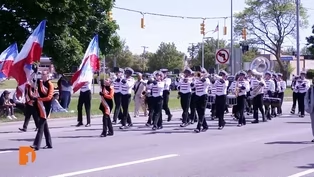
Dearborn Memorial Day Parade celebrates 100 years of community pride and patriotism
Video has Closed Captions
Clip: S10 Ep47 | 5m 4s | Thousands of people from Dearborn and surrounding communities attend the parade each year. (5m 4s)
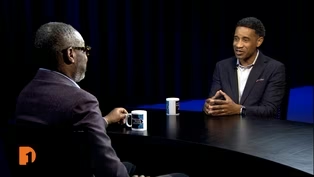
Nonprofit organization “Life Remodeled” focuses on revitalizing Detroit neighborhoods
Video has Closed Captions
Clip: S10 Ep47 | 9m 15s | Life Remodeled president discusses the nonprofit’s efforts to improve Detroit neighborhoods. (9m 15s)
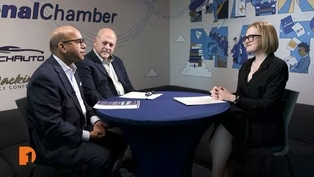
A preview of this year’s Mackinac Policy Conference
Video has Closed Captions
Clip: S10 Ep47 | 8m 6s | Learn about the goals, challenges and conversations shaping the theme, “A Quest for Common Ground.” (8m 6s)
Providing Support for PBS.org
Learn Moreabout PBS online sponsorship New Episode
- News and Public Affairs

Top journalists deliver compelling original analysis of the hour's headlines.

- News and Public Affairs

Today's top journalists discuss Washington's current political events and public affairs.

 New Episode

 New Episode




 New Episode
Support for PBS provided by:
One Detroit is a local public television program presented by Detroit PBS