2026 State of the State Address
Special | 1h 14m 43sVideo has Closed Captions
Gov. Tony Evers delivers his State of the State, and Sen. Devin LeMahieu responds.
Democratic Wisconsin Gov. Tony Evers delivers his 2026 State of the State Address to the Wisconsin Legislature, and Senate Majority Leader Devin LeMahieu provides the Republican response.
Problems playing video? | Closed Captioning Feedback
Problems playing video? | Closed Captioning Feedback
PBS Wisconsin Public Affairs is a local public television program presented by PBS Wisconsin
2026 State of the State Address
Special | 1h 14m 43sVideo has Closed Captions
Democratic Wisconsin Gov. Tony Evers delivers his 2026 State of the State Address to the Wisconsin Legislature, and Senate Majority Leader Devin LeMahieu provides the Republican response.
Problems playing video? | Closed Captioning Feedback
How to Watch PBS Wisconsin Public Affairs
PBS Wisconsin Public Affairs is available to stream on pbs.org and the free PBS App, available on iPhone, Apple TV, Android TV, Android smartphones, Amazon Fire TV, Amazon Fire Tablet, Roku, Samsung Smart TV, and Vizio.
More from This Collection
Wisconsin's annual State of the State addresses delivered by the governor to the state legislature.
2025 State of the State Address
Video has Closed Captions
Governor Tony Evers delivers his State of the State, and Assembly Speaker Robin Vos responds. (1h 10m 25s)
2024 State of the State Address
Video has Closed Captions
Wisconsin Governor Tony Evers delivers his 2024 State of the State Address. (1h 58s)
2023 State of the State Address
Video has Closed Captions
Wisconsin Governor Tony Evers delivers his 2023 State of the State Address. (59m 46s)
2022 State of the State Address
Video has Closed Captions
Governor Tony Evers delivers the 2022 State of the State Address. (1h 11m 38s)
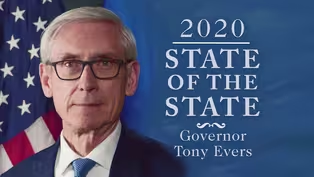
2020 State of the State Address
Video has Closed Captions
Gov. Tony Evers delivers the 2020 Wisconsin State of the State address. (49m 33s)
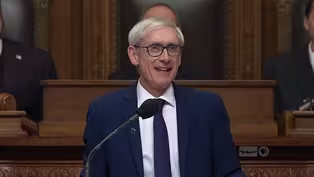
2019 State of the State Address
Video has Closed Captions
Gov. Tony Evers delivers the Wisconsin State of the State. (46m 50s)
2018 State of the State Address
Video has Closed Captions
Gov. Scott Walker delivers the Wisconsin State of the State. (1h 20m 37s)
2017 State of the State Address
Video has Closed Captions
Gov. Scott Walker delivers the Wisconsin State of the State. (1h 1m 8s)
2016 State of the State Address
Video has Closed Captions
Gov. Scott Walker delivers the Wisconsin State of the State. (1h 2m 17s)
2015 State of the State Address
Video has Closed Captions
Gov. Scott Walker delivers the Wisconsin State of the State. (41m 59s)
January 22, 2014 - State of the State
Video has Closed Captions
Gov. Scott Walker delivers his 2014 State of the State address. (1h 14m 32s)
January 15, 2013 - State of the State
Video has Closed Captions
Gov. Scott Walker delivers his 2013 State of the State address. (46m 54s)
Providing Support for PBS.org
Learn Moreabout PBS online sponsorshipThe following program is a PBS Wisconsin original production.
>> Welcome to Wisconsin Public Media's coverage of Governor Tony Evers eighth and final state of the state address.
We are bringing you live coverage tonight from the Wisconsin State Capitol in Madison.
In a few moments, the 46th governor of Wisconsin will make his way, already making his way into the assembly chambers.
>> Evers will speak tonight before a joint session of the Wisconsin Assembly and Senate, the state Supreme Court, his cabinet and tribal leaders.
Good evening.
I'm Shawn Johnson from Wisconsin Public Radio.
>> And I'm Frederica Freyberg from PBS Wisconsin.
Tonight, Democratic Governor Tony Evers lays out his plans for 2026.
He'll be speaking to the 107th session of the Wisconsin Legislature.
>> Senate Majority Leader Devin LeMahieu, who represents communities along Lake Michigan, including Sheboygan and Manitowoc, will provide this year's Republican response immediately following the governor's state of the state.
>> And so the governor is already in the chambers.
>> I got to say, as far as governors go, he wanted to get out there fast tonight with this speech, his eighth and final.
He's had a few budget addresses thrown in there.
He knows the drill and, you know, seem eager to get going.
Take that.
For what it's worth, I think you're going to hear a lot of the governor talking about those eight years tonight and what he sees as his legacy and his accomplishments.
>> We could expect this address to be longer because of that.
He'll be looking back, but also looking ahead.
He wants the legislature to get to work on some of his priorities for the remainder of 2026.
>> Yeah, we already know he's going to send them a little hint that they should stick around and and keep working on priorities that they can all support.
We also know that the state Assembly is tentatively scheduled to adjourn for the year this week.
So they have different plans on how 2026 is going to go.
But still potential for some big deals on property taxes and school funding.
We'll see if the governor gets those kind.
>> Let's go to Governor Tony Evers.
>> Thank you everybody.
Thank you.
>> At this time, it is my honor to introduce the governor of the great state of Wisconsin, the Honorable Tony Evers.
>> Thank you.
Thank you.
Thank you.
Thank you.
Thank you.
Hello there.
Wisconsin.
Last time around, folks, honorable Supreme Court justices, tribal nation leaders, constitutional officers, adjutant General Straube, members of the Wisconsin National Guard, active and retired members of our armed forces, cabinet members, legislators, distinguished guests, and Wisconsinites from near and far.
Thank you for taking the time to join us this evening.
It's going to be a blast.
So I'm Tony Evers, and I'm honored to be the 46th governor of the great state of Wisconsin.
As I deliver my eighth and final state of the state address to you tonight, it's true.
A lot a lot of happy faces over here.
My daughter Katie and my grandson Keaton, as well as my son Nick and his wife Linda, are here with us tonight.
And my former kindergarten classmate and junior prom date is also up in the gallery.
Kathleen.
Frances, you never waved.
Kathleen.
Kathleen.
Frances, you've never waved Frances, you've never waved through all the ups and downs of my 50 years of public service.
You're a saint.
Thank you for being a saint.
Before we begin tonight, Wisconsin, today is an election day.
If you haven't voted yet in the spring primary, there's still time to get registered and vote.
And the good news is, if you go right now to participate in our democracy, you can still catch my full speech afterward on Facebook, YouTube, and probably whatever else kids get their news these days.
Polls are open to 8 p.m.
so go to my vote.
Gov.
Find your, find your place of and of polling.
Then grab your photo ID and proof of residence if you need to register and get out to vote.
I'm so humbled and thankful for the last seven years and those who helped make it happen.
But tonight, Wisconsin, I want to focus on the work we still have left to do.
So I'm going to save my long list of gratitude for my farewell address later this year.
And no legislators.
That doesn't mean my speech got any shorter.
In fact, I think it's probably longer.
Sorry.
I know many lawmakers are antsy to end the legislative session and pack up to get back on the campaign trail.
By the way, if anybody running that wants advice from someone who won five statewide elections.
Scoreboard right here, right here.
Folks, I know many of you are up for the election, but but here's the deal.
After years of delivering historic bipartisan wins for our state, Wisconsinites have high expectations for the work we can do together over the next ten months.
And they should just look at what we've accomplished over the last seven years.
My vetoes are often the focus of news coverage and even political criticism.
I know Republicans get upset when I use my veto pen to do good things for kids in schools, for example.
But.
But here's the truth.
Here's the truth.
The truth is, I've signed over 800 bills as governor, and more than 97% of those bills signed passed with bipartisan support.
How about that?
And here are just a few.
Here are just a few of those bipartisan bills.
We improved our justice system, bolstered support for public defenders and Das, and made the largest addition of circuit court branches in over two decades.
We made sure firefighters and law enforcement officers can can access worker's compensation for post-traumatic stress.
We created a holiday honoring Hmong Lao veterans and our kids now learn about Hmong and Asian American history in schools.
We fixed gaps in the Amber alert system through the Prince Act so that we could locate missing kids faster.
And folks, this is all barely a fraction of the more than 800 bills I've been proud to sign as governor.
We expanded tax credits to help lower the cost of child care for working families.
We made it so that the state park passes can be used for 12 full months, regardless of when they're purchased.
We provided Medicaid coverage for telehealth services so that folks can access health care right from home.
We supported peer to peer suicide prevention efforts for kids in schools.
We invested in helping local communities prepare for and prevent flooding before disaster happens.
And we work together to keep major League Baseball in Milwaukee until 2050.
So future generations of Wisconsin kids will grow up rooting for the Brewers.
Like so many of us have.
Good work, good work, good work.
We've also managed to do all of this important work while still saving where we could and paying down our state's debt.
We've saved taxpayers over $600 million by paying off about $3 billion of our state's debt at the.
After.
Excuse me.
Excuse me.
Thank you.
After 30 consecutive years of our state's checking account running a deficit, we've ended every full fiscal year I've been governor with a positive balance.
How about that?
That's a good thing.
That's a good thing.
Thanks to our bipartisan efforts to cut taxes, Wisconsin taxpayers will see over $2 billion in tax relief annually, with most of those cuts going to the middle class.
And I'm not only I'm not only kept my campaign promise to Wisconsinites that I deliver a 10% tax cut for middle class families.
In fact, middle class taxpayers have seen an income tax cut of 23%, more than double what I promised.
Wisconsinites.
You're keeping more of your hard earned money today than at any point in the last 50 years.
How about that?
I'm also grateful to the legislature that they supported a key part of my affordability plan last year to help lower monthly energy energy costs for working families.
Because of our bipartisan work, Wisconsinites are no longer paying sales tax on household utility bills, which is expected to save Wisconsinites $178 million over the next two years.
Not only are Wisconsinites keeping more of their hard earned money, Wisconsinites are making more money too.
Average annual wages in Wisconsin went up nearly 26% over my first six years in office, and median wages in 2024 reached an all time high.
Record high.
Giving working families a little more breathing room in their household budgets is something we've worked on together over the last seven years.
I'm hoping we can continue building on those efforts this session, including reaching bipartisan agreement on a plan to get meaningful resources to our K through 12 schools and provide property tax relief at the same time.
And it must and it must balance these important obligations a heck of a lot better than the plan Republican leaders sent me this week.
Another important priority for us over the last seven years has been addressing the workforce challenges that have plagued our states for generations.
We've been working to build a 21st century workforce in Wisconsin that needs to compete in the 21st century economy.
We've reduced barriers to joining our workforce by investing, excuse me in child care slots for working parents and making sure that they can get to and from work.
We're helping over 127,000 Wisconsin workers get career and skills training, thanks to investments.
I directed Wisconsin's seen record high employment and record low unemployment, and we've had the highest ever enrollment in our in our registered in apprenticeship programs ever in state's history.
For several years in a row.
And by cracking down worker misclassification, we made sure over 134,000 workers got the wages and benefits they were owed.
A key part of our work to support working families, strengthen our communities and grow our state's workforce has been ensuring folks have the housing they need in the communities they work in.
It's about connecting the dots and expanding access to affordable housing is an issue I hear about almost everywhere I go in Wisconsin.
We work together to pass the largest state investment in workforce housing in Wisconsin history, and my administration has supported over 30,000 new housing units across the state.
Much like how much like housing, having access to affordable, high speed internet in the 21st century is a necessity, not a luxury.
It's why no administration has done more to expand access to high speed internet for working families than we have.
I declare 2021 a year of broadband access and created a broadband access task force.
We also created new tools to help folks get connected and find affordable internet options.
Thanks to our investments, including federal funding, I directed more than 410,000 homes and businesses across our state will have new or improved internet.
Supporting our farmers and their families, and our state's agricultural industries have always been part of our work.
Over the last seven, seven years, I created the Blue Ribbon Commission on Rural Prosperity and the Office of Rural Prosperity, and we worked together to create the Wisconsin Initiative for Agricultural Exports to increase dairy, meat, crop and other products exports by 25%.
Today, Wisconsin is well on the way to become a top ten state for agricultural exports after being ranked 13th just a few years ago.
Thanks for the applause.
I get to drink.
And from our smallest rural towns to our largest cities, after generation of state government asking local partners to do more with less.
We also worked together to approve a historic increase in support for our local communities.
Thanks to our bipartisan efforts, Milwaukee is no longer on the brink of bankruptcy and for state support for most municipalities increased over 20% to help them meet basic and unique needs alike.
>> Good.
That's a good thing.
We're also making.
>> Sure the state helps support local communities by investing in infrastructure needs across Wisconsin that long have been neglected.
When I took over, our transportation fund was on the brink of insolvency.
For years, the state spent money that was meant for to improve our infrastructure on other things, leaving our roads and bridges in disrepair.
Disrepair.
I made a promise to Wisconsinite that I'd work to fix the darn roads.
Even been out on my annual pothole patrol as governor to fix the roads myself, we approved the largest investment in local road construction and maintenance in state history.
Thanks to our bipartisan work, local partners will receive $600 million in funding this year.
Together, we also created a new Agricultural Roads program with bipartisan support to make sure our farmers and producers can get their product to market safely and efficiently by by improving local road infrastructure across our state.
It's already supporting over 90 projects across 48 counties to help improve and repair roads that are farmers, agricultural industries and rural All of these efforts have played a key role in our work to fix the darn roads across Wisconsin, and we've delivered thanks to our work together.
My administration has been able to improve or repair over 9600 miles of roads and over 2400 bridges across our state.
And it's a darn good thing we've been fixing the roads, because under my administration, Wisconsin's been welcoming more visitors than ever before.
Investing in our tourism industry has been an important part of our work over the last seven years, and it's paid off.
Wisconsin's travel and tourism industry has been setting records for three years.
Running in 2024, we had a hat trick here.
Wisconsin tourism brought in more money, welcomed more visitors and generated a record high $25.8 billion in total economic impact.
A big, a big driver of our tourism industry success is our Wisconsin's outdoor recreation economy biking and hiking, camping and canoeing, fishing and hunting, snowmobiling and skiing, you name it.
Outdoor recreation is part of our DNA.
As Wisconsinites, it's it's also become an $11 billion industry that drives and supports local jobs and economies across our state.
I propose creating our state's ever first office of Outdoor Recreation, and we work together to get it done so that Wisconsin now has a dedicated office to support this critical economic industry.
>> Things are good.
>> Our bipartisan our bipartisan budget last year also improved my request to create new film office at the Department of Tourism and a new film tax credit program.
I'm excited to announce we're launching the new program this week, which will help bolster our travel and tourism economies and bring exciting creative endeavors right to Wisconsin's doorstep.
>> I'll watch that.
>> Folks.
We've gotten a lot done for Wisconsin over the last seven years.
Our work during the year of the kid is another good example from teaching science and Baraboo to getting the scoop from students on Smokers Corner as principal in Tomah, to the decade I spent as state superintendent to becoming your governor, I've devoted most of my life to doing what's best for our kids.
After watching Republican, a Republican governor and legislature legislature.
Excuse me?
Shred my education budgets as state superintendent, I knew we could do more and better for our kids.
Our kids are why I got into this gig in the first place.
So while every year is the year of the kid for me, I declare 2025 the official year of the kid and introduced the most pro kid budget in state history.
And then we went to work.
>> When it.
>> When it comes to doing what's best for our kids, we have to start early.
A top priority for me during the year of the kid was to lower the cost of child care so more kids and families could access early childhood education, getting direct support to child care providers in our state budget was a bright line issue for me, and negotiation with Republican leaders.
I fought hard to make sure our pro kid budget included $360 million to support our child care industry and working families, more than one third of which will go directly to providers to support care for nearly 170,000 kids.
>> Yes.
>> Thank you.
>> We also created our state's first ever fully state funded child care program called Get Kids Ready.
Get Kids Ready is a new first of its kind program in Wisconsin to help give four year olds four year olds a boost getting ready for kindergarten.
So here's how it works.
Qualifying child care providers will focus on making sure kids have the academic, physical, and social emotional skills that kids need to be successful in school, and in return, the state pays child care providers directly for the time kids spent and get kids ready programing, making that part of the day free.
For families.
That's a big deal for Wisconsin kids in our future.
And I'm excited to announce tonight that nearly 1400 providers have signaled that they're ready to be part of this program, an effort that's been is projected to help as many as 24,000 kids across Wisconsin get a head start on their education in just the first year.
How about that?
>> Good work, good work.
>> A key part of our work to do what's best for our kids includes, includes making sure our kids can bring their best and full self to our schools and our classrooms.
A kid who's hungry or facing or facing mental health challenges isn't going to be able to focus on their studies or their or their coursework at school.
It's why I fought hard to secure $10 million for food security and $30 million to help support mental health resources in.
>> Schools across our state.
Thank you.
When I delivered.
>> My state of the state address last year, I said I'd be asking the legislature to make meaningful investments in public education at every level, from early childhood to our universities, and I made sure that's exactly what our bipartisan budget did.
Republican lawmakers who spent the better part of two decades waging war on higher education and the Wisconsin idea, planned to cut our UW system by nearly $90 million.
And that was a nonstarter for me and many other people.
I fought hard to make sure the final budget I signed included the largest increase for our University of Wisconsin system in nearly 20 years, and over $1 billion for UW projects across our state.
Folks, I declare 2025 the year of the kid because I wanted everything we did last year to be focused on doing what's best for our kids at every age and every way.
And no matter where they live in our state but Wisconsin.
I've always promised to give you great information here, and that's exactly what I'm going to do.
So I want to talk about how our bipartisan budget delivers for our K through 12 kids and schools.
And I also want to talk about the ways that fell short and the work the legislature must do to make good on the bipartisan promise we made to our kids in the last budget.
A decade of Republicans consistently failing to meaningful invest meaningfully, to invest in our kids and our K through 12 schools has consequences.
Wisconsinites.
Wisconsinites have been going to referendum in high numbers and years, raising their own property taxes just to keep the school lights on.
It started long before I became governor.
I get Republicans want to blame my 400 year veto for property taxes going up.
Why, of course it's politics.
Of course, Republicans running under fair maps need someone else to blame for for failing to fund our schools at the levels I've asked them to for about two decades of my life.
Here's the truth funding our schools is a responsibility that the state and local partners share.
Local property taxes go up when the state fails to do its part to meet its obligation.
I'll go ten toes with any lawmaker ten toes with any lawmaker about school funding.
>> My my.
>> My four 400 year veto isn't an automatic property tax increase, folks, because that isn't how school funding works in Wisconsin.
The legislature has rejected over $7 billion for K through 12 schools that I requested over the last four state budgets.
If lawmakers want to have an honest conversation about property taxes, start their.
Folks a decade plus.
Disinvestment can't be undone overnight.
But I've spent the last seven years working to reverse that trend.
We secured an additional over $2.3 billion for K through 12 kids and schools.
In my budgets, I fought hard for nearly 1.4 billion in revenue.
Revenue we approved in our bipartisan budget negotiations last year that included a net categorical aid increase that was roughly five times larger than our previous historic budget.
We also fought for and secured the largest increase in special education reimbursement rate in state's history.
We raised the state's commitment to reimburse Special education aide at 42 and 45% over two years.
>> But.
>> And there's a big but here.
But here's the problem the legislature refuses to set aside enough state money to actually meet those percentages.
So in reality, DPI estimates the state's only reimbursing at a rate of about 35%.
Instead, well short of the budget we negotiated, we have a constitutional obligation.
We have a constitutional obligation to fund our schools in the state.
Folks, the legislature must approve the level of funding necessary to meet the percentages our kids and our schools were promised in the last budget period.
>> And they can't get it done.
>> With all the successes that we've had over the last seven years, Wisconsinites are eager for us to continue our progress.
We can't afford for lawmakers to lose focus on the future.
We've been working hard to build together just because it's an election year, so I know the legislature would rather hit the road and take the rest of the year off.
But I'm going to ask lawmakers to stick around until our work here is finished.
>> Thank you.
>> There's always more work we can do, folks.
Let's start with public safety.
I wish Republican lawmakers would have been willing to do more during the year of the kid to help keep our kids, families, and communities safe.
I was really disappointed that for all the rhetoric about who cares about crime and who doesn't care about crime, Republicans voted against my proposal to make the Wisconsin Office of Violence Prevention permanent.
We could do.
We could be doing so much more to address domestic and intimate partner violence.
For example.
These statistics drive me nuts.
Domestic violence homicides in Wisconsin jumped by 20% between 2021 and 2022.
20%.
We hit a new record high of Wisconsinites murdered in domestic and intimate partner violence incidents.
The record only lasted until 2024, when 99 Wisconsinites were killed.
They were murdered, folks, this trend is headed in the wrong direction.
Obviously, the legislature cannot find these statistics acceptable.
And on top of voting not to make the Wisconsin Office of Violence Prevention permanent.
Last year, Republican lawmakers also voted against my request to provide $66 million for the Victims of Crime Act programs, many of which helped survivors of domestic violence and their families get on their feet.
I urge.
>> Thank you.
>> I urge the legislature to send bills to my desk to codify the Office of Violence Prevention and Fund Victim of Crime Act programs, do this right thing and get it done.
>> Thank you.
>> In the meantime, my administration and I will continue our work however we can to reduce crime and violence and help make kids and families safer.
So one of the things I'm jazzed to announce tonight is that my administration will be partnering with our own Milwaukee Bucks on a public campaign to help combat domestic violence across Wisconsin.
>> Go, bucks.
Go back.
>> I also want to talk about gun violence, which is why I created the Wisconsin Office of Violence Prevention, the very first special session that I ever called as governor was to ask Republicans to pass universal background checks and red flag laws, two concepts that 80% of our staff are state support.
I could spend the rest of my speech listing everything I proposed to crack down on gun violence, keeping guns out of the hands of violent people, and making our community safer.
Instead, I've cut to the kicker.
All of them went nowhere.
Because in seven years, there's no issue.
Republicans have done less about than guns.
>> This much is clear.
>> This much is clear.
If Wisconsinites want to get something, anything done about gun violence, we must elect legislators who will do the damn thing to.
>> Change it.
I've also.
>> Spent years urging >> Spent years urging Republican lawmakers to approve reasonable common sense policies to move Wisconsin's corrections courts and justice systems into the 21st century.
I introduced a sweeping corrections reform plan last year that would close by 20 2129.
Excuse me?
Get kids out of Lincoln Hills and Copper Lake and turn Waupan into a state of the art vocational facility.
Republicans quickly dismissed it, insisting they'd come up with a better plan and pass that instead.
It's been over a year now, and I haven't seen one.
Neither acted either enacting my plan or proposed a plan of their own.
I still hopeful that we can work together to pass a bipartisan bill this year on a comprehensive, comprehensive, excuse me, corrections reform to set an achievable goal for Gbci to close convert Lincoln Hills and revamp Waupan.
We also need to make sure the plan includes evidence based efforts to stabilize our skyrocketing prison, skyrocketing prison population, and reduce likelihood that people will reoffend, making our communities safer and saving taxpayers on correction costs down the road.
We don't need to ask taxpayers to pay for a brand new prison that won't be done for a decade.
My plan remains the safest, fastest and cheapest, cheapest option available.
I don't care who gets the credit.
Doesn't make any difference.
I'm going to be gone in a few months.
Let's just get it done, please.
In the meantime, I will continue to exercise my constitutional powers as governor to do what I can to improve community safety and change Wisconsin's justice system for the better.
Before I took office, Wisconsin got an F in judicial diversity due to a lack of women and people of color on our bench.
So it was important to me to appoint judges who are a reflection of the people of our state.
I'm especially proud that no governor has appointed a more diverse class of judges in state history.
More than a third of the judges I appointed are people of color, and more than half are women.
I exercised my constitutional powers as governor to grant pardons for the first time in a generation.
A pardon is an official act of forgiveness that signals an individual has paid their debt to society, worked to make amends, and tried to turn their lives around.
I've issued more grants of clemency than any other governor.
This month, I'll hit 2000 pardons as governor, and we're not done yet.
We also have we also have important things to get done this year, to clean up our water and protect our natural resources.
We make a promise to our kids and grandkids that will leave them a better state and world than the one we inherited.
That's the future we've promised them, and that's the future they deserve.
And my administration has worked to lead the way.
For starters, science and the words climate change have returned to the Department of Natural Resources.
I also created the Office of Sustainability and Clean Energy, and we released the first ever Wisconsin's first ever clean energy plan to help lower energy bills for working families, reduce reliance on out-of-state energy sources, and create more than 40,000 jobs by 2030.
We also joined the US Climate Alliance, took the Trillion Tree pledge, and committed to planting 100 million trees by the end of 2030, we planted over 42 million and saved over 76 acres of forest land in just the first four days four years, four years.
We created a new Wild Rice Stewardship Council to help protect wild rice resources that are culturally significant and important food source for indigenous communities.
And we continue to work and learn from the tribal nations of Wisconsin, like Menominee and Bad River Band, who are investing in clean and reliable energy sources to become energy independent.
For years, the state has purchased renewable electricity certificates from Wisconsin Utilities to power our state agencies.
I want to make sure we continue to work towards our clean energy goals.
Thanks to the steps in I'm announcing tonight, we're ensuring the state will continue doing so long after I'm governor.
Tonight, I'm announcing that the state is going to purchase about 225,000 megawatt hours of renewable energy every year for the next 20 years, folks, just.
Folks.
Just to put that in perspective, that's enough renewable energy to power more than a half million Wisconsin homes.
We're also continuing to explore new ways for Wisconsin to be a leader in clean energy.
I'm excited to announce that we're going to be partnering with the UW Madison's Department of Nuclear Energy, Engineering and Engineering Physics to study nuclear energy as opportunities in Wisconsin.
Nuclear energy is the largest source of clean power in our country, and it's a safe, reliable, carbon free option to power our homes and businesses.
This could be a game changer for our state.
I'm glad this work has received bipartisan support this session.
>> Thank you.
>> Folks.
This partnership, this partnership on nuclear energy is the Wisconsin idea in action.
Wisconsin Idea has always been around harnessing the extraordinary research and innovation that's happening on UW campuses and using it to improve public policy in Wisconsin and beyond.
It's why I'm also excited we're continuing the tradition to support small businesses across our state.
Our newly created Ignite Wisconsin program is going to make strategic investments to advance startups in our state, targeting sectors to boost our homegrown innovation.
This includes connecting the dots to invest in the Wisconsin Fusion Energy Coalition, anchored by UW Madison's fusion research.
So Wisconsin becomes a national hub for commercializing fusion energy.
That'll be fun.
That'll be fun.
That's going to be a blast, folks.
A key part of our work to build more sustainable future is building a 21st century workforce to meet 21st century needs.
Wisconsin wants to continue to compete and be a leader in new and innovative industries.
We must invest in workforce training to prepare workforce for the future.
It's why my administration worked to secure over $7 million to launch a workforce training programs focused on developing our advanced manufacturing and AI workforce in Wisconsin.
Folks, AI is here to stay, so making sure Wisconsin is prepared to create jobs for the future and meet the rapidly evolving needs.
Needs of a 21st century economy has to be a top priority.
At the same time, we also have to make sure we don't jeopardize the work we have done and are doing to build a more sustainable future for our state.
Wisconsin is ready for bold and urgent solutions that will stop treating these goals as mutually exclusive.
And that's especially true when it comes to data centers ensuring our state is prepared for the 21st century does not mean abandoning all our state's history and traditions.
We aren't and we won't.
Wisconsin must embrace a future where we don't have to choose between mitigating climate change and protecting the environment, or creating good paying jobs and having a strong economy.
We must do both.
Simple as that.
We also couldn't reach consensus during the state budget negotiations on a comprehensive plan to reauthorize the Knowles-Nelson Stewardship Program.
The namesake of two Wisconsin conservation heroes, the Stewardship Program, which has been a proud part of Wisconsin's heritage for decades, is now set to expire at the end of June.
Let's get a bipartisan bill done to reauthorize the stewardship program that both supports land acquisition and management of Wisconsin's valuable natural resources and public lands.
We have to do this, folks.
We have to.
>> Thank you.
>> I also repeatedly asked the legislature to do more to improve water quality and get contaminants out of lake lead and PFAS out of our water.
The Knights should be able to trust trust the water coming out of their tap, so we must find common ground on bipartisan, bipartisan legislation to help Wisconsinites get contaminants like PFAS out of their water and release the $125 million we approved over two years ago.
Now, we've gotten a lot done for Wisconsin over the last seven years, but tonight, I don't want to just talk.
I want to reflect on our work together.
I also want to talk about what's next, where Wisconsin goes from here, what worries me about our future, and actually keeps me awake at night.
As governor, I'm worried about the impacts of reckless decisions being made in Washington, and that these decisions will have disastrous consequences for Wisconsinites, taxpayers and the state budget going forward.
I'm worried about the tens of thousands of federal employees who are fired for no reason, including thousands of Wisconsin workers.
Many serve veterans and our farmers and agricultural industries.
I'm worried about the people who suddenly found themselves without jobs due to no fault of their own.
And I'm worried about Wisconsinites, especially our veterans and farmers who depend on the services these folks are supposed they are supposed to provide.
I'm also angry when I think about our neighbors, young kids, and families across the state who aren't going to school or work or any place else because they're scared leaving their home may mean their family will be torn apart.
I worry about our kids who are being traumatized by violence on social media, in the news, on our streets and in our neighborhoods, and I worry about what all this means for America's Dairyland, which has depended on the hard work of immigrants for generations.
And I'm also worried that with our successful, even with our successful efforts to help folks make ends meet, Wisconsinites are feeling the squeeze due to tariff taxes and erratic trade wars.
Prices are going up and things like school supplies, groceries, Kohl's gas.
More Americans last year footed the bill for 96% of the cost from tariffs.
I noted earlier that our state has seen historic economic success under my administration.
With all your help, which has seen a budget surplus and rainy day fund at record high levels based on what's coming, I worry how long that will last.
I'm worried about the impacts President Trump's so-called big, beautiful bill.
If Republican lawmakers don't approve resources, the state needs to keep food share payments ER's low.
Wisconsin taxpayers could have to pay hundreds of millions of dollars in penalty fees to the Trump administration every year under the B-b-b.
And let me be clear, on top of the more than $284 million we've already estimating Wisconsin taxpayers will have to pay in future budgets, the sooner the legislature invests in foodshare quality control efforts, the more time the state has to keep Foodshare airs down.
It's pretty simple.
We can save Wisconsin taxpayers potentially hundreds of millions of dollars in penalty fees a year.
We could have to pay the Trump administration if we don't.
So I'm not I'm not negotiating with Republicans about a $70 million investment the state must make right now to save Wisconsin taxpayers as much as $200 million in penalty fees later.
We've been asking for this for months, and it has to get done.
If the legislature fails to provide, excuse me, provide the funding that is needed, Republicans will be able to blame the penalty.
Fees at taxpayers will be forced to pay.
It's not good.
It's pretty simple.
Let's get it done.
And that's not all that keeps me awake.
Health care costs are skyrocketing.
Wisconsinites already don't feel like they're getting a fair shake when it comes to insurance coverage.
And now, because of the so-called big beautiful bill, over 270,000 Wisconsinites will lose their health care because Republicans in Congress refuse to extend tax credits under the Affordable Care Act that make health care more affordable for millions of Americans, many are going to be priced out.
I talked to Kim, a small business owner in green Bay whose health care coverage went up by 100% this year.
Kim says she had enough money to pay for one month of health care coverage, and then she's going to go without.
Wisconsinites across our state will be forced to do the same.
Congress must fix the health care crisis they've created, or every member of Congress from Wisconsin and beyond who allowed this to happen should be held accountable at the ballot box.
You know this I'm not a rocket science, but I did teach science, but I did teach biology.
Maybe if we want to make Americans and Wisconsinites healthy again, making health care affordable and accessible would be a great place to start.
It could also start.
We could also start by trusting the science, public health experts and medical professionals who have eradicated diseases and found cures and kept us healthy and safe for decades.
Folks, public health is not a Partizan issue and it isn't up for debate, and real lives are at stake if we fail to listen.
It's why in the coming weeks, I'll sign an executive order to have Wisconsin join the World Health Organization's Global Response Network.
We must do what we can to keep our kids, our families, and our communities healthy and safe.
It's as simple as that.
Wisconsin is as purple as ever, but we've shown we can put politics aside and work together to get good things done.
Compared to all the chaos, dysfunction, and recklessness in Washington, DC, here in Wisconsin, we've worked.
We've worked to lead by example.
And a big part of that is the fact that today, lawmakers are elected under fair maps.
I signed into law.
But here's the problem Wisconsin new maps are redrawn every ten years.
While we have fair maps today, we still don't have a nonpartisan redistricting process in place.
That means there's no guarantee Wisconsinites still have fair maps.
After the next census, Wisconsinites and Americans across our country have watched the president of the United States put pressure on Republican legislators into adopting new maps that will benefit him, and as a result, Democratic legislators have been put in the unthinkable position to respond by trying to restore balance.
It is crazy.
Well, very few people in this country know what it means to live under some of the most politically gerrymandered maps in Wisconsin, but Wisconsinites do, and they know because they lived it.
And we are not going back.
>> No.
>> I know people here disagree sometimes.
Sometimes a lot.
Politics could get in the way of creating a nonpartisan redistricting commission that everyone can support.
But there's one thing that we all should be able to do to agree on, which is that politics should stay out of the redistricting from start to finish.
So tonight, I'm announcing that I'll be calling a special session of the legislature this spring to take up a constitutional amendment to ban Partizan gerrymandering once and for all in Wisconsin.
And let me be clear, I hesitate to bring this legislation to special session later this year in August or September or October.
Heck, I'm old enough to remember when the legislature was willing to meet in December.
I don't know if you remember that.
I do, folks.
Wisconsin has fair, safe, and secure elections.
We must continue to fight every effort by any politician to interfere with, or make it harder for eligible Wisconsinites to cast their ballots.
And a big part of the reason we have fair, safe and secure elections is because of the amazing election officials and poll workers across our state.
So next time.
So next time.
By Kathy.
And I did today you cast your ballot and I hope you did today.
Thank the folks who's making it happen.
>> These folks are our friends and neighbors who often volunteer their time to make sure we can exercise our most basic and fundamental rights as Americans, and they do so out of a sense of duty.
They do it because it's the right thing to do.
They do it because they're a good neighbor.
That's extraordinary.
As governor, I have often Eau Claire a theme for a year, a topic or issue I want to focus on.
We had the year of clean drinking water, the years of broadband access, mental health workers, and of course the year of the kid.
This year I want to keep it simple.
I want us to focus on our Wisconsin values of kindness, respect, empathy, compassion.
I'm declaring 2026 the year of the neighbor because we could.
Get to know your.
Neighbors.
Because we all could use a good neighbor, and we could all be better neighbors.
And we're going to spend the next year celebrating the neighbors who make Wisconsin a great place.
It is to call home.
The first responders who answer our call in our darkest hour, the librarians who help find our new favorite book, the teachers who comfort, inspire, and educate our kids.
The state worker who helped us find and apply for health care or job training, the veterans who served our country, the farmer farmer who feeds our families, the nurse taking care of our loved ones.
The helpers who work every day to make life just a little bit better for everyone who lives here.
Wisconsinites, our helpers.
By nature, it's in our DNA.
When things are tough, we roll up our sleeves and get to work.
We shovel a driveway or bake a casserole, and we show up for our neighbors because we know that whether it's unpredictable weather or the unpredictable nature of politics, we're all in this together and we're going to get through this together.
Not by alienating our neighbors, but by getting to know them, by looking out for one another and maintaining our Wisconsin values of kindness, empathy, compassion, and respect.
Because it's the golden rule.
And it's the right thing to do because it's who we are as Wisconsinites.
>> Here we go, folks.
>> I always promise to be a >> I always promise to be a governor who works for all Wisconsinites and who does the right thing when it matters most.
I'll never stop working to make good on the promise as long as I'm governor.
We have lots of work to do, folks, so let's get back to it.
Thank you.
And on Wisconsin UW Marching band.
Let her rip.
>> And so the University of Wisconsin marching band concludes.
Governor Tony Evers, eighth state of the state address before a joint session of the Wisconsin Assembly and Senate.
>> Senate Majority Leader Devin LeMahieu, who was elected to the state Senate in 2014, is making his way back to our location as we speak.
He'll provide this year's Republican response in just a few moments.
>> So before the senator arrives, Sean, I just wanted to express that again.
The governor had declared this the year of the neighbor.
And yet, as we listen to this pretty long speech, you said there's no deal.
What were you talking about?
>> Yeah, well, I mean.
>> You've heard the governor and Republican leaders for, you know, maybe people haven't been paying attention to this, but there have been actual negotiations going on.
It seemed like at the Capitol over some kind of a plan that would reduce property taxes and increase school funding.
Just listening to the rhetoric between the governor and leaders lately, it seems like they are fairly far apart on that.
And with the assembly set to go home in a couple days, it just makes it difficult to to reach an agreement on something so big.
But, you know, you did hear a lot of the governor's accomplishments as he views them in a speech that long.
You hear sort of the list of what he views as as his legacy.
He's also quite a long list of things that he would like to do, but is going to have his work cut out to get accomplished when the legislature is not in his party.
>> Because the governor has been talking about how one of his priorities is property tax relief.
And of course, the Republican majority would also like to see property tax relief.
The plan that they are working on at times with the governor, at times with the majority itself, is something that the governor said is going to have to be a heck of a lot better than what Republican leaders sent him this week.
He said that in his address.
>> Yeah.
I mean, you've.
>> Got a couple of factors that have driven up property taxes in Wisconsin.
A few, really, but a couple that they can kind of point to the other side with is that the governor did issue a veto that extended school revenue increases for four centuries.
And that's something Republicans.
Have pointed to 400 year veto.
And in that same or in this last budget, Republicans didn't include any general school aid which would offset property taxes.
So those factors working together, and you have some of the largest school property taxes we've seen in in three decades, just kind of an open question at this point about whether or not they'll be able to address that before they go home for the year.
>> Senate Majority Leader Devin LeMahieu leads the Republican controlled state Senate.
He's held this position in leadership since 2021.
Here is Senator LeMahieu with tonight's Republican response.
>> Good evening everyone.
The state of our state is strong, but not for the reasons you heard earlier tonight.
The state of our state is strong in spite of the governor, not because of him.
Thanks to strong Republican majorities here in the legislature, Wisconsin families have only seen one example of what state government could look like with full Democrat control.
Governor Evers disastrous 400 year veto that is driving property taxes through the roof.
The.
If the Democrats were in charge in Madison, Wisconsin would be a very different place.
Jobs would flee to other states after they repealed the Manufacturers and agricultural tax credit.
Our increasingly mobile workforce would leave for states with lower income tax rates, and popular reforms like voter ID, and the Reins act would have been repealed long time ago.
Thankfully, that's not reality, and thanks to our state legislature, the state of our state is strong.
Since 2011, we've cut your taxes by a cumulative $42 billion.
That's more than $7,500 for each person in Wisconsin that they have left in their pockets to address rising costs.
Even after these historic tax cuts, the state continues to have strong surpluses.
Right now, Wisconsin has a projected $2.5 billion surplus.
Tax cuts are an important way the state government can do what's best for Wisconsin families, but we also need to invest in core priorities like health care, education and transportation.
Earlier this session, the Senate passed two important bills that will increase access to affordable health care.
The first proposal extends Medicaid eligibility for postpartum mothers from 600 from 60 days to a full year after giving birth.
The second ensures insurance coverage for supplemental breast cancer screenings for women with heightened cancer risks.
That's on top of the 7.8 billion increase for state budget provided our health care system, including supporting support for hospitals, long term care and mental health facilities, those those investments won't solve every challenge facing our health care system, but they'll make a meaningful impact across our state.
For schools, the bipartisan biennial budget provided record high funding, including the largest in state support for special education.
Roads are a critical part of Wisconsin manufacturing, agriculture and tourism, so we invested more than $1 billion in transportation, including 303 million for local roads and bridges.
Tonight, Wisconsin stands at a crossroads as families across the state feel the impact of rising costs.
The state government has a $2.5 billion surplus.
You know what?
Let me repeat that.
As you and your families are struggling to pay for groceries, housing, utilities, the state government has $2.5 billion of your money just sitting here in Madison.
We want to give that money back to you.
Speaker Vos and I sent a proposal to Governor Evers to return a portion of the surplus to taxpayers through a $1,000 rebate check.
This would come on top of the 1.5 billion in tax cuts for the middle class and retirees we already passed last summer.
Our plan would use the remaining surplus to strengthen our commitment to special education above what we promised in the budget, and dedicate 500 million to limit the property tax impact of the governor's 400 year veto.
You know, I love Wisconsin.
I've chosen to live here most of my life.
I've owned a small business for 20 years.
I want to make Wisconsin even stronger.
We can make our state stronger by lowering property taxes, supporting schools, and returning the surplus to the people who created it.
You, the taxpayers.
The legislature is ready.
It's up to Governor Evers to make this compromise a reality.
God bless you and may God continue to bless the great state of Wisconsin.
>> That was Wisconsin Senate Majority Leader Devin LeMahieu with the Republican response.
>> If you'd like to watch tonight's speech from Governor Tony Evers or Senate Majority Leader Devin LeMahieu again, we will have it posted later tonight on our website at PBS Wisconsinite.
We will have continuing coverage and reaction to the state of the state address this Friday at 730 on here and now.
>> Wisconsin Public Radio will also continue to follow developments from the State Capitol, both on air and online at.
We want to thank you for joining us this evening live from the state Capitol in Madison.
I'm Shawn Johnson with Wisconsin Public Radio.
>> And I'm Frederica Freyberg with PBS Wisconsin.
This concludes our coverage of Wisconsin's 2026 state of the state address.
Thanks for watching.
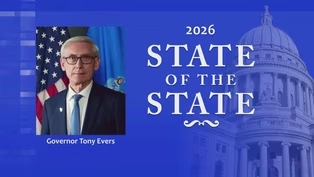
Preview: 2026 State of the State Address
Gov. Tony Evers delivers his State of the State, and Sen. Devin LeMahieu responds. (30s)
Providing Support for PBS.org
Learn Moreabout PBS online sponsorship
- News and Public Affairs

Top journalists deliver compelling original analysis of the hour's headlines.

- News and Public Affairs

FRONTLINE is investigative journalism that questions, explains and changes our world.












Support for PBS provided by:
PBS Wisconsin Public Affairs is a local public television program presented by PBS Wisconsin