
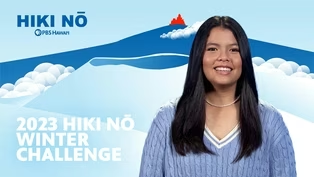
2/21/23 | 2023 HIKI NŌ Winter Challenge
Season 14 Episode 12 | 28m 41sVideo has Closed Captions
The winning entries of the 2023 HIKI NŌ on PBS Hawaiʻi Winter Challenge.
On this special episode of HIKI NŌ on PBS Hawaiʻi, find out which schools produced the winning entries of the 2023 HIKI NŌ on PBS Hawaiʻi Winter Challenge. EPISODE #1412
Problems playing video? | Closed Captioning Feedback
Problems playing video? | Closed Captioning Feedback
HIKI NŌ is a local public television program presented by PBS Hawai'i
2/21/23 | 2023 HIKI NŌ Winter Challenge
Season 14 Episode 12 | 28m 41sVideo has Closed Captions
On this special episode of HIKI NŌ on PBS Hawaiʻi, find out which schools produced the winning entries of the 2023 HIKI NŌ on PBS Hawaiʻi Winter Challenge. EPISODE #1412
Problems playing video? | Closed Captioning Feedback
How to Watch HIKI NŌ
HIKI NŌ is available to stream on pbs.org and the free PBS App, available on iPhone, Apple TV, Android TV, Android smartphones, Amazon Fire TV, Amazon Fire Tablet, Roku, Samsung Smart TV, and Vizio.
Providing Support for PBS.org
Learn Moreabout PBS online sponsorship[intro music] HIKI NŌ, Hawai‘i's New Wave of Storytellers.
Aloha and welcome to this episode of HIKI NŌ on PBS Hawai‘i.
My name is Isabella Seaman and I'm an eighth grader at Highlands Intermediate School on O‘ahu.
Each season during the school year, HIKI NŌ dares student reporters to produce videos in just five days during contests called challenges.
This time for the 2023 HIKI NŌ Challenge on PBS Hawai‘i Winter Challenge, the call was for videos based on the prompt ‘Disruption Sparks Change.’ I've participated in HIKI NŌ Challenges before and they're crazy.
Usually, we have weeks to work on projects for HIKI NŌ and lots of help from our teachers and industry mentors.
During these challenges, we must quickly find a story and people willing to be interviewed on camera.
By the time we sit down to edit, the time on the clock is nearly up.
This time, it's my treat to share the winning entries with you here at the PBS studio.
The competition was fierce in both the middle and high school divisions.
The judges looked for stories produced with technical skill and storytelling finesse that also fit the prompt.
That means everything from camera and audio work, to whether or not the judges could follow the storyline and learn something new.
And boy, did the students deliver.
Let's watch the pieces that wowed the judges.
And now in the high school division of the 2023 HIKI NŌ on PBS Hawai‘i Winter Challenge receiving an honorable mention is Kaua‘i High School.
Congratulations.
This story spotlights a local historic theater that continues to operate against all odds in Waimea, Kaua‘i.
The theater is pretty much one of the cornerstone businesses of Waimea, and especially the West side.
I mean, now that we're the only theater on Kaua‘i, it's kind of becoming a cornerstone for the, kind of like the whole island.
On the west side of Kaua‘i, the historic Waimea Theater continues to serve the community as a hub and place of entertainment since opening in 1938.
I think we pride ourselves and we integrate ourselves with the community as much as we can doing special events and community, um, meetings and whatnot for nonprofit organizations here.
So, I think we're pretty, um, integrated within the community.
However, over the decades, Waimea Theater has had their share of hardships as competing theaters opened around the island.
Business was, eh, kind of alright, you know.
We were kind of surviving doing special events and whatnot.
Um, we weren't going into red, but we were just on that borderline between red and black making some profit.
Already facing trying times, the Waimea Theater hit a new low with the COVID-19 lockdown, doing what they could to stay open for the community.
It kind of gave people hope, I think, you know, because like they could still do stuff and they could go places and grab popcorn and go home and watch a movie, you know.
The community came out and supported us, uh, helped us, you know, come and clean and, uh, to help this theater survive that period during the pandemic.
With a new sense of hope and support from the community, the Waimea Theater was able to stay afloat until they could receive their grant aid, surviving competing theaters who shut down amidst the pandemic.
Creating those relationships in the community and the relationships, the community will come out in and support you when you're in need.
And now being the only theater on Kaua‘i, business has probably tripled in attendance and, um, and other, uh, special events and community events have also doubled in the past, uh, year and a half.
With business booming and community support, the show goes on for the theater, with no sign of a final bow.
This is Ty Kajihara from Kauai High School, for HIKI NŌ on PBS Hawai‘i.
And now in the high school division of the 2023 HIKI NŌ on PBS Hawai‘i Winter Challenge receiving an honorable mention is Roosevelt High School on O‘ahu.
Congratulations.
In this story, we meet a teacher whose classroom renovation project continues to evolve and inspire his students.
[bell rings] This is the sound that students hear whenever they enter Mr. Kam, the STEM and coding teacher’s room, where teachers and students lounge around at lunch and after school.
Over the pandemic, Mr. Kam has been working on his room, hoping to make it inspirational for his students.
At the very start of distance learning, because of COVID, we had a lot of teachers that were on their laptops, and I looked at the quality of those videos, and it was always an upward shot, meaning I, I'm looking into somebody's nose, right?
Even when I will interact with my students, I'm staring up their nose and this weird angle up their face.
And I really didn't like that.
I thought, well, if I can see my students like that, what do I look like?
He started his YouTube channel, posting coding tutorials with him in his kitchen to slowly upgrading his setups during virtual learning.
Even through distance learning, uh, I would come back to my classroom, and I just made change.
I mean, what a perfect time.
There's no students here, there's nobody to bother me.
I can saw, cut wood, make noise.
Uh, Power Tools are loud.
But I can design things, I can paint, I can, I can do all of these things without being bothered.
I thought that was a perfect time.
This is a terrible situation.
I hate every minute of it, but let's go ahead and create something different that someone's going to enjoy and say like, this is what you did.
This is what you did while everyone was home sleeping.
This is what you did while everyone was home trying to study.
And this is what you did when, um, people needed you the most.
The feeling of need has made Mr. Kam dedicate hours after hours into this project, all of this stuff, all of this design stuff took about three years.
I'm gonna keep changing things around, and the minute I receive funding or, you know, donations that I can, I can make change.
In fact, some of the labs that I get, some of the furniture that I get are not bought; I, I fished them out of the dumpster.
Mr. Kam's idea of converting his room not only created a spacious and creative classroom, but also the start of a new curriculum.
It really just started from designing the classroom because I figured if kids are already going to be in here, because they, they look at the design aesthetic and they see all the studio space, they're like, well, let's build you a little studio space.
Let's build a public studio space that students can use to practice.
And then from there, I'm like, well, why can't we just make this an entire curriculum?
Why can't we just teach them how to speak and how to be, um, how to be productive conversationalists.
As a teacher going through the pandemic, Mr. Kam believes that people should embrace change, especially during a time like this.
If we don't do it, then we're going to stagnate, and I don't want to be stagnant.
I want to be dynamic, and I want to show the students that if I can be dynamic, and I can create this change, then I should lead by example by saying this is something that you can do, too.
It shouldn't just be me.
This is Jiaying Cao from Roosevelt High School, for HIKI NŌ on PBS Hawai‘i.
And now in the middle school division of the 2023 HIKI NŌ on PBS Hawai‘i Winter Challenge coming in third place is Maui Waena Intermediate School on Maui.
Congratulations.
This story is a reminder of the power we have as customers, especially in the food industry.
This is really about eating local.
Here in this locally owned restaurant, Tails Up.
Some of the founding leaders of Maui Eat Local speak to us about the importance of supporting the local economy.
The disruption was, pandemic, was, um, Maui starting to look a lot like the mainland.
That's scary for me.
You know, uh, that's what, one thing I always pride in coming back here after visiting, was that it didn't look like that.
We don’t have the strip malls with the same fast food restaurants.
Though COVID brough many disruptions, it also sparked change.
There was a core group of chefs and restauranteurs of about 25 to 30 people.
That number is growing every day as the word gets out.
Talking about Maui Eat Local, we have social media presence on Instagram and Facebook, and it's just sharing.
I, I'm a connector.
I am in the, I am out in the community all the time.
If I'm in Hawaiian Moons, I find the owner, Kristina, and I talked to her about joining the movement.
If I'm in Oki’s buying fish, I talk to them about joining, joining the movement.
The members of Maui Eat Local have the same desire for change.
They commit to one year of participation, and to source 40% or more of their food locally.
You're voting with your food dollar; every dollar you spend is a vote.
So do you vote local, or do you vote mainland?
And just start there, and I think that resonates with everybody that lives here.
Have a great day.
Thank you.
There's food trucks that, you know, get everything from their, from their farm, right, or buy from their neighbor, and, uh, those are the places that we want to support because every dollar that's spent there, stays in our economy.
I think Maui Eat Local is great.
It's, uh, I think we need it here on Maui because not only does a lot of the food that is being grown here not even stay here in the community, but then all of, all of the food that we, or the majority of the food that we eat here is brought in so it doesn't make a whole lot of sense.
It's more of a, it's a call to arms, if you will, um, where we can all join together and, and push this thing forward as a community.
The disruption of COVID sparked the desire of some local businesspeople to start the Maui Eat Local movement, which supports both financial and physical health of Maui citizens.
This is Sarah Rosete from Maui Waena Intermediate, for HIKI NŌ on PBS Hawai‘i.
And now in the high school division of the 2023 HIKI NŌ on PBS Hawai‘i Winter Challenge coming in third place is Kapa‘a High School on Kauai.
Congratulations.
Let's meet a multi talented young musician in this profile story produced by the students at Kapa‘a High School.
There's always the feeling of mediocrity and not feeling like I'm good enough to be, uh, where I am in my musical journey.
As a young musician on Kaua‘i, Makana Aqui understands where he is, and what he wants to become.
My family plays music.
Uh, I worked in a show when I was 13 with my uncle who did like, Polynesian music and dance.
I played drums for him kind of sparked my, um, my interest in music because he started making me play ukulele and guitar for the show.
From there, kind of jumped up because I went to Bandwagon Music Center, where they taught us a lot about how to play in bands and continued to pique my interest in how to play like guitar and bass and drums and ‘ukulele and all that.
I have a lot of inspirations, most of them come from local communities.
Uh, these guys kind of helped shape the way I play music now and how I interact with other musicians.
Currently contributing to three bands and playing at two local venues, he aspires to influence a larger audience.
When I first heard Makana playing music, it was about four years ago when he joined Bandwagon, and he was more in the elitist jazz genre, whereas I was more in the elitist metal and rock group.
So, there's this clash of genres automatically.
So, we were kind of like at each other's throats.
But eventually, through the years, we grew closer and started opening up to each other's genres more, and the mix of jazz and metal really created this awesome, um, brotherhood with Makana.
We've been pushing each other as musicians ever since.
I began taking guitar lessons from him during winter of 2021.
And during that time, I was dealing with a lot.
Our guitar lessons were the only consistent thing in my life.
The lesson itself was the one thing I looked forward to.
Establishing myself as a music instructor and local musician is far from Makana’s end goal.
There's been a lot of high-end producers and influencers that come up and tell me, "Oh, hey, this is who I am.
Check out my page and stuff.
I'd love to get, you know, whatever you've recorded, and I want to listen to it.” So, but I don't have anything out yet.
So, I feel bad turning them down and being like, “Oh, I don't, I'm just starting.
I don’t have anything.” Although he doesn't have everything needed to take the next step, he is still focused on refining his signature style locally.
When you play wrong notes in a performance, it kind of sets you down and you feel like you have to relearn all the roots, but it's not that bad.
It's just, you're still learning.
I found there's been regulars coming down on Saturdays just to listen to my music.
It's been a very prominent part of my life.
It's kind of become my whole life and my main interest.
Makana Aqui is in pursuit of a career in music, no matter what difficulties lie ahead.
This is Ella Anderson from Kapa‘a High School, for HIKI NŌ on PBS Hawai‘i.
And now in the middle school division of the 2023 HIKI NŌ on PBS Hawai‘i Winter Challenge coming in second place is E.B.
deSilva Elementary School on Hawai‘i Island.
Congratulations.
The students of E.B.
deSilva Elementary School impressed the judges with this report about how their campus is running out of space.
How would you feel if you learn where everyone else eats, and you're only six years old?
That's what's happening at E.B.
deSilva Elementary School.
So currently we are overpopulated, so that means that there are a lot of students.
Our school was built for about 360 students.
At 360, we have enough space for everybody.
Okay, but right now we're pushing 500.
This year, one of our first-grade classes has to have half of their day in the Learning Lab and then the other day in the cafeteria, and then a lot of other students are having their learning opportunities outside of the classroom or on our benches.
So, we've used every available space on campus to help service our students and provide spaces for our staff members.
This disruption in learning sparked the school community to take action.
We got over 440 letters from our students here on campus, another 60 or so from our parents.
So, that's nearly 500 letters.
We've sent those to Honolulu to try and persuade the state legislature to give us the money that's required to build four or five classrooms.
With Bill 531 currently moving through the legislature, the school is hopeful that they will get the money it needs to build more classrooms.
This is Summit Chun-Hoon from E.B.
deSilva Elementary School, for HIKI NŌ on PBS Hawai‘i.
And now in the high school division of the 2023 HIKI NŌ on PBS Hawai‘i Winter Challenge coming in second place is Hilo High School on Hawai‘i Island.
Congratulations.
The judges were wowed by this timely piece about an artificial intelligence writing tool that is disrupting classrooms across the country.
With the rise of AI development, new platforms like ChatGPT by OpenAI have surged in global use, allowing for new opportunities and obstacles to surface in the classroom.
Chat GPT.
ChatGPT.
ChatGPT.
ChatGPT.
ChatGPT.
Chat.
Chat.
Chat.
ChatGPT.
But what is ChatGPT?
ChatGPT, in its own words, is a computer program that can understand and generate written language.
As of now it can write stories, answer a wide variety of questions, translate, summarize texts, or even participate in conversations similar to that of people talking.
However, the views on its usage are deeply mixed.
It could be dangerous.
School purposes, I will say it as a positive.
Fascinating, little frightening.
But how can something like this programming cause such a fuss, even being banned in school districts around the country?
They can do a lot.
So, I played around with, uh, writing poetry and personal statements about my goals.
I tried to put in a poem and a personal statement into the, um, something that tells you whether or not it's written by a human or a computer, and it was not able to tell.
It could be dangerous.
It could, it might make people more lazy.
I would be hesitant to talk about it.
It would have to be, I think a conversation would have to, um, take place in the classroom to talk about ethics and honesty and what the students thought of it, maybe, uh, go back to paper pencil assignments.
I believe the most furthest that a teacher went would be to transition all of our homework from online to in paper.
Because of my English teacher, she went from putting all of our information and our homework on Google Docs to worksheets, simply because she fears that if you use ChatGPT, we can easily rewrite it.
I don't think Chat GPT is very useful in a classroom.
You'll simply be getting the answers immediately, and that goes against the entire reason why you're in school in the first place.
I think it's a positive because of the amount of information you're able to access within such a short limit of time.
So how should schools determine the usage of ChatGPT?
Both sides need to understand, um, uh, how it's being used and how it can be used effectively.
And like any tool or resource, it, it really depends on how it's used.
So, assuming students are using it to support writing and critical thinking, and artificial intelligence helps students to do that then, um, then again, it's a tool to be, a resource to be used.
This is Clara Steele from Hilo High School, for HIKI NŌ on PBS Hawai‘i.
And now in the middle school division of the 2023 HIKI NŌ on PBS Hawai‘i Winter Challenge coming in first place is Moanalua Middle School on O‘ahu.
Congratulations.
This story examines the power of recycling, especially on school campuses.
[cans rustling] Each year, the Kōkua Hawai‘i Foundation sponsors a Reduce, Reuse, and Recycle drive at Moanalua Middle School to bring the community together and educate everyone on the need for change.
So Kōkua Hawai‘i Foundation was started in 2003 by Kim and Jack Johnson.
Um, Jack Johnson born and raised on the north shore.
Um, he, his children were going to Sunset Beach Elementary School, and he noticed there was no recycling program there.
And so, him and his wife brainstormed why don't we start our recycling program at Sunset Beach Elementary, and we'll pilot from that school and see how we can help other schools to implement recycling programs.
The first recycling program with Kōkua Hawai‘i Foundation is called the 3R's.
Um, the three R's, reduce, reuse, recycle.
The foundation has grown to include many other programs like these recycling drives, to try and spark a change in the mindset of the throwaway society that we have become.
According to the WorldCounts.com, we dump 2.1 billion tons of trash every year, partly because 99% of the things we buy are thrown away within six months.
If we have any hope of changing this disturbing trend, we need to act now.
So, the 3R's are reduce, reuse, recycle, and they're in order of behavior.
Um, you know, it was really, you know, the ancient Hawaiians and all First Nations peoples, they didn't waste anything that they used.
Making something that was for a single use was not even in their mindset.
Um, they, everything they use was from natural materials and was completely biodegradable and compostable.
Um, they did not do anything to harm or pollute their environment.
So, now here we are 2023, and we are inundated.
We are saturated with stuff, and so the 3R's really gets you to stop and reduce.
The first R is to reduce; reduce the amount of stuff we are bringing into our lives.
The second disruption or action is to reuse as much of what we're bringing into our space as much as possible.
So, we need to reduce, we need to reuse, and we need to recycle.
And the recycle drive that's been held at your school, Moanalua Middle School, is one of the most powerful disruptions to spark change that your school has stepped up to do.
Recycling drives like this is the start of an action that will hopefully lead to a change in our overall view of how we can really help our environment.
A disruption that can spark true change.
This is Mila Oka from Moanalua Middle School, for HIKI NŌ on PBS Hawai‘i.
And now in the high school division of the 2023 HIKI NŌ on PBS Hawai‘i Winter Challenge coming in first place is Moanalua High School on O‘ahu.
Congratulations.
Let's meet a dedicated math teacher and learn how he navigated a major life disruption in this impressive profile story.
Anybody else hungry?
Some of them, I know them more than their own family do.
You know, so it's like a special relationship that you can build with, with students.
Keith Kitamura, a teacher at Moanalua, loves to encourage his students.
Mr. Kitamura teaches in a way that, no matter who you are, you'll be able to understand what he's saying and what he's trying to get across.
So x equals nine over five.
Well, anyone can teach math, you know, but I want to do more than that, inspire, or help them in some way beyond math, beyond the classroom.
Mr. Kitamura has helped me to keep on trying, uh, by doing, I've been doing more math, and it's been helping me on my notes, and honestly, throughout my whole life.
As much as he loves teaching math, this wasn't always the plan.
Everybody had high hopes for him, and he was accepted into the College of Engineering at UH.
However, things quickly changed when Keith drove down a new road.
So, I'm paralyzed from, basically that chest down where I cannot feel.
So, I got into the accident when I was 17 years old.
We were driving back from a basketball game, uh, we started losing control.
Then we started spinning out, and the whiplash, came forward and I hit my chest on the steering wheel.
In 1997, Keith was in a car accident that forever changed his life.
I was forced to change.
You know, I couldn't do a lot of sports that I love to do or fishing.
A lot of things that I could not do the same way that I could before.
So, relearn everything; how to get up in the morning, how to get dressed, how to go to school.
You know, how to get from point A to point B is not so easy anymore.
You know, think about how you're going to get there.
Well, the way I drive is, so instead of using my feet, I have hand controls.
So, this is the hand controls; controls the gas and the brake.
So, you push in for brake and then down for gas.
Like that.
Well, this has affected my entire life, and everything.
Like, this is who I am, and it's a huge part of my life and who I became.
Although his life was disrupted, he found a love for equations.
So, teaching is a new passion because I get to help people that, I was a senior, because I was a senior in high school when I got hurt.
I kind of think of him as kind of like a superhero because like, he's helping students and he's helping me at the same time.
He inspires a lot of people because of who he wants to be and who he wants other people to be.
I like teaching because, because of people are more open, and they see someone in a chair and then it's not, defines them.
You know, it's what you can do or what kind of teacher you are, the kind of person you are.
This is Misty Griffith from Moanalua High School, for HIKI NŌ on PBS Hawai‘i.
[ocean wave] What an incredible mix of stories.
The students really stepped up to the challenge.
We hope you've enjoyed the work of Hawai‘i's New Wave of Storytellers.
Don't forget to subscribe to PBS Hawai‘i on YouTube, Instagram and TikTok.
You can find this HIKI NŌ episode and more at PBSHawaii.org.
Tune in next week for more proof the Hawai‘i students HIKI NŌ, can do.
[outro music]
Providing Support for PBS.org
Learn Moreabout PBS online sponsorship
- News and Public Affairs

Top journalists deliver compelling original analysis of the hour's headlines.

- News and Public Affairs

FRONTLINE is investigative journalism that questions, explains and changes our world.












Support for PBS provided by:
HIKI NŌ is a local public television program presented by PBS Hawai'i