State of the Arts
State of the Arts: April 2021
Season 39 Episode 4 | 26m 47sVideo has Closed Captions
NJSO Music Director Xian Zhang, Choreographer Carolyn Dorfman, Artist Grace Lynne Haynes
Covid hit the art world hard, but new work continues to be made. On this edition of State of the Arts, choreographer Carolyn Dorfman creates her first socially distanced work; New Jersey Symphony Orchestra's music director Xian Zhang makes music in a pandemic; and painter Grace Lynne Hayne's vivid work addresses complex topics and stereotypes surrounding black femininity.
Problems playing video? | Closed Captioning Feedback
Problems playing video? | Closed Captioning Feedback
State of the Arts is a local public television program presented by NJ PBS
State of the Arts
State of the Arts: April 2021
Season 39 Episode 4 | 26m 47sVideo has Closed Captions
Covid hit the art world hard, but new work continues to be made. On this edition of State of the Arts, choreographer Carolyn Dorfman creates her first socially distanced work; New Jersey Symphony Orchestra's music director Xian Zhang makes music in a pandemic; and painter Grace Lynne Hayne's vivid work addresses complex topics and stereotypes surrounding black femininity.
Problems playing video? | Closed Captioning Feedback
How to Watch State of the Arts
State of the Arts is available to stream on pbs.org and the free PBS App, available on iPhone, Apple TV, Android TV, Android smartphones, Amazon Fire TV, Amazon Fire Tablet, Roku, Samsung Smart TV, and Vizio.
Providing Support for PBS.org
Learn Moreabout PBS online sponsorshipNarrator: This week on "State of the Arts," stories of resilience, creativity, and relevance in a difficult year.
The New Jersey Symphony launches a stunning series of concert films and confronts racism.
Roumain: Title of the piece is, "I am a white person who blank Black people."
Zhang: During 2020, with the Black Lives Matter, I think it makes a great point.
Narrator: Carolyn Dorfman creates a new dance to the music of Louis Prima.
Dorfman: There was this oddity about doing this celebratory, fun improvisation.
And yet I think that joy actually gave -- fed us life.
Announcer: And artist Grace Lynne Haynes contemplates what it means to be a Black woman artist after two of her paintings became New Yorker covers while still a grad student at Rutgers.
Haynes: But there's also a stress as a young and emerging artist.
A lot of times, the industry sees what you're doing, and they like it, and they want you to keep doing that.
Narrator: "State of the Arts," going on-location with New Jersey's most creative people.
♪♪ Announcer: The New Jersey State Council on the Arts, encouraging excellence and engagement in the arts since 1966, is proud to co-produce "State of the Arts" with Stockton University.
Additional support is provided by the Geraldine R. Dodge Foundation and these friends of "State of the Arts."
♪♪ Zhang: A month ago, we had woodwinds and brass in with the orchestra playing together for the very first time, and everybody felt so joyful.
Before the pandemic, I didn't think about this very much.
We took it for granted.
The chance to make music with other people together is rare, and it's really very precious.
Narrator: When the COVID pandemic shut down concert halls, musicians were especially hard hit.
The New Jersey Symphony Orchestra, like many others, immediately began creating music online.
In late 2020, they launched a series of concert films created by award-winning Newark-based director Yuri Alves.
But for the first five months of the lockdown, they use their own cellphones at home.
♪♪ ♪♪ Rosin: Our work stopped, but we did not stop playing.
Actually, playing was the only thing that would keep me sane.
♪♪ I played a mini recital with my son, the livestream.
He's now doing a PhD at the University of Chicago in applied math.
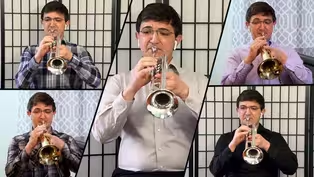
Romero: I did one that's called Frevo "Marcela" the piece that I played, for three trumpets and two flugelhorns.
It's part of a big Brazilian piece called "Fantasia Brasileira."
♪♪ ♪♪ Zhang: We also did the final movement of Beethoven's Fifth Symphony.
I remember I had to record the conducting solo part without any sound at home.
It was my son, was my older son, at the time.
He loved making the video for me.
And he -- To him, it was completely nuts looking at me, like, going crazy without any sound.
Narrator: Violinist Darryl Kubian has played in the orchestra for more than 30 years, but he's also a composer and audio/video engineer.
He stitched together 67 individual iPhone performances.
Kubian: Each person, since we were in the lockdown, had to perform the piece by themselves in their homes using their iPhones.
And then back in the studio, I was able to bring all of those disparate elements together once we lined them up.
♪♪ ♪♪ Once everybody's lined up, it's amazing, since we all play together so much, how together the audio actually sounds in the final project.
♪♪ ♪♪ [ Cheers and applause ] Putting that all together took over 100 hours and many weeks.
[ Applause ] Narrator: In the fall, the orchestra agreed to return to in-person performances without an audience and with masks, shields, social distancing, and weekly testing.
That's when they began work with director Yuri Alves on a series of concert films.
The first features a newly commissioned work by Daniel Bernard Roumain Zhang: And the title is, "I'm a white person who blank Black people."
♪♪ ♪♪ Aalst: I think the name of Daniel Bernard Roumain's piece is shocking, but it also allows you and encourages you to contemplate the role that you have played in the past in systemic racism.
♪♪ Narrator: We met the composer at Fort Greene Park in Brooklyn, a few blocks away from his apartment.
Roumain: Title of the piece is, "I am a white person who blank Black people."
The blank is a space.
The blank in the title is an opportunity for anyone to affirm how they feel about Black people.
♪♪ I'm a Black Haitian American composer, and I decided this was an opportunity, by the title and by the message and by the music in the piece, to take a stand and affirm my own race, my own cultural identity, but also allow and invite others to affirm how they feel about Black people and I hope define how they feel about BIPOC people, the AAPI community, and all of those who have been marginalized, left out, or excluded.
♪♪ ♪♪ Zhang: I feel really great to have that opportunity to let our audience know during 2020 with the Black Lives Matter, with the movement and all the social injustice that's happening, I think it makes a great point.
♪♪ Narrator: Yuri Alves is making five concert films with the orchestra, featuring music by Mozart, Shostakovich, Mahler, Still, Coleridge-Taylor, and others.
Alves: My brother and I grew up here.
I came here when I was 3 years old.
I did a lot of short independent films and had an opportunity to go out in Europe and direct some things, but Newark and, you know, sort of the characters that you find here, the sort of melting pot always allowed me to have so many stories to tell, of struggle, of subculture.
I did two short films.
I did them back-to-back.
One was called "On the Cusp," which was about a skateboarder who built a park.
Cuba: My older cousin, he actually got me my first skateboard.
Alves: And then the other movie is called "Grind," featuring Robert Wilmote, professional bodybuilder.
Wilmote: My mother had five kids.
She didn't have no job.
I had to help her.
I don't want to be in no game, but I need to provide.
Alves: I love classical music.
You know, I love it.
And I've used it many times in my films in the past.
It's actually a great honor to be able to capture these musicians playing these great compositions that I already love.
♪♪ I wanted to blend sort of the urban landscape of Newark, which is the home of NJPAC, and of the New Jersey Symphony so it sort of connects in that way.
And I wanted to show sort of the everyday life, the landscape, and the texture of the buildings to try to, like, evoke a little bit of the history.
♪♪ Zhang: They took some shots right here in Newark on the streets, and it was really blending the lyrical quality of the music into a reality that is -- by looking at the pictures, makes it so realistic and makes you just -- You feel something, something very weighty.
♪♪ For me personally, as a person and as a musician, I think it really offered me the time and the chance to reflect on actually how fortunate I am and how lucky we are here.
We can be here doing what we're good at and connecting with different people through our art.
And I think that's a great blessing.
And this year has offered me that chance to rethink about it.
I think I took it for granted before.
♪♪ ♪♪ Narrator: Later on the show, choreographer Carolyn Dorfman found a way to create during lockdown.
But first, an artist who's achieved enormous recognition while still a grad student at Rutgers.
♪♪ Haynes: One of my favorite speeches is Sojourner Truth, "Ain't I a Woman?"
where she talks about how Black women are not seen as not only human being, but we're not seen as women.
♪♪ The example of womanhood is white womanhood.
And the farther you are from that, oftentimes the less worthy of protection you are seen or the less womanly you are perceived to be.
And so that's something that I always wanted to emphasize in my work -- that not only am I Black, but I am woman, and I have the right to put my womanhood first and prioritize my womanhood.
♪♪ My name is Grace Lynne Haynes, and I am a visual artist.
I consider art to be a spiritual practice.
I remember when I wasn't making art, it was like my senses weren't alive.
It's like I felt Christmas again.
♪♪ Over the past year, things have really started to blow up, and I've had tons of press and amazing art collaborations and opportunities and experiences.
♪♪ But there's also a stress as a young and emerging artist to produce work constantly and to also feel like you don't have time to really explore your creativity.
A lot of times, the industry sees what you're doing, and they like it, and they want you to keep doing that because that's what they like.
♪♪ Being in graduate school with already a certain amount of success, there's this battle that goes on where it's like, I can technically just keep doing what I'm doing and be fine, or I can really challenge and push myself.
And I choose to challenge and push myself.
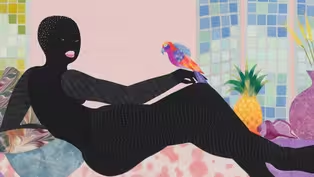
♪♪ I'm really interested in ideas of color, specifically challenging ideas in which we historically have seen the color black as associated with negative connotations, especially in Western religion.
♪♪ I wanted to show that dark is feminine.
Dark is sublime.
It's ethereal.
It's mystical.
And I want to surround it with colors.
Dark and light can coexist together in one image, and the dark can be the central point and represent the figure.
♪♪ I consider the women in my paintings to be the spirits of Black women.
They aren't representational paintings.
They are spirits.
It's an energy.
Black women, we are seen as strong.
We are seen as resilient, and we definitely are, because we have to deal with racism and sexism.
However, we are also soft.
We are also passionate.
We are also nurturing.
I believe the strong Black woman archetype has been around in the country for years now, since enslaved Africans were put on the continent.
The goal was to de-masculinize the men, which causes the woman to have to take on a more traditionally masculine role.
When you're always perceived as strong, you're not seen as deserving of protection, which leaves a lot of stress for Black women, who feel like we have to carry the world on our shoulders.
For the poses and the spaces and the environments that I choose to show my paintings in, it's very much inspired by spaces where Black women can rest, so whether it be our bedroom, our living room, out in nature.
♪♪ There's a universal theme that connects the women in terms of the skin tone, but each painting has a distinct woman.
And I use a different set of eyes collaged in from magazines on each of the paintings, and I don't replicate that.
[ Scissors cutting ] Now in 2021, I'm specifically focusing on young Black girls, and I'm also focusing on collectives of Black girls and activities that bring Black girls together, such as dance, because oftentimes, Black children are adult-ified or overly sexualized at a very young age.
And so I really want to address this adolescent stage in the Black experience and show that in my work and show that it's a stage that deserves to be protected.
It's a stage that is very much there.
♪♪ In my work, I strive to use different materials, different fabrics, different publications, and construct my own figure that is distinct to my imagination.
♪♪ I am honoring the tradition of African American collage-making, because historically, oil painting has been associated with Western art.
And on top of that, oil paint is also very expensive.
And so, in the past, a lot of African American artists didn't use oil paint because of the price, because of the type of facility it takes to do oil paint.
And so they found innovation in using collage materials.
That is what Black creativity is.
It's being able to work and make amazing art from a lack, and it's also being able to make your own new genres without any strict linear rules.
And I believe that collage and gouache really allow me to play around in that form of creativity.
♪♪ For me, art is almost my escape, and it's also my reality.
I believe that sometimes fantasy and reality can come together.
And sometimes you kind of have to go outside the realm of reality to show people what could possibly exist and how they can shape their identity in a new way that society hasn't shown them yet.
For me, it's such a privilege to be to show other young women of color, little girls of color, what they can make out of their life.
Sometimes you have to see it to believe it, and that's the power of representation.
♪♪ ♪♪ Narrator: Up next, it's been a year like no other for choreographer Carolyn Dorfman and her dance company.
[ Jazz trumpet music playing ] ♪♪ Dorfman: It's been a time of reflection for us.
It's been a time of creating, educating ourselves as a community, bringing people together.
So, the pandemic has just brought a multitude of challenges and a multitude of opportunities.
Thomas: She is a very great storyteller, and her work is very narrative.
She thinks through what she wants a work to portray or to represent.
[ Dorfman vocalizing rhythmically ] Narrator: Over the past 40 years, choreographer Carolyn Dorfman has created an impressive body of narrative work.
"Echad," the Hebrew word for "one," explores her Jewish roots as the child of Holocaust survivors.
♪♪ "Keystone" deals with the bonds that have sustained and strengthened her marriage over decades.
Armstrong: ♪ Skies of blue and clouds of white ♪ ♪ The bright blessed day, the dark ♪ Man: ♪ Can it clean a dirty mirror?
Narrator: "Snap Crackle Pop," on the other hand, is an often humorous look at the impact of commercial advertising on American culture.
Men: ♪ Brylcreem, a little dab'll do ya ♪ ♪ Brylcreem, you'll look so debonair ♪ ♪ Brylcreem, the gals'll all pursue ya ♪ ♪ They'll love to get their fingers in your hair ♪ Chong-Jimenez: She has, with her history and her Jewish ancestry, and the way that she carries that into her life and her art is very inspiring.
I think that it inspires others of other backgrounds, of other ethnicities, of other life walks, to share all of that in dance.
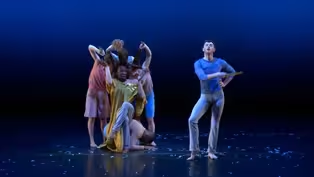
Narrator: Just before the COVID pandemic shut everything down, Carolyn received a commission to create a new work based on the music of jazz artist Louis Prima.
Dorfman: I was commissioned to celebrate the legendary 50-year career, stellar career, of Louis Prima.
So, interestingly, there was this oddity about doing this celebratory, fun, kind of sexy, you know, banter, play, improvisation.
And yet I think that joy not only sustained all of us in the process, but it gave us -- It -- The very thing that you thought might be hard to do actually gave -- fed us life.
Prima: ♪ Don't plant taters and don't plant cotton ♪ ♪ Them that plants 'em soon forgotten ♪ Dorfman: Louis Prima was -- I think Louis actually founded, like, the whole Vegas scene as a performer.
I mean, he was a jazz musician who was a brilliant musician, but also a showman.
Narrator: The pandemic forced the company to spend its first five months creating "Prima" entirely on Zoom.
Dorfman: We learned the ins and outs of Zoom in a really remarkable way.
We embraced any way that we could connect.
And I started creating "Prima."
We had tremendous amount of material.
By the time we actually came into the studio in October, I had a ton of material to work with.
Chong-Jimenez: I'm always turning over to my right side.
So, after the 3, I'm turning to my right.
You can get things done on Zoom.
There is a huge learning curve.
Guthier: Some of us live in New York City tiny apartments.
And I, you know, certainly for myself, found that I had to sort of -- I was living in an obstacle course.
You know, I was banging into my couch or a bench, or I could never get my full body in the camera screen.
So I could either say, "Okay, I can show you this movement from my waist up or from my waist down."
Two 8's, you're going to go to the up-left corner.
1, 2, 3, 4, 5, 6, 7, 8.
Back down to the down-right corner.
Dorfman: Nobody is hearing the music at exactly the same time depending on transmission.
So trying to work on musicality is very difficult.
Woman: You guys look like you're hurting a little less.
Jones: While we are so grateful to be able to dance even from home and from, you know, virtually far away from each other, missing the physical connection, missing -- which ultimately breeds an emotional connection, is a bit trying.
Prima: ♪ You gotta jump, jive, and then you wail ♪ ♪ You gotta jump, jive, and then you wail ♪ Guthier: Carolyn always works in a collaborative process with us when she's creating a new work.
So, it usually begins with her giving us a prompt or an idea.
Chong-Jimenez: There is a moment in the finale of "Pure Prima" that involves socks on our hands.
And we were just kind of on -- we were on Zoom, actually, and it's set to the song, "I Wan'na Walk Like You," which people usually associate with, like, that Disney film.
♪ I wanna walk like you, talk like you ♪ And I just thought, like, imagine I'm not a dancer and what it would be like to be some strange, alien person trying to walk and do these things.
And I like, shrunk my sleeves into my sweater and started doing dancing movements with, like, an extra, like, fabric appendage trying to walk.
And I made a whole phrase like that, and the whole phrase ended up in the entire finale.
I'll always remember that as, like, this funny Zoom moment.
Prima: ♪ I wanna walk like you, talk like you, too ♪ ♪ You'll see it's true ♪ An ape like me ♪ Can learn to be Narrator: After much discussion, the company returned to in-person rehearsals in October.
Dorfman: It was scary, 'cause I did not want to put anybody at risk.
I kept questioning, and we kept talking about it.
We set our protocols.
We had this electrostatic sprayer.
The way it gets made, it can kill coronavirus.
Guthier: When we first came back, we had our face masks, we had shields, and we even had goggles, also.
And we had 10-foot-by-10 foot squares taped out on the floor that we had to stay in when we were dancing in the studios.
Woman #2: Coming back into the studio for the first time, everyone was filled with a little trepidation.
Dorfman: Open and over.
Narrator: One of the dancers did test positive for COVID after the company filmed the final version of "Prima" but didn't become seriously ill, and no one else in the company has tested positive.
Their strict safety protocols seem to have worked.
Dorfman: Feel it and fall.
Jones: After so much time away from each other and now just feeling so fortunate to be back together at all and getting to dance in a broad, open space together, even if it's without partnering, without contact, was -- It was exhilarating and really -- [ Voice breaking ] really emotional.
[ Jazz trumpet music playing ] ♪♪ ♪♪ ♪♪ ♪♪ Narrator: That's it for "State of the Arts" this week.
To share stories you've seen or leave a comment, visit StateoftheArtsNJ.com.
Thanks for watching.
Prima: ♪ Sing, sing, sing, sing, everybody start to sing ♪ ♪ La dee da, ho, ho, ho, now you're singing with a swing ♪ ♪ Sing, sing, sing, sing, everybody start to sing ♪ ♪ La dee da, ho, ho, ho, now you're singing with a swing ♪ ♪ And when the music Announcer: The New Jersey State Council on the Arts, encouraging excellence and engagement in the arts since 1966, is proud to co-produce "State of the Arts" with Stockton University.
Additional support is provided by the Geraldine R. Dodge Foundation and these friends of "State of the Arts."
Video has Closed Captions
Clip: S39 Ep4 | 7m 20s | Carolyn Dorfman Dance's new work inspired by jazz artist Louis Prima, created during Covid (7m 20s)
Video has Closed Captions
Clip: S39 Ep4 | 7m 9s | Artist Grace Lynne Haynes creates work celebrating the Black female spirit. (7m 9s)
Symphony in Lockdown: The NJSO 2020-21
Video has Closed Captions
Clip: S39 Ep4 | 9m 16s | Music director Xian Zhang and composer Daniel Bernard Romain create new work during Covid. (9m 16s)
Providing Support for PBS.org
Learn Moreabout PBS online sponsorship

- Arts and Music
The Best of the Joy of Painting with Bob Ross
A pop icon, Bob Ross offers soothing words of wisdom as he paints captivating landscapes.












Support for PBS provided by:
State of the Arts is a local public television program presented by NJ PBS