
Celebrating Black Female Trailblazers
Season 50 Episode 10 | 23m 55sVideo has Closed Captions
Celebrating Black Female Trailblazers for Women’s History Month | Episode 5010
For Women’s History Month, “American Black Journal” celebrates two African American women trailblazers, Michigan Court of Appeals Judge, the Hon. Cynthia Stephens and the late author and anthropologist Zora Neale Hurston, whose accomplishments have paved the way for future generations of African Americans. Episode 5010
Problems playing video? | Closed Captioning Feedback
Problems playing video? | Closed Captioning Feedback
American Black Journal is a local public television program presented by Detroit PBS
Celebrating Black Female Trailblazers
Season 50 Episode 10 | 23m 55sVideo has Closed Captions
For Women’s History Month, “American Black Journal” celebrates two African American women trailblazers, Michigan Court of Appeals Judge, the Hon. Cynthia Stephens and the late author and anthropologist Zora Neale Hurston, whose accomplishments have paved the way for future generations of African Americans. Episode 5010
Problems playing video? | Closed Captioning Feedback
How to Watch American Black Journal
American Black Journal is available to stream on pbs.org and the free PBS App, available on iPhone, Apple TV, Android TV, Android smartphones, Amazon Fire TV, Amazon Fire Tablet, Roku, Samsung Smart TV, and Vizio.
Providing Support for PBS.org
Learn Moreabout PBS online sponsorship>>Just ahead, we've got a great show for you on American Black Journal this week.
We are celebrating Women's History Month.
The stories of two African American women whose accomplishments have paved the way for future generations.
Judge Cynthia Stephens is here to talk about her long career on the bench and we'll delve into the life and legacy of the late author Zora Neale Hurston.
Don't go away, American Black Journal starts right now >>From Delta faucets to Bear paint, Masco Corporation is proud to deliver products that enhance the way consumers all over the world experience and enjoy their living spaces.
Masco, serving Michigan communities since 1929.
>>[Detroit Public TV Narrator] Support also provided by the Cynthia & Edsel Ford Fund for Journalism at Detroit Public TV.
>>[DTE Foundation Narrator] The DTE foundation proudly supports 50 years of American Black Journal in covering African American history, culture, and politics.
The DTE foundation and American Black Journal partners in presenting African American perspectives about our communities and in our world.
>>[Nissan Foundation Narrator] Also brought to you by Nissan foundation and viewers like you.
Thank you.
(upbeat music) >>Welcome to American Black Journal.
I'm Stephen Henderson.
March is Women's History Month, and my first guest is a trail blazer in the field of law.
The honorable Cynthia Diane Stephens is retiring this month from the Michigan court of appeals after 14 years of service.
Prior to her appointment, she was a judge for the third circuit court and 36 district court here in the city of Detroit.
She was also the first African American woman appointed to the Michigan court of claims where she made headlines in 2020 after rejecting claims of election fraud in a lawsuit filed by the Trump presidential campaign.
I sat down with Judge Stephens to talk about her career and the importance of African American representation on the bench.
So first of all, congratulations on your impending retirement, but I just also wanna say condolences to the rest of us.
I mean, you're such an important presence on the bench, but I think it comes at such a pivotal time, not just in the terms of legal circles, but in terms of the American conversation that we're having right now, and of course it comes just as President Joe Biden has nominated the first African American woman to be on the U.S. Supreme Court.
You're the first African American woman on our court of claims.
Life is really full circle, isn't it?
>>It is that, it is that, and unfortunately the United States Supreme Court is going to have a Supreme Court Justice before the state of Michigan has ever had a black woman.
>>That's absolutely right.
We still have not smashed that ceiling.
>>Not yet.
>>Yeah, yeah.
So I want to start with you talking to our viewers just a little about your career, how you got started, what got you interested in law, and then we'll talk about the constant kind of barrier breaking that you've had to do.
>>Well, you know, what got, got me started in law I can't exactly tell you, but I know the moment when I decided I could be a judge.
Judge Damon Keith was the graduation speaker at Cass Technical High School in 1968, and that made me think not just about lawyers, but about judges.
I was privileged to, like yourself, I bleed maize and blue, so I went to the University of Michigan and was going to go to Michigan's law school, but at the time I was both engaged to be married to somebody, whom luckily I did not marry.
He married someone else and has been a wonderful husband and father, but I wanted to go to either Michigan or Harvard.
I was able to get into Harvard, but we needed a year for him to work before he could transfer, so I went and went into a PhD program, and then, as my mother reminded me, I dropped out, worked for the poverty program for a minute, and then went to Emory Law School.
From Emory, I was privileged to take the bar in Georgia, Texas, and Michigan, because Michigan is where mom was, and I knew I was gonna come home.
Had the opportunity to work for one of the most brilliant lawyers I have ever met in my life, the late Basil Brown, Senator Brown, as the associate general council for the Michigan Senate.
I ran for the charter commission in Wayne County, was its vice chair, and then this new thing was created called the 36 district court, and so I was amongst the very first judges to be elected to that court.
It was a conversion from the old common pleas, and I was a district court judge for 32 months.
Governor Blanchard was kind enough to appoint me to be a circuit judge, and I was there for about 28 years.
So here we are now at year 40 and month three of judicial service, and I am going to be retiring at the end of this month, and I am happy to say because I was the last black appellate judge in the state that as of this month, Noah Hood will join the court of appeals, and next month, Judge Christina Robinson-Garrett will join the court.
So we'll be back to two, but that'll still put us down by one from the number we used to have.
>>Yeah, yeah.
So I do wanna talk about your presence on the court of claims and what that was like, because we're about to see Ketanji Brown-Jackson, I think, experience the same thing.
You're the first in this austere company and in this austere place, and I imagine there's lots of pressure but I think there's also, of course, lots of opportunity.
>>The court of claims was curious because I've been there for, I was there for about six years, and in the last year we had all of those election cases and we had all of the cases involving COVID so it was a court that was a hotbed of issues that were both legal, but very, very, very political.
The pace was fairly fast in that year, and so were the threats that would come in and it never occurred to me that anybody would call up a judge's chambers and threaten them, but that's where we are now.
>>Well, obviously you've got security and state police, I would imagine to deal with those threats.
It changes the way that I think we all interact with one another and it changes the dynamic between us.
>>It does, it does.
On one hand, it reminds you of how personal legal issues are now.
You tend to think of them as kind of esoteric and et cetera, but they're real life issues.
When I was a trial judge, I knew that who got custody of the kid mattered deeply.
I absolutely knew that whether or not you got compensated for discrimination, or things like that, mattered.
On the appeals court and in the court of claims, you're usually dealing with paper, and so the good thing, if there's a good thing about this changed environment, is that it does sharpen your focus to understand that every single case, whether you see the people in it or you're reading the paper and reading their briefs, every single case is personal to somebody and deserves that kind of focus and respect.
>>So I wanna go back to your time on 36 district court, which is a court that, it's got kind of a rough reputation at times at least because of the slow pace of things, and I think it's an underfunded court, and that contributes to that, but as you point out, it was a new court when you joined it and the idea there, as I remember, it was representation, better representation for Detroiters in these matters.
Talk about how important it was that we did that and what it was like in those early years.
>>Well, in 1980, we had a major funding crisis in Wayne County for a number of things, for both the recorder's court, which existed at that time, the circuit court, and the common police court, and Senator Brown and others, including Mayor Coleman-Young and soon to be Justice Archer got together with Sam Gardner and some others, and came up with a plan to do a couple of things.
First to shift the burden of funding the state court off of the people of the county of Wayne, and secondly, to afford the people of the city of Detroit what every other city had, which was a district court that managed its traffic tickets and misdemeanors and landlord tenant matters, and they were able to come up with an agreement with then Governor Millikan to do that, and we went from a situation where in common pleas at that point, there were seven judges.
Of those seven judges, three, no, there were 10 judges.
Of those seven judges, three were at African American, John Murphy, who will be retiring from the circuit court, the amazing Lucia Watts who has left us, and Freddie Byrd who we all called cousin, and we went from three judges there to, when we added another seven judges when the district court first began, of those seven judges, six were African Americans, and so we went from a point where we had maybe 30 black judges in the state of Michigan, to the point where we reached over a hundred.
>>And that matters.
I mean, there are people who want to say it doesn't, but it does, it matters that people who not just look like you but have your life experience sit on the bench.
>>And there are a couple of real easy things for people to understand why it matters.
An individual is accused of, let's just say it's a traffic offense, okay?
It's significant, but it's a traffic offense, and the question is, do you get bail or don't you get bail?
And if I know that the fact that somebody moves every year is not a big deal.
I don't consider that person to not have community ties.
So it matters.
When you have a child custody case or a child termination of parental rights case, and a parent says, you know I can't make manage this on my own, and they go move in with a fictive aunt 'cause everybody's an auntie and they move in so they have a multi-generational house.
Some people would say that's not a stable home, but if you've lived in multi-generational houses, if you understand that fictive kin are sometimes much nicer than the real ones, you're gonna realize that that person has made a wise and safe decision and that you don't want them living on their own because they're having trouble managing kids.
So it matters.
>>Yeah.
What are you gonna miss about judging when you leave the bench?
>>It will not be the color black.
>>You get to wear more colorful clothes right?
>>Yeah, see, I'm wearing red, red, red.
I will miss the direct ability to influence decisions that affect important issues in people's lives as a judge.
On the other hand though, I got it, I think of it as a Christmas present, the Michigan Supreme Court created finally a diversity, equity, and inclusion commission for the state of Michigan.
I get to be one of its first co-chairs, and so maybe I'll get a chance to make some systemic changes.
>>Our celebration of Women's History Month continues now with a look at the accomplishments of the late author and anthropologist, Zora Neale Hurston.
She's considered one of the best writers of the 20th century and her work's often focused on African American life in the south.
My next guest, Rae Chesny, is an author who was inspired by Hurston's writing.
She's working on a book titled "Dear Zora" and she travels the country giving lectures and presentations about the world renowned writer.
Here's our conversation.
Rae Chesny, welcome to American Black Journal.
>>Thank you so much, Steven.
>>Yeah, so I'm really excited to have you here, and I'm really excited for this conversation.
I feel like Zora Neale Hurston is both a well known figure in literature and history and all kinds of other things but also kind of an obscure figure in some ways, like people don't know as much about her as they think they should.
One of my favorite kind of trivia things about her is the number little black girls I knew growing up whose names were Zora, and I like, I always kind of assumed that that's why they were named that way.
Speaks to her influence.
But let's start with your fascination with Zora Neale Hurston.
What is it about her and her work that draws you to her?
>>Yeah, so I agree with you.
It's funny because if you bring up Zora's name, people will say, oh yeah, the lady who wrote "Their Eyes Were Watching God".
I love that book, but there's so much more to her that we need to know, and we're right between Black History and Women's History Month, and so I think this is a perfect time.
My fascination actually started in 2018 when a professor at Michigan State invited me to do a black history presentation, and as a writer, I had been working with children.
We had collaborated through partnership with afterschool programming and summer camps.
He said, "The kids love you, my students love you, come do a black history presentation on the person who most influenced your career as a writer."
And I was actually a reluctant reader as a child, so I didn't have anyone who really influenced me.
I just always loved to tell stories, but Steven, he gave me this magical word that really changed my mind.
He said, "I will pay you an honorarium," and so.
>>That is a magic word.
>>Yes, I had never had that word in conjunction with my name, so I felt very inspired, and so I set out to do the presentation on Langston Hughes because I love the Harlem Renaissance, of course Langston is probably the most popular person from the Harlem Renaissance, and I love that he was a poet, used everyday language, and focus on working class black men, but as I kept researching Langston, I didn't find a personal connection, instead I found Zora Neale Hurston, and I started going down this rabbit hole.
I'm like, oh wait.
She was raised in the first all black incorporated municipality which just means legally established town in the history of the United States.
Her father was married three times.
She was a trained anthropologist in 1928.
She interviewed the last person to live during slavery and be enslaved.
Well, how come we don't know about her?
And she was best friends with Langston Hughes during the Harlem Renaissance.
And so I was like, well, how come we don't learn about her?
But then I asked myself a hard question.
How come I wasn't presenting Zora Neale Hurston?
And so that first year I tacked her on to the end of the presentation as an and with Langston Hughes and the sensation as I was presenting her, I would start sweating and everything, and I joke that it was probably Zora jumping up from the grave, telling me, "Don't ever make me an and," and I promised her in that moment, if I ever got another chance to do a black history presentation, she would be the star of the show, and she has been since that moment.
Funny enough, I was assigned "Their Eyes Were Watching God" in high school and I did not read the book.
>>Well, that's pretty common.
That's a pretty common thing to happen.
We all kind of get 'em in high school.
I feel like a lot of the work that she did is especially relevant right now given the things that we're talking about and given our renewed focus on the importance of black history to the present and to the future.
>>Absolutely, she was typically out of step with the black thought leaders at the time.
She had a lot of pride at that time.
WEB Du Bois coined the phrase the "talented tenth" and so Zora really opposed that ideology, because it separated a certain class of black people, this upper echelon away from the roots, the history, and so she did fight to preserve that and to also share it in creative ways.
One of the interesting things about Zora is that she often did not want to write full length novels because it takes so much time, and I can tell you as a writer, it's a lot of investment.
It's a long shot.
It's a lot of investment of time, of resources.
You can't fully work a full time job, and so she actually took her anthropological field work and staged it as plays, and so she was very focused on theater, and if she could have had her choice that is what she would've wanted to do.
When it came to writing short stories was kind of her sweet spot and she felt, Hey, I could churn some of those out and still do the plays, still do the anthropological work, but showcase authentic black life, and even beyond that life throughout the African diaspora, she traveled to Jamaica and Haiti.
Her first application for the Guggenheim was actually to go to west Africa, the gold coast as it was called back then to trace these roots to say, Hey, the Southern Negro is not as far from these original west African spiritual practice, cultural practices that still exist in black culture today.
>>So tell us a little more about the book that you're working on which is of course, about Zora Neale Hurston.
What is the focus of it and what thrills you about the work?
I think if you're not thrilled to be writing a book, you're not gonna finish so.
>>Right, right.
And I would say equal parts thrilled and nervous because it's deeply personal.
So it's part memoir and part biography of Zora, part memoir for me.
When I started presenting on her, after that first presentation in 2018, I decided to write her a letter, and I don't know, it's that writer thing.
Sometimes things just come to you and you do it and you don't understand why until later, and so I started writing her letters and it was my way to try to communicate with her and do something more so than just think about things in my head.
This was our communication, and so it progresses, the book does, with these very intimate letters from the first time I presented on her to present day, and so it's documenting my unexpected journey in becoming a Zora scholar but it also annotates and gives context about Zora.
So just like if we were friends and we were having some, you know, random conversations someone listening in might not understand the references of what we're talking about.
But for me, I always want to give my audience, my readers a chance to start doing their own research.
So we have citations, context, annotations, facts about Zora that are little known random things like, oh, it's your birthday, Zora.
I made you fried shrimp and okra, 'cause that was your favorite thing.
Or I saw a Magnolia tree today and I thought about you, 'cause that was her favorite flower.
But it also goes into some of the other things, talking about her schools of thought in comparison to WEB Dubois and other black thought leaders.
She was Team Booker T. Washington, I should say.
And how she really felt about her life is very personal, and most of the time I remind people I am Zora scholar, not a Hurston scholar because my relationship with her is deeply personal.
>>We're gonna leave you now with a performance by Monique Ella Rose from Detroit Performs Live from Marygrove.
You can find out more about our guests at americanblackjournal.org, and you can always connect with us on Facebook and on Twitter.
Take care and we'll see you next time.
(soft upbeat music) (singers vocalizing) ♪ There's no shame ♪ In how you make me feel ♪ ♪ It feels so unreal ♪ ♪ With you I know it's not a game ♪ ♪ Your love is indescribable ♪ ♪ You've been there for me in my time of need ♪ ♪ And you never let me go ♪ ♪ Even when I was afraid ♪ ♪ To give you my heart ♪ ♪ You said, trust my love will never depart ♪ ♪ Yes you've got me convinced ♪ ♪ I didn't think this could exist ♪ ♪ No matter sun nor rain, you've been by my side ♪ ♪ It can't be denied ♪ There's no love like our love ♪ ♪ I don't wanna know what life is like ♪ ♪ And this is beautiful ♪ I get butterflies when I hear your voice ♪ ♪ I know I made the right choice ♪

Video has Closed Captions
Clip: S50 Ep10 | 8m 21s | Author Rae Chesny Keeps Zora Neale Hurston’s Life, Stories Alive With ‘Dear Zora’ Book (8m 21s)
Video has Closed Captions
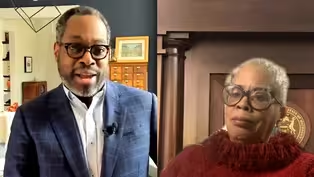
Clip: S50 Ep10 | 10m 50s | Michigan Court of Appeals Judge Hon. Cynthia Stephens Retires After 14 Years (10m 50s)
Video has Closed Captions
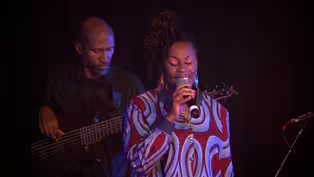
Clip: S50 Ep10 | 1m 43s | Singer Monique Elle Rose Performs For ‘Detroit Performs: Live From Marygrove’ (1m 43s)
Providing Support for PBS.org
Learn Moreabout PBS online sponsorship
- News and Public Affairs

Top journalists deliver compelling original analysis of the hour's headlines.

- News and Public Affairs

FRONTLINE is investigative journalism that questions, explains and changes our world.












Support for PBS provided by:
American Black Journal is a local public television program presented by Detroit PBS