
Police Reform/Davóne Tines Portrays Malcolm X
Season 50 Episode 18 | 26m 46sVideo has Closed Captions
Patrick Lyoya and Police Reform, Davóne Tines Portrays Malcolm X | Episode 5018
Host Stephen Henderson leads a roundtable with Greater Grand Rapids NAACP President Cle Jackson and Black Lives Matter Detroit Co-founder John Sloan III about the fatal shooting of African immigrant Patrick Lyoya by a white police officer. Plus, Stephen talks with bass-baritone Davóne Tines about his role in portraying Malcolm X in Detroit Opera’s “X: The Life and Times of Malcolm X.”
Problems playing video? | Closed Captioning Feedback
Problems playing video? | Closed Captioning Feedback
American Black Journal is a local public television program presented by Detroit PBS
Police Reform/Davóne Tines Portrays Malcolm X
Season 50 Episode 18 | 26m 46sVideo has Closed Captions
Host Stephen Henderson leads a roundtable with Greater Grand Rapids NAACP President Cle Jackson and Black Lives Matter Detroit Co-founder John Sloan III about the fatal shooting of African immigrant Patrick Lyoya by a white police officer. Plus, Stephen talks with bass-baritone Davóne Tines about his role in portraying Malcolm X in Detroit Opera’s “X: The Life and Times of Malcolm X.”
Problems playing video? | Closed Captioning Feedback
How to Watch American Black Journal
American Black Journal is available to stream on pbs.org and the free PBS App, available on iPhone, Apple TV, Android TV, Android smartphones, Amazon Fire TV, Amazon Fire Tablet, Roku, Samsung Smart TV, and Vizio.
Providing Support for PBS.org
Learn Moreabout PBS online sponsorship- Just ahead on "American Black Journal," the president of the Grand Rapids NAACP and a co-founder of Black Lives Matter Detroit are gonna be here to talk about the shooting death of Patrick Lyoya at the hands of a Grand Rapids police officer.
Plus, my conversation with the acclaimed African-American classical singer, who's portraying Malcolm X in a Detroit Opera production this month.
Stay right there.
"American Black Journal" starts right now.
(light, jazzy music) - [Announcer] From Delta faucets to Behr paint, MASCO Corporation is proud to deliver products that enhance the way consumers all over the world experience and enjoy their living spaces.
MASCO, serving Michigan communities since 1929.
- [Announcer] Support also provided by the Cynthia & Edsel Ford Fund for Journalism at Detroit Public TV.
- [Announcer] The DTE Foundation proudly supports 50 years of "American Black Journal" in covering African-American history, culture and politics.
The DTE Foundation and "American Black Journal," partners in presenting African-American perspectives about our communities and in our world.
- [Announcer] Also brought to you by AAA, Nissan Foundation, and viewers like you.
Thank you.
(upbeat music) - Welcome to "American Black Journal."
I'm your host, Stephen Henderson.
It's been one month since African immigrant, Patrick Lyoya, was shot to death by a white Grand Rapids police officer after a traffic stop turned into a violent altercation.
The incident has sparked protests in Grand Rapids and all across Michigan.
I spoke with Grand Rapids NAACP President, Cle Jackson, and with Black Lives Matter Detroit co-founder, John Sloan III, about this latest deadly police shooting of an unarmed Black man.
So Cle, I'm gonna start with you.
Give us a sense of the way this feels, I guess, in the African-American community, in Grand Rapids right now.
We are still waiting to know much more about the consequences of what happened, but what did happen, I think, not only shocks that community, but also reminds of such a long narrative of tension between the police department there and African-Americans.
- Mm-hmm.
Yeah, well, again, thank you for having me today to discuss this very egregious situation and horrific situation for the Lyoya family here in West Michigan.
The community is, of course, outraged, right.
The emotions are very high here, and they have been, and I should say, we have been, I think, patiently waiting for some answers.
As you might know, the Michigan State Police is the lead investigatory agency right now for this.
We have not received an update from there in terms of where they are currently with releasing the findings of their investigation.
So we're waiting for that, still.
We've asked, in terms of the NAACP of Greater Grand Rapids, has asked publicly and officially yesterday, when we held a press conference at the Kent County Prosecutor's Office, to, which is Chris Becker, to recuse himself from this case, we also have, we'll be meeting with the Attorney General, Dana Nessel, I believe next week, to ask her to come in and take full control and oversight of the investigation.
So we'll see where that gets us.
Chris Becker, the Kent County prosecutor, put a statement out, official statement yesterday, indicating that he will not recuse himself from this case, and so, we're continuing to move forward, continuing to keep Patrick's name in the spotlight, continuing to support his family as best as we can, and so, we'll see.
And as you said, you know, this is a situation that we have been, in America, have been dealing with for years and years and years and years, and it has to stop.
At some point, it really has to stop.
We have to stop automatically being criminalized by local law enforcement agents across this country.
We have to stop being demonized by white America, and things have to change.
And they have to change quickly, and that's what we're expecting for in this situation.
- Yeah.
I wonder if you can talk about, for our viewers here in Detroit, I guess, the differences between what it's like to be African-American in a place like Grand Rapids in Michigan, a smaller city, with a smaller African-American population than in someplace like Detroit, where, of course, we are the overwhelming majority.
- Well, I think there's a big difference.
As you guys know, there's a distance in West Michigan.
A lot of folks, they use this term here, we play West Michigan nice, right?
So what that means is that the drapings on the window are often not opened, and so, what happened during the pandemic, during the COVID-19 pandemic back in 2020, all of the curtains were pulled off the window, right?
And honestly, even the windows were broken out and busted.
I'll just say that, and what happened with that is it showed the gross disparities that exist here in West Michigan, not even from just a criminal justice lens but also, from a healthcare lens, from an economic lens, from an education lens, from a youth engagement and involvement lens, and so, the list goes on and on and on.
West Michigan is ultraconservative, it is rooted in the faith of the Christian Reform Church, and our numbers here, we probably had, in the city of Grand Rapids, well, actually, the county, I believe, about 60,000 Black folks here.
Out of almost 200,000.
I think that was the last census, we were up near the 200 mark.
And so, that's what we're dealing with here.
It has been a lot of, historically, a lot of managerial racism here, as well, and so, it has been intentional.
It has been blatant, and it is, and a lot of people here, I believe, in mind, this is not, you know, a criticism, it's just an observation, have perpetrated this system of white oppression and I say oppression, repression, depression, every oppression you can think of.
And it's been very intentional here.
And so, that's what we're dealing with in West Michigan.
- Right, yeah.
So John, you and I have, of course, talked about this before, and not one time, but many times.
It happens over and over.
What I wanna talk to you about, though, is something that you said to me a few years ago, about the next step for African-Americans in this whole narrative of the relationship with the police and you talked about that it wasn't time to wait for the police to change themselves.
It's not time anymore to wait for someone else to change the police, but that African-Americans, and other people who have really tense relationships with police officers were gonna start, essentially, stop engaging with police, pulling away from that form of assistance or interaction in our communities.
And I wanna start there with you.
You know, you watch this video of this officer interacting with Patrick Lyoya, and you say, over and over again, why are they interacting in the first place?
And why does it turn so violent so quickly?
And the answer to both of those, really, ultimately is that the interaction itself is the problem, and that not interacting is, in so many cases now, it's just the way that African-Americans can avoid what happened to Patrick Lyoya.
- Yeah, thank you, Stephen, for having me.
I always enjoy talking to you, but unfortunately, I feel like we talk too often under these circumstances.
I think what we saw with Patrick's murder and I wanna, I'm always gonna be clear about calling it a murder and not a death or killing, right, because that was intentional homicide, was there were so many opportunities for deescalation.
There were so many opportunities for that situation to go differently, and so, every time I hear somebody say, well, we just need to reform the police, if we give them more training in deescalation, then they'll be better able to handle situations like this.
This was one clear example about how that training doesn't work, right?
And so, when we talked, one of the times that we spoke during the summer of 2020, when we were seeing protests all across Detroit, all across the state, all across the country, one of the things that we talked about, and that I hoped would happen, and did, to a large extent, was that those protests created pressure on officials.
They allowed us to leverage that pressure into political engagement.
The problem is that there is such force, and when I say force, I mean political will, but also money, dollars, behind the opposition to those things.
I'm gonna point very clearly to Proposal P as an example.
So you saw the process for Proposal P, and the remaking of Detroit City Charter, start years earlier, right, as something that is part of how our system is supposed to work.
We as the residents of this city are supposed to have an opportunity to weigh in about how our city is being run and being governed.
The aftermath of the summer of '20, of George Floyd, Breonna Taylor, and the innumerable names that we can't mention, a lot of citizens, including myself and other residents of this city got together and put forth an amendment for the city charter, right, completely remaking the way the Board of Police Commissioners was structured, completely separating the the Board of Police Commissioners from DPD, putting in mechanisms to give more teeth to how discipline could be meted out to agents of law enforcement agencies, as well as a myriad of other things.
Participatory budgeting, like a lot of other things that were in there, and we saw Proposal P go down, unfortunately, as drastically as it did, because there were so much money that was put into the opposition.
You couldn't drive anywhere.
I couldn't watch ESPN Monday Night Football, Hulu, anything, without seeing P is a Problem.
And so, what we're seeing is that, as much as we, as Black folk might wanna disengage, as much as we, as Black folk might wanna say, oh, I'm gonna step away from this problem, we can't step away from the problem, because the problem seeks us out.
Right?
This system of policing is not broken.
It's doing exactly what it was designed to do.
It's upholding a social structure, it's upholding a social hierarchy and it's criminalizing folk that those that have power wanna make sure stay without, right?
So the more that we can frame this conversation less surrounding let's fix a broken system, the more that we can frame this conversation less around, well, we just need to get the police to do X, Y and Z, and the more that we can take advantage of this opportunity, insofar as it's a horrible and unfortunate event, but leveraging this moment to be able to get legislative action, sustainable change and progress through, if we can't do that during moments like this, during moments like George Floyd's death, then the further away we get, we've seen, with our society, the further away in the rearview mirror this event becomes, right, the less leverage we're going to have on our elected officials.
And the unfortunate reality of it is, for those of us who did not know Patrick, those of us that aren't members of his family, we have the privilege of being able to put this in the rearview.
They don't.
They're gonna have to live this every day for the rest of their lives, and we owe it to them, then, as a community, to be able to stop and say, hey, hang on a second, this is, we've continued to run up against this wall.
It's time to actually do something about it.
It's time to not just talk.
It's time to not just write legislation.
It's time to enact powerful change.
- Mm, yeah.
John, I've only got a minute or so left, but I do wanna have you talk about, just kind of update us on these efforts around the country to create alternatives to the police for people to go to when they do have problems.
That would not have saved Patrick Lyoya's life, of course, but this, again, this idea of stepping away from police in African-American communities has actually gained some steam.
- It has, and so, we've seen, if you look at Minneapolis, the Twin Cities, right, in the aftermath of George Floyd's death, there was a huge push to dismantle that system of policing and to build something new.
The difficulty that is occurring is in the execution of that thing, and not replicating the same harmful systems that have put us in this position in the first place.
I'm in the leadership of a local organization called the Detroit Safety Team, and part of what we focus on is transformative justice and non-punitive responses, right?
How do you center safety in the community?
How do you make sure that the people that are on that block, in that neighborhood, have as much control and have as much say into what safety looks like in their community as anybody else, with the understanding that, what safety looks like in Brightmoor is gonna be different than Jefferson-Chalmers, is gonna be different than Southwest, is gonna be different than North End, like we all need to be able to have that type of weigh-in.
Where we're always gonna run into difficulty is this idea that it's easier to just accept what we know now and just deal with it, than it is to make something new.
And so, whenever somebody says, we defund the police means to tear things down and make us unsafe, I say, no, it doesn't.
It means to divest from a system that has proven to kill us, that has proven to criminalize us, and invest in systems that we know work.
None of these things are brand new, right?
Like we, historically, have seen this type of self-governance, this type of self-understanding of what safety can look like be productive and be successful.
We need the willpower as a community and we need the willpower to put pressure on those people that have that type of legislative power and monetary control, right, to be able to create that change.
One of the first key things we can do whenever somebody sees participatory budgeting coming up on their ballot, that's one of the first things that we can do that could really make a stand, because that's our immediate way, as residents, of us saying, we have a right, we're paying taxes into the city and to this community, and we should be able to have a say as to how that money gets spent.
- Detroit Opera is closing out its season this month with a new production of "X: The Life and Times of Malcolm X."
Artist in Residence Davone Tines is cast in the role of Malcolm X in this really interesting opera that's infused with jazz.
I spoke with the award-winning bass-baritone when he arrived in Detroit last year.
Here's a portion of that conversation.
Malcolm X set to opera.
Right there, that's a provocative statement.
Tell us what that's been like, pulling this all together.
- Completely.
So the incredible Anthony Davis, Pulitzer Prize winning composer, and actually, his cousin and common collaborator, Thulani Davis, I think that they have made a really unique mark in opera, in telling Black stories.
Anthony Davis won the Pulitzer for his opera, "The Central Park Five," and just tackling a number of critical stories in that form.
And as I was saying, I think what that form brings is attention and scale.
So a character like Malcolm X deserves that attention and that scale, and I think the way that they've worked out how this piece exists does that in an incredible and special way.
Anthony writes in a jazz idiom, essentially, but you know, co-mingled with classical, which some people would say are different branches of the same tree, but I think it's gonna be really incredible for audiences to experience what does it mean when you take a full symphonic orchestra with a jazz quartet or a jazz ensemble embedded in the middle and have that kind of expression blasted to that scale, all with the purpose of saying, you know, this man's life and furthermore, his mission are even beyond the scale of the resources we have available?
- Yeah, yeah, and for you, personally, playing this role, talk about how that feels.
- Completely.
I continue to find that, being a performing artist is a deep blessing and a privilege, in order to live out on stage emotions and ways of being that don't necessarily exist or that I would have the opportunity or venue to express otherwise, and being a Black man in America, being a Black person or marginalized identity in this country, as James Baldwin says, "can fill someone with a sort of madness," and taking on this role, you know, it allows a place to put all of that energy.
Not to say that Malcolm X is mad, but I think he's often misconstrued as a person who had ill intent or malice, and one thing I continue to deeply respect in looking into his life and his work was that I think he really just aimed to be a mirror.
He aimed to be a reflecting point of the world and of the time that he lived in.
You know?
The first aria in the opera, titled, "You Want the Truth, But You Don't Want to Know," talks about how his family and he had been through so much degradation at the hands of white people, his father being killed, his mother not being able to collect insurance on that hate crime of a death, and later, being driven to her own madness, and his family being disassembled by a white system that didn't have space for their particular quote-unquote, "problems," all of what he did was motivated as a reaction, as a reflection of the energy put towards him.
So he says, you know, if my life had been torn asunder at these forces, why shouldn't I have access to those same forces in order to save or continue my life?
But even more altruistically, the lives of my people.
- You know, the relationship between Detroiters and the arts has always been really strong, and of course, we've produced lots of great art in many different forms here in Detroit.
I'm not sure everybody thinks of classical music or opera, though, when they think about that.
I imagine you would like to change that.
- Completely.
Something I've been really, really interested in for a long time is trying to figure out, what is opera, really, or what is the greater potential of opera?
And I think part of that has to deal with going back to a deeper root of what opera was, and it has to deal with, you know, the word opera in Italian means work, and a part of that definition has to deal with how can you bring together different mediums, different aesthetics, whether that's an orchestra, or lighting, or the grandiosity of a theater, to work, to focus on telling a story?
So opera is, in essence, a really incredible way to tell a story and often, the stories that people know from opera are not something that people can really connect to.
You know, maybe it's in German, maybe it's telling the story of a people that one doesn't see themselves in, so I'm trying to make it a priority for people to understand that opera is anything with intentional storytelling.
And I think, especially with this piece, "X," it's an opportunity to put a story that isn't normally engaged, a story that, I think, many people today, especially Black people, can connect to, and saying, this is opera, too.
This deserves those resources.
This deserves that sort of consideration.
And so, I think a way to save or redefine opera is to change what stories and what people are in the middle of it.
- Mm.
In addition, of course, there are not as many African-Americans who work in the classical music space or in the operatic spaces as we'd like.
Tell us how you became interested in this, and decided that this is how you wanted to spend your life and express your art.
- Definitely.
Well, I grew up in Northern Virginia, and singing in the Baptist church there.
My grandfather was a church choir director, but also in the Navy for a long time, and he discovered that I had a unique voice.
One day he sang, kind of jokingly.
♪ How are you ♪ And I said.
♪ I am fine ♪ And he thought, whoa, you have (chuckles) something else going on there, and I didn't think that I wanted to sing or have anything to do with it, you know, in a professional way, but he really encouraged me to figure out what is a classical singer, or what is a way of training my voice in order to communicate something?
And then, I also played violin for about 14 years, and also, sang in a lot of different church contexts, be it the Baptist church or the Greek Orthodox church, or even the Catholic shrine in Washington, D.C., and what I respond to, I think, most in music-making, is when it's done for a reason, and in the church, music is always made for a reason.
It's in order to connect to our human and lived experience.
So walking into an operatic context or the classical music world, I never fully saw it for what those stories were, or what the content was.
I saw it for its possibility.
I saw, you know, what it is if we can take an orchestra and put it with gospel, as people like Kirk Franklin have so brilliantly done?
Or what it is if we take the grandiosity of the theater and pay homage to stories that we just don't lift up as a society?
So I've always been trying to engage it for the tools and I think that also has to do with a larger tradition of Black people in America taking what's available to us, in order to get along and do what we need to do, and what we need to do right now, I think, is tell stories that are going to change perspective on how we exist.
♪ We will bring ♪ ♪ The light ♪ ♪ Hallelujah ♪ ♪ Hallelujah ♪ - And "X: The Life and Times of Malcolm X" is at the Detroit Opera House on May 14th, 19th and 22nd.
That's gonna do it for us this week.
Thanks for watching.
You can find out more about our guests at americanblackjournal.org, and you can always catch up with us on Facebook and on Twitter.
We'll see you next time.
(light, jazzy music) - [Announcer] From Delta faucets to Behr paint, MASCO Corporation is proud to deliver products that enhance the way consumers all over the world experience and enjoy their living spaces.
MASCO, serving Michigan communities since 1929.
- [Announcer] Support also provided by the Cynthia & Edsel Ford Fund for Journalism at Detroit Public TV.
- [Announcer] The DTE Foundation proudly supports 50 years of "American Black Journal" in covering African-American history, culture and politics.
The DTE Foundation and "American Black Journal," partners in presenting African-American perspectives about our communities and in our world.
- [Announcer] Also brought to you by AAA, Nissan Foundation, and viewers like you.
Thank you.
(bright music)
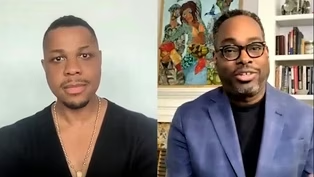
Davóne Tines on Detroit Opera Residency, Playing Malcolm X
Video has Closed Captions
Clip: S50 Ep18 | 7m 56s | Davóne Tines discusses his Detroit Opera Residency and portraying Malcolm X on stage. (7m 56s)
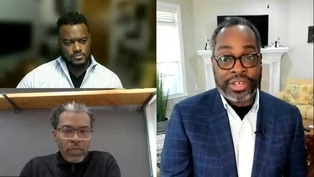
Patrick Lyoya, Police Reform Roundtable with NAACP and BLM
Video has Closed Captions
Clip: S50 Ep18 | 14m 59s | A roundtable discussion on the fatal shooting of Patrick Lyoya and police reform. (14m 59s)
Providing Support for PBS.org
Learn Moreabout PBS online sponsorship
- News and Public Affairs

Top journalists deliver compelling original analysis of the hour's headlines.

- News and Public Affairs

FRONTLINE is investigative journalism that questions, explains and changes our world.












Support for PBS provided by:
American Black Journal is a local public television program presented by Detroit PBS