
ARISE Detroit!, COTS 40th Anniversary, Aisha Ellis Trio
Season 50 Episode 28 | 26m 46sVideo has Closed Captions
ARISE Detroit! Neighborhoods Day, COTS 40th Anniversary and drummer Aisha Ellis performs.
"American Black Journal" gets a preview of Detroit's annual citywide community service event, " ARISE Detroit! Neighborhoods Day." Then, the Coalition on Temporary Shelter (COTS) celebrates 40 years of helping to curb homelessness and poverty. Plus, a performance by Detroit percussionist Aisha Ellis and her trio. Episode 5028
Problems playing video? | Closed Captioning Feedback
Problems playing video? | Closed Captioning Feedback
American Black Journal is a local public television program presented by Detroit PBS
ARISE Detroit!, COTS 40th Anniversary, Aisha Ellis Trio
Season 50 Episode 28 | 26m 46sVideo has Closed Captions
"American Black Journal" gets a preview of Detroit's annual citywide community service event, " ARISE Detroit! Neighborhoods Day." Then, the Coalition on Temporary Shelter (COTS) celebrates 40 years of helping to curb homelessness and poverty. Plus, a performance by Detroit percussionist Aisha Ellis and her trio. Episode 5028
Problems playing video? | Closed Captioning Feedback
How to Watch American Black Journal
American Black Journal is available to stream on pbs.org and the free PBS App, available on iPhone, Apple TV, Android TV, Android smartphones, Amazon Fire TV, Amazon Fire Tablet, Roku, Samsung Smart TV, and Vizio.
Providing Support for PBS.org
Learn Moreabout PBS online sponsorship- We have a really great show coming up for you on American Black Journal.
It's almost time for an annual city-wide tradition.
Arise Detroit's Neighborhoods Day.
We're gonna talk about what's planned for this year.
Plus the organization COTS has been helping the homeless for 40 years.
I'll talk with the CEO about its impact on our community, and we'll have a performance by the Aisha Ellis trio.
Stay where you are.
American Black Journal starts right now.
- [Narrator] From Delta faucets to BEHR paint.
Masco Corporation is proud to deliver products that enhance the way consumers all over the world experience and enjoy their living spaces.
Masco, serving Michigan communities since 1929.
Support also provided by, the Cynthia and Edsel Ford Fund for Journalism at Detroit Public TV.
- [Narrator] The DTE Foundation proudly supports 50 years of American Black Journal in covering African-American history, culture, and politics.
The DTE Foundation and American Black Journal partners in presenting African American perspectives about our communities and in our world.
- [Narrator] Also brought to you by, Nissan Foundation and Viewers Like You.
Thank you.
(upbeat music playing) - Welcome to American Black Journal.
I'm your host Stephen Henderson.
This is the 16th year for the city-wide community service event, known as Arise Detroit Neighborhoods Day.
Block clubs, churches, community groups, and volunteers are all gonna come together on Saturday, August 6th, for more than 100 events all around the city.
These include clean-up and improvement projects, art festivals, resource fairs, school supply giveaways, children's activities, concerts, and much, much more.
The nonprofit, Arise Detroit, promotes, markets, and supports the groups who host the days' events.
I spoke with the executive director, Luther Keith about the impact of Neighborhoods Day on the city and its people.
This is the 16th year of Neighborhoods Day.
I mean, when you started off with this 16 years ago, did you ever think that you would get to 16 years and the size, and scope, and scale of this event?
It's not an overstatement to say it involves the entire city and neighborhoods all over Detroit.
- It does.
And I don't think any of us knew our board members when we started this in 2007, what it would become, but we just felt there was a need to put spotlight on neighborhood groups.
And not just about one day, as I often have said, this is about what these groups do every day, all year long but you really don't pay attention to it because it just kinda goes with the territory.
But if you can get all of these groups doing one thing on this same day, or primarily on this day you've got something really grand.
and pre-pandemic, we would have over 200 events, even in the pandemic, we would have over 100 we're gonna have over 100 again this year.
And it's about putting the spotlight on all these churches, community groups, black clubs, myriad of programs, and initiatives go unsung unheralded throughout the year.
But on this day we see all of them are special.
Lift them up thankfully to the media of people like yourself, shine, a spotlight on these groups.
And with the deluge of seemed like incessant bad news that we are hit with.
(Stephen laughs) It is so refreshing to look around and find something that you can really feel good about people take pride in, they smile about.
So, to answer your question, we didn't know where it was gonna go, but the fact that it's 16 years and still going tells us that this is something that the people of Detroit really love and wanna be part of.
And I think it's actually kind of iconic.
No other city in America does anything quite like this in Detroit.
So I think along with Coney Island and Motown we should claim Neighborhoods Day as an iconic Neighborhoods Day (Stephen laughs) - Neighborhoods Day, that's right (laughs).
So, let's talk about the pandemic and how disruptive it was, not just to this day and the events on this day but disruptive to neighborhood groups.
I know from working in the neighborhood where I was born that neighborhood groups became a place of refuge for people, they had to become social service agencies, and the strain was a lot.
I mean, there are a lot of groups that really just did everything they could do to hang on.
How are we doing with those groups now and recovery from it all?
- I think most of them have come through it even in the depths of the pandemic pre-vaccination, 2020, we had a campaign called Stay Safe Creating Your Space where we had people have small events, 10 people or less, wear masks and social distance.
Since then we've had the vaccine.
Now, of course, we encourage everybody to be vaccinated.
And if not, to wear mask with social distance and have all your volunteers vaccinated and many people have taken to that.
As you know rise to Detroit, which is totally, non-political stepped out a bit last year to make the statement and issue an official call for all Detroit is to be vaccinated because we felt that strongly about it.
And many of them have taken that to heart.
And many of these community groups are moving forward.
This year we have an amazing array of events on our website at arisetdetroit.org, you can click our event list into study the amount of energy that people are applying, beautification projects, cleanup projects, but also (indistinct), and concerts, and festivals, and book fairs, and food supply giveaways, and school supply giveaways.
And one bit of exciting news, Stephen, you're the first news person I'm gonna tell this to.
(Stephen laughs) In the past we've had the Detroit public schools we've had like blue cross we should adopt, 12 or 14 schools a year with their employees.
But they have not been able to do this, in Detroit Schools have not been able to do this kind of beautification project, getting the school ready for the students for the new school year.
This year, we've been asked by the Detroit Public School District and Dr. Beattie to have volunteers come out to every one of Detroit Public Schools, all 106, they are seeking volunteers to come out and help get these schools together.
So we're calling on large companies, organizations, people, just plain neighborhood people to step up and volunteer at the schools.
We have other volunteer opportunities as well but this one is really... they've never done anything like this on this scale.
When you think about all 106 schools I think they're shooting for like at least 10 volunteers for a school, which would be something over 1000 volunteers spread out across the city.
- Wow.
- In Neighborhoods Day.
So if you're out there, you're listening, and you wanna do something for the students and the young people getting ready for school, you can call here at Arise Detroit (313) 921-1955.
You'll also be releasing information, how you can directly contact Detroit Public Schools to get engaged in this really great work on behalf of our students, and it's gonna be a great highlight of Neighborhoods Day on August 6th this year.
- Yeah, yeah.
That's really exciting, and again, coming out of the pandemic and the strain on schools, the strain on kids in school, that's the kind of support that we need them to start getting.
I wanna talk more specifically, about some of the things that people can go do on Neighborhoods Day how they get hooked up.
But I always say the best way to do it is to start in your own neighborhood, isn't that right?
- That's the whole idea, Neighborhoods Day is... look around you (Stephen laughs) and you'll see Neighborhoods Day.
And I'm gonna mention very briefly, of course, that you can register for Neighborhoods Day right now through July the 15th by going to our website arisedetroit.org.
There's a minor $50 registration fee for that.
You're gonna get banners, t-shirts, if you're doing a beautification project, you get $100 voucher to buy supplies courtesy of one of our sponsors.
But yeah, basically, it's anything you wanna be.
We have big events in Detroit that we all love.
The fireworks, the grand Prix, everybody goes downtown.
What's unique about Neighborhoods Day, we really have to educate people about 'cause people say Luther, "Where is Neighborhoods Day?
It's where you want to be.
"What time do we start?"
What time do you wanna start?
"What should we do?"
What do you wanna do?
So if this is your event, but so used to be people telling us what to do.
I can't tell you what's best for your neighborhood.
You live there, not me.
So, that's the beautiful tapestry or smorgasboard about Neighborhoods Day.
If all of these are independently produced groups, Arise Detroit does not tell anybody what to do or where to do it, how to do it.
As long as it's a positive activity, you do it.
So we have small events, little block clubs.
And we have community organizations, we have churches, we have fraternities, and sororities all doing their own little thing.
We're gonna be having book fairs by some of the literacy organizations.
So again, just what you wanna do.
What do you think you would like to do?
Some people just wanna have an old fashioned meet and greet just have a block party, just come out your house cook some food, have people talk and people talk.
And what happens is that sometimes people have foreign block clubs because of neighbors.
They say we don't have a block club.
So my thing is that cook some food, invite people over, talk about it, and then you start coming together.
That's well in.
So that's what Neighborhoods Day is about.
It's really very simple, it's not complex.
Often stay in your lane, don't reinvent the wheel.
Sometimes you can partner up with a community organization or a like person and do the same thing.
And what happens is that you build relationships that carry forward throughout the year, a lot of people come together, they meet their neighbors, they talk about things and they build on that.
So that's really what is about community.
People always ask me "Well, what makes a good neighborhood?"
A good neighborhood, nine times out of ten is an organized neighborhood.
There's somebody who is at the wheel, it's like raising a child.
You're a father yourself.
kids don't raise themselves by themselves.
If you don't raise them, they're gonna go, just like neighbors will do if you don't take care of 'em, somebody's not at the wheel.
And what we see in Detroit is that so many many organizations I am so inspired.
I get in my car on neighbors down literally drive all over the city.
And every single Neighbors Day event is on our website.
So you can go on it right now to arisedetroit.
or click the event list, you'll see east side events west side events, downtown events.
You can go with contact information.
You can call the person in charge and say, "I wanna come out and volunteer," or "I wanna come out and just help."
You can do that, there's not a lot of layers and bureaucracy involved in this.
That's what makes it, I think a uniquely people-based thing.
It's not somebody that somebody on high declared this is what this is gonna be.
This is truly people-led, a people-inspired event.
And the fact that 16 years later, we're still out here doing this.
And I started getting calls, "Are you gonna."
And in the midst of the pandemic, are we still gonna have Neighborhoods Day?
Are we still gonna have Neighborhoods Day?
(Stephen laughs) And by now we have people who have 10 or 12 banners every year, they're there and they proudly display their banners.
Some people never take their banners down there all year.
(Stephen laughs) So, it is a wonderfully inspiring event but it's not just a picnic, this year, I called the day of pride and pride in neighborhood pride, neighborhood power because these people are working.
Neighborhoods Day literally, and I'm not overstating this, Neighborhoods Day literally changes Detroit.
Because trash is removed.
Houses are painted.
Kids get books, people are fed, things get done.
So the city is not the same city after Neighborhoods Day.
It's a better city.
And so if we can be gonna build on it throughout year end, even though volunteers was very very important to Neighborhoods Day, Arise Detroit really is bigger than volunteerism.
I think I've used this on your show before Steve, because I say, do you volunteer to take care of your kid?
- Right, right.
(Luther giggles) - And you don't do it because it's your responsibility as a parent.
We live in Detroit, so we wanna make people understand that it's our responsibility every day to do something.
And to keep that in mind as I see it before I quote C.T.
Vivian, the contemporary and Dr. King, you see, during the Montgomery Boycott, and the Civil Rights Movement.
There's a question that was always asked, what are you doing for the movement?
Well, I'm cooking, I'm driving people to work, but you're doing something for the movement.
What are you doing for Detroit?
Now, you don't have to run a big organization.
I'm making sure my kid graduates from high school.
Okay?
- Mm-hmm.
- Do that.
So, it doesn't have to be a big grand thing but what makes it is all these connections.
And so you know that you're in Southwest Detroit somebody on the east side is working like you, somebody north end is working like you.
And you're all connected as resident of one organization told me, she said "Everybody feels big on Neighborhoods Day."
- Yeah.
- "Everybody feels big on Neighborhoods Day."
- Yeah.
- And so that's the thing I think that connects Arise Detroit, so many people have come to Arise Detroit because we're just about one thing.
How are we gonna have a better community?
That's all we care about.
We don't care about your politics, where you go to church, how much money you make, how good looking you are, all that is.
You want a better Detroit, I wanna better Detroit let's work together to make it happen.
- How do we get there.
- And that's what Neighborhoods Day is about.
- Yeah.
All right, Luther Keith, always great to talk to you and congratulations on the 16th year of Neighborhoods Day.
- Thank you, Steve.
Appreciate it.
- So this is a milestone year for the coalition on temporary shelter, better known as CoTS.
The Detroit nonprofit is celebrating 40 years of helping people who struggle with homelessness.
In addition to providing temporary solutions, the agency's focus has evolved to include long term strategies to help families overcome generational poverty.
Here's my conversation with COTS CEO, Cheryl Johnson.
So, congratulations on 40 years of COTS.
I think on the one hand, it's a remarkable milestone and something to be really proud of.
But on the other hand, it also suggests that we still have this profound need in our community and that we have not yet found a way to solve it permanently for enough people.
- Yeah, it is.
And thank you for the congratulations.
I love to say that out of those 40 years I've been with the organization for 32-- - Wow.
- Of them.
- So to be able to see a full generation and we can talk a little bit about how that has evolved, and what we see in the future.
But, yeah, the issue... And we don't talk about it in terms of homelessness anymore.
We talk about it in terms of generational poverty.
Because really at the root of all of that, we have to tackle that piece of it in order to address homelessness.
- Yeah, yeah.
So let's go back to 40 years ago and compare what the problem looked like then to what it looks like now, and what the organization was doing then versus what it's doing now.
- Yeah, so back in '82, it's basically a group of clergy, and community folks that came together to say, "Hey, there's an issue basically at that time "with single folk on the street."
How do we address that?
And in the basement of old St Peter's Episcopal Church right across from old Tiger Stadium, COTS started & it's Coalition on Temporary Shelter that was the legal name of it with really getting these single folk off the street.
Over time, we began to see something very different, and that is whole families, like parent and children now who are experiencing homelessness, many sleeping in their cars, in other places where they should not be sleeping.
And then today you see now totally different a view of what that looks like even across our country.
- Yeah.
The idea though, of trying to address it from a systemic context, I think is a really important point to go back to because I think people don't understand all the time that people can move in and out of this issue.
And that, that is what you see over time.
Multi-generational struggle with home insecurity, with the inability to keep your family in one place.
- And that's exactly what it is and what resulted in us transitioning about eight years ago from serving what we say homeless folk to really laser focusing on families, was the fact that we began to hear what I call a narrative from folk.
And these are people who are now adult people in our emergency shelter with their children who would say something like this, Stephen.
they would say, "I remember being here when I was six.
"I was here when I was seven."
And now a full generation later they're here with their children.
So that was one issue.
The other issue was we saw more than two generations.
I remember seeing four; great grandparent, grandparent, parent, and child altogether.
So that speaks to this ongoing cycle of not being able to address poverty.
So that's when we decided to really kinda stop things and began to look at generational poverty and create a very different theory of change about how to move people into communities where they are now thriving.
And not caught up in this vicious cycle.
And so we really focus on these five areas of family stability, education, career goals, employment and career goals, health, and wellbeing, and economic mobility.
Goals that they set, they are assets.
They are able with the help of coaching to really move through this and have great generational impact.
- Yeah.
I wanna talk just a little about the pandemic and how much it set families back on this issue here in Detroit.
I know that if you go to any neighborhood you can see the impact that it had on families and again, on their housing security.
- Yeah, so, I am saying this and I believe it to be a truth that we haven't seen the real impact of that yet, because right now courts are still behind.
There was as you know, the moratorium on, and folk were able to kinda stay put but across our country and Detroit is gonna be hit really hard.
You got prices of housing rents, just going the roof.
People cannot support that.
And a bit that we don't talk about is the impact on our children.
Our kids are not going to catch up folk, and (giggles) that's a real thing.
And so how do we mitigate that?
And for kids that have already experienced homelessness we're already behind, there is this now increased gap of how do we address that and mitigate it.
We can't fix it.
We've gotta mitigate the impact of it.
- Yeah.
And that was gonna be my next question, was this impact on children and how you address that separately?
I mean, the goals that you're talking about are adult goals for head of households and people who are in charge but this visits, so hard on our kids, and how do you get them to not repeat the cycle, right?
- Yeah, so our work really is two generational.
I mentioned those goals specifically around parents.
However, our children, we have a youth coach who works particularly with our kids on things that matter to them.
And so, everything from their executive functioning, how they think, how they see themselves in the worlds, the goals and aspirations.
And believe it or not, kids are dreaming, and they are thinking, like they actually want things.
And so when you pair working with parents and the child together, and I shouldn't always say parents it's the adult person, because our families now consist of grandparents, aunts, sisters, whoever, right?
And so we work with all families as long as it's adult person, accompanied by our children but our kids specifically have goals that they are creating for themselves.
And working with a coach, that's important and their overall health and wellbeing is at the center of all of that.
- We're gonna leave you now with the sounds of drummer Aisha Ellis and her trio from their appearance on Detroit Performs Live from Marygrove.
You can find out more about today's guests at www.americanblackjournal.org and you can always connect with us on Facebook and on Twitter.
Take care, and we'll see you next time.
(instrumental band music) - [Narrator] From Delta Faucets to Behr Paint, Masco Corporation is proud to deliver products that enhance the way consumers all over the world experience and enjoy their living spaces.
Masco, serving Michigan communities since 1929.
Support also provided by the Cynthia & Edsel Ford Fund for Journalism at Detroit Public TV.
- [Narrator] The DTE Foundation proudly supports 50 years of American Black Journal in covering African American history, culture and politics.
The DTE Foundation and American Black Journal partners in presenting African American perspectives about our communities, and in our world.
- [Narrator] Also brought to you by Nissan Foundation and Viewers Like You.
Thank you.
(high-pitched beat music)
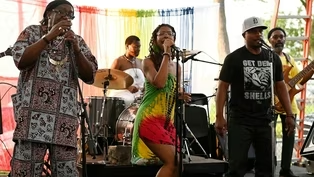
Arise Detroit! Neighborhoods Day Returns August 6
Video has Closed Captions
Clip: S50 Ep28 | 11m 54s | ARISE Detroit! Neighborhoods Day, Detroit’s annual community service event, returns. (11m 54s)
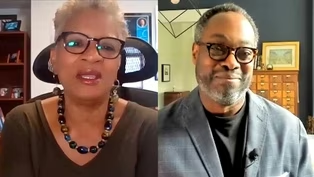
COTS Celebrates 40th Anniversary Fighting Homelessness
Video has Closed Captions
Clip: S50 Ep28 | 7m 39s | The Coalition on Temporary Shelter nonprofit celebrates 40 years of fighting homelessness. (7m 39s)
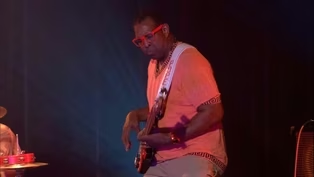
Detroit Drummer, Percussionist Aisha Ellis Performs
Video has Closed Captions
Clip: S50 Ep28 | 3m 20s | Drummer and percussionist Aisha Ellis performs with her trio. (3m 20s)
Providing Support for PBS.org
Learn Moreabout PBS online sponsorship
- News and Public Affairs

Top journalists deliver compelling original analysis of the hour's headlines.

- News and Public Affairs

FRONTLINE is investigative journalism that questions, explains and changes our world.












Support for PBS provided by:
American Black Journal is a local public television program presented by Detroit PBS