
Black Midwest Symposium, Detroit Expat Artists, Gun Violence
Season 50 Episode 41 | 26m 46sVideo has Closed Captions
Black Midwest Symposium comes to Detroit, Detroit Artists Market, State of the Hood summit
“American Black Journal” host Stephen Henderson learns more about the 2nd biennial Black Midwest Symposium coming to Detroit Oct. 20-22, 2022. The Detroit Artists Market celebrates its 90th anniversary with a new, multigenerational exhibit. Plus, the State of the Hood summit on Detroit’s east side brings civic leaders and community activists together to explore solutions for stopping gun violence.
Problems playing video? | Closed Captioning Feedback
Problems playing video? | Closed Captioning Feedback
American Black Journal is a local public television program presented by Detroit PBS
Black Midwest Symposium, Detroit Expat Artists, Gun Violence
Season 50 Episode 41 | 26m 46sVideo has Closed Captions
“American Black Journal” host Stephen Henderson learns more about the 2nd biennial Black Midwest Symposium coming to Detroit Oct. 20-22, 2022. The Detroit Artists Market celebrates its 90th anniversary with a new, multigenerational exhibit. Plus, the State of the Hood summit on Detroit’s east side brings civic leaders and community activists together to explore solutions for stopping gun violence.
Problems playing video? | Closed Captioning Feedback
How to Watch American Black Journal
American Black Journal is available to stream on pbs.org and the free PBS App, available on iPhone, Apple TV, Android TV, Android smartphones, Amazon Fire TV, Amazon Fire Tablet, Roku, Samsung Smart TV, and Vizio.
Providing Support for PBS.org
Learn Moreabout PBS online sponsorshipon American Black Journal.
The Black Midwest Symposium is gonna land in Detroit for a conversation about making the Midwest a center for social justice and change.
Plus the State of the Hood Summit explore solutions for stopping gun violence.
And we'll tell you about a special exhibition that honors the works of Detroit artists.
Don't go away, American Black Journal starts right now.
- [Narrator 1] From Delta faucets, to Behr paint.
Masco Corporation is proud to deliver products that enhance the way consumers all over the world experience and enjoy their living spaces.
Masco, serving Michigan communities since 1929.
Support also provided by, the Cynthia & Edsel Ford Fund for Journalism at Detroit Public TV.
- [Narrator 2] The DTE Foundation proudly supports 50 years of American Black Journal in covering African American history, culture, and politics.
The DTE Foundation and American Black Journal partners in presenting African American perspectives about our communities and in our world.
- [Narrator 1] Also brought to you by Nissan Foundation, and viewers like you.
Thank you.
(upbeat music) - Welcome to American Black Journal.
I'm your host, Stephen Henderson.
The Black Midwest Symposium is coming to Detroit later this month.
It's gonna bring together African American scholars, artists, writers, and community organizers for a candid discussion about the struggles of blacks in the Midwest, and the possibilities for change.
The event is hosted by the Black Midwest Initiative, which advocates for the lives of African Americans in the Midwest and in Rust Belt regions.
I got the details on the symposium from planning committee member Marquis Taylor.
- Tell me about the Black Midwest Symposium.
I'm not sure lots of people even know about this wonderful gathering of black intellectuals, let's call it.
- Yeah, for sure.
So, to kind of give you a backstory.
The symposium was started, or rather is created by the Black Midwest Initiative, which is a group of scholars, activists, students, you name it.
We came together in 2017 when we were founded, and in 2019 we had our inaugural convening in Minneapolis, Minnesota, which I had the pleasure of living at for many years.
And then we decided to do something bi-annually.
So initially we wanted to do it in 2021, but everything that happened, so we moved it to 2022.
So here we are in Detroit, my hometown, I'm excited to be here to have it.
And what it is is a collection of, again, scholars, activists, speakers, poets, writers.
And we're going to be convening October 20th through the 22nd over at Wayne County Community College or as I know, it's WC3.
And we'll be there and we'll be able to connect with many different individuals, whether they be from Minneapolis, Detroit, Chicago St. Louis, but also amplifying other cities that people may not know about.
So, the founder and the director of the program, Dr. Terrion Williamson, who was out of the University of Illinois Chicago, she is from Peoria, Illinois, to my understanding.
So being able to amplify those places, Iowa, and for us to just kind of come together and just amplify our voices and just come together as a unit.
So, we're excited to have this in Detroit.
- Yeah, so there is something about life in the Midwest and especially life in Rust Belt cities that has a different effect on African Americans and a different history, really, with African Americans than other parts of the country.
Talk about what those- what those differences are and why it's important to be able to talk and think about those things consciously right now.
- Yeah, I think the Midwest, with respect to the West coast, East coast and even down south, we are oftentimes overlooked.
And I know in many cases, and I'll use myself as an example, I'm born and raised in Detroit, lived in the Twin Cities for a number of years, but my family migrated from Georgia.
And centering our voices in contrast to the west and east coast, and again, the deep south, is that we were built on industry.
Thinking about the trade, the automotive industry, thinking about Pittsburgh and some of the other places, Cleveland, same thing, they were built on steel and, you know, the industrial portion.
But it's important to center our voices because in going to the things that happened in 2020 with the murder of George Floyd, we were there live and in living color, and there were so many uprisings and protests and we wanted to center what happened, but also looking at it from the perspective of how do we navigate all that had happened, but also navigating the historical development of the Midwest, again, paying homage to Detroit, Minneapolis, Chicago, St. Louis, and then some of the other cities as well.
But it just is so important that we focus on who we are, and just the things that we've been able to accomplish historically, and yeah.
- Yeah.
So, one of the panels that I'm really interested in that you're holding is called the "Commitment to Place: Cultivating and Reclaiming Black Land in Michigan".
That's a fascinating title, that's a fascinating subject It's something that I feel like we're just now really starting to see people acknowledge and want to know more about.
But, but tell me about- tell me about that panel.
- Yeah, so that reclaiming space, to my understanding, is going to feature a variety of individuals and thinking about what does it mean to reclaim that space.
And, I know historically, we, being on indigenous land and is also just thinking about who we are and, you know, what we've been able to accomplish in the Midwest, so that panel in particular and so many panels, that one escapes me off the top of my head, but to my understanding, that's more or less thinking about just reclaiming the space and, you know focusing our energies, you know, being here in the Midwest.
- Yeah, yeah.
Talk about the things that you would like people who attend this to be able to take away, and talk about it both in terms of African American people, but also in terms of non-African American people who might decide, "hey, I wanna show up for this too".
- I will say the biggest takeaway that we would want people to get from this, or why we would want people to attend is, number one, thinking about the synergy that exists in the Midwest.
Again, thinking about those, the cities that I highlighted Detroit, Minneapolis, Chicago, but then also just the works that we have been able to do.
So, I'm a big music fan, big fan of music.
And one of the panels that I'm most excited about, I think, is the "Black Midwestern Futures", where they're going to be talking about the Minneapolis sound talking about Motown, talking about some of the other musical movements that have, you know, taken place in the Midwest.
So just in terms of the speakers that we have, Aaron Foley is one of the opening speakers, who is a Michigan State graduate, Renaissance graduate, who's a writer-author, and there are other writers and panelists as well from the Midwest, Jeff and Tama Wray, who were renowned faculty at Michigan State University.
But I would say, just in terms of people wanting to learn about the diaspora, the black diaspora, or African diaspora that exists across the Midwest, how we've been able to leverage and do great things, and being able to, you know, learn about the poets, the activists, the arts, and most importantly, how we were able to navigate the pandemic of 2020.
But also just the protest and the uprisings, it's for us to kind of come together.
So I would say those who are black-identified and those who are not black-identified I think you'll find something for- in it for everyone.
- Yeah, yeah.
That black diaspora dimension of this is the subject of a panel as well.
And that really concentrates on the idea that there are lots of us in these places who came from other places in America, mostly the American South, but that this continues to be a place of immigration for people from Africa.
Talk about the importance of that mix, and acknowledging that there is this diversity among blackness in the Midwest.
- That is a great question, Stephen.
And I think with respect to where both myself and Terrion- or Dr. Williamson, where we connected in Minneapolis, Minnesota, there's a high concentration of East African immigrants.
And for me personally, growing up in Detroit, I didn't see that, per se.
I mean, you see it in pockets, but I think I was able to see it more so living in the Twin Cities.
And it's important for us to recognize their contributions as well, and us to kind of come together in unity in the sense of understanding, you know, how they were able to come to this country, versus, you know, us- those of us who are American-born descendants of slavery, and recognizing that we're part of, you know, in many cases the same fight and the same struggle.
But, you know, in respect to Minneapolis, I think Columbus, Ohio also has a high concentration of East African immigrants, and there are other parts of the Midwest that escape me right now.
But I really just think that we just, you know, need to come together to unify and again, having this lived experience, living in the Twin Cities, knowing what that was like, and, you know, Dr. Williamson as well, as well as a few other panelists and people in the committee, just to recognize our collective contributions because we are more alike than we are different.
- Yeah, yeah.
Okay.
Marquis Taylor, really great to have you here on American Black Journal, and congratulations on the second Bi-annual Black Midwest Symposium.
Thanks for being with us.
- Thank you.
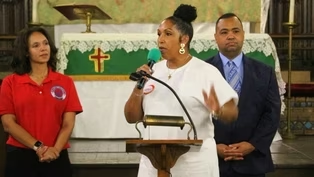
- Ministers, community activists, and concerned citizens came together for the State of the Hood Summit and rally hosted by the Church of the Messiah on Detroit's east side.
The event addresses issues that directly impact inner city neighborhoods.
This year's focus was on gun violence.
American Black journal producer Marcus Green was there.
- The state of the hood is that we would change the state of the hood, that we would use our gifts and talents and resources, and come together in a mindset of agreement about the missions that are happening in our community.
- We asking everybody to roll up their sleeves, put on white, but represent peace.
We wanna hear it's peace, peace in the homes.
We wanna hear peace on the streets as well as the suites.
This is a peace movement that is going to not end, (clapping) because we gonna keep on keeping on.
- We believe that, as we continue to promote peace and wear peace and talk about peace, that peace will become as great as a reality, if not greater than violence.
- We have a lot more work to be done, and I wanna stand here today to encourage all of you all to think outside of the box and to be proactive in your efforts to end gun violence.
So let us come together today and spend the majority of our time and money on prevention, not punishment.
(clapping) - There are churches and religious organizations that's in the hood making things happen, but a lot of times, it does not make the news.
And what we want to be able to do is let everybody know we're gathering together to let everybody know that the hood is working together.
The other thing we want folks to know is that the community groups and the religious organizations are working together, and we're working with our political leaders.
- We have to fight this battle in multiple directions.
We have to be horizontal, where we can reach those who need us most, but we also have to be vertical, that we can call in the God who we need the most.
And some have said it's absurd for politicians, and preachers, and laborers, and teachers to come together, but God has called us to come together right now because this chill of murder is too cold.
So we're coming together to bring light and to bring white, and to bring salt, and to bring peace and to bring a presence that is not familiar to this generation.
- So when you think about life's most vulnerable populations there are young people and our seniors.
And the rest of us in the middle we've gotta make sure that we're suited, rooted, and booted, for the work.
(clapping) It is indeed time out.
It's troubling that young people don't know what peace looks like.
- [Crowd] That's right.
- [Angelique] That's our fault.
- [Crowd] That's right.
- That's our fault.
Because what they do know is that when they hear gunshots, they hit the ground.
They do know that.
They do know that they are becoming desensitized because it's one too many stories being told.
- All throughout the country, we talk about what's divided, what's divided, what's divided, and a lot of stuff in our community and neighborhood is not divided.
And people are working together.
For us to come together today to say that we're going to do the city in white.
To say that we are bringing together different denominations, different faiths, all coming together for the same purpose.
Coming together with our community leaders and coming together with our religious leaders is amazing.
And one of the most amazing things that, I think, that's about to take place is we are gonna be able to work directly in the school system.
(clapping) - We're gonna work directly in the school system to be able to work with the children who are the most vulnerable.
- So what would I love to see in the school?
One, I want them to know what peace looks like.
It's really hard to have achievable results on something when you don't know what those results are.
So I want them to know what peace looks like, and then know that they can have peace.
It is absolutely possible.
Whatever those challenges are, we need to identify those challenges, and address those head on so that the young people can- when they come to school, they can learn.
And that learning looks, you know, really different.
It's no longer just reading, writing, and arithmetic, but maybe it's about the wraparound services that are needed, maybe it's the social emotional learning that needs to happen.
We do a really good job of that, but we could always do better, because until we can have, not just a day of peace, but a week of peace, a month of peace, and we keep moving that needle further and further, people can see that it is possible, it is achievable, but it requires a commitment and due diligence from everybody involved in the ecosystem.
- I have been intently focused on doing my part to end gun violence in our community.
Now with that being said, I have taken a more proactive approach than the typical reactive approach that we typically see with government in the criminal justice system.
There are countless studies that suggest that we cannot police our way out of violent crime.
So, my approach has always been about meeting people where they are, attacking the root cause of violence, and using my voice and my position to further the cause of peace.
There is an old saying that says, "I don't care how much you know until I know how much you care".
- [Angelique] So the time is now.
If not us, then who?
- [Crowd] Right?
- [Angelique] Enough is enough.
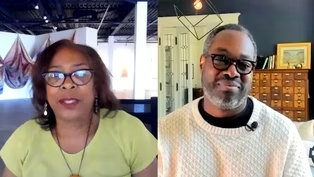
(clapping) - And finally today, the Detroit Artists Market is celebrating its 90th anniversary with an exhibition of works by a multi-generational group of artists who develop their careers right here in Detroit.
The exhibit is called "Detroit Expat Artists: Homecoming", and it features a variety of media and genres.
I spoke with one of the curators, Stephanie James.
So first of all, 90 years of the Detroit Artists market.
It is one of my favorite places in town.
Not just to buy art, but to just go see local artists.
Talk about the significance first of that anniversary.
- Yeah, you know the Detroit Artists Market is a wonderful jewel in Detroit.
Most people don't realize that it is as old as it is.
It founded in 1932 when things were falling apart in Detroit and the rest of the country.
And yet, there was this handful of art supporters and advocates and patrons that wanted to keep arts alive in the Detroit community and have done so all these- and we've done so all these years.
- Yeah.
- And that's part of, I'm sorry, I was just gonna say that was just also part of the the inspiration for putting together this show.
- Yeah, no, I was gonna say this show celebrates artists who are from here and have gone on to, in some cases fame and fortune, but certainly productive artists' lives elsewhere.
Talk about "Detroit Expat Artists: Homecoming".
- Yeah, so the show, the exhibit features visual artists whose artistic talents were honed here in the Motor City and have created extraordinary opportunities for them to live and work in other parts of the country.
My cohort, Elizabeth Youngblood and I were drawing on our history of involvement in the Detroit arts community along with recommendations from some of our committee members, and we selected artists from multi generations working in a variety of media and styles, and whose art practices span more than 50 years.
- Yeah.
Talk about some of the artists who are included.
There are some names here that people will recognize.
- Yeah, yeah.
Some of the- the wonderful aspect of it being multi-generational, we have a number of seasoned, mature artists such as Artis Lane, who I don't think would mind sharing this, she's in her mid-90s now.
Artis Lane, McArthur Binion, Brenda Goodman, the work of the late Al Loving.
And then we have a number of mid-career artists, such as Yolanda Sharpe and Michael Kelly Williams.
Eric Smith, Melvin Clark.
Oh, who am I leaving out?
There's emerging artists like Matthew Bandsuch and Joshua Newth and Christopher Batten.
This is the danger in naming names.
(laughing) - [Stephanie] I lost count, there's 13 artists.
- [Stephen] Yeah, yeah.
And talk about how you sort of choose them and feature them here.
What is it about these artists that we're celebrating?
- We're interested in showing the diversity of styles and genres that Detroit artists have taken on and have further developed in their different areas.
Artists like Nick Sousanis, who works in a- not the typical genre when we think about in the fine arts, in comic and graphic novels, but has created quite a name for himself in those areas.
And of course has a long history in Detroit as a leader in the arts community.
And, you know, folks like McArthur Binion, who has been known to many Detroiters and art enthusiasts for decades, but really got on the map in 2017 when he was featured in the Venice Biennale, and received a wonderful critical reception there.
- Yeah.
- And so his work is very much in demand.
- Yeah.
Yeah.
Talk about the importance of opportunity, and- Yeah, well, opportunity really for young artists now in Detroit, I mean, this is celebrating folks who were here and have gone on to other things.
I feel like the Artists Market is still a place where- where aspiring artists and new artists can really find their footing and find an audience.
- Right, Stephen.
That's exactly right, And what the Artists Market has sought to do all these years as part of our mission, not only to cultivate artists and give opportunities to artists, but also to cultivate a collecting community and a supportive community for these artists.
Yeah, several of the artists in this show had a history of showing at the Detroit Artists Market in the years when they were in Detroit.
And then for some, this is their first time being shown at the Artists Market.
You know, there's been a lot of attention placed on Detroit's arts community in recent years and sometimes the media has- media has suggested that it's- it may have- it's happening as a result of the influx of transplants and folks moving to Detroit, from artists moving to Detroit from other parts of the country because the accessible spaces and all, and other parts of the world, even, relocating here.
But the reality is Detroit has always had a thriving and vibrant arts community.
And we've always had institutions that have nurtured these artists and supported these artists.
I mean the Detroit Institute of Arts, Cranbrook Academy of Art, your Heritage House, the National Conference of Artists, Michigan Chapter, Detroit Society of Arts and Crafts, which eventually became Center for Creative Studies and then College for Creative Studies.
Those were the training grounds for a lot of these artists and they still acknowledge that today.
- Yeah.
Yeah.
Okay.
Stephanie James, congratulations on the exhibit and of course, congratulations to the Detroit Artists Market on 90 years here in Detroit.
Thanks for being with us on American Black Journal.
- Thank you for having us.
- That's our show for this week.
You can find out more about our guests at americanblackjournal.org.
And as always, you can connect with us on Facebook and on Twitter.
Take care and we'll see you next time.
(upbeat music) - [Narrator 1] From Delta faucets, to Behr paint.
Masco Corporation is proud to deliver products that enhance the way consumers all over the world experience and enjoy their living spaces.
Masco, serving Michigan communities since 1929.
Support also provided by, the Cynthia & Edsel Ford Fund for Journalism at Detroit Public TV.
- [Narrator 2] The DTE Foundation proudly supports 50 years of American Black Journal in covering African American history, culture, and politics.
The DTE Foundation and American Black Journal partners in presenting African American perspectives about our communities and in our world.
- [Narrator 1] Also brought to you by Nissan Foundation, and viewers like you.
Thank you.
(piano sting)

Video has Closed Captions
Clip: S50 Ep41 | 9m 15s | Black Midwest Symposium | Episode 5041/Segment 1 (9m 15s)
Detroit Expat Artists: Homecoming
Video has Closed Captions
Clip: S50 Ep41 | 7m 31s | Detroit Expat Artists: Homecoming | Episode 5041/Segment 3 (7m 31s)
Video has Closed Captions
Clip: S50 Ep41 | 5m 30s | State of the Hood | Episode 5041/Segment 2 (5m 30s)
Providing Support for PBS.org
Learn Moreabout PBS online sponsorship
- News and Public Affairs

Top journalists deliver compelling original analysis of the hour's headlines.

- News and Public Affairs

FRONTLINE is investigative journalism that questions, explains and changes our world.












Support for PBS provided by:
American Black Journal is a local public television program presented by Detroit PBS