
2023 economic outlook, Alvin Ailey American Dance Theater
Season 51 Episode 10 | 25mVideo has Closed Captions
WE’RE ALMOST THREE MONTHS INTO THE NEW YEAR, AND THERE ARE STILL A LOT OF QUESTIONS ABOUT
Host Stephen Henderson examines the economic outlook for 2023 and its impact on African American entrepreneurs and consumers with Mark S. Lee, president of The LEE Group. They talk about inflation, small businesses, credit card debt and home buying habits. Plus, the Alvin Ailey American Dance Theater is making a tour stop in Detroit. Henderson talks with Artistic Director Robert Battle.
Problems playing video? | Closed Captioning Feedback
Problems playing video? | Closed Captioning Feedback
American Black Journal is a local public television program presented by Detroit PBS
2023 economic outlook, Alvin Ailey American Dance Theater
Season 51 Episode 10 | 25mVideo has Closed Captions
Host Stephen Henderson examines the economic outlook for 2023 and its impact on African American entrepreneurs and consumers with Mark S. Lee, president of The LEE Group. They talk about inflation, small businesses, credit card debt and home buying habits. Plus, the Alvin Ailey American Dance Theater is making a tour stop in Detroit. Henderson talks with Artistic Director Robert Battle.
Problems playing video? | Closed Captioning Feedback
How to Watch American Black Journal
American Black Journal is available to stream on pbs.org and the free PBS App, available on iPhone, Apple TV, Android TV, Android smartphones, Amazon Fire TV, Amazon Fire Tablet, Roku, Samsung Smart TV, and Vizio.
Providing Support for PBS.org
Learn Moreabout PBS online sponsorship- Coming up, we've got a great show for you on American Black Journal.
We're gonna talk about business and economic trends to watch for in 2023 and how it could impact African American entrepreneurs and consumers.
Plus, the world famous Alvin Ailey American Dance Theater is making a stop right here in Detroit.
We're gonna hear from the company's artistic director, so don't go away.
American Black Journal starts right now.
- [Narrator 1] From Delta Faucets to Behr paint.
Masco Corporation is proud to deliver products that enhance the way consumers all over the world experience and enjoy their living spaces.
Masco, serving Michigan communities since 1929.
Support also provided by the Cynthia & Edsel Ford Fund for Journalism at Detroit Public TV.
- [Narrator 2] The DTE Foundation proudly supports 50 years of American Black Journal in covering African American history, culture, and politics.
The DTE Foundation and American Black Journal partners in presenting African American perspectives about our communities and in our world.
- [Narrator 1] Also brought to you by Nissan Foundation.
And viewers like you.
Thank you.
(percussive jazz music) - Welcome to American Black Journal.
I'm Stephen Henderson.
We are almost three months into the new year and there are still a lot of questions about the economic outlook for 2023 as the pandemic eases.
Will this be a year of recovery for small business owners?
Or will inflation and unreliable supply chain and fears of a recession lower hopes for a financial rebound?
I sat down with marketing consultant Mark Lee of the Lee Group to talk about what African-American entrepreneurs and consumers can expect in 2023.
This is a weird year I feel like from an economic standpoint.
There are indicators all over the place, right?
We've got record unemployment on one end but also still record inflation even though it's not still going up on the other end.
It makes it hard, I think, to decide, well what are the smart plays for the year and what's the economy likely to do?
Just start off giving me a thumbnail of what you think we're dealing with and anticipating in 2023.
- Well, I think you hit the nail on the head and we're seeing inflation is still high.
It is slowing down.
It's been kind of bumpy the last couple of months.
I think it'll be safe to assume that inflation is still gonna be relatively high in 2023.
In terms of other economic data, we suggest we see that credit card balances soon remain fairly high.
Housing prices are beginning to subside as a result because the interest rates have continued to increase.
I mean, you can finance a home at 6%, and just a couple of months ago was about two and a half, three percent.
- Yeah.
- So the inflation is driving up those prices as well.
The economists are trying to cool it down.
So I think the challenge this year is going to be how do we continue to control the economic value that we're seeing across the country, and how can people continue to control their expenses as well?
- So what are we looking at in terms of people who own businesses and are making plans for the year and maybe making decisions?
What kinds of things should they have in mind for this year?
- Well, let me start by saying particularly for black businesses, let me just say that earnings are down significantly relative to the population at large when it comes to white businesses year over year.
So the third challenge is that businesses are going to look, particularly black businesses but it's also equates to all businesses.
Go back and review your bottom line.
Go back and review your expenses.
Make sure that you have a plan.
You're not taught about this before.
Make sure you have a backup plan in place.
Do you understand where your sources of revenue are coming from?
Are you beginning to or enhancing enabling technology to deliver your services?
So you really need to go back in and retrench if you will and look at your current business plan.
Look at the technology capabilities that you may or may not have and apply those directly into your business as you think forward.
- Yeah, so the cost of borrowing money, that's of course related to inflation and then the interest rate hike has special implications for business owners.
What are you counseling, especially as you point out given the reduction in sales and in revenue that black businesses in particular are facing.
Is this a time to even think about borrowing?
- I always say we've heard this phrase haven't you before, Stephen?
Cash is king.
- Cash is king.
(laughs) - Cash is king.
That's honest about it.
If you have cash in the bank, again I'm not a financial planner, I would encourage you to talk to a financial planner or a financial advisor, but cash is always king.
If you're going to use credit, I would recommend you'd be very judicious with it.
Because what's gonna happen is that your monthly payments are going to continue to increase.
Let's take the housing for example.
The cost to borrow money again has gone off from two and a half, 3% to over 6%, and you run the math on $100,000, $200,000 home.
At that rate, that's a significant increase for families.
So from a business perspective, if you're looking to chart for services render and you gotta pay back that credit card via the mindset you're gonna pay more than a monthly basis.
So I always encourage people, if you have the cash, if you have the resources available, try to use those resources appropriately and try to minimize the credit, the debt creation, if at all possible.
- Yeah.
So you mentioned sales being down and as a a result, of course revenue goes down as well.
Talk about what's driving that and why it's so acute in black communities, among black businesses right now.
- That's a great question.
I just had a conversation about two or three weeks ago of a successful black business that launched five or six years ago.
They abruptly shut down within the last month.
- Oh no.
- And I asked a question, I said why?
What happened?
And this individual was very candid with the downtown area.
They said, quite frankly, people just stopped coming to us because of the pandemic.
This individual tried to modify and use technology, deliver those services.
People at that point had made a decision to go elsewhere.
So one of the challenges that we're seeing is it's important that people support small businesses.
This is not the time to turn your back on small businesses.
And this individual is very direct with me and said the customers that they had quite frankly disappeared.
And from a black business perspective she said that they went from her business to other businesses across the city and into the suburban areas.
And quite frankly they went to white businesses.
- Wow.
- So the bottom line is it's important that we continue to allocate and spread your resources appropriately and also choose to support those small black businesses that account for a significant part of Detroit's economy, as well as the national economy as well.
- Yeah.
I always like to think of individual economic questions and issues in the frame of home ownership first because that is of course still the best way to build wealth and things like that.
Talk about this housing market.
There's really strange dynamics there too.
Low inventory, but high prices, in terms of sales in some cases.
But then you've got these crazy interest rates too.
- Yeah.
- That's made buying a house more expensive than it used to be.
Should African Americans in particular even be participating in purchasing homes this year?
Or should we be waiting until things cool off a bit?
- No, I think it's always encouraged, again if you have the resources, if you can invest in purchasing a home, you should.
Why?
Because that's still a person's biggest investment in terms of creating wealth.
And if you sit out another year, it's kind of like playing the stock market.
I don't play in the stock market but we've all heard this phraseology, you wanna diversify your portfolio.
You don't know what the market's gonna do for the next day or for the next year.
And if you have the resources, you're right.
We are in a crazy market right now when it comes to housing, when it comes to inventory, when it comes to cost.
So go back and evaluate your personal finances.
Go back and evaluate your resources.
If you have the opportunity to purchase a home at this point, that's for you to make your own personal decision.
But in terms of wealth generation, that's one way that we can continue to build wealth.
And as it comes to housing for blacks, we are still underrepresented in the marketplace when it comes to purchasing homes.
Therefore you still have that wealth gap when it comes to home ownership.
- Yeah.
So one of the big questions on everybody's mind is whether all of the strangeness in the economy is ultimately signaling that we're gonna go into a recession.
And of course politicians worry about that, economists worry about that.
But individuals and businesses have to worry about it too.
What should people be doing to prepare for the possibility of a recession?
If it's gonna happen?
- There is a lot of speculation.
Again, I've talked to a lot of businesses, I've talked to economists as well.
There's a mixed bag.
Some people are saying it will be a mild recession in 2023.
Some people are saying it might be pushed back to 2024.
My recommendation is very simple.
As soon as there's gonna be a recession, manage your business appropriately.
And what I mean by that is don't go on a spending spree.
Spend prudently as if you have a plan.
Do not go over budget.
Invest your resources and those items that will give you the best return on the investment.
Identify the people that know how to quite frankly who can help you allocate those resources.
So at this point in the situation, assume there's gonna be a recession.
Hopefully there won't be, assume it might be a mild recession, and adjust your business model and your expenditures accordingly.
Now is not the time to go on a spending spree.
- What about in individuals?
Same advice or maybe different?
- Again, I would give the same advice.
I would give the same advice to individuals.
I mean, I'll use myself as an example.
I'll be rather candid.
I'm pretty transparent.
I have adjusted my spending spree, right?
Let me back up.
I've adjusted my spending expenditures, from a business standpoint.
I do have a corporate credit card for my business.
I made a conscious decision to pay off that corporate credit card.
Why?
Because I did not wanna pay the additional expense on a monthly basis.
And that's the advice that I would give to the viewers today.
If you have the opportunity, if you have the resources, from a business standpoint, from an individual standpoint, now it's the time to modify your spending.
If you could pay off your credit cards or any outstanding debt, I strongly recommend that you do that.
If you're not sure of exactly what to do at this point, spend some time with a financial advisor.
- Yeah.
And hunker down and hope that things get better, not worse as we get deeper in the year.
Mark Lee, it's always great to have you here to give us a sense of what's going on in the economy and businesses and black businesses in particular.
Thanks so much for joining us on American Black Journal.
- I appreciate it.
Thanks again.
- One of the world's most popular dance companies is coming to Detroit later this month as part of a 22 City North American tour.
The Alvin Ailey American Dance Theater is gonna perform at the Detroit Opera House on March 17th through the 19th.
Members of Ailey Two, the organization's second company of emerging young dancers were in town recently to hold workshops and meet with Detroit public school students.
I spoke with Alvin Ailey's artistic director Robert Battle about the group's upcoming performance here in Detroit and its longtime influence on African American culture.
Robert Battle, welcome to American Black Journal.
- Thank you for having me.
It's great to be here.
- It's great to have you here.
So before we start, I have to tell a quick story.
Back in the mid 1970s, I was a young person growing up here in the city of Detroit.
And some friends of my family got us tickets to go see Alvin Ailey.
And I remember thinking up front that I was not really excited to see it 'cus I was like it's ballet and stuff like that, and I'm not gonna be into it.
But I have such vivid memories of what I saw on stage that night and how much it influenced my love of dance of all kinds today.
And of course the fact that the folks on stage were African American like me was a shock and something that I will never be able to put out of my mind.
So I'm really excited to talk to you about Alvin Ailey coming back to Detroit this year.
So that's very, it's very cool.
- Oh, I love that story.
- It's one of the reasons I love ballet now even.
- Yeah.
- So let's talk about this visit to Detroit.
What people might expect.
- Wow, well, we always try to honor past, present and future.
And of course wonderful to be of course back in Detroit, a city that I have personal fondness of, of the history there certainly.
And so one of the works we're doing is called "Are You In Your Feelings?"
It's a brand new work by choreographer Kyle Abraham.
And it's great because of not just the dancing but the music selections that crosses generations, right?
It's a kinda soundtrack to folks' lives depending on what your generation is from Drake to Kendrick Lamar to Erica Badu to the Flamingos to gosh, Shirley Brown singing that song, "Woman to Woman".
I mean, you have the breadth of that.
And it also celebrates black love and black joy in a beautiful, beautiful way.
And as we describe it it's like the perfect mix tape from back then.
- Yeah.
(laughs) That's a great way to think of it in the kind of modern terms of the way people listen to music.
- Right.
- So you also are doing some really important work outside of the performance here in Detroit with young people, getting them interested in and involved in dance.
- Yeah, we always try to honor what Mr. Ailey wanted us to do is not just be on the stage but step off the stage and into the communities that we serve by doing outreach and classes and arts and education.
All of that is a part of the backbone of this organization and part of our purpose we feel is to make sure that people have access and feel included in what we do on and off stage.
- Yeah, yeah.
So let's talk a little about the history of Alvin Ailey, where it comes from and the kind of idea behind it.
As I said, as a young person in the 70's, I was really keenly aware of it.
I imagine that young people today are just as aware.
- Yeah, when he founded, Alvin Ailey founded this company in 1958 on the cusp of the Civil Rights movement, he founded it based on the fact that he didn't see as many of the stories being told about his people on the concert dance stage.
And indeed there weren't a lot of opportunities for black dancers.
And so he really wanted to change that.
And then in 1960, a couple of years after he founded the company, he made one of the most important dances ever created.
And that work is called "Revelations."
Of course if you've even sort of heard of the Ailey company you've heard of "Revelations."
- Yeah.
- The suite of spirituals that expresses the tenacity of the human spirit to endure through faith.
And it's a universal message of hope that we close every program with.
But Alvin Ailey really changed the face of contemporary dance when he started his company through his work and through him giving the platform to other choreographers, as we continue to do that, Judith Jamison continued and now I'm only the third artistic director.
It's a wonderful organization, a vast organization that does some very important work not just in our country, but all over the world.
- Yeah.
And as you point out, there were doors that needed to be opened and ceilings that needed to be smashed through for African Americans who were interested not only in ballet or classical dance, but all forms of dance and getting work.
That's really changed over the time that Alvin Ailey has existed.
- Yes, absolutely.
I mean there are a lot more possibilities now of folks who've come through the Ailey School.
I'm just speaking about Ailey right now, but of, we have even within our own structure, we have the main company that you'll see, but we have a junior company called Ailey Two which is 12 dancers that also tour that come out of the Ailey School.
We have our arts and education program, we have Ailey Extension, which is classes for everybody.
So, you have to imagine over a company that's about 64 years old, that so many have gone on to create their own companies or do their own work.
And the lineage keeps going that way but opportunity keeps growing that way as well.
- Yeah, yeah.
So you recently were invited to the White House.
- Yes.
- To have lunch with First Lady, Jill Biden.
Tell me how much fun that was.
(laughs) - Oh, it was great.
It turned out that she wasn't feeling well, although she loves the company and has long before he was even president, Joe Biden was even vice president.
- Uh-huh.
- And so, but we did have an audience with the President himself who made a surprise appearance, guided us into the Oval Office and regaled us with wonderful stories and anecdotes for about a half hour.
It was really personable and wonderful to be back there at the White House again.
- Yeah.
So I wanna talk just a little about the arts in sort of a broader context and the constant challenge that we face, maintaining the arts, making sure that people have opportunity to participate in the arts and what that looks like, sort of on the back of the pandemic which of course was this massive disruption to all of our lives but was particularly disruptive to performing arts.
- Yes, yes.
I think we will never take for granted that this is not promised to you, that I think the reality of it came into focus kind of like this intense reality.
I mean I think most of us, we were on in the middle of a tour and we had to bring the dancers home, but we thought oh maybe a couple of weeks and then we'll get this sorted out.
That kind of thing, as many people did.
So we had to go to our digital world and really tease that out and have a virtual presence, which in some ways now that the cat's out of the bag will never change but it will help augment the live performance 'cus nothing beats that.
But we did something called Ailey All Access just to keep our audiences engaged.
And indeed we grew our audience because millions of people who probably otherwise would be too busy to go or not able to go, were able to have that access.
So I think that speaks to inclusivity in a wonderful way 'cus that's what Alvin Ailey was all about.
- Yeah.
- And so we managed to survive based on some wonderful gifts that we received, Ford Foundation, et cetera, and our wonderful board that helped and donors that helped maintain us through this really unprecedented time.
But I think we have to continue to think outside of the box.
We have to continue to engage in different ways as we move forward, not let it just be a footnote on the pages of history.
- Sure, sure.
And as you said, you're just the third artistic - Yes.
- Director at Ailey.
You've had to lead out of this pandemic and into the future.
What's next and what do you look forward to now that we can all be together again?
- Yeah, I'm just looking forward to the way audiences have responded has been wonderful being back on tour and often in sold out houses regardless of that.
Just the enthusiasm and the I think gratitude that people feel of being together again but also witnessing the beauty of the artists of the Alvin Ailey American Dance Theater.
I think maybe I am biased but I think it's like no other experience in terms of leaving the theater feeling uplifted.
So I look forward to us getting back to what we do in a more fulsome way and being able to continue to grow and challenge ourselves as an organization and as artists.
- Yeah.
Well we look forward to seeing you here March 17th through 19th here at Detroit at the Opera House.
Robert Battle, thanks so much for being here with us on American Black Journal.
- Thank you for having me, really.
- That'll do it for us on this week's show.
Thanks for watching.
You can find out more about our guests at americanblackjournal.org.
And you can always connect with us on Facebook and on Twitter.
Take care and we'll see you next time.
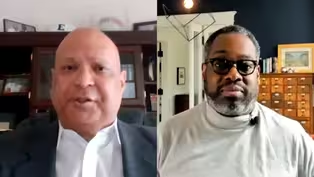
The 2023 economic outlook for Black businesses, consumers
Video has Closed Captions
Clip: S51 Ep10 | 9m 57s | The 2023 financial forecast for African American businesses, entrepreneurs and consumers. (9m 57s)
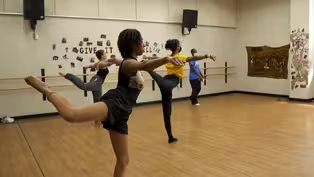
Alvin Ailey American Dance Theater tour comes to Detroit
Video has Closed Captions
Clip: S51 Ep10 | 10m 57s | The Alvin Ailey American Dance Theater makes North American tour stop in Detroit. (10m 57s)
Providing Support for PBS.org
Learn Moreabout PBS online sponsorship
- News and Public Affairs

Top journalists deliver compelling original analysis of the hour's headlines.

- News and Public Affairs

FRONTLINE is investigative journalism that questions, explains and changes our world.












Support for PBS provided by:
American Black Journal is a local public television program presented by Detroit PBS