
Mental Health Awareness Month, ALICE Report, Harry Belafonte
Season 51 Episode 18 | 26m 46sVideo has Closed Captions
Mental Health Awareness Month, the ALICE report and remembering the late Harry Belafonte.
May is Mental Health Awareness Month. In recognition, American Black Journal examines the impact of mental illness on communities of color. The recent Michigan Association of United Ways’ ALICE report shows how the pandemic has impacted the financial security of families in the state. Plus, a recognition of the contributions of the late singer, actor and activist Harry Belafonte.
Problems playing video? | Closed Captioning Feedback
Problems playing video? | Closed Captioning Feedback
American Black Journal is a local public television program presented by Detroit PBS
Mental Health Awareness Month, ALICE Report, Harry Belafonte
Season 51 Episode 18 | 26m 46sVideo has Closed Captions
May is Mental Health Awareness Month. In recognition, American Black Journal examines the impact of mental illness on communities of color. The recent Michigan Association of United Ways’ ALICE report shows how the pandemic has impacted the financial security of families in the state. Plus, a recognition of the contributions of the late singer, actor and activist Harry Belafonte.
Problems playing video? | Closed Captioning Feedback
How to Watch American Black Journal
American Black Journal is available to stream on pbs.org and the free PBS App, available on iPhone, Apple TV, Android TV, Android smartphones, Amazon Fire TV, Amazon Fire Tablet, Roku, Samsung Smart TV, and Vizio.
Providing Support for PBS.org
Learn Moreabout PBS online sponsorship- Coming up, we got a great show for you on American Black Journal.
We're having a candid conversation about mental health in the African-American community.
We're gonna talk about the pandemic's impact on mental health and when you need to seek help.
Plus, a new report from the United Way shows a rise in the number of Michigan families who are just struggling to make ends meet.
Don't go away.
American Black Journal starts right now.
- [Announcer 1] From Delta faucets to Behr paint, Masco Corporation is proud to deliver products that enhance the way consumers all over the world experience and enjoy their living spaces.
Masco, serving Michigan communities since 1929.
Support also provided by the Cynthia & Edsel Ford Fund for Journalism at Detroit Public TV.
- [Announcer 2] The DTE Foundation proudly supports 50 years of American Black Journal in covering African American history, culture, and politics.
The DTE Foundation and American Black Journal partners in presenting African American perspectives about our communities and in our world.
- [Announcer 1] Also brought to you by Nissan Foundation and viewers like you.
Thank you.
(bright music) - Welcome to American Black Journal.
I'm your host, Stephen Henderson.
May is Mental Health Awareness Month and it's a time to check in on your own wellbeing and to realize you're not alone if you are struggling with your mental health.
National Alliance on Mental Illness says one in five adults experience mental illness each year plus the chaos and the stress of the pandemic really affected the mental health of our children and youth.
My first two guests are with nonprofit agencies that provide behavioral health services here in southeast Michigan.
Here's my conversation with Michael Garrett who is president and CEO of CNS healthcare and Jamila Stevens, director of Integrated Care Services at Judson Center.
I wanna start off talking about this moment and the sort of difference that we're seeing because of the pandemic with mental health.
I think this took a very difficult subject and made it even darker.
Jamila, I'll start with you.
- I definitely agree, Stephen, and I think one of the things that impacted is the isolation, one, and then two, just this notion of literally living through a pandemic where grief and loss and trauma are at the forefront definitely impacted everyone when it comes to depression, anxiety, fear, not even feeling comfortable if you could interact with your family members, fear of losing people.
So it definitely has escalated symptoms in individuals who already had a diagnosis but then secondly, it caused other people to may have a diagnosis that necessarily wouldn't have had one prior to the pandemic.
- You know, the pandemic is technically over.
I mean, at least much of the disruption of the pandemic is behind us.
And so I think that is also telling people, in some ways, that the problems of the pandemic are not necessarily with us anymore.
And I think with mental health, that's just not true.
That just because we're no longer social distancing just because there isn't the kind of loss and grief that we were experiencing doesn't mean that the effects on our mental health have gone away as well.
- It's not even close.
The effects of the pandemic are still ongoing.
We've all seen in the news that during the pandemic the stress on the primary healthcare system, the emergency rooms, the overcrowding of hospital beds was at the forefront of people's minds.
But there's been kind of a delayed reaction when you talk about the behavioral healthcare impacts of that.
We have started seeing the increase in demand probably about a year, eight to 12 months after the pandemic started, where the behavioral health increases started rising exponentially.
We have more people needing behavioral healthcare treatments than we have the capacity to treat right now.
So, as the previous guests talked about, the issues of loss and depression and isolation have been on the rise.
Substance use disorders nice have been on the rise as well.
We've been seeing a lot of people come to our doors requiring treatments for those.
So no, while the pandemic is over we're gonna feel the effects of that for many years to come.
- Yeah.
So I want to talk specifically about children our kids and the ways in which the pandemic made mental health more of an acute issue for them.
In some ways, I think it's kind of an obvious thing to have happened given the disruption to them.
But again, I'm not sure that the kind of attention that the issue needs is being put on it.
Jamila, tell us about the kind of things that you're seeing with children that is different from the rest of the population.
- I think one of the things that we're seeing here at Judson Center as we're providing services to our community members and we also provide services in the schools is this disruption in regards to development.
So one of the things we have to remember is that as some of our younger kids, even kindergarten and younger, were starting their development in school, they were isolated.
And part of child development is peer-to-peer interaction.
And so one, we're seeing as the kids are returning to school, their sensory issues, there's an overabundance of this interaction of individuals that they weren't accustomed to which is then causing them to have a reaction in behavior which in some instances may look like negative behavior but it's really anxiety.
It's really this impact of being thrust into an environment that they did not really have the chance to step into in a traditional way.
So that's at our elementary, younger age, as the kids get older, similar to what Michael was stating grief and trauma, there's a delay in that process.
So you're in shock.
And now those symptoms of grief are presenting themselves where there is a higher rate of suicidal ideation, a higher rate of depression.
I'm getting referrals every day and the ages are getting younger and younger for kids who are experiencing those intrusive thoughts and those internal responses to stress.
Now at a later time with the loss and grief that they were experiencing was a year or a year and a half ago.
- Yeah.
Yeah.
Michael, what are you seeing and hearing about young people's mental health with the pandemic?
- It's the same thing.
When we talk about suicide rates, particularly among black people between the ages of 10 and 24, the suicide rates or the people who have at least contemplated or tried suicide are kind of through the roof right now.
And it's a very disheartening and disconcerting thought but it's something that we see with the people that we intake every day and really have to get very aggressive in our treatments and our interactions and our engagements with those individuals with some of the programs that we offer to offer those mental health interventions a lot sooner than maybe otherwise we typically would have.
And particularly among black females.
It's one of the groups that we're seeing a particular rise and that requires suicide interventions in that particular age group.
So we're doing everything we can on the front lines to try and get these people into treatment, get them into some of our suicide prevention programs, and the ones that we have been able to enroll and the ones follow the treatment guidelines we've been very, very successful in preventing those adverse outcomes that come along with some of those struggles.
- Yeah.
So I want to talk about how we know and how individuals know when they should be seeking help when they're having the kind of problem that a professional care environment would help with.
But I also want to talk about that in the context of our community, the African American community where there is still a bit of a stigma associated with mental health care and the idea of raising your hand and saying you're having a hard time.
What should we be looking for and how do we get people to engage, Jamila?
- I think the first key is that mental health services is not for a specific community or a specific diagnosis.
Most individuals have a mental health benefit for their insurance, and that means that it's accessible to all.
So I think there's a misconception around when to seek services.
Our role is when people come in is to determine what level of care they need based on what they've experienced.
So that's the first step.
Taking away the stigma of you have to have a particular type of severity in order to receive mental health services, which could consist of therapy, as well as medication, as well as support services, case management services, things like that.
So one, what those services entail and that is accessible to all.
I think one thing that is a key to look for, specifically in our community is that if you begin to disengage even more, and you find yourself exhausted more than usual.
If you are having what I stated those intrusive thoughts, just random thoughts coming through your mind, don't ignore those.
Pay attention to them.
Because over time, thoughts can turn into action.
And then also if you're noticing that your temper is changing, part of anxiety is that sort of adverse reaction to things, being angry or aggressive.
We assume that we're upset or it's just a bad day.
But you could be overstimulating and your anxiety could be increasing.
- Michael, how do we identify when we need help and how do we get more African Americans to be comfortable with that idea?
- Well, African Americans this is an issue that's unique to African Americans.
Let me first state that.
And predominantly in communities of color, whether it's Latino Americans, Arab Americans, Asian Americans, the stigma for people who require mental health treatment and people seeking mental health treatment is extremely high.
The fear that they're gonna be labeled crazy by their friends and loved ones is still out there.
One of the encouraging signs that we've seen is that the younger generation, particularly people who are under the age of 21, and college age individuals as well, have been far more receptive to being open about their mental health struggles engaging in treatment and seeking out that help.
So, generationally it is changing, but anecdotally, our aunts and uncles and grandmothers and grandfathers, they're still on that same page of deal with it, walk it off, it's gonna be okay.
We don't talk to people about our problems.
That's not the path forward that we need to do.
Encouraging signs have been that the primary care community has started engaging in things that can help get more people into treatment.
If you've been to a physician in the past few years, oftentimes they'll ask, how are things going at home?
Have you had any thoughts or any struggles with regard to stress?
Or have you had any thoughts of harming yourselves or others?
Your primary care doctors are now asking those questions.
I think we could all benefit from what I call a mental health checkup every year just like you go to your primary care doctor to make sure that your blood sugar levels are okay, your cholesterol is okay.
Talk to a therapist or psychiatrist once a year.
You may not be having any issues that you may be aware of but just sit down, talk to 'em.
If they say, "Okay, everything seems to be fine with you," great, see you next year.
But if they detect something that may require a follow up visit, then handle that at the appropriate time.
And as Jamila talked about, most commercial insurances have a mental health benefit to allow for that.
The second thing that I would encourage people to do, and this has more to do with people who are resistant to treatment, who, to their friends and family could be suffering from something obvious in the behavioral healthcare space.
Be a buddy to your friend, okay?
And particularly males.
Okay, I'm speaking to the guys now because, we don't like to go to the doctor unless our arm is literally about to fall off or something like that.
Well, if you have a buddy, you know that he's going through something, say, "Hey, look, my man, I know you've been having some difficulty in things," maybe when you're having lunch or dinner at a sports bar or a sporting event and say, "Hey, look, you know you might benefit from talking to somebody.
And as a matter of fact for your first appointment, I'll go with you.
I'll drive you there.
I'll sit in the lobby while you're in there talking to the mental health professional.
And you know, after you're done, we'll go to a ball game," or something like that.
Having that level and that kind of support from a trusted person in your life can make people feel far more comfortable engaging in mental health treatment than just saying, "Hey, you know, I know something's wrong.
You need to go see somebody."
- Right.
- No, be a true friend.
And help them through that process.
- A new report from the Michigan Association of the United Way shows that nearly 40% of Michigan households are financially insecure because of the pandemic.
And in the city of Detroit, that number is almost 70%.
These are working families who still can't afford all the basic things that we need.
The information is in United Way's ALICE report which stands for Asset Limited, Income Constrained, Employed.
I learned more about the findings from United Way for Southeastern Michigan president and CEO, Dr. Darien Hudson.
I wanna start with just the stark numbers that are in this report.
Nearly 70% of people in Detroit and lots of people around southeast Michigan really struggling just to make ends meet just to do basic things that we all need.
And a lot of this still has to do, I guess, with the pandemic and the disruption.
- Absolutely.
Our ALICE report gives us a accurate understanding of what's happening in our households and in our communities.
The report that everyone has access to now says 2023.
It's actually a reflection of what was happening in 2021.
And the sad part, Stephen, is that we are still very much in the same position.
38% of our households in Wayne, Oakland, and Macomb County are still struggling to meet their most basic needs.
And even with pandemic support and resources that came from the federal government some of the tax credits that were instituted we still saw our families struggling to afford food and housing and transportation and childcare.
- Yeah.
I'm not sure that a lot of people really, really think anymore that the pandemic is still causing the kinds of disruptions it did.
Can you talk just a little about why that's true?
Why we're three years from the beginning of the pandemic now, why is it still having this effect?
- So during the height of the pandemic we were actually able to institute a number of what we call pandemic era tax credits and stimulus programs.
And so I believe that it kept people afloat for a period of time.
And what's happening now are all of these programs are coming to an end.
So a prime example, the SNAP benefits that were helping people have more resources for food insecurity they actually came to an end on March 1st.
And since that time, we've seen a 33% increase in the number of calls that we received from 211 just for food insecurity.
We actually had a partnership with DTE Foundation to get 20,000 gift cards, Kroger gift cards, into the hands of people who are struggling to meet their most basic needs.
So, you know, even though we are three years in, the resources that were coming have now come to an end.
Most of them have come to an end.
And so people are still really struggling to meet their basic needs.
And I think what you hear everyone talk about all the time is also inflation and rising costs.
And our wages have been stagnant.
So when you have all of these factors coming into play it really ends up being a pretty difficult situation for a number of our families in our region.
- And we're talking here about working families.
I mean, I really want to emphasize that this is a thing that is happening to people who have jobs, who earn money, and they still are not able to earn enough to be able to take care of their families.
- Far too many of our jobs in the state of Michigan are still paying below $20 an hour.
And if you think about the household, the survival household budget for a family of four in southeastern Michigan is over $88,000.
- Wow.
- And most of our families, one or both are working in retail.
We're in some type of a customer service role, and those roles just are not paying enough for our families.
So even with all of the pandemic supports and resources we still saw our families well below that $88,000 marker.
And like you said, with both families working.
- Yeah, yeah.
So I wanna do some comparisons of our region to other parts of the state and maybe even to other parts of the country.
Is this more acute here in Southeast Michigan and especially in Detroit than it is other places?
- So one of the key takeaways with the ALICE report is that ALICE is all of us.
Ah, so you might see a variation of a percentage point here or there, our entire state is still at this 39% number.
So, you know, we were looking at a tri-county snapshot is at 38%, but the state's at 39%.
So this is something that we're seeing everywhere.
It's across our age demographics.
We see our heaviest hit households is with our youngest 25 and under population as well as our seniors who are the hardest hit.
But we also see it across our demographic groups.
60% of black Michiganders are struggling to meet their basic needs.
So in terms of how we compare across the country especially when you think about the Midwest and the rust belt, you will see many of our major cities our sister cities have numbers that are very similar to ours.
And then countywide you still have these numbers that are hovering around this 40% mark.
- Yeah.
So I do wanna talk about solutions.
As you point out, some of the safety net measures that were taken during the pandemic are now going away.
We're going back to, I guess, a pre pandemic state there.
I don't think there's probably much hope that that safety net will be strengthened again at least not to the extent it was, but talk about some of the other things that we really need to be thinking about in terms of making it easier for people to earn wages that allow 'em to support their family.
- So I think quite a bit has occurred that is giving us some momentum in terms of most recently the working family tax credit that was passed into law used to be called the EITC where now the state is is matching 30% of the resources that we received from the federal government.
So, you know, families are now getting $5,000 back when they file their taxes.
And it is actually putting more money back into the pockets of our working families.
And I appreciate that you emphasize the word working because that is key.
There are a number of conversations that people are having around universal pre-k, preschool, excuse me, and the universal childcare and trying to make that much more affordable.
We operate the Early Childhood Support Network.
We have 11 counties that we're supporting.
And that by far is the largest expense that our families are experiencing.
You know, I have an eight month old at home and it is the exact, I mean, this is one of our largest costs.
So I believe these are systemic issues.
Stephen, there are a number of coalitions if you look at all of the different factors with ALICE whether it's transportation, health, housing, food insecurity, there are coalitions all around our region of people, business leaders, community leaders, nonprofits coming together to try to tackle these issues.
But a lot of it really will depend on policies that are passed to support working families.
- But what about moving the needle on the policy side I think a lot of people feel kind of helpless when they think about that.
- Advocacy is key.
I'm someone, I stress voting rights.
I think it's really important that everyone who has the ability to vote, cast their vote.
But once you cast those votes you have to advocate for the policies that matter.
Our organization, we send out a number of different resources for people to be able to sign on to different letters.
They can actually get a template of a letter that they can send to their local representative.
They can also send it to their congressperson as well.
And we have a number of agencies, we have the League that does this at the state level but it really is rolling up our sleeves.
We have to study.
We actually have to pay attention to what's happening in Lansing, even what's happening with our local governments and really inform ourselves on ways that we can start to have more of a voice in the advocacy space for the things that are most important to us.
- And finally, today we wanna acknowledge the loss of African-American icon, Harry Belafonte, the singer, actor and activist was a trailblazer on many, many fronts.
He was the first African-American to win an Emmy.
Plus he was also awarded a Grammy and Oscar and a Tony giving him rare EGOT status.
Belafonte broke racial barriers in acting and music, igniting a Calypso music fad in the 1950s with his hit version of the Jamaican song "Day O" He was a close friend of Dr. Martin Luther King Jr. And he helped organize the March on Washington for Jobs and Freedom 60 years ago.
Belafonte was 96 years old.
And you can find links to his past interviews on PBS News Hour at americanblackjournal.org.
That's gonna do it for us this week.
You can find out more about today's guests on our website plus you can connect with us anytime on Facebook and on Twitter.
Take care and we'll see you next time.
(gentle music) - [Announcer 1] From Delta Faucets to Behr paint, Masco Corporation is proud to deliver products that enhance the way consumers all over the world experience and enjoy their living spaces.
Masco, serving Michigan communities since 1929.
Support also provided by the Cynthia & Edsel Ford Fund for Journalism at Detroit Public TV.
- [Announcer 2] The DTE Foundation proudly supports 50 years of American Black Journal in covering African-American history, culture, and politics.
The DTE Foundation and American Black Journal partners in presenting African-American perspectives about our communities and in our world.
- [Announcer 1] Also brought to you by Nissan Foundation and viewers like you.
Thank you.
(gentle music)
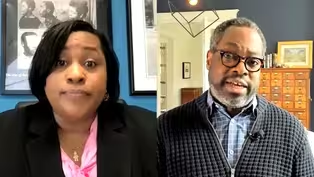
ALICE Report shows financial hardships for Michigan families
Video has Closed Captions
Clip: S51 Ep18 | 8m 19s | 2023 ALICE Report sheds light on the financial struggles of Michigan’s working families. (8m 19s)
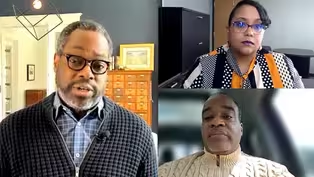
Mental Health Awareness Month in the Black community
Video has Closed Captions
Clip: S51 Ep18 | 13m 40s | Communities of color address stigmas and self-care for Mental Health Awareness Month. (13m 40s)
Providing Support for PBS.org
Learn Moreabout PBS online sponsorship
- News and Public Affairs

Top journalists deliver compelling original analysis of the hour's headlines.

- News and Public Affairs

FRONTLINE is investigative journalism that questions, explains and changes our world.












Support for PBS provided by:
American Black Journal is a local public television program presented by Detroit PBS