
Lost Constellations, Merit School of Music, Filipino Supper
Season 6 Episode 25 | 26m 46sVideo has Closed Captions
Lost Constellations, Merit School of Music, Filipino Supper Club, Dave Bennett Quartet
One Detroit associate producer Will Glover talks with journalist, activist and poet Frances Kai-Hwa Wang about the “Lost Constellations” project commissioned by the DIA. The Merit School of Music President Charles Grode shares the importance of collaboration for arts organizations. Plus, the Detroit Filipino Supper Club cooks up culture, history and community around the dinner table.
Problems playing video? | Closed Captioning Feedback
Problems playing video? | Closed Captioning Feedback
One Detroit is a local public television program presented by Detroit PBS
Lost Constellations, Merit School of Music, Filipino Supper
Season 6 Episode 25 | 26m 46sVideo has Closed Captions
One Detroit associate producer Will Glover talks with journalist, activist and poet Frances Kai-Hwa Wang about the “Lost Constellations” project commissioned by the DIA. The Merit School of Music President Charles Grode shares the importance of collaboration for arts organizations. Plus, the Detroit Filipino Supper Club cooks up culture, history and community around the dinner table.
Problems playing video? | Closed Captioning Feedback
How to Watch One Detroit
One Detroit is available to stream on pbs.org and the free PBS App, available on iPhone, Apple TV, Android TV, Android smartphones, Amazon Fire TV, Amazon Fire Tablet, Roku, Samsung Smart TV, and Vizio.
Providing Support for PBS.org
Learn Moreabout PBS online sponsorship- Hi, I'm Satori Shakoor, and here's what's coming up this week on One Detroit Arts and Culture.
Marking Asian American and Pacific Islander heritage month, we look back to a unique performance of dance and poetry that streamed at the DIA.
Then you're invited to a Filipino Supper Club to combine new friends and recipes passed down by generations.
And Arts Engines' Aaron Dworkin with Charles Grode on the power of arts collaboration.
It's all ahead this week on One Detroit Arts and Culture.
(calming music) - [Narrator] From Delta Faucets to Behr paint, Masco Corporation is proud to deliver products that enhance the way consumers all over the world experience and enjoy their living spaces.
Masco, serving Michigan communities since 1929.
- [Narrator] Support for this program is provided by the Cynthia and Edsel Ford Fund for Journalism at Detroit Public TV.
The Kresge Foundation.
- [Narrator] The DTE foundation is a proud sponsor of Detroit Public TV.
Among the state's largest foundations committed to Michigan focused giving, we support organizations that are doing exceptional work in our state.
Visit DTEFoundation.com to learn more.
- [Narrator] Nissan Foundation and Viewers Like You.
(gentle music) - Hi, and welcome to One Detroit Arts and Culture.
I'm your host, Satori Shakoor, coming to you from the Kayrod Gallery at the Hanen Centre in Midtown, Detroit.
It feels so good in here.
This gallery aims to give spotlight to artists age 60 and up, though they still give some love to the young ones.
Coming up, we mark Asian American and Pacific Islander heritage month by looking back at dance and poetry performance by the Collaborative Island.
Plus we're given an invite to a Filipino Supper Club here in Detroit.
It's about passing down shared culture and recipes through generations.
And then Sphinx founder, Aaron Dworkin and his Arts Engines series.
This week he talks with Charles Grode, the president of Merit School of Music in Chicago about the importance of arts organizations sharing ideas.
It's all just ahead.
We start with dance and poetry.
This celebrates AAPI heritage month.
It's called the Lost Constellation Project.
(bell chime) - [Poet] Sometimes I feel lost.
Lost among the stars.
You could trace the constellation of my body.
The constellation- - "Lost Constellation" is a project by Island, I-S, slash L-A-N-D.
It's a Asian American contemporary performance art collaborative.
We are a collective of artists.
We have musicians and dancers and poets, that's me, and other artists.
And we try to create beautiful and meaningful art.
With the rise in anti-Asian American violence across the country, with the shootings in Atlanta and Indianapolis, the way that Asian American women are overly targeted or disproportionately targeted for these anti-Asian American hate crimes, as well as elders and Asian women, elders even worse.
We wanted to do something that could capture the beauty of Asian American women and elders.
And also say something.
Say something.
- Why choose constellations as the theme?
What, in particular, about that is impactful?
- What I love, What I did with the poem, I started with the idea of a lost constellation and the stars and being lost.
You're right there.
That's the thing with constellations.
The stars are there.
Whether you see them or not, they're there.
And so that's not the issue.
The stars are there.
And so a lot of times Asian Americans are not seen, in the popular media, as well as in society but we're right there.
And we've always been there.
Asian Americans have been in this country since the 1500s.
- One of the lines in the poem is "Coming from one tradition and growing up in another and choosing to take the best of both to create something new."
- [Poet] Coming from one tradition, growing up in another and choosing to take the best of both to create something new.
- Can you elaborate on that in the context of exploring interdependence, healing and connecting and the elders and how all that culminates?
- A lot of times when people immigrate, for them, their culture stays frozen in time as of the year that they immigrated.
Because they remember back very fondly, usually, of their country, but at the same time they're courageous to take this mad adventure.
To go to another country, new language, new culture.
I mean, think how many of us, we grew up here in America.
How many of us would go somewhere, not speaking a language with $150 in our pocket, it's hard to do.
But then, at the same time, So they've made this leap and they bring all these memories and these cultures and these things that they understand.
A lot of times in America, there's a lot of things in America that don't make sense to an immigrant.
I grew up here, so I'm second generation and there's still a lot of things in the mainstream culture that don't make sense to me.
At the same time parents are raising children.
In this way the children are being socialized, not just by their parents and their parents' original culture, but also by the mainstream culture, the kids on the playground and all that stuff.
And so you're caught between two different cultures and you need to find your way through that in a meaningful way.
But some parents really want their children, their daughters, especially, to be nice and quiet because that's a cultural, actually, that goes across cultures.
A lot of people like their daughters to be nice and quiet.
And then, at the same time, once they grow up, they want them to be outspoken and to be able to go get, To be a go-getter and get that big marketing job, to get that big corporate job or be a lawyer.
But how can you do that if you've been socialized your whole life to be nice and quiet?
- [Poet] We are a zigzag path of lights.
As we forge new identities and create real lives in this place.
- Part of this is this mixed message that you're trying to, How do you fit between cultures?
And so a lot of people have to, it's like code switching, but culture switch.
So you switch.
You one way in one culture and you're another way in another culture.
How do you build an authentic life for yourself between these two cultures?
- We're in AAPI month.
There has been a lot this month, but overall, do you feel that there is ample representation of the AAPI community in the arts?
- No, absolutely not.
There's a huge underrepresenation of Asian American artists and there needs to be more outreach.
There needs to be more financial support because this is an important part of our American history and our American culture and our American experience.
But sometimes, museums and curators and arts organizations, they don't necessarily understand that.
They put the Asian Americans in a box.
Some people, not all, of course, but some people don't understand the difference between Asian and Asian American.
That's the first divide and that's huge.
And then access economic aspect of it, that if you come from immigrants and refugees, you have a much smaller safety net.
And how do you go and be an artist without that big safety net?
Without intergenerational wealth?
Without a lot of support?
It's really a big risk to take.
- [Poet] To build the bridge of magpies to bring together the beloved community, for every one is welcome, seen, fed, housed, reunited.
- Could you tell us where people can go to experience "Lost constellations" and how they can interact with and enjoy the project?
- If you wanna find out more about Island Asian American contemporary performance collaborative go to our website, it's I-S, dash or hyphen, I-S, dash L-A-N-D dot O-R-G. And if you would like to see "Lost Constellation", go to YouTube and look up the DIA, Detroit Institute of Arts and "Lost Constellation", and you should be able to find it.
- Musician and founder of the Sphinx Organization, Aaron Dworkin, has an interview series here on Detroit Public Television called Arts Engines.
He caught up with Charles Grode who is the president and executive director of the Merit School of Music in Chicago.
Let's see what they had to say about the impact of collaboration between arts organizations.
- I'm so excited because I have been honored to be able to know about Merit for many years and it's extraordinary impact, not only in Chicago, but really on our field as a whole.
But could you just give us that quick, Just overarching sense for any of our audience who might not be familiar with Merit, the scope and focus for Merit?
- Sure.
Happy always to talk about Merit.
Merit has been around since 1979.
We were started at a time when the Chicago public school system really pulled back their investment in arts education.
And we were founded by two visionary leaders, two visionary women who said, "Talent is equally distributed but opportunity is not."
So Merit was founded with that in mind.
We have grown significant over the last 40 years.
We have approximately 3,000 students and we work with them across the city and centrally in our west loop location.
It's everything, early childhood up through high school, and we are jazz and classically focused.
We really believe that music offers lifelong transformation opportunities and that's what we're pleased and what I'm pleased and honored to be doing every day.
- As you look at the field today, where do you see the, either the biggest challenges and or the biggest opportunities that just exist in music education?
Are there any key things that you think, now, right now, here's what we're, This is the biggest challenge that we see for young people, either accessing music education or engaging in it, or here is the biggest, we think, opportunity that may be underutilized at this point?
- Sure.
Well, I think there are two components to that answer.
One is related to the pandemic and one is related to, I think, an overdue reckoning with long standing systemic racism.
And just an inequity in the arts.
And so at Merit, we're really, I think, digging deeply into both of those, so part of that is about the opportunity and the access provided by virtual instruction.
Prior to last winter, prior to mid-March, there was no virtual instruction happening at Merit School of Music.
We pivoted within two weeks in the interest of keeping our musical community whole and vibrant.
Also, as you know, a few months after that, with the murder of George Floyd, a real need to continue to dig deeply into what I think has long been a fight for equity at Merit.
And I think the intersection of those two challenges is really extraordinary work to do.
It's the work that will, I think, shape the future and the next generation of musicians and arts leaders.
I think it also presents us with tremendous opportunity because there's such destabilization.
There's such isolation due to the pandemic.
I think people are so eager to connect and to make things better together through the arts.
So I think that's, I think that's where we're doing the work.
I think the last thing I would say is the best news, I think, is that it's not work that we are doing alone.
You started your question by asking about the field, and if I think about the time that I've been active and that we've had the opportunity to work together, I think the conversations, rather than having multiple disparate conversations, the conversations are becoming one.
And I think Sphinx Connect has been just extraordinary at bringing individuals from the League of American Orchestras, from the National Guild for Community Arts Education, bringing those groups together, and instead of having two separate conversations at two different conferences (digital chime) or three different conferences, we're really having that conversation thanks to Sphinx Connect.
And that's leading to some really, I think, really powerful collective impact work in lots of cities across the country.
- Any sense or any kind of key aspects or ways that you view music schools being able to collaborate with orchestras or with a presenter, in other words, outside, if you will, of the direct field?
Any examples of that that you think are really important?
- Sure.
Well, I think, that part of what I've also seen is a much greater awareness within individuals and within organizations, that the work to do is what's important.
That the transformation that we seek for the young people, that we exist to engage and to help really see them achieve success.
I think that is work that has grounded people that I've worked closely with here in Chicago over many years to say what we need to do together, it's too big for any one of us to do.
It's bigger than my ego or my fundraising goal.
And so what I've seen is a real spirit of generosity.
I've had the pleasure of planning for and then co-leading the Chicago Musical Pathways initiative.
It's been tremendous over the last year and a half.
We're in our second year.
It's really about identifying young musicians from traditionally underrepresented communities that want to be professional musicians, helping them to achieve success in getting into top colleges and conservatories.
And that's work that Merit is leading.
It's funded with a generous grant by the Andrew W. Mellon Foundation.
And we do that work with Chicago Youth Symphony Orchestras and with Chicago Sinfonietta.
And so many others.
It's a nine organization collaborative.
And you mentioned orchestras.
I've talked about the Sinfonietta.
The Chicago Symphony Orchestra and the Nigani Music Institute are at that table along with many smaller organizations, too.
I'm talking about the structure, but what I really, I think the content of that work is that we all have a part to play.
And we can build that work with the pathway, the developmental pathway in mind, and what Merit can bring to it is hosting of the staff for CMPI.
But then those orchestras have tremendous resources in their roster.
They're musicians, extraordinary performances, extraordinary teachers.
Those are the, Those are the things that we have to look at.
What are our unique talents?
How do we bring them around the table and work together on behalf of young people?
- There's nothing better in the summer than getting together with family and friends, sharing a meal.
Meals are also a great way for people to share and celebrate different cultures.
We heard about Shane Bernardo a few years ago.
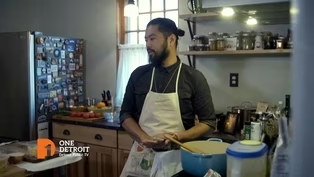
He started the Detroit Filipino Supper Club as a way to stay connected to his roots.
Shane invited some of the One Detroit Arts and Culture crew to dinner, to experience old recipes handed down through generations.
- For sure.
Yeah.
(chattering) - Today I'm cooking the meal in preparation for our supper club.
It's called the Detroit Filipino Supper Club.
And it's a way for those of us in the diaspora to help celebrate our culture and come together around food.
These are spaces that are important for me to build, socially, but also culturally and politically because food is a really great way for bringing people together.
- Whoa.
Wow.
- The way it started is a mutual friend introduced me and Ali together.
And we were just reminiscing about all the different foods that we used to enjoy when we were growing up and how much we missed that.
And we missed the camaraderie and the social aspects of coming around food, especially around the holidays.
The Philippine archipelago is made up of over 7,100 different islands.
And Luzon is the north where my people are from, the Visayas is the central region, and Mindanao is the Southern region.
To look at our foods is just one of the many ways to show that how nuanced and how varied our culture really is.
My grandmother transitioned to ancestor hood in 2016.
So fairly recently.
That hit me pretty hard because when my parents were working, my grandmother was one of my main caregivers.
But then growing up as an adult and having to deal with grief of losing my father and my grandmother, I can now pair the grief that I was feeling from that sense of loss, with some of the, what I refer to as ancestral wisdom and ancestral creativity within the food that I'm making.
It's healing to be able to reconnect with our land, in an indirect way, by preparing and celebrating some of these foods and dishes.
If I were to ask you what your favorite food was, I'm sure you could name a whole list of things.
If I were to ask you, "Is there a particular dish or food that you look for in and around your family gathering?
", you could probably come up with another list.
And then if I were to ask you, "How would you feel if you could never enjoy those dishes or foods ever again?
", you could probably come up with another list of emotion.
When are you going?
- When?
- Yeah.
- Same time.
- Okay.
(chattering) - Because then we could travel together.
- The reason why I'm really happy to do this piece is because it gives folks an alternative for seeing our community.
A lot of times Filipino Americans are homogenized and our identities are really flattened.
- We thank everybody for being here as well and for creating a community for us.
- So the work that I do within myself and within the Filipino American community here in Detroit is indicative of the kind of work that needs to happen for anyone that's been displaced off their ancestral land and has found it particularly harder and more difficult to celebrate their own traditions.
- Mm.
That food look good.
Delicious.
Thank you so much, Shane.
Make sure to check out all of our arts and culture segments at OneDetroitPBS.org I'd like to thank the Kayrod Gallery for having us here.
In addition to coming to the gallery, check out some of their virtual events online.
Well, that's gonna do it for us at One Detroit Arts and Culture tonight.
See you next week.
(lively jazz music) (music intensifies) (music abates) (music abates) (music intensifies) (music abates) - [Narrator] You can find more at OneDetroitPBS.org or subscribe to our social media channels and sign up for our One Detroit newsletter.
(gentle music) - [Narrator] From Delta Faucets to Behr paint, Masco Corporation is proud to deliver products that enhance the way consumers all over the world experience and enjoy their living spaces.
Masco, serving Michigan communities since 1929.
- [Narrator] Support for this program is provided by the Cynthia and Edsel Ford Fund for Journalism at Detroit Public TV.
The Kresge Foundation.
- [Narrator] The DTE foundation is a proud sponsor of Detroit Public TV.
Among the state's largest foundations committed to Michigan focused giving, we support organizations that are doing exceptional work in our state.
Visit DTEFoundation.com to learn more.
- [Narrator] Nissan Foundation and Viewers Like You.
(gentle music) (thematic music)
Video has Closed Captions
Clip: S6 Ep25 | 3m 19s | Detroit Filipino Supper Club Cooks Up Connections to Culture, History, Community (3m 19s)

Exploring the Underrepresentation of the AAPI Community
Video has Closed Captions
Clip: S6 Ep25 | 6m 51s | Lost Constellations: Exploring the Underrepresentation of the AAPI Community in Art (6m 51s)
Providing Support for PBS.org
Learn Moreabout PBS online sponsorship
- News and Public Affairs

Top journalists deliver compelling original analysis of the hour's headlines.

- News and Public Affairs

FRONTLINE is investigative journalism that questions, explains and changes our world.












Support for PBS provided by:
One Detroit is a local public television program presented by Detroit PBS