Spotlight on Agriculture
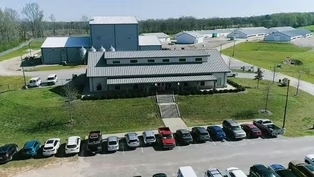
The Miller Center at Auburn
Season 7 Episode 3 | 56m 40sVideo has Closed Captions
Take a look inside Auburn University's groundbreaking poultry research center.
Take a look inside Auburn University's poultry research center that's providing learning opportunities for students and industry leaders throughout the Southeast.
Problems playing video? | Closed Captioning Feedback
Problems playing video? | Closed Captioning Feedback
Spotlight on Agriculture is a local public television program presented by APT
Spotlight on Agriculture
The Miller Center at Auburn
Season 7 Episode 3 | 56m 40sVideo has Closed Captions
Take a look inside Auburn University's poultry research center that's providing learning opportunities for students and industry leaders throughout the Southeast.
Problems playing video? | Closed Captioning Feedback
How to Watch Spotlight on Agriculture
Spotlight on Agriculture is available to stream on pbs.org and the free PBS App, available on iPhone, Apple TV, Android TV, Android smartphones, Amazon Fire TV, Amazon Fire Tablet, Roku, Samsung Smart TV, and Vizio.
Providing Support for PBS.org
Learn Moreabout PBS online sponsorshipSo the Miller Center is a about a 40 acre piece of property about 15 minutes north of campus.
We have a number of different facilities out here, including a feed mill for all of our feed production, All the feed for all research here at the Miller Center comes from the feed mill.
We have a hatchery, very small research hatchery with about a 9000 egg capacity Currently we have nine bird spaces for broiler research, for live animal research.
We have the necropsy lab.
It's just a giant wet lab that we perform anatomy and physiology classes, blood sampling, tissue sampling, things of that nature.
The first facility built out here was the feed mill.
It's been here since about 2012.
The first two bird houses were built around the 2015 2016 time frame, and everything else, including the administrative building here, have been built in the last 5 to 6 years.
I'd say so 2020, 2019.
That area between now and then, was the rest of them.
Charles Miller was one of the first pioneers in the vertical integrated poultry industry.
So you hear about integrators.
So Tyson, Wayne Sanderson Farms, Pilgrim's Pride, those are all integrators and their integrators are they are all vertically integrated.
So one company has control over everything.
The feed mill, the hatcheries, the processing plants, so on and so forth.
Charles Miller was one of the first to explore that way of operating and his family chose to give to Auburn University.
And and that is why we have this facility and that's why it is named after him.
The Fortenberry processing plant is a small pilot plant that's got all of the modern commercial equipment.
I call it our crown jewel of the Miller Center.
It is a very well put together facility.
We have a we have all the standard equipment that our students can can learn to operate and manage and just get familiar with.
There is no other facility like the Fortenberry processing plant in the country in terms of research.
It is one of a kind when most of our research ends up down there.
But all of our yield studies go down there, we'll take I'm not going to say all of our birds end up in our processing plant at the moment, but the majority of our research does end up down there.
Courtney Gardener is our associate director for that facility.
She does a great job, has some big plans for it moving forward.
A lot of exciting ideas are being talked about, but a great place for our students, a great place for our industry to come and learn a lot of workshops down there, you know, a lot of industry support down there as well, a lot of a lot of cool things.
But our students can learn first processing the meat processing debone.
A number of the sky is really the limit.
Very nice facility.
We have barely scratched the surface on its capabilities though, so moving forward, a lot of a lot of exciting thing Here at the Miller Center, we also have a poultry infectious disease biocontainment facility.
It will contain 24 isolation chambers in four separate rooms.
We plan to use it for exactly what it sounds like.
We will be able to do research on some more call them hazardous diseases, diseases we do not want here at the Miller Center.
It is not here on site.
It is up the road about a half a mile.
So it is separate.
We have to observe our biosecurity as strictly as possible.
So it is off site.
It will be very strict.
The access to that building will be strictly enforced, but a lot of exciting things up there as well.
It's not a it's not something many folks like to talk about when it comes to poultry, infectious diseases of any kind.
But it is very necessary for our industry.
We have got to continue to do research on viruses, any kind of disease that may affect our industry.
We can't just sit by and wait on it to strike.
We need to be ready for it.
We need to do research on those bugs as well.
So we do have that capability.
Here at the Miller Center, we do have a lot of extra space that could be utilized in the future for a number of different possibilities.
I know there's been talk of aviaries building specific for broiler breeders or layers.
We have two broiler breeder projects on the on the farm as we speak and the facilities are working.
There are some minor, minor changes we could make in facilities in the future that would improve those the operation of those buildings and the ability to do those types of research.
So things of that nature.
But when it comes to expansion, if someone can think it up and we can come up with the funding, it can it can be done.
A lot of space out here, a lot of extra space for future growth of this facility.
I manage and coordinate all research projects that have to do with the live side of the research.
So the feed mill, the hatchery, all of the production houses, the broiler penthouses, broiler, broiler breeder, pin trial houses, so on and so forth, primarily nutrition type studies.
Uh, the feed mill gets used a lot for that.
We do a lot of foodborne illness type studies, salmonella, campylobacter, uh, things of that nature, and then a lot of yield studies as well.
The research in general we do we have we do a lot of work with the federal government, federal grants.
So a lot of research that that is intended specifically for our industry, that that helps with management, best management practices, improving welfare of the birds, saving money on all inputs, gas, power, ammonia.
Ammonia is a big one that we do some research with.
But live performance of of the animals is a is a huge one that we do a lot of yield studies, a lot of nutritional studies in that these grants help pay for.
so I got involved in the poultry industry through a summer job as a high school kid.
I know it's always been a big driver for the economy in Alabama.
The poultry industry supports a lot of small rural communities where there aren't many other job opportunities.
And so, you know, I've always found it to be a worthwhile industry to work in and really enjoy supporting that industry from this side and training students and doing research to to support the industry in the state and globally too.
I've been here about a year and a half after serving on faculty at another university.
This is my alma mater, so it was an opportunity to come back.
So I engage primarily in research and teaching.
I have a 70% research, 30% teaching appointment.
And so most of my activities around research, specifically poultry, nutrition, and then I also teach nutrition classes in our department.
So to start a research project, being in a applied program and as an applied scientist, I try to find a problem that's relevant to the industry and generally always working with the industry to identify research problems.
And then from there we obviously seek funding, whether that's through an industry partner or another organization.
And then from that point we're looking at a lot of different approvals, So all of our research involving live animals on campus, including at the Miller Center, has to be overseen by the Institutional Animal Care and Use Committee.
So the first step is always to draft those protocols and make sure they approve the procedures that we're doing.
So we have to get all of those approvals.
Obviously, scheduling becomes important too, and then just lining everything up, lining up personnel and scheduling and then just get moving and go from there.
the amount of research we currently perform.
Or we could perform at any amount at any point in time.
Depends on the researchers, it depends on the faculty and what they are charged with doing.
Currently, we have four projects going on, another to start this upcoming Thursday and there are a lot being talked about, a lot still in the it's still in the planning phase, but I have nine nine bird call, I call them bird chambers.
There are five chicken houses, but four of those houses are to have two chambers, so nine bird chambers to do research.
We could have nine projects going on in each of those at any given time So a lot of what I do as a nutritionist is to evaluate new ingredients, potential novel ingredients, and particularly those that aren't competing for human feedstuffs.
And so there's been big interest across the globe around black soldier fly.
It grows very efficiently and we can make a black soldier fly larvae meal and derivatives from that ingredient.
And poultry obviously naturally eat insects.
So it's a very good fit.
And so the big benefit is that we can take food stuffs that aren't suitable for human consumption, feed those to the soldier fly, and then kind of repackage it into the nutrient profiles that work very well for poultry and are readily consumed by poultry.
And so we've been working on a project to evaluate that basically from farm to fork My role specifically was to oversee the kind of the nutritional evaluation and how we did this.
So we worked to formulate the diets and balance the diets in a way that should support adequate performance for the birds and allow them to be healthy and see how high we can get in this new ingredient to feed as much as we can and offset other inputs such as corn and soybean meal so we started from very early on just taking the material, analyzing the nutritional content before we even fed it to the birds, formulate in the diet, and then made those diets here at the Miller Center, fed them to the birds, grew the birds out, and then were able to process and then subsequently do meat quality and sensory characteristics.
So we got to scale the whole project here at the Miller Center.
This is a world class facility for doing that type of research and very few places where that can actually be done in one location.
So there have been several people in the Miller or in the poultry science department involved in this project myself, Dr. Amit Morey, Dr. Sungeun Cho collaborators, faculty in the department, and then also my entire graduate team, including a graduate student and Nelsa Beckman.
She's a doctoral student who's done previous work on sustainable type foodstuffs at K-State during her master's.
And so she's been leading this project from our end.
But we have a lot of people in all the events from the the farm staff here throughout undergraduate helpers, a lot of different people involved.
So my main advisor is Dr. Sam Rochell And so my whole purpose is to conduct experiments and then analyze those results that we get.
my background has been a lot of sustainability, specifically in the feed science, feed manufacturing world.
So my master's was actually looking at food waste and feeding it to broilers and seeing how well they performed on that.
So this was kind of just another step in sustainability and alternative feed ingredients.
So this was definitely up my wheelhouse.
I mean, the main point is sustainability.
So using alternative feed ingredients that are more sustainable, it requires less land to produce.
So, you know, as our population grows, we need more food.
And chicken is the most growing popular meat product.
And so chicken is in very high demand right now.
And so we're trying to find alternative, more sustainable ways to produce chicken meat.
And so this black soldier of fly larvae frass came up.
And so the whole project was trying to see how much of it we could include in the diet without affecting growth performance.
So we fed it at levels of zero five, ten and 15% of the frass and the diet.
And then we measured growth performance.
So things like body weight gain, feed intake, feed conversion ratio.
So just how well are they converting that feed and depositing it into muscle or meat?
And then we also measured processing yields.
So we took those birds to the processing plant and then measured individual part yields.
So things like drumsticks, breast filets, things like that.
And then we also did an another lab, a sensory panel.
So we had just regular people who consume a lot of chicken meat.
They came in and helped us determine if it had an off flavor or if they had a better flavor, texture, smell, those kinds of things.
So everything we do in our lab is as a team, we definitely can't do any of this by ourselves.
But my, my main goal was just to orchestrate it, kind of get everyone organized on the same page, organize what were the things that we were doing day to day.
So if we were having, like a weigh day, I would get everyone organized, you know, have them all meet at the same place, same time.
So this research is important because we're always looking for novel feed ingredients that aren't in direct competition for human consumption.
So any time we can take waste streams and convert those into good protein through transfer of protein from from waste ingredients to poultry meat, that's always a big benefit, both economically and environmentally.
we're collaborating directly with the poultry industry.
So they're looking at these results to apply immediately in their own operations.
And so we're working hand-in-hand with them.
And so we're certain that there are going to be decisions made off of the results from the research we're doing here at the Miller Center.
really wanted to do poultry nutrition and poultry science because of for me, from a research standpoint, it was the type of research that was coming out.
So I would go to conferences and the research talks was was what most interested me compared to, say, like swine or cattle or anything else like that.
And so it was just the topics that were being worked on.
It was I would I would almost say more advanced, more cutting edge, I guess you could say.
They were talking about newer concepts, newer things compared to like swine and cow.
But then also just the people.
I liked the people a lot more.
So and that's always a big part of your career and who you have to work with.
So So here at the Miller Center, we do a lot for extension.
We do a lot of seminars, a lot of feed milling and nutrition seminars.
There is a commercial poultry basics course that we we go through here as well 4-H, FFA.
So we do an annual FFA contest out here.
We just a few weeks ago had a clinic and FFA judging clinic to get ready for that course.
But yes, every year we do, the FFA judging.
Well bring in bring in birds from from commercial farms and these students will come in and they'll they'll they'll compete until and then the winner of that competition will go compete at the national level later on.
I'm Jeremiah Davis, professor and director of the National Poultry Technology Center.
The NPTC is located at the Miller Center at Auburn University.
Our center started as a collaboration between the Alabama Agriculture Experiment Station and the Alabama Cooperative Extension System.
Our goal or our our mission is to work on the sustainability of poultry farmers in Alabama and beyond through innovative research and hands on extension workshops.
So at Auburn, for 23 years, I have coordinated the extension program for what's called the National Poultry Technology Center, or NPTC, which means I host the hands on training seminars.
We do field training seminars.
So I'm kind of the extension person for that group.
the National Poultry Technology Technology Center, which is the building that we're hosted in, is a separate center, but it is the only one in the world the place you can come and get actual training inside of a house without it being actually on a farm.
That's a working building.
So it's literally somewhere you could come in.
You can't hurt anything, you can't tear anything up.
But it's a place that you can get the real world experience on equipment and training and electronic controllers without hurting anything.
We host tours for elementary school kids, high school kids.
So we host we have a tour set up for in our building for people that have absolutely no poultry experience.
However, our specialty is doing hands on training seminars in what's called our NPTC, our demonstration building for people that are in the industry.
So a lot of those training opportunities are specifically designed for a certain need for the industry.
Some of those might be electrical training, generator training, ventilation training, things like that.
our center is is one of a handful of people that work on environmental control issues with animal housing.
There's only a couple of groups that do it with specifically with broiler chickens or our meat birds.
So people come from all over the world to attend our workshops.
What's nice about our center is we Auburn University is close to the Atlanta airport and so it's cheaper for these companies to send their people in and send their clients in for training.
We get to do what if scenarios that we can do on a commercial poultry farm.
And so what makes this unique is the quality of our facilities, the hands on trainers that we have developed, and then the educational learning objectives that we've created around those are unique compared to anywhere in the world.
when we look at our who would normally be our participants, all the major integrators, whether that be Tyson Foods, Wayne Farms, Pilgrim's Pride, they send people from around the country.
We also get the primary breeders Aviagen and Cobb, both host international workshops.
During the summer.
We get a big contingent, big contingency from Latin America, from Cobb, and then aviation brings parties and participants from all over the world, our normal hands on training.
We're going to get heavy participants from the Southeast, but we also get people coming in from Wisconsin and California, other major broiler producing states.
So one of the things that makes our workshops really challenging to put together is we have people in there that may have 30 years of experience and we have people in there with two weeks experience.
So we've got different educational angles there.
The other thing is, is we get people from different geographical issues.
So we've got people dealing with hot temperatures in the south as well as people dealing with below zero temperatures in Canada.
And so trying to develop learning objectives that meet both the variety of needs from our participants is challenging.
But it's also good because you get to hear a variety of opportunities that each of those participants share with the group.
And so the variety makes our workshops a fun experience for people coming in from around the world.
It's a win for everybody involved.
I feel like, number one, it's win win for the poultry because we're helping design and engineer and manage an environment that's conducive for them to thrive.
They don't have to worry about heat.
They don't have to worry about cooling a war, have to worry about feeding water.
So the things that we do help design a better environment for poultry, our protein source from a poultry standpoint for the farmers, it's helpful because we help look at new technologies, we help vet new technology.
We can prototype things in our facility that helps them make good business decisions.
It also helps the commercial industry or the integrated industry in the United States and the world to kind of look at technologies and the way things are managed in the United States.
And it gives them education experience to be able to look at something that's already been used and tested so that they know when they make the investment that it's a good investment for them to use, be useful for.
Also, from my standpoint, I feel like I learn something every time we host or do a training seminar because we've got literally people from all over the world that come and you get a different mindset, different different points of view.
Some of these houses are set up in much different environments, so it helps me stay sharp and focused then.
So I'm just as much a student as anyone else.
So one of the workshops that we're hosting will be for a company called Wayne Sanderson Farms.
They're a large poultry integrator in the United States.
Most of the time, we host seminars that are open registration to anyone that's in the industry in Alabama or the Southeast in the US.
But our seminars have become so popular now for corporate events.
So this is a company wide meeting.
It will have only Wayne Sanderson people there.
So we will supplement a corporate company meeting with our hands on training events there also.
So it's this is one of those where sometimes companies don't they won't host their own meetings and have their own personal business or their own proprietary business meetings, but then they supplement their meetings with our building and our training seminars there, too.
So a typical workshop would consist of a variety of hands on activities.
So we may cover something going into spring.
We're going to cover ventilation, maintenance or fan maintenance, evaporative cooling maintenance and then operation of those systems going into the fall.
We would focus more on heater maintenance in our heating needs with small chicks And so it's going to be seasonally directed.
And then also specific to whatever the company is needing at the time.
We're having a broiler manager's meeting up here, And Jess, Jeremiah, Cody and Kelly have all done a great job.
It's a very hands on training and it's very entertaining and very informative.
So we will do what we call minimum ventilation training, transitional ventilation training, and maybe some tone ventilation training.
We'll do some energy efficient efficiency testing we call house type testing in that building.
So we will help kind of demonstrate good and bad things and how those things work.
And we'll set up some scenarios to where some of the things are not working right and they can walk around and see demonstrations or simulations of things that are wrong.
And then they can we can have a meeting afterwards and then they can kind of help talk through and discuss things they found wrong or even maybe some things that they find one of the demonstrations that you will be seeing in the workshop is we've got several migration fences that we use in houses to keep the birds segregated so that they they are spread out across the house.
If we don't apply, those birds will tend to move to one end of the house or the other.
And so if we're going to do precision management of animals, if we're going to do a good job through the life of that flock of birds, we've got to understand how migration fences work, what they look like, what are the management challenges with those.
And so we're going to go through a discussion with that.
These classes are very beneficial.
Being able to actually see things in person and see the application of it is a great thing.
A lot of times we're out in the field, it's easy to say we understand something, but to see it for ourselves makes things a lot better.
for me, it's the networking.
I'm always going to learn no matter where we go to conferences or workshops.
But it's this is a good meeting today to be able to meet everybody across the company and put names with faces.
Some people I've met before, some people I've never met.
So it's just a good networking opportunity.
Having Auburn so close to us has really given us a leg up in the industry.
In my opinion, Jess and Jeremiah do such a great job of interacting with us any time we have any problems, they come out in the field and help us.
These classes are important because we see these things every day, but it's easy to forget the small things.
It's easy to forget the minor details and having them here to remind us and help us with those things and educate our growers gives us an advantage on other people.
one of our biggest challenges when we're on farms is getting people to understand the maintenance issues that they have.
So one of our demonstrations is to allow our participants to go through before we tell them anything and have them identify the problems that we have set up.
So part of the goal is, is to get them to understand and identify and see the problem.
And then the next step is we've got to fix that problem.
And so we would go into specific teaching demonstrations and give them tools to here's how you would fix each of those problems.
So here at the Miller Center, we do all the above.
We do a lot of research, a lot of teaching activities, Introductory classes is a big one out here.
So getting our students introduced to the industry, we do very basic management type courses.
We do.
We have some more advanced courses as well.
They get a little more in-depth with what is done in the industry.
I speak with industry professionals all the time and they love what we're doing.
Other universities are doing it as well, but it's it's really neat to see these students actually get to perform these jobs and projects at this facility and then are tasked with building their own commercial complex as well.
So I'm Charlene Hanlon.
I'm assistant Professor of reproductive physiology at the Poultry Science Department at Auburn, and I've been here for about a year and a half now.
I work a lot and really breeder fertility, reproduction, of course, and trying to improve reproductive efficiency of those broiler breeders, also laying hens and trying to just maximize that chick output or egg output from those birds.
I actually stumbled into poultry really late into my undergrad studies.
There was a poultry club at the University of Guelph that I had attended and they had an artificial insemination program.
So one of my friends wanted to go to a poultry club and I thought she was absolutely crazy.
But I went and got certified in artificial insemination of poultry and never looked back.
Honestly, I fell in love with the industry itself.
I realized how small it was and how much of a tight knit community it was, but how many opportunities it could provide.
And I went on, got my Ph.D., and as soon as I finished a Ph.D., I knew I wanted to end up in a poultry school.
I want poultry focus.
I wanted to teach students who were invested in this industry So I started looking around and Auburn's facilities, honestly, was what drew me here.
I moved here from Canada.
I jumped in headfirst into the Southern poultry industry.
But this Miller Center itself is honestly an incredible place to work.
The amount of technology that we have here, the facilities itself, there's it's unlike any other I've seen.
And the opportunity for research here was just above and beyond, in addition to the fact that the poultry students are here and invested and we can get them involved in the projects too.
So for the students here, there are two main tracks.
They're either poultry production students or they are poultry private students.
So there's two different streams that these students can take, both in the poultry major program.
There's also a poultry miner that some of the students are in, in collaboration with the animal science department usually.
They also take business minors and things like that.
So a lot of different variety of backgrounds, but they all get to take those core poultry courses.
So during the degree here, a lot of students actually do work on the farm.
I have a few undergrads in my lab.
There are many undergrads in many of the faculties labs.
They have a really good opportunity to get involved in the research, and it also teaches them on a smaller scale how to manage birds So they're able to take the skills on a small scale that they've learned and have the time to hone those skills and be able to bring those out into the industry.
Our students here are involved with, We have interns.
We have all kinds of interns here at the Miller Center.
The student undergrads do have the opportunity to work here at the Miller Center.
They can work with research groups.
We have a number of research professors doing research out here at the Miller Center, and they all have students who work and get hands on and learn.
Sometimes that's the best way to learn.
So, yeah, internships working out here, I would love to have a few more students work out here.
Like I said, I think that's the best way to get the education.
The hands on education goes a lot further, in my opinion, than the classroom does sometimes.
But a lot of labs out here as well.
A lot of classes, a lot of labs.
There are some the basic production management classes out here, those are hands on labs, So, yes, there's there's a lot of opportunity out here for undergrads, graduate students, a lot of grad students doing their own research here, working for those professors.
But those grad students typically take the take charge.
They are typically in charge of their own research, making all the big decisions and learning, learning from both the mistakes that they could possibly make and and the successful, successful projects as well.
There's a wide variety of classes that we offer and we try to take advantage of this place as much as we can.
So when it comes to the Miller Center, the students get the opportunity in our third year to go out and do a commercial poultry production course.
And with that course, they're able to actually raise broilers themselves and go through and see what those management practices look like.
On my class with the reproduction, they get to hatch out chicks, so they get to see that whole incubation process.
They get to go through what that management looks like, chick scoring and all that kind of stuff.
On the processing side, they get to look at the processing and further processing.
They get to go to the feed mill and learn how to actually make their own feed.
So they really do get to see every aspect of the industry just on the farm here itself.
They learn how to manage birds.
They know what goes wrong and how to make everything go right.
They learn these smaller scale aspects that of course we can't teach the commercial side, but it gets them enough insight that they have a leg up.
When they do go out to the industry, they are able to get those hands on experiences within those classes because our classroom is on farm.
So we're able to say, okay, you're having some difficulty understanding this concept, get up, let's go get some biosecurity on, let's go out into the farm and actually do some hands on work.
So I think instead of us lecturing in classrooms, it's been such a benefit to actually be able to take the students out to the research facility and say, you're going to learn what you're actually going to do for the rest of your life.
Instead of me standing here lecturing, giving you this information.
once you actually get into the real world, there are things that happen that they just can't teach you in the classroom, especially when it comes to the agricultural industry, working with people how to manag And there's a lot of they just can't all cover in a classroom.
So when you get to do all of that hands on, you see things that could happen.
Or maybe you run into things that do happen.
And so that really helps you when you get into industry or the real world, because sometimes things that you learn in the classroom also aren't always realistic, I guess you could say.
And so you could learn something in the classroom, but then you could go to a company and say, Well, why don't we do it this way?
And they have really good reasons for why they might not be able to do it, whether it be cost effectiveness, location, resources, whatever it may be.
And you wouldn't necessarily always learn that in the classroom.
when I took over the poultry production class, I was really adamant about getting a lab back into that class because the students were learning a lot more in the classroom and not so much on the farm.
So I wanted to take advantage the fact that we have a brand new hatchery out there and we want to get those students in the hatchery and understanding what are the parameters of incubation, what does embryonic development look like, what is a good chick look like?
And it's stuff that if they were to work at a hatchery, they don't have the time to necessarily go into this level of detail.
So it's the only opportunity they have to do that.
So we take them out, we go through, they, they pick their own eggs, they set what they think is going to hatch.
They're giving me rationale the entire time of why they think those are the best eggs.
They have a little bit of competition to see who can get the best hatch.
And each week they go through and candle those eggs.
They see that development of that embryo all the way through to the hatching process where they get to score their own chicks.
So at the end of that assignment, they'll write their report on how well their incubation was compared to the other people in the class, what went right, what went wrong.
Sometimes we messed with the incubation parameters just a little bit, just to give them something to think about so the class overall is just a really great opportunity for the students to see the entire process from beginning to end of that hatching and actually understand if their incubation went wrong and they were working in a hatchery, what that would look like, I find these hands on opportunities very beneficial because this is actually what we're going to be doing whenever we go out into the industry.
So not a lot of other majors can say that, but we get a lot of hands on experience and it definitely helps out So you really get to see the beginning to end.
So if something is going on in the barn, say, like they aren't gaining weight or something, you can always go back and check to see what you did at the feed mill.
Maybe there was something that went wrong at the mill that day when your feed was being made that would impact growth performance or, you know, there's endless possibilities that can impact something.
And so the benefit that we have here is that you're there and you get to see it and you're doing it, whereas other facilities, you know, they might have to buy their feed from somewhere else and they might not get to see that portion.
And so that might impact their study.
But they would they wouldn't know possibly.
So here we get to really see the full circle and really get that bigger picture so hands on classes.
You you really get a feel for what your you know, what what you're going to be going into when you get out of school.
So you kind of get an idea of what you like and what you don't like early on rather than, you know, getting getting out of school and realizing, well, I kind of don't really like this, but also it helps prepare you.
So, you know, when you get into the industry, you don't feel clueless.
You feel like you kind of know what's going on.
And you you say you feel like you've seen this before.
So it's it's really good for that like pre-exposure before you get into the industry.
Yeah.
So we actually have a 5 to 1 student teacher ratio.
So a lot of our classes don't feel like some of the other classes on campus where you feel like maybe you're not noticed by your professors.
We have a lot of one on one time with them, and I can honestly say that every single professor in our department would take time out of their day to help you with whatever you need.
always a really big benefit is in my office.
I would say there's about 15 other students just in my office, and my whole lab is also in my office.
So it's really, really easy.
If I have a question, I can just turn my chair around and talk to someone who might know or even someone else in my lab.
And as far as like one on one with professors, at least.
Dr. Rochell my advisor here, has like an open door policy, so he's very easy to talk to.
Or if he's busy, I can just text him.
I've never had an issue trying to get in contact with him or, you know, having to wait days for an email reply.
So I would say it's it's very open communication, easy to get a hold of people.
Everyone is super willing to talk to you, work with you, help you.
Any questions.
You know, I wouldn't feel afraid to even go to a professor who's not my main advisor and ask for help too.
So that's a really huge benefit for what we have going on here.
it's it's hard to it's hard to compare the experience they will get out here with other with other locations.
There are several very good schools in the country with this degree with this with this degree option.
And they all do a great job.
This facility, based on what I have seen, is, is it's hard to beat like I said, we've got everything.
We are our own complex.
We are our own poultry farm.
We've got everything we need out here to operate feed, mill, hatchery houses, the whole nine yards.
And for students to be able to come in here and get this experience is it's really invaluable.
You cannot go to a lot of places.
There are not many places in the country you can go for students to get this kind of an experience.
A number of students have come through here and actually worked for us here at the Miller Center, and four years later, they've they've got a job.
Most of our students, as they graduate, will have a job.
But those students who come and work for us here, two in particular that I'm thinking of worked in our feed mill for several years.
And when they graduated, they had a job in a feed mill.
I don't know that they would have had we not been here to give them the experience they got.
so the students here, typically when they graduate, they're going into either live production, they can go into processing, they can go into the feed milling side.
There's really a great variety and I think it's a really great opportunity that they get to see a little bit of everything here and find out what they really like.
They come out of this program pretty confident that they're going to enjoy their future careers and they get that taste here.
They go into their internships, which is a requirement of our program, and then they're able to really solidify the fact that they know exactly what they want to do when they leave here, So when I was in high school, I was unsure of what I wanted to go into.
But growing up, I grew up helping my father run a six house broiler form, so I knew I had experience in that and I didn't know that there was a degree for poultry science until my senior year of high school, and I learned about Gadsden State's two plus two poultry science program with Auburn.
So that's kind of how I got into it.
After graduation I want to pursue a career in hatchery management.
Um, I actually have an internship with Aviagen this summer in Pikeville, Tennessee, where I'll be doing a hatchery internship.
So I'm looking forward to that.
So the reason I chose to get into poultry science, I'm from Albertville Alabama.
Poultry industry is very prominent there.
And, you know, in high school, didn't really know what I wanted to do.
And I knew that was an industry that was very prominent and, you know, that I knew I could have a job in it and be able to stay at home if that was something I wanted to do.
So I just kind of thought about that and started out at Wallace.
I did the two plus two program at Wallace and starting out, like I said, I thought that was something I wanted to do and I actually had a friend, their Dad reached out to me and said, Hey, I'm plant manager at this plant.
If this is something you're actually interested in, come work for me.
So while I was at Wallace, I actually worked in a processing plant for two years in the maintenance department, and I fell in love with it, knew was something I wanted to do.
So I came down here in Auburn to finish up my degree.
upon graduation, I actually accepted a job with Wayne Sanderson Farms in north Alabama at the Albertville location.
I will be working in management and training, so pretty excited to start that.
My advice to students graduating from poultry take advantage of every opportunity you are given, and one opportunity that they will have access to is travel.
Get out and travel a little bit.
I know a lot of people who are from here in Alabama and they don't want to leave, Get out, see what else, See what's out there.
It doesn't mean you have to stay there forever, but get out, travel a little bit, get experience in different parts of the country within our industry or allied industry.
This is the kind of industry that will, if you're willing, will take you all over the country.
And if you if you play your cards right all over the world, if that's your if that's what you're looking for, if you want to travel and see different parts of the country and different parts of the world, it's a good industry to be in.
But you've got to be willing to take that step.
And I think I don't think that step.
I don't think that opportunity is taken advantage enough in this industry and it needs to be.
So my biggest advice would be when you get down here, you just get involved.
You know, put yourself out there, don't be shy.
You know, get to know your classmates because the people that you start your first class with, you're going to be having classes when the whole time out.
So the quicker you make friends and make those groups, the easier your life is going to be when you get your senior year.
make connections, because the people that you're going to school with and the people that you get to know in the industry are people that you're going to be working with one day, and while you're a student here in Auburn, I advise you to be a sponge and be able to absorb a lot of new knowledge every single day.
definitely take every opportunity you can because you never know what you're going to end up loving.
I was not a kid who started out in poultry, so I took every opportunity I could and poultry was kind of a surprise for me.
So take every opportunity that you can and really figure out what exactly you love doing and what you don't like doing.
And I think there's so many there's so much variety in every job that you can have.
And there's there's such a variety of jobs out there in the industry that I believe that there is if you figure out what you love to do and what you're not such a fan of, you can find a job that 95% of it is what you love.
I know a lot of students end up going towards a processing plant.
Processing plant.
There's there's a little more money involved over there.
But the opportunities are endless.
If processing plant is not for you, maybe the live operations, maybe you may be a broiler technician or a breeder technician or hatchery supervisors.
Hatchery managers feed milling.
As I mentioned earlier, two of our recent grads are currently working for feed mills.
But one thing that I, I think goes unspoken a whole a lot is you don't necessarily have to be directly you don't have to be hands on touching chickens or in a hatchery.
The allied industry is enormous for the poultry industry.
Yes, the poultry industry is the number one industry in the state of Alabama, $15 billion annually to the state.
But this support for our industry, we would not be successful enough without allied industry.
And that is another avenue for these students.
Yes.
Come get here.
Come to the Miller Center, get the education, get the experience.
But that doesn't necessarily mean this is what you've got to do the rest of your life.
There are a number of ways Jeremiah and Jess down in NPTC.
can speak to this, but there are a lot of a lot of allied industry, a lot of a lot of support for our industry that need poultry grads as well.
So I grew up on a cattle farm in the Texas Panhandle from an engineering standpoint, there wasn't a lot of opportunities on the beef cattle side.
And so I got through.
Some of my professors learned about commercial broiler production.
And from an engineering standpoint, there's a lot of opportunity there.
If we can save a fraction of a percent of efficiency that turns into millions of dollars.
And so from an engineering standpoint, we have a lot of opportunity to help farmers on on the sustainability of their farms.
And when we look at poultry as a protein source, it is the fastest growing source in the US.
It's outpacing all the other livestock.
And the reason for that is the housing and the controlled environment that we create allows for year round production at a low cost.
And so it gives a lot of opportunities as a as an engineer to make improvements in that system and help farmers like my parents do successful job on their farms.
I would say my biggest piece of advice would be to just talk to people.
I know that probably sounds cliche, but you know, there are more job titles and roles than you could ever imagine out there, and you really don't truly know what's all out there and the opportunities that are out there until you just start talking to people.
And from my experience, everyone that I've talked to is more than willing to, you know, have a student come shadow them for a day or a week and just very extremely helpful answering questions.
So and giving that different insight and perspective.
I got involved in the poultry industry very late in my college career.
So my major degrees animal science production management late, I think it was late in my junior year, it may have been my senior year.
I chose to pursue a minor in poultry science.
A good friend of mine who I'd known for several years said, Give it a try.
Great job opportunities when you graduate.
At the time I wasn't 100% sure what my plans were, so I gave it a try.
I got involved with the Poultry Science Club, did what I needed to to go to the show in Atlanta, the International Production and Processing Expo.
I went up there, spent a few days, interviewed for dozens of jobs and got several phone calls.
And the job I ended up taking it really introduced me to poultry.
Yes, I got the minor here at Auburn and that told me that taught me the basics.
But until you get out there and actually get your hands dirty, that's when my real experience in education started.
And I've been in it ever since.
I've worked in research almost the whole time.
I've won years as a assistant hatchery manager.
Everything else has been research, product development, things of that nature.
So it's been very the industry has treated me very well.
So my father built broiler houses in that 1896.
I didn't have any idea what a broiler house looked like when my dad built the farm.
I was there and I saw the construction, I saw the design, I saw the equipment installation, and I had no interest in being involved in the poultry industry.
But I got a chance to come to Auburn, got interested.
I was interested in poultry since my dad just built the houses, I saw some opportunities I had a little bit of a construction and maintenance background, so I saw some things that I felt like maybe could have been done better.
Possibly So that intrigued me about the building, really amazed me at how one person can manage so many animals, keep them comfortable and watch them grow and gain.
And really from a farming standpoint, poultry, you see the reflex of your business and the inputs that you do.
You can kind of see that happen so fast.
And it really amazed me that you could do that on a farm.
Just the technologies and the way the birds are handled and they grow and just the technology, the computer systems and all that.
So that's really kind of how I got interested in it.
Came to Auburn and went through poultry science and like I said, that was 23 years ago.
I'm still doing it today and I love it.
I think, if I'm not mistaken, per capita, each person in the United States eats an average of over 100 pounds of poultry a year.
So poultry is very relevant and it is a very economic and efficient protein source.
We have farmers, plenty of farmers here in the United States that can supplement their life.
They can stay home and still farm for a living, and that allows them to do some other things like beef and row crops like corn, peanuts, cotton, things like that also.
So, yes, I think poultry is very relevant.
There's always new technologies.
There's always something changing, and our relationship is just to serve those folks.
So I love to see them grow and gain and learn new things myself.
Also you know, I have been to many other research facilities throughout the US university and Private and the Mills Center is certainly one of the nicest, if not the nicest, that you're going to find really in the world for the type of capabilities.
And what we're specifically trying to do here I would say the most benefit is just the people having a full team of staff and faculty here to help us set up processing days, help us set up the barns.
The the staff are great about if we need if we're short hands one day we have extra staff around to help us in a way feed bags or something like that.
So, you know, the people are the key that make this place run and they've been the biggest help.
I think our industry moving forward, there's always going to be growth.
We've got to feed a growing world.
It's not we're not just feeding this country.
We're not just feeding the state of Alabama.
We are feeding the entire globe.
And as the world's cheapest, arguably most popular protein, we have got to continue to develop more efficient ways of operating and we've got to have leaders out there who can lead this industry in the right direction.
There's a lot of development in technology now.
Artificial intelligence is a is a big one.
I think that'll have a big place in our industry.
There's a lot of a lot of people looking into that.
So we'll see.
The future is going to be interesting, but people have got to eat.
So I think I think a lot of growth moving forward can be expected and we've got to but we've got to produce the the leaders, the the leaders, the future leaders for the industry if we're going to get there.
Preview Spotlight on Agriculture: Miller Center at Auburn
Preview: S7 Ep3 | 1m | Take a look inside Auburn University's groundbreaking poultry research center. (1m)
Providing Support for PBS.org
Learn Moreabout PBS online sponsorship
- News and Public Affairs

Top journalists deliver compelling original analysis of the hour's headlines.

- News and Public Affairs

FRONTLINE is investigative journalism that questions, explains and changes our world.












Support for PBS provided by:
Spotlight on Agriculture is a local public television program presented by APT