
Dyani Reynolds-White Hawk
Clip: Season 3 Episode 17 | 6m 20sVideo has Closed Captions
Mni Sota: Reflections of Time and Place, curated by Dyani Reynolds-White Hawk
Mni Sota: Reflections of Time and Place is a stunning exhibit traveling to galleries across Minnesota.
Problems playing video? | Closed Captioning Feedback
Problems playing video? | Closed Captioning Feedback
Minnesota Original is a local public television program presented by Twin Cities PBS
Dyani Reynolds-White Hawk
Clip: Season 3 Episode 17 | 6m 20sVideo has Closed Captions
Mni Sota: Reflections of Time and Place is a stunning exhibit traveling to galleries across Minnesota.
Problems playing video? | Closed Captioning Feedback
Where to Watch Minnesota Original
Minnesota Original is available to stream on pbs.org and the PBS app.
Providing Support for PBS.org
Learn Moreabout PBS online sponsorship(woman) Mni Sota: Reflections of Time and Place is an exhibit that highlights the artwork of 19 Native American artists that all have ties and relationships with the land base of Minnesota.
And so we've chosen to highlight tradition through the lens of innovation, recognizing that things that have become traditions, were at their initial stage, they were moments of innovation.
And those moments of innovation have continued throughout our historical practices.
So beadwork is a prime example of that.
♪ ♪ Beads are not a native product to this land base.
Beads were an object that came available through trade.
So the moment that our ancestors took beads, this foreign item, and incorporated them into already established artistic practices, that was a moment of innovation, and that moment of innovation has flourished into this fantastic tradition.
And then that tradition now continues to evolve and flourish and branch off into different directions.
So we have people that still practice traditional beadwork, and then we have artists that continue to experiment with different forms of beadwork, and every time a new material has become available, people take and run with those materials, and the practice grows.
So we have artists like Cheryl Minnema who creates bandolier bags, and bandolier bags are an example of an art form that was also a combination of native practices with influence of European trade.
So the form itself is something that was influenced by contact with European people.
But the beadwork and the floral motifs and those things, are particularly Ojibwe, and so this particular bag is an example of a more traditional style of bandolier bag and Ojibwe beadwork, whereas Melvin Losh's bandolier bag has those influences, but this bandolier bag is particularly Melvin in the fact that Melvin has taken that idea of a floral bandolier bag and exploded it where it includes almost everything that you would see in a woodlands environment.
We've got the floral designs and the blueberries, which are particular to Ojibwe beadwork, but we have bees and butterflies and ladybugs and dragonflies and spiders and spiderwebs and he said there's wood tick in here somewhere too, so this one is very much Melvin's interpretation of a woodlands floral style beaded bandolier bag, so it's very particularly him.
And then if you work your way down to Cecil Taylor's work, she has taken this idea of the floral Ojibwe bandolier bag and it's come to life in a 3-dimensional manner.
And as far as I know, this is most likely the first 3-dimensional bandolier bag that's been made.
And that spurs from the fact that that's her passion, is creating 3-dimensional beadwork.
It's a beautiful example of those moments, those moments that can create traditions in and of themselves, and those moments that not only draw from our history and our relationships with our ancestors or relationships with our tribe, and that upbringing and then the aesthetic that is so particularly a part of who you are, but also really gaining influence and inspiration from your individuality as well and that desire to just push your creative process.
[piano and rattle play softly] The pieces that Francis submitted as a body of work to also be included in this exhibit, the title of this body is "What I Learned in Boarding School, One, Two, Three, and Four."
The boarding school era was a moment of our history that was another portion of the attempt to assimilate our people.
Children were forced to leave their homes and go into boarding schools, and a lot of these boarding schools were extremely abusive, and so Francis has used this form of art to record that moment in his history, and it's an extremely difficult portion of our history to acknowledge.
And I really admire his courage in being able to use this art form for what I see as a moment-- it's a tool of healing, because we have to be able to acknowledge hurt and trauma before we can grow past it.
[electric guitar, bass, & rattle play] We have artists that draw from their traditions, they draw from their teachings, they draw from tribal practices and understandings of our worldviews, and some of them do them in old modes of making, but there's examples here of people who may be creating new traditions that we just don't know are going to become traditional practices at some point.
So it's really about celebrating our creativity.
Our creativity determines what we're going to do with that indigenous knowledge.
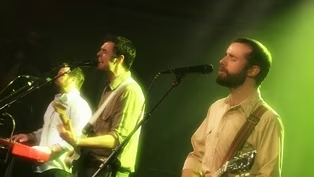
Joey Ryan & The Inks: The Part Taken
Video has Closed Captions
Clip: S3 Ep17 | 5m 30s | Joey Ryan and The Inks perform The Part Taken at Varsity Theater in Minneapolis. (5m 30s)
Video has Closed Captions
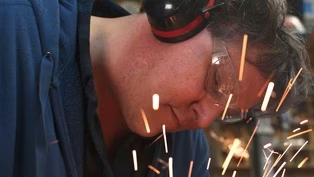
Clip: S3 Ep17 | 5m 53s | Kyle Fokken's make-do aesthetic is inspired by a childhood spent re-imagining model toys. (5m 53s)
Video has Closed Captions
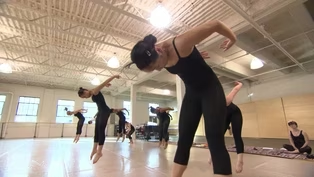
Clip: S3 Ep17 | 7m 45s | TU Dance Artistic Directors Toni Pierce-Sands and Uri Sands and the TU Dance Center. (7m 45s)
Providing Support for PBS.org
Learn Moreabout PBS online sponsorship
- Arts and Music

Art21 showcases today's contemporary visual artists and their groundbreaking creations.







 New Episode



Support for PBS provided by:
Minnesota Original is a local public television program presented by Twin Cities PBS