
Hannah Albert
Clip: Season 4 Episode 20 | 7m 6sVideo has Closed Captions
A diagnosis of cancer reawakened mixed-media artist Hannah Alberts artistic desire.
A diagnosis of cancer reawakened mixed-media artist Hannah Alberts desire for artistic self-expression as a way to both communicate her ideas and to help her in her healing process.
Problems playing video? | Closed Captioning Feedback
Problems playing video? | Closed Captioning Feedback
Minnesota Original is a local public television program presented by Twin Cities PBS
Hannah Albert
Clip: Season 4 Episode 20 | 7m 6sVideo has Closed Captions
A diagnosis of cancer reawakened mixed-media artist Hannah Alberts desire for artistic self-expression as a way to both communicate her ideas and to help her in her healing process.
Problems playing video? | Closed Captioning Feedback
How to Watch Minnesota Original
Minnesota Original is available to stream on pbs.org and the free PBS App, available on iPhone, Apple TV, Android TV, Android smartphones, Amazon Fire TV, Amazon Fire Tablet, Roku, Samsung Smart TV, LG TV, and Vizio.
Providing Support for PBS.org
Learn Moreabout PBS online sponsorship(Hannah Albert) My painting process starts with laying the canvas on the floor and wetting the canvas and then painting into the wet canvas.
The sizing I use is called Rabbit Skin Glue.
So normally people use gesso that prepares the surface so that the paint will slide over the top of it, but I actually want there to be, you know, the fabric and the paint are interacting.
♪ ♪ ♪ ♪ I try to just allow myself to get absorbed in the process and allow however the paint's going to flow naturally and organically on the surface to happen.
I'm intentionally trying to not totally have control over the outcome.
This is really just the first layer, and I'm not thinking about, you know, is this a landscape, or what is this?
It's just, I don't know-- whatever is going to happen is going to happen.
It's a very organic process.
See these little edges, and they get these little ruffly edges?
I just love that, like choo, choo, choo, choo, choo, choo.
The next day, I put the canvas up against the wall and I start looking to see what's there, appreciating the shapes, and I'll just wait until something starts to stand out to me that wants to be defined, and then I start to work into it to develop certain areas and then there are areas that I want to leave as they are, because they just organically have a really beautiful energy to them, and then other places that need to be brought out and defined.
So a lot of it is just deciding what to leave alone and what to work on.
[acoustic guitar plays softly] Every artist passes through a time or times in their life when they question whether they want to keep doing it.
I think that I came up to a point in time when I was in my late 20s when I really questioned-- am I going to make a living doing this?
And I didn't feel like I was really ready to launch into that at that point.
And at the time, I felt like I was just saying good-bye to that part of my life for a while; I wasn't really sure even when or if I would come back to it.
And it felt okay at the time.
I started to feel like I was really missing making things.
I started to have dreams again about painting, and I listen to my dreams.
So I started making art again, and then made the decision to move to Seattle, and within a year of being there, I was diagnosed with cancer.
So needless to say, that was rather life-changing.
Being in a new city, I didn't know very many people, I wasn't making very much money.
So one of the outcomes of that whole process for me was recognizing that my drive, or my desire, to say something with my art was a core part of who I am.
And as I spent more time painting and teaching, I also recognized that this is an important part for a lot of people in their healing processes, that they have something in their lives that is just for them.
You know, we all have things we do for other people, and things that we need to do to be responsible and pay our bills, but there's something that makes you different from everyone else that you need to do.
It's like you, you have to sing your own song.
My work is really like a microcosm of what's going on inside.
We change a little bit every day.
We have millions of processes going on inside us; everything's changing all the time, even though it seems static.
You can look at the landscape and say, wow, this really doesn't seem to be changing.
You come back 10 years later, and things look pretty different.
And it's the same thing with us, and when I do a painting that I really like, it's a painting that you can come back to and see in a new way.
The paintings are an opportunity to shift your vibration.
Just the act of observing something very carefully and closely over a period of time can change how you're feeling and how you're moving through the world.
And so I want my paintings to be like that, where you have it hanging in your house, and maybe you're feeling a little stuck, and something needs to shift, and you sit in front of this painting that has a lot of movement-- it's really about change and transformation, and it pulls you along.
Video has Closed Captions
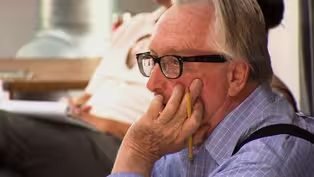
Clip: S4 Ep20 | 10m 4s | Bain Boehlke, founder of The Jungle Theater in Minneapolis, Minnesota (10m 4s)
Video has Closed Captions
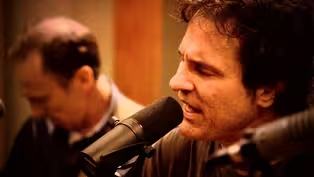
Clip: S4 Ep20 | 3m 20s | Kevin Bowe and the Okemah Prophets perform Never Don't Stay from album Natchez Trace (3m 20s)
Video has Closed Captions
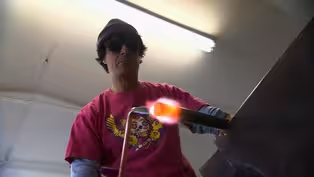
Clip: S4 Ep20 | 5m 29s | Peter Morales creates public art pieces out of stone and metal. (5m 29s)
Providing Support for PBS.org
Learn Moreabout PBS online sponsorship

- Arts and Music
The Best of the Joy of Painting with Bob Ross
A pop icon, Bob Ross offers soothing words of wisdom as he paints captivating landscapes.





 New Episode
 New Episode



Support for PBS provided by:
Minnesota Original is a local public television program presented by Twin Cities PBS