
The Schubert Club Letters Collection
Clip: Season 3 Episode 27 | 5m 35sVideo has Closed Captions
The Gilman Ordway Manuscript Collection, with letters from notable classical composers
The Gilman Ordway Manuscript Collection, which has grown from 20 to more than 100 letters since its opening in 1985, contains pieces of correspondence from such notable composers as Mozart, Rachmaninoff and Liszt.
Problems playing video? | Closed Captioning Feedback
Problems playing video? | Closed Captioning Feedback
Minnesota Original is a local public television program presented by Minnesota PBS
The Schubert Club Letters Collection
Clip: Season 3 Episode 27 | 5m 35sVideo has Closed Captions
The Gilman Ordway Manuscript Collection, which has grown from 20 to more than 100 letters since its opening in 1985, contains pieces of correspondence from such notable composers as Mozart, Rachmaninoff and Liszt.
Problems playing video? | Closed Captioning Feedback
Where to Watch Minnesota Original
Minnesota Original is available to stream on pbs.org and the PBS app.
Providing Support for PBS.org
Learn Moreabout PBS online sponsorship(Barry Kempton) The Schubert Club is a music organization based in St.
Paul, dedicated to promoting the very best of music in the Twin Cities.
♪ ♪ Our music is really focused on the smallest scale of performance recitals, which are given by one or two performers, sometimes quartets, so it's really about the intimacy of the group and about the closeness of audience and performers with one another.
♪ ♪ Schubert Club was actually founded in 1882.
We believe we're the oldest arts organization in the state, and it was founded originally as a club for ladies who were here in St.
Paul without much to do and looking for entertainment.
Over it's long, long history, the Schubert Club has been fortunate to welcome some of the greatest performers from around the world.
[piano plays Liszt, "Etude No.
3 in D-Flat Major Un Sospiro] The Schubert Club has a museum, which actually started in the early 1970s, and since then, the collection has grown to many instruments, a number of manuscripts which include letters from all sorts of interesting composers, as well as some of the original handwritten pieces of music.
♪ ♪ (Jason Kudrna) The Schubert Club has a collection of letters by famous composers that was begun in 1984 with a donation of about 20 letters from Gilman Ordway of the Ordway Center for Performing Arts family.
Since that time, he's expanded his donation, and our collection has grown to well over a hundred letters, ranging from Mozart and Hayden and Beethoven, all the way up to 20th-century composers like Rachmaninoff and Ravel.
This Beethoven letter is really a note, rather than a letter.
It's a very small scrap of paper written in Beethoven's famous scrawl.
It's in German, writing it to his friend who identifies as Z, and he's talking about he's just attended a party or a celebration, and he's going to the archduke's house for probably New Year's Eve or Christmas Eve.
He's hoping he won't get any poisoned wine at the archduke's house, that the food and the wine is better at the party he's going to than the one he was just coming from.
On display in our museum in downtown St.
Paul are 12 letters, and we rotate that exhibit about every year-and-a-half.
One letter that we probably will always have on display is the star of our collection, which is the Mozart letter.
This letter was written in 1790 to his wife, Constanze.
He says, "I am as excited as a child at the thought of seeing you again, but as it is, everything seems so empty.
Adieu my love, I am ever your husband who loves you with all his soul."
And then he signs it "Mozart."
So the touching sentiment, but then, which was typical I think at that time of his writing-- his last name.
I think it's exciting for Classical music lovers to see their handwriting and to see something that they touched.
I think that's very exciting The other part of this is just the fact that these are letters from 150 years ago, from 200 years ago.
These are the building blocks of what biographers use to re-create people's lives.
So without these items, without these letters and the insight into the mundane to the more extraordinary events of peoples' lives, we don't know how people lived 150 and 200 years ago.
(James Callahan) This is a Bechstein piano that was constructed in 1878.
It was played by many very famous composers, Mahler, Brahms, Bartok, Liszt.
So it's a really historic instrument.
[playing Brahms, "Variations on a Theme by Handel op.
24"] We have physical objects that these composers have had in their hand and have imprinted with their writing.
And to combine that with the fact that we've got instruments that they've heard and played on, This is a combination that's really quite remarkable.
♪ ♪ The Schubert Club itself has the history, has fantastic concerts, education program, and the museum, but it also has so much potential, I feel, for taking the lead in what performances can be, looking forward into the future.
♪ ♪
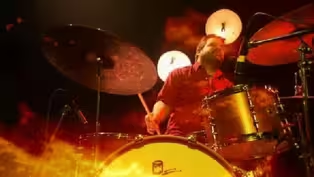
Alpha Consumer: You Ain't Alone No More
Video has Closed Captions
Clip: S3 Ep27 | 3m 16s | Alpha Consumer performs "You Ain't Alone No More." (3m 16s)

Video has Closed Captions
Clip: S3 Ep27 | 7m | Harriet Bart's installations draw attention to a past event, place or feeling. (7m)
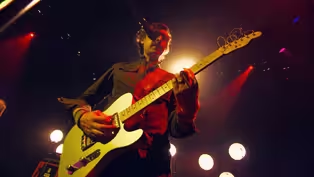
Video has Closed Captions
Clip: S3 Ep27 | 1m 45s | Jeremy Ylvisaker, Michael Lewis & J.T. Bates of the rock band Alpha Consumer perform. (1m 45s)
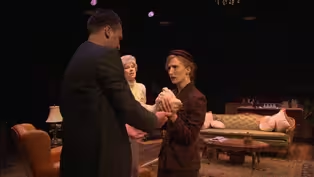
Video has Closed Captions
Clip: S3 Ep27 | 8m 13s | Theatre in the Round Players have been entertaining audiences for the past 60 years. (8m 13s)
Providing Support for PBS.org
Learn Moreabout PBS online sponsorship New Episode
- Arts and Music

Innovative musicians from every genre perform live in the longest-running music series.
 New Season







 New Episode
 New Episode

Support for PBS provided by:
Minnesota Original is a local public television program presented by Minnesota PBS