
A City of Champions/Derek Chauvin Verdict & Police Reform
Season 4 Episode 34 | 26m 46sVideo has Closed Captions
A City of Champions/Derek Chauvin Verdict & Police Reform | Episode 434
Head back in time to when Detroit was officially named the city of champions. Vaccine supply in Michigan has increased, but vaccinations are slowing in Michigan. A powerful & thought-provoking conversation about police reform & racism following the conviction of former Minneapolis police officer Derek Chauvin in the murder of George Floyd. Episode 434
Problems playing video? | Closed Captioning Feedback
Problems playing video? | Closed Captioning Feedback
One Detroit is a local public television program presented by Detroit PBS
A City of Champions/Derek Chauvin Verdict & Police Reform
Season 4 Episode 34 | 26m 46sVideo has Closed Captions
Head back in time to when Detroit was officially named the city of champions. Vaccine supply in Michigan has increased, but vaccinations are slowing in Michigan. A powerful & thought-provoking conversation about police reform & racism following the conviction of former Minneapolis police officer Derek Chauvin in the murder of George Floyd. Episode 434
Problems playing video? | Closed Captioning Feedback
How to Watch One Detroit
One Detroit is available to stream on pbs.org and the free PBS App, available on iPhone, Apple TV, Android TV, Android smartphones, Amazon Fire TV, Amazon Fire Tablet, Roku, Samsung Smart TV, and Vizio.
Providing Support for PBS.org
Learn Moreabout PBS online sponsorship- Hi, I'm Christy McDonald and here's what's ahead on One Detroit this week.
The City of Champions.
Head back in time when Detroit sports reigned.
33 championships in a single year, and gave way to Detroit's dominance as one of the greatest sports towns in the country.
Plus, overcoming vaccine hesitancy and access in Detroit with Lt.
Governor Garlin Gilchrist.
And changing the future of policing.
It's an American Black Journal roundtable.
It's all coming up this week on One Detroit.
- [Narrator 1] From Delta faucets to Behr paint, Masco Corporation is proud to deliver products that enhance the way consumers all over the world experience and enjoy their living spaces.
Masco, serving Michigan communities since 1929.
- [Narrator 2] Support for this program provided by the Cynthia & Edsel Ford Fund for Journalism at Detroit Public TV, The Kresge Foundation, Community Foundation for Southeast Michigan.
- [Narrator 1] The DTE Foundation is a proud sponsor of Detroit Public TV.
Among the state's largest foundations, committed to Michigan-focused giving.
We support organizations that are doing exceptional work in our state.
Visit DTEFoundation.com to learn more.
- [Narrator 2] Business Leaders for Michigan, dedicated to making Michigan a top ten state for jobs, personal income, and a healthy economy.
Also brought to you by, and viewers like you.
(slow gentle music) - Hi there and welcome to One Detroit.
I'm Christy McDonald, thanks so much for joining me.
Lotta news this week, including the census numbers that show Michigan will lose a congressional seat.
Where will representation be consolidated?
It'll depend on the redistricting process, to see how new legislative lines will be drawn, and which incumbents could face each other.
For more detail on redistricting, we have a series of in-depth reports.
Just head to OneDetroitPBS.org.
All right, also coming this week on the show I talk with Lt.
Governor Garlin Gilchrist about vaccine hesitancy and access in the city of Detroit.
and then, next steps for policing.
How the murder conviction of Derek Chauvin and the death of George Floyd could change training, racial profiling, and police process.
It's an American Black Journal roundtable.
And it's all coming up.
But we're starting off this week by heading back in time when Detroit was officially named the City of Champions.
It marked the sports season in 1935 through 1936.
When the Lions, the Tigers, and the Wings all won their championships, as well as the rise of boxer Joe Louis.
There's even a designated City of Champions Day, which is April 18th.
One Detroit Senior Producer Bill Kubota has more on how one Detroit sports season gave rise to Detroit's dominance as one of the greatest sports towns in America.
- Well, Bill Aitken, he found this plaque at a fair, up in Armada, at a swap meet.
He brought it down to me, and asked if I could get it reconditioned, which I did, it's got the signature of Franklin Delano Roosevelt and it's got the signature of every single governor of all the at that point 48 states.
- [Bill] This swap meet discovery made back in the 1980s.
The plaque dates back to 1936, a salute to the athletes of Detroit.
The woman who sold it didn't offer much information.
- How she got it, I don't know, but she wanted to get rid of it, and Bill paid her $30 for it.
We gave it to the Historical Museum, as it should be.
And I'm not sure any of us really understood what it was.
- [Bill] The plaque, it went down to storage.
Which brings us to the state of Detroit sports today.
The Lions, last again.
The Tigers, Red Wings, and Pistons, they're at the bottom now too.
Makes us think of headier times, like 13 years ago, when the Wings last took the Stanley Cup.
Four years before that, the Pistons won their last championship.
But the Tigers, stunningly bad that year.
The last time the Tigers were champs, 37 years ago.
The Lions, 63 years, way back before the superbowl started.
But there was a magical moment when all the Detroit teams were winners, all at the same time.
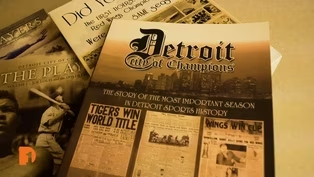
Charles Avison's written a book spreading the word of when we were the City of Champions.
The season, 1935-36.
- It actually says City of Champions right on the newspaper.
What the season has is, the Tigers, Lions, Red Wings, first championships, same season.
You can see in the bottom left-hand corner Joe Louis, this is the year that Joe Louis rises from an unknown fighter to an international superstar.
We have Eddie Tolan for sprinting.
- [Bob] The world's fastest human.
This was before Jesse Owens.
- [Charles] We have Gar Wood.
- [Bob] The speedboat king.
- [Charles] We have Walter Hagen.
- [Bob] Pro golfer.
- [Charles] Women's tennis, or we have billiards, and this is just 21 of the 33 championships from the season.
Every one of these athletes contributed to the rise of Detroit from a baseball town that had never even won a World Series, to one of the great sports towns in the country, in only a single year.
- [Bob] Ty Cobb took the Tigers to the World Series three times, but they lost them all, the last time in 1909.
- Detroit had been a boom town in the 1920s, it was like Silicon Valley.
A lot of new money, a lot of people were flush with capital.
The Dodge brothers, and Henry Ford, Chrysler.
But, the depression hit Detroit probably harder than it hit most American cities.
So people needed something to feel positive about.
And in 1935-36, they had a lot to cheer.
- Boxing was in a bad way in 1935.
There was no true superstars.
1934, nobody knew who Joe Louis was.
Complete unknown.
- Joe was not actually a champion yet, but he was on the verge, and everyone knew that Joe Louis was the best fighter, heavyweight fighter in the world.
- [Bob] 14 matches in 1935, Joe Louis won them all, the biggest in New York against former champion Max Baer that September on the same day Louis got married.
- And it is one of the greatest fights you will ever see.
Joe Louis was the first universal African-American superstar.
And after the fight, they asked Joe, "Hey Joe, where you gonna go for your honeymoon?"
Joe says, "We gotta get back to Detroit, the Tigers are in the World Series."
- [Newsreel Sports Announcer] More than 50,000 fans- - [Bob] The Tigers faced the Chicago Cubs in the '35 series.
Detroit had been on a tear since 1934, all because of owner Frank Navin.
- Unlike all these other major league owners that were, the baseball team was sort of a fun diversion with their money and they made their money in other businesses, Frank Navin's business was the Tigers.
- [Bob] Navin lost big in the stock market crash and suffered a heart attack in 1933.
Friends told him he should sell the team.
- Frank Navin doesn't sell the team.
He takes a gamble, the biggest gamble of his life, and rather than sell the team, he borrows a hundred thousand dollars and he goes out and pays the Philadelphia Athletics and he gets Mickey Cochrane.
- [Bob] Mickey Cochrane took over as Tigers player manager.
- Going into spring training of 1934, the media gets to Mickey Cochrane and they ask him, "Hey, Mickey, how ya think the Tigers are gonna do this year?"
He says, "We're going to the World Series."
And he says to them, "You don't know how to win.
It all starts with believing that you can do it."
- [Bob] Other than Cochrane, there weren't many standout players.
Among them, second baseman Charlie Gehringer.
- Gehringer was pretty much their only star.
- [Bob] Soon there'd be another, the first baseman from the Bronx.
- As I got older, I learned more about the significance of Hank Greenberg as the Jewish cultural sports hero.
- And so was 1934 was his first full season, and he breaks out in the biggest way.
I mean, he was an absolute smasher in 1934 and '35 he wins the MVP.
- You think about Detroit at the time.
Who was the most popular radio personality?
Father Charles Coughlin.
And Hank Greenberg is playing in this atmosphere in this city, where an internationally known anti-semitic priest is broadcasting anti-Jewish propaganda in Detroit.
- [Bob] The Tigers lost in the last game of the '34 series to the St. Louis Cardinals.
Expectations ran high for '35.
- And when they asked Mickey Cochrane, hey Mickey, how do ya think the Tigers are gonna do this year, what do you think his answer is?
"We're going back and this time we're gonna win it.
This time we're gonna win it."
- [Bob] Cochrane, right again.
Beating the Cubs in six games, even scored the winning run.
- [Newsreel Sports Announcer] The run that wins the ballgame and the World Series- - [Bob] Detroit already had seen three failed NFL teams come and go, the fourth arrived in 1934 from Portsmouth, Ohio.
- George Richards bought them.
The guy who owned the Lions was the owner of WJR radio.
- The idea is to bring this talented team to Detroit, name them something along the lines of the Tigers, like to keep it, they're like, I don't know, maybe the Lions?
Their number one player, his name is Dutch Clark, he was nicknamed the Ty Cobb of football.
So the idea is that there's a new Ty Cobb in Detroit, but he doesn't play baseball.
You gotta come over to University of Detroit field and watch him play for this new team, is called the Lions.
- [Bob] That first year brought a Detroit Thanksgiving tradition.
No TV yet, but on the radio coast to coast.
They finished near the top in '34.
In '35 they'd rally in the last five games to face the New York Giants.
- They won the championship on a very cold, blustery day.
Not only did they fail to sell out their tickets, but the people who bought them didn't show up.
- [Bob] The crowds did get bigger and the Lions would move to what would become Briggs Stadium.
- It's do or die.
- [Bob] Charles Avison's talking hockey for his City of Champions podcast.
- We spent an entire episode talking about one of the most fascinating components in Detroit Red Wing history, which has never been discussed.
- It baffles me that people can be so fanatical about Detroit, and Detroit sports, but this just isn't on the radar.
- This was the first group of guys who won a championship under the Red Wings banner, and yet their numbers are not retired, their names are not hung in the rafters of Little Caesars arena.
- Well, one guy certainly deserves recognition of a retired jersey, and that would be Ebenezer Goodfellow.
From Fallowfield, Ontario.
Now how many people do you know named Ebenezer?
- It's unknown.
- [Jamie] Yeah.
- And how can it be known?
The whole season's forgotten, but in this particular case, what we have is Ebbie Goodfellow is the captain of the team, the most revered and one of the best players in the entire NHL, gives up his captaincy to Doug Young to force Doug Young into the spotlight and say, Doug, you are a star, and we think you're such a star, we want you to lead us as the captain of this team.
- [Bob] Ebbie Goodfellow, the guy who stepped up by stepping back.
- Well, he was a good fellow.
You just can't beat the name, yeah, Goodfellow.
- [Bob] The Wings beat Toronto, the city celebrated again.
And again.
- The Detroit Times actually threw this big banquet at the Masonic Temple in April of 1936, and declared Detroit the City of Champions, brought, you know, a lot of the players and coaches.
- It was celebrated as the greatest gathering of champions under a single roof.
- [Bob] The Tigers, Wings, Lions, Joe Louis, and others, they all came.
Since it was a Detroit Times event, the News and the Free Press gave it scant coverage.
- The awards were given, and then everybody kind of forgot about it.
- Things that happened in the '20s and the '30s, they sort of fade out unless there's good film, and there's not much good film.
- [Bob] How does this story of champions live on?
You can find it at the big mall in Novi, an artist's co-op store where Charles Avison's been selling and storing his books for the last decade.
- So these books got shagged in the water.
You can see these boxes are all wet.
- [Bob] A leak of some sort.
One more thing to contend with.
- Am I crazy?
Did I find this story, and I'm the only one in the world that thinks this is important?
- [Bob] Sales are slow, but will pick up at Christmas time.
A fine gift, but will people spend the time to read it?
- Of course Charles wrote the book, and then in 2012, Dave Bing reinstituted City of Champions Day, it's April 18th.
And he tasked the Detroit Historical Society with keeping that history alive.
- [Bob] That includes the plaque Jim Nicholson brought to the museum those decades ago.
Nicholson says he's not a big sports fan, but he's had season tickets for the Lions since the '70s.
- Detroit is still a great sports town, despite four really bad pro sports teams.
And a lot of people figure, oh, if we just hang on, they'll be another Ebbie Goodfellow, or another Hank Greenberg to lift us and carry us to the next championship, which might be decades away.
Detroit fans are pretty patient.
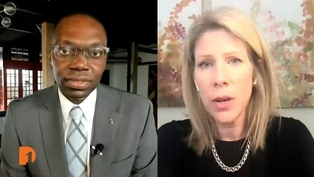
- Turning now to COVID cases in Michigan and vaccination numbers that are lagging in Detroit compared to the rest of the state.
I spoke with Lt.
Governor Garlin Gilchrist, who just got his first vaccination last week, on vaccine hesitancy and access.
- I was glad to frankly join the now more than six million people in Michigan who've gotten a vaccine dose.
And so this has been something that's been really important to me, you know, my wife as an education worker has been fully vaccinated for a few months now, and I think this is the choice that everyone needs to make, so, I got an appointment, I went to a community site in the city of Detroit, and this was really about showing that there are so many different ways to get a vaccine, whether it's you go to a pharmacy, you go to a community site, like I went to a church.
- All right, well let's go ahead and take a look at the numbers, 'cause we know we have some disparities, especially when it comes to the city of Detroit.
I think some of the latest numbers said about 26% of the population of the city, ages 16 and up, have had at least one dose of a vaccine, and that's compared to the rest of the state, which is about 44%.
Do you think it is hesitancy that we're seeing the difference in these numbers, or is it access at this point?
- Well, we have a lot of work to do, first of all, so let me say that, and the truth is, we need to address both of these challenges.
You know, the fact that people have had questions or issues with vaccines in general, or with the COVID19 vaccine specifically, like that's why we established the Protect Michigan commission, which I chair, to try to get all that information and those resources out in a credible way.
And we still are gonna continue to invest in that work of the state.
And then with access, I think city leaders, I think leaders across there are doing everything they can to break down those barriers to access, and we still have work to do there as well, so that's one of the reasons why I went to a community site, because I wanted to demonstrate you know, that this was a place that was pretty accessible, a neighborhood anchor, frankly, that people are used to going to.
And I was proud to see, you know, frankly, a church full of Black folks getting vaccinated on Saturday, and I think that's the kind of thing that we're gonna need to continue to press access on, to make sure that Detroiters can get vaccinated and that Michiganders can get vaccinated.
- Because I'm still hearing stories, and it's complicated for a lot of people, they're getting on line or they have to try multiple times or they have to go to different sites at different times, and that it is not that easy of a process.
What are some of the people telling you, like when you were at a community site, at a church, about what people's experiences have been and then what they're telling other people.
Because again, spreading things by word of mouth or saying, look, this is my story, it wasn't so bad and this is how I can help you.
- Yeah one of the things that's been important, is again as vaccine supply has increased, we've been able to increase the availability of walk-in appointments at places.
Because you're right, some people have had challenges navigating, you know, online systems, or even text message-based systems.
Being able to walk in and get a vaccine dose is really the most optimal format for a lot of people, and seeing that coming online in cities like Detroit and other cities across the state, again, I think is an important step forward in making sure that we are making the vaccine as accessible as possible.
And we've shifted that infrastructure now to provide mobile vaccine units to communities across the state of Michigan and particularly in southeast Michigan where we have vans full of vaccines driving to places in community (indistinct), driving to a sports field, driving to a recreation center, driving to a church, and also being able to vaccinate people that way, so that kind of flexibility is gonna be really critical.
Just making sure the vaccine can meet people where they are.
- What are some of the conversations that are happening between the mayor and the governor's office?
- You know, so we're in communication with the mayor's office as well as with the municipal leaders across the state on pretty much a daily basis.
I mean, you know we're working together to make sure people can get what they need, and so in the city of Detroit certainly, they've been pretty aggressive in terms of again the types of availability that's been made possible for Detroiters, whether it's walk-in clinics, mobile sites, churches, there were sites at high schools in the past week or so.
And so I think they just wanted to make sure they have all the tools that they need, and we're gonna make sure that we get 'em.
- How important is it, I guess, to see example?
To have community leaders come out and share their stories of vaccination and help people navigate that?
- I think this is one of the most important things.
What I've been hearing since the vaccines became available back in December, is that people wanted to see not only people who look like them, but people who they know get vaccinated.
And so as we ramp up the number of people who are getting vaccines, in communities across the state, I think it's gonna help, because people see someone they know, and they love, and they trust, who has made this choice, and who's doing okay.
So you know, I got my vaccine, my arm was a little sore for the rest of that evening, but I'm good.
And as a young, you know, 38-year-old Black man who's relatively healthy, I thought it was important to do that publicly so that other people who are my peers or also family members of my peers could see that and make that similar choice.
- We're talking about the importance of vaccinations, but people are saying Michigan has the highest rates of COVID now in the country.
Why aren't we shutting it down?
Why aren't we going back and saying, gosh, we've got to take a two-week pause, we're gonna halt everything.
Your administration's taken a lot of heat for not doing that in the past month.
- You know, we've asked for people to pause a lot of activity.
We've asked for people to not dine indoors.
We've asked for indoor sports, for example, to take a pause.
We've asked for people to, you know, quarantine after coming back, if they've taken a vacation or spring break trip.
And so we hope that people in Michigan will step up and do the right thing.
The truth is, we're in a different position than we were in 2020.
The question is why.
Why are we in a different position right now?
And unfortunately it's because of the politicization, frankly, of the pandemic and the response to the pandemic.
We have many fewer tools available to us, because the republicans fought us tooth and nail, and frankly took us to court to take away some of those tools that were available to us.
And so we're trying to work with what we have at our disposal, and also ask people to look at the knowledge and experiences that we've had over the last year.
We know what works.
We know masking works, we know being careful with indoor gatherings works.
And so if we do that, these are things that can help us, along with ramping up vaccines, to get through not only this increase in cases, but ultimately in the pandemic, which we can do on our terms.
We have the capacity and the knowledge to do that.
We just need every Michigander to step up and play their part.
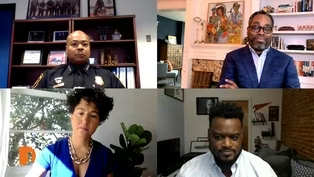
- The conviction of police officer Derek Chauvin in the beating death of George Floyd last week brought relief, yet more concern about police reform and racial discrimination moving forward.
This week on American Black Journal, Stephen Henderson talks with Southfield Police Chief Elvin Barren, Black Lives Matter Detroit co-leader John Sloan III, and Dr. Riana Anderson from the University of Michigan School of Public Health.
- I first want to get you to react to the Derek Chauvin verdict, but then get us started on the concept of why defund the police is the policy position that you think is gotta be the starting point for reform.
- So Derek Chauvin case was a trial that if I'm gonna be really honest, I tried to avoid watching.
I had so much anger, emotion, you're hurt, you're afraid, you're fearful, you're frustrated, and all those things kind of swirl in together to create that anger and that energy inside of you.
And I had so much of that, that I didn't know how to process.
And then came the announcement of the verdict.
And there was this void.
People were happy and excited, and I couldn't be.
And I think it was because I found it difficult to accept that this was worth being excited over.
This to me seemed to be the bare minimum.
If my life is worth so little, that the only way that my murderer can come to justice is by having videotape of somebody standing on my neck for close to 10 minutes, and that that deliberation of that trial takes more than five seconds, right, to me is nothing to be proud of.
And when people hear defund the police, I think there's this rhetoric out there, I know there's this rhetoric out there, that makes people feel like there's lawlessness that we want.
That we don't want any sort of order or safety.
We are separating the idea of safety from the idea of policing.
We are saying that safety in and of itself is an inherent concept, that communities have every right to be able to govern themselves, and that for as long as the system of policing has existed, it has been inherently antithetical to that concept of safety for a huge swath of Americans.
And so when we talk about defunding the police, I'm not talking about walking up to individuals like Chief Barren and saying, "You know, you're an awful person, I want you gone, I want you out of my community, and I want to run everything myself."
What I'm talking about is moving funds, is divesting and reinvesting.
Much like, John, I had anxiety myself waiting for that verdict to be rendered.
Because here's my thoughts.
Would there be that one or two jurors who spin into a mistrial?
After receiving all this overwhelming evidence that Mr. George Floyd was in fact murdered.
And so, I did have a sigh of relief when the verdict came in, that this individual was guilty on all three counts, much like John, the work still has to continue.
You look at the history of law enforcement, there is a history of racism and police brutality.
It's a fact.
It's not only a fact, it's a documented fact.
And so, reforms must take place, they must take shape, you need leaders in policing who are courageous enough to make the much-needed changes and support for these changes.
When we have conversations about defund the police, so yes, I'm not an advocate of defunding the police.
And right now, we do a number of different jobs.
We do a lot of community efforts, there's a lot of hats that we wear in this business.
I believe that the government has money, I see the government spend money on many different things that are really not necessary.
And so some of that money should be used for some of the programs.
For example, we're starting a mental awareness response.
Where we're looking to hire a medical professional to assist us on those types of calls for service.
Although there are calls for service for persons suffering from mental illness, that have the potential to be violent, a majority of those are non-violent, and we could use a medical professional to assist us in those types of response duty calls.
- Policing is often something that's emerging as a problem and sometimes we're trying to hit it back down into the ground or into this field but one thing that I want us to really be mindful of is that the field itself is American soil, that it's emerging, that this problem is emerging from, is racism.
We have had a problem in this country of racism since its inception, because things that have occurred in this country have been based on race.
Categories of people have been enslaved, categories of people have been stripped of their land, et cetera.
So when we look at the American history and our culture through a lens of race, then you're able to understand as these problems emerge, as policing problems emerge, whether it's the entire system of policing or individual cases, because we often also look at a Daunte Wright and we try to handle that and we create a hashtag.
And then we move to Ma'Khia Bryant.
We move to all of these cases that are emerging, but the entire problem of racism is what is feeding the systemic problem of policing in America and these individual cases that are emerging.
So Stephen, I want to say that because for me, it's not enough just to say that policing is a problem.
It is, but that people who become police officers are born and raised in a society, in a country that sees people racially and has continued to treat people in different ways.
- For more stories from American Black Journal and all of the reports we're working on, Just head to OneDetroitPBS.org and find us on social media @OneDetroit.
That is gonna do it for us this week, I will see you next time.
Take care and be well.
You can find more at OneDetroitPBS.org or subscribe to our social media channels and sign up for our One Detroit newsletter.
- [Narrator 1] From Delta faucets to Behr paint, Masco Corporation is proud to deliver products that enhance the way consumers all over the world experience and enjoy their living spaces.
Masco, serving Michigan communities since 1929.
- [Narrator 2] Support for this program provided by the Cynthia & Edsel Ford Fund for Journalism at Detroit Public TV, The Kresge Foundation, Community Foundation for Southeast Michigan.
- [Narrator 1] The DTE foundation is a proud sponsor of Detroit Public TV, among the state's largest foundations committed to Michigan-focused giving, we support organizations that are doing exceptional work in our state.
Visit DTEFoundation.com to learn more.
- [Narrator 2] Business Leaders For Michigan.
Dedicated to making Michigan a top ten state for jobs, personal income, and a healthy economy.
Also brought to you by, and viewers like you.
(soft music)
Video has Closed Captions
Clip: S4 Ep34 | 10m 8s | Head back in time when Detroit sports reigned--33 championships in a single year. (10m 8s)
Derek Chauvin Verdict & Police Reform
Video has Closed Captions
Clip: S4 Ep34 | 5m 48s | A roundtable on the Derek Chauvin Verdict: its impact and where the nation goes from here. (5m 48s)
Lt. Gov. Garlin Gilchrist on Vaccine Access & Hesitation
Video has Closed Captions
Clip: S4 Ep34 | 6m 6s | Overcoming vaccine hesitancy and access in Detroit with Lt. Gov. Garlin Gilchrist. (6m 6s)
Providing Support for PBS.org
Learn Moreabout PBS online sponsorship
- News and Public Affairs

Top journalists deliver compelling original analysis of the hour's headlines.

- News and Public Affairs

FRONTLINE is investigative journalism that questions, explains and changes our world.












Support for PBS provided by:
One Detroit is a local public television program presented by Detroit PBS