
A Frontier Champion
Clip: Season 32 Episode 2 | 6m 20sVideo has Closed Captions
Many credit frontier guide Simon Kenton with founding Maysville, Kentucky.
Simon Kenton was a frontier explorer and a contemporary of Daniel Boone and George Rogers Clark. He guided pioneers through the Ohio River port of Limestone, the settlement that would later become Maysville, Kentucky. Because of his role in the community’s early development, many consider him the founder of Maysville.
Problems playing video? | Closed Captioning Feedback
Problems playing video? | Closed Captioning Feedback
Kentucky Life is a local public television program presented by KET
You give every Kentuckian the opportunity to explore new ideas and new worlds through KET. Visit the Kentucky Life website.
A Frontier Champion
Clip: Season 32 Episode 2 | 6m 20sVideo has Closed Captions
Simon Kenton was a frontier explorer and a contemporary of Daniel Boone and George Rogers Clark. He guided pioneers through the Ohio River port of Limestone, the settlement that would later become Maysville, Kentucky. Because of his role in the community’s early development, many consider him the founder of Maysville.
Problems playing video? | Closed Captioning Feedback
Where to Watch Kentucky Life
Kentucky Life is available to stream on pbs.org and the PBS app.
Providing Support for PBS.org
Learn Moreabout PBS online sponsorshipVisitors traveling through Kentucky will often come across the name of Simon Kenton, the Simon Kenton Highway in Kenton County in northern Kentucky, for example.
He was an explorer in the Western Wilderness, a contemporary of Daniel Boone and George Rogers Clark.
Kenton guided settlers of the time to a place on the Ohio River called Limestone, what today is Maysville, Kentucky.
Indeed, some would say Simon Kenton is the founder of Maysville.
[music playing] Born in 1755 in Colonial Virginia, Simon Kenton grew up tall and strong.
At age 16, he would find himself fighting over a woman, beating his rival so severely he thought he had killed him, and therefore he would be punished.
Kenton ran away from home and, like others of his time, began to explore the wilderness to the west.
He learned to track game animals and built a reputation in fighting and learning the ways of American Indians.
He found himself attracted by the stories of the cane lands in an area called Kentucky.
Kentucky had that mythological cane land that everybody wanted to find.
It grows anywhere from 6 to 15 feet, and it's like a bamboo.
There was an abundance of deer and turkey and different kinds of wildlife that could hide in that cane.
In 1775, Simon Kenton traveled down the Ohio River, disembarking at a natural port where Limestone Creek emptied into the Ohio, Limestone Landing.
Limestone Landing was a river port at that time.
Limestone is the predominant rock here.
We're built on a rock, basically.
In 1773, there was a Colonel Hedges, a Colonel Young, Lawrence Darnell that came down, and Lawrence Darnell founded Lawrence Creek and named it after himself.
And Mr.
Hedges named us Limestone.
Most pioneers coming down the river traveled by flatboat, a boat that served two functions.
The reason they were flat was because at that time, Kentucky didn't have dams.
And so, at any point, the Ohio River could be shallow, or it could flood.
And then, when they reached Limestone, they would dismantle those boats, carry the wood in as far as they felt they were safe from the Indians, and they used that same wood to build their cabins.
These pioneers dragged their flatboats inland to build their homes in newly established Washington.
Several of these log cabins still stand, including one serving as the town's post office.
Simon Kenton chose not to settle in Washington, but continued south into central Kentucky on a buffalo trace.
His experience in fighting Native Americans led him to become a scout at the forts of Boonesborough and Fort Harrod.
Here, he met two other well-known explorers, Daniel Boone and George Rogers Clark.
During one attack on Boonesborough, he saved Daniel Boone's life.
[instrument playing] This was the time of the American Revolutionary War.
George Rogers Clark, now a general for the colonies, asked Simon to join him on a mission down the Ohio River to the Falls of the Ohio and then to go north to fight the British and the British-led Indians.
Kenton and Clark were followed by pioneers who chose to stay at the Falls, settling on Corn Island.
Eventually, these settlers founded the city of Louisville.
A short time after the battles, Simon Kenton was captured by a Shawnee tribe.
He would face excruciating torture and eventually was forced to run the gauntlet.
The Indians lined up on either side.
They've got tomahawks.
They've got clubs.
They've got switches, everything.
But he was a big man.
He was at least a little over six foot, and he was fast.
And he learned a lot of things, dodging people and everything.
And he survived eight gauntlets.
And they were so awed by his bravery, they gave him a membership to their tribe.
Kenton would return to Limestone in 1784 and build Kenton Station.
This station, like Tanner Station that still stands just south of Washington, was a small wooden fort designed to defend those living inside against attacks.
In 1787, Kenton married his first wife, Martha Dowden.
That same year, the name of Limestone would change.
John May came down the river on a flatboat, and he was bringing another group of people, and they heard children and women crying on shore, “Help me, help me.” And it was Indians, and they ambushed him, and he was pierced in the chest with an arrow.
And when he died, they renamed Limestone Maysville after John May.
[music playing] Kenton continued to help those coming through the area, and he carefully chose and encouraged certain pioneers to remain and help build Maysville into a town that earned a distinct title.
We were called the Gateway to the West at that time.
Had it not been for Simon Kenton, I don't believe that we would have been the mecca of the area that we became.
 New
NewVideo has Closed Captions
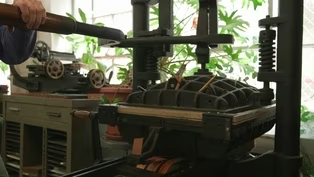
Clip: S32 Ep2 | 8m 29s | Artisans keep letterpress alive, printing Kentucky’s greatest literature by hand. (8m 29s)
 New
NewVideo has Closed Captions
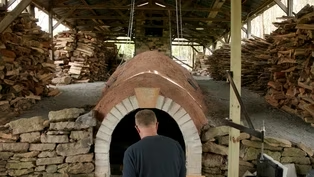
Clip: S32 Ep2 | 8m 38s | A group of potters embarked on a project to breathe new life into a kiln that had been dormant. (8m 38s)
Providing Support for PBS.org
Learn Moreabout PBS online sponsorship











Support for PBS provided by:
Kentucky Life is a local public television program presented by KET
You give every Kentuckian the opportunity to explore new ideas and new worlds through KET. Visit the Kentucky Life website.