
A look at this year’s Small Business Workshop and “Caregiving Conversations”
Season 54 Episode 18 | 26m 46sVideo has Closed Captions
A Detroit workshop helps small businesses, and we’ll hear the personal stories of caregivers.
The 12th annual Small Business Workshop taking place in Detroit is just around the corner. We’ll get details on what entrepreneurs can learn at this year’s event presented by The LEE Group. Plus, we’ll share stories from caregivers about the challenges and rewards of caring for others.
Problems playing video? | Closed Captioning Feedback
Problems playing video? | Closed Captioning Feedback
American Black Journal is a local public television program presented by Detroit PBS
A look at this year’s Small Business Workshop and “Caregiving Conversations”
Season 54 Episode 18 | 26m 46sVideo has Closed Captions
The 12th annual Small Business Workshop taking place in Detroit is just around the corner. We’ll get details on what entrepreneurs can learn at this year’s event presented by The LEE Group. Plus, we’ll share stories from caregivers about the challenges and rewards of caring for others.
Problems playing video? | Closed Captioning Feedback
How to Watch American Black Journal
American Black Journal is available to stream on pbs.org and the free PBS App, available on iPhone, Apple TV, Android TV, Android smartphones, Amazon Fire TV, Amazon Fire Tablet, Roku, Samsung Smart TV, LG TV, and Vizio.
Providing Support for PBS.org
Learn Moreabout PBS online sponsorship- Just ahead on "American Black Journal" the 12th annual Small Business Workshop is just around the corner.
We'll get details on what entrepreneurs can learn at this year's event.
Plus we'll share some stories from caregivers about the challenges and rewards of caring for others.
Stay right there.
"American Black Journal" starts right now.
- [Announcer] Across our MASCO family of companies, our goal is to deliver better living possibilities and make positive changes in the neighborhoods where we live, work and do business.
MASCO, a Michigan company since 1929.
Support also provided by the Cynthia & Edsel Ford Fund for Journalism at Detroit PBS.
- [Narrator] The DTE Foundation is a proud sponsor of Detroit PBS.
Through our giving, we are committed to meeting the needs of the communities we serve statewide to help ensure a bright and thriving future for all.
Learn more at DTEFoundation.com.
- [Announcer] Also brought to you by Nissan Foundation and viewers like you.
Thank you.
(upbeat music) - Welcome to "American Black Journal."
I'm your host, Stephen Henderson.
It's almost time for the annual Small Business Workshop presented by the Lee Group.
This year's event takes place on May 13th at the Corner Ballpark in Detroit.
The workshop's theme is resilient by design, innovating through disruption.
The free event provides expert advice, resources and networking for small business owners.
Here to tell us more is Mark Lee, he's president and CEO of the Lee Group, and a Detroit PBS Board member, along with Ray Waters, president of the Detroit Development Fund, which is one of the event's sponsors.
Welcome both of you to "American Black Journal."
- Thank you.
- I love the theme of this managing through disruption.
Everybody is familiar with that idea right now.
Talk about what that means in the context of small businesses though.
- Well, first of all, I wanna thank you for having us and Detroit PBS has been a ongoing supporter, sponsor since day one, so thank you very much.
We are living in these unusual times.
You and I chatted about it before.
There's a lot of uncertainty right now.
Well, as it relates to the economy, as it relates to globalization and small businesses are no different, and there's a lot of disruption.
So the question becomes with disruption, how do you navigate the uncertainty of running a business in these times?
So the objective of this workshop provides you with tips, resources, practical advice from business leaders like a Ray Waters and other sponsors and other people involved in this workshop to help you navigate those challenges.
- Yeah, yeah.
The disruption.
All businesses have to be able to manage that.
How different is it right now?
I mean, as a very small business owner, I can say that the disruption to my business is greater now than it has been, at least in the last 10 years.
But I'm wondering what you think about what's going on, and I guess how long you think we're all gonna have to put up with it?
- I think the fundamental difference is that a disruption may last short term.
- Yeah.
- It could be longer term.
This one feels different.
- Feels different.
- It feels like it's a little bit more scary.
- Yeah.
- And the scaredness is because of inflation, because of the uncertainty of the economy.
Certainly things that are going globally.
How long is it going to last?
I don't have a crystal ball.
- Right.
- But it feels like it could last a little bit longer than what it normally would last.
So I think, to answer your question again, this one just feels a little bit more scary.
And I get a sense, I talked to so many businesses, there's a lot of uncertainty out there, and over the last several months, we have lost several small businesses here in Detroit.
- Yeah, the number of restaurants closing has started to catch my attention.
I think that's a sign of what's sort of out there.
- And what you're seeing is that that's a direct result of the inflation.
That's a direct result of the cost squeezing that you're seeing right now.
There's no question about it.
- Yeah, so Ray, you guys support small businesses with a number of different resources and tools.
What are you saying to them right now?
What are they asking of you right now?
- We do support businesses through loans that we provide to companies that aren't able to get bank financing, technical assistance, and some grant money.
And this is our 12th year that we've been working with Mark on this workshop.
And I think we're seeing exactly what Mark just said from our customers.
They're coming to us, they need more money.
They are in the middle of this disruption, which is seems as Mark said, to be going on and on and on.
And we see it within our restaurant group that we talked about.
There are many of our restaurants that are struggling because people aren't getting out as they used to.
They're ordering and all of that.
Before, when you ran a business, you would just deal with the disruption at the time.
You go through it, you figure it out, but it's becoming so constant now that you have to start planning for it ahead of time.
And that's the problem our loan customers are going through now.
How can we plan for it?
What can we look that's different?
And that's what I hope this workshop will help people understand that you plan for it instead of reacting to it.
- Right.
- That's kind of the goal,.
- But what does that plan look like?
I mean, what does that mean to plan for disruption?
- Well, I think you have to look through all of the options that you have available.
For example, if you're a manufacturing firm and you get supplies from one supplier, you've gotta start branching out more and finding other suppliers that you might be able to use if your original supplier either ups the cost so bad, you can't handle it or they have a problem.
- Or they just go away.
- And delivery problems.
So I think you have to start branching out and doing that a little bit more.
This is a tough one.
How do you find new customers?
That's what every loan customer goes through.
But how do you do that?
And trying to find ways for us to send our loan customers to experts who can help them with a marketing plan that broadens out what they do instead of this to deal with more customers who bring more in.
- And I think the bottom line is, excuse me, the bottom line, what Ray is saying is how do you plan for this?
You have to be flexible right now.
You have to be flexible.
- Talk about the workshop this year and some of the things that you'll be focusing on.
- Yeah, I'm excited to talk about it.
No question about it.
We've identified great speakers.
They're gonna come in, we're gonna have a keynote speaker that talks about, from their perspective, how do you manage disruption?
What does that mean to you?
We're gonna have a panel discussion.
Business experts from across the great city of Detroit, across the southeast of Michigan region will share their perspective.
Practical examples, again, how do you navigate these disruptions?
What what do disruptions look like?
How do you address those?
Do you have a popular fireside chat?
We have a business leader, we have a couple business leaders that I'll be interviewing, having time with them and we get intimate in terms of the conversation, again, start to share real life examples.
So we have all types of speakers.
We have great sponsors such as Detroit Development Fund, First Independence Bank, amongst others.
They're gonna be providing their resources there as well to provide, again, practical solutions and people will have a chance to network as well.
- Yeah, yeah.
Mark, you and I have talked about this before, but because things are so bad in the economy with businesses, one of the things I've noticed is the prevalence now of offers for loans.
Every day my phone is ringing, my email box is full of people saying, ah, here's 80, a hundred thousand dollars to help your business get through this time.
And I'm always absolutely reluctant to do it because, you know, that's building structural fixed cost into your model that maybe you can't afford, even though the cash is nice.
But I wonder if you're thinking differently about, or you're encouraging businesses.
And Ray, this is a question for you too, to think differently about borrowing to get through the disruption and, you know, whether that's an answer.
- Well, I'm gonna defer to Ray, I have my perspective, but obviously, you're focused with micro goals and things like that, give your thoughts.
- What we're seeing now that is becoming more and more prevalent is, yes, you can go on LinkedIn and you can apply for a 24 hour response and get a loan.
At least 70% of those are predatory lending loans.
They're at high interest rates that are 15, 20, 25%.
And many of the small business owners are scared right now, and they don't understand that that interest rate will eventually really, really hurt them.
So while I recommend the possibility of borrowing, I suggest that you find somebody local, even if you're not bankable, there are a lot of CDFIs in Detroit who are willing to do these type of loans for small businesses.
We can't do it in 24 hours, but we can be helpful along with providing technical assistance to them to help them with getting ready for that loan and all of that.
But we were at a meeting this morning of some of the CDFIs, and in the last month, from what they could find here, 70% of the loans that small businesses took were predatory lending with race at least 25%.
And that's really, you talk about being disruptive.
It's not when you start, but at the end, that's a horrible interest rate to have to pay.
- And I think that the bottom line there too is that you talking about financial or financing your business, be practical.
Be pragmatic, understand what your specific needs are and be very careful.
- Yeah, yeah.
I think there's also an important difference between, I don't wanna get too technical, but structured debt versus revolving.
There's all kinds of revolving debt that people get offered, which does not go away automatically.
Gotta be aggressive about paying that down.
Structured debt, even if the interest rate is higher, at least it's a term loan, right?
Five years, 10 years, whatever.
That seems more practical for businesses.
- And the other thing that we see some of our small businesses doing, we just financed a company that came to us that had put $32,000 on all high interest credit cards.
Because they needed to do it quickly.
And I get it, I understand that, but thank heavens as an avenue that he could come in, we can take that note down and he's paying 7.5, 8% on it.
But that's another challenge businesses have to be careful of.
- Yeah, yeah.
What kind of things should the new administration here in Detroit, for instance, be thinking about in terms of support for small businesses?
You know, government doesn't play the most outsized role in business anymore but there are some things that it feels like they could be helpful with.
- I will credit the Sheffield administration, recently I went to the state of the city address and she talked about specific programs that will support small businesses such as the Motor City Match, as the example.
She's also, the administration's focused on expediting the approval process, you know, in other words, breaking down the bureaucracy.
I think those are types of programs and offering access to capital opportunities that are crucial to support small businesses.
So I want to give her early credit, still early in the administration but that are exactly what we need to look at right now, because we know Washington DC's challenging.
It's being challenged in terms of financial resources.
So make sure the city's continuing to step up and I'm gonna applaud her efforts thus far.
- Yeah, go ahead.
- And I would totally agree with that.
I mean, the Motor City Match program is a great program and we have sponsored and funded with loans, probably 40% of those companies that got the Motor City Grant.
So they now get a loan.
And then the other thing she did just recently was the Michigan or the Detroit Startup Fund.
Where brand new companies came in, they got a check from the city so they could start their business, provided with technical assistance from organizations to help them make sure they climb that ladder and don't go away off the ladder, but they can get up the ladder.
Programs like that the mayor's going to do will be very helpful.
- What about starting a business right now?
Is it a good idea, is it a bad idea or you just wait?
- You know, again, that's your personal choice.
- Right.
- That's a personal decision.
I mean, here's what I would recommend, is don't make rash decisions.
Be very thoughtful, be very pragmatic.
Look at your resources, look at your resources that you have in terms of financials, your board of advisors and talk to a lot of people and make sure that you have a plan.
Ray talked about it earlier, what is your plan going to be?
Don't just wake up and say, I got this brilliant idea and try to launch a business.
Doesn't quite work that way.
Is it a good time to start a business?
That's still your choice.
I'm not gonna advise people either way at this point.
- Yeah, yeah.
- And I would totally agree with that.
If you're going to do it, be prepared.
There are really great resources in this city that you can use at no cost to help you put your business plan together, to help put your projections together and to look at the market.
And you may think, I've got this product and I love it.
It's gonna go like this.
And after about a month of looking at it, it may not go that way.
It may go a little sideways, so I agree.
You've gotta take the time and plan it.
- And quickly, a sobering thought is 80% of businesses will fail within 12 months, within 12 months.
And just let that sink in.
So goes back to planning, being thoughtful, being pragmatic, and make sure you have the proper resources as you wanna do this.
- Well Mark, congratulations on another year, another workshop.
And thanks to both of you for being here on "American Black Journal."
- Thanks for having us.
- Appreciate it.
- Up next, conversations with local caregivers, but first, here's a clip from a 1986 "Detroit Black Journal" episode about African American entrepreneurs with guests Dave Bing and Earl Graves.
- Well, as a Black man in business, how did you see your cloud grow specifically, and what could be done for the Black community as it relates to gaining that kind of power?
- I would say I'm very fortunate in location more than anything else, to be very honest with you, to live in a city like Detroit that has a mayor like Coleman Young, that has the whole political team that's very, very supportive of Black entrepreneurs.
To be in a city where you're in manufacturing, such as my business and have all three major car companies located here that are very, very supportive of the program has helped also.
So I think location and support from major corporations and the whole political process has helped me to grow from a very, very small company in a short period of time to expand my growth, not where I'd like to be, but has helped tremendously.
- You mentioned that though, it is important to find, and especially I think for Blacks to find a niche.
Now you found a corporation that needed to supply for others.
Now many Blacks do not necessarily do that, or for some time they did not, they had traditional Black businesses.
Is it important that we move past that and start to grow into other areas?
Is that why you picked steel, perhaps?
- I think so, without a doubt.
Because in steel, it was something that obviously as non-traditional vis-a-vis most Blacks may venture into in terms of business.
And I saw an opportunity here in this city where it was a major, major business.
It's a support system to the big automotive industry.
And I saw an opportunity to get involved into something that could accrue major dollars for me, which would help me leverage myself to diversify into some other areas.
- Mr.
Graves, what about that diversity and being able to supply for larger corporations and moving away from the more traditional Black businesses, how important is that for Blacks and what do you see as a person who perhaps has the best pulse of the Black community?
- Well, first of all, there's two things.
Well, let me just answer your question.
It's terribly important.
It seems to me that we look at the fact that we're in the threshold of where we can go as far as business is concerned.
We're knocking at the door of opportunities such as the business that Dave is in, such as telecommunications, such as businesses having to do with manufacturing, other businesses that were in a service oriented society.
When you look at the number of auto dealerships we have that have come outta Detroit in the last 10 years, you look at the number of Black owned radio stations and television stations that we have in place today.
You look at the number of franchisees when you start talking about fast food chains, where you're talking about McDonald's or Burger King or KFC, all the like, those opportunities are there.
And so, and in terms of where we're going, we need to look at those kind of opportunities.
And we also need to look at the opportunities of setting up our own brokerage firms, our own finance firms, and so forth, because we clearly need the cloud of having our own economic wherewithal.
Now, one of the things which is terribly important, and Dave, because he lives here in the city and has such an outstanding mayor, glossed over it rather quickly and not intentionally, he takes for granted the fact that Coleman Young does a great job because he's here, I don't wanna say take for granted, but at least he acknowledges he's here.
In our own city, we can't make that kind of statement.
In New York City, the mayor of New York City is almost unalterably opposed to setting quotas and setting goals where it's gonna allow minorities to move forward.
And so we really have an environment which is not a very happy environment in terms of the opportunity.
So being in an area where there's a Black chief executive of the city is terribly important.
- As part of our coverage on caregiving, Detroit PBS has produced a series of conversations with local caregivers.
We've captured their personal stories about the challenges and rewards of caregiving.
Here are some of those stories.
(bright music) - My mom is Julia Esaw.
She's 105 years old as of October 29th last year.
Actually, I don't consider myself a caregiver 'cause we take care of each other.
My belief is if a person can already do an activity, allow them to do it until they can't do it anymore, then that's when the caregiver steps in and does it for the person.
So my mom is, which is 105 years old, she is able to dress herself, tie her shoe laces, put on her boots in the wintertime.
She cuts up our fruit and makes our fruit bowl in the morning.
She cuts up our vegetables and makes our tossed salad in the evening for dinner.
And she basically does everything herself.
There are caregiving workshops that mom and I have attended 'cause we attend almost everything together and there are caregiving workshops.
And I listen to people and they tell me the problems that they're having.
But mom and I, we don't have those problems.
But it's nice to know that there are other people who are in similar situations.
(bright music) - I've been a caregiver since COVID and I'm a caregiver for my mother.
When COVID came about, my mother, she has health issues, so she wasn't able to go out in public.
So that's when it all started.
So I had to start doing her grocery shopping and running other errands for her.
It was very difficult at first 'cause I didn't know what I was doing.
But then, it flowed naturally for me because it's someone that you care for.
And then I knew I had to do this and I had to be on front to support my mother.
My sister is a great resource for me to go to to help me, to help my mother a whole lot better by her working in the healthcare field, especially working with older adults.
Caregiving showed me that I have patience and I didn't think I had, and the way my mother cared for me, made me want to do the same for her.
So that's what gave me that motivation to do that.
When she texts me and says, thank you son, that's the reward.
'Cause I don't do things just for accolades or anything.
Just for her to acknowledge that fact and she sees that I'm going above and beyond, just that acknowledgement, just from a text that brings me joy.
What I would recommend to someone that's starting off in caregiving, reach out to different organizations that are available here in the Metro Detroit area that assist you and give you insight in how to become a better caregiver and also how to navigate that process.
(bright music) - I first came into caregiving just observing my mother who was caring for her mother, my grandmother, who lived to be a hundred, and she lived in the family home with my mom.
And I just sort of, from a distance, I helped and filled in when I needed to, but I never realized the complexity of it.
So it was grandma first.
And then after she passed, about five years later is when mom's health began to decline.
And we had a five year run.
I was here, there's just two of us, my sister and I. My sister was in California, and five years in, then dad began to decline.
And so I had a 10 year run with both mom and dad.
I knew nothing about healthcare systems really.
I didn't know about long-term care.
I didn't know the difference between Medicaid and Medicare.
I didn't know anything and I was 50.
If I had known what I known now, I would have started with Detroit Area Agency on Aging where they could have plugged me into different services.
Mom had to go into a nursing home.
Dad was at the family home, which was about 10 blocks from each other, which made it easy.
I got a job with the Institute of Gerontology at Wayne State and I had an old journalism degree.
I call it a 20th century journalism degree.
So all of that, once I realized that this was something that a lot of people were struggling with, I said, and this was early on in the caregiving, people need some place where they can go and get their information.
Through my advocacy work with the state, once I worked at Wayne State and then I sat on the Michigan Commission for Service for the Aging.
And I learned how the dollars flowed and what they went to.
I learned that there were very few dollars that went towards marketing of resources.
So a lot of programs were underutilized.
So I said, when I get through this, I'm going to come up with a newspaper and inform people and educate people about what's available.
I titled the paper Urban Aging News, and it's a quarterly and it launched in 2015 and I circulated to all three counties, Wayne, Oakland and Macomb to senior centers.
A lot of churches.
I used to run a piece in the paper where we highlighted caregivers and most of them would say, and I had to agree with them, that caregiving mom and dad or one of the parents, maybe one of them, they weren't as close to, that it really brought about them being closer to their parent.
It's a awesome responsibility.
And that became very clear to me.
I'm totally responsible for mom, I'm totally responsible.
And I guess, I mean, she was totally responsible for me at one point.
But it makes you very clear that that's what caregiving is.
And if you love the person, you wanna make sure that you're providing them with this as excellent of care as possible.
- You can see more caregiving conversations at detroitpbs.org.
That's gonna do it for us this week.
You can find more about our guests at americanblackjournal.org and you can connect with us anytime on social media.
Take care and we'll see you next time.
(upbeat music) - [Announcer] Brought to you in part by IMPART Alliance, Ralph C. Wilson Jr.
Foundation and by.
Across our MASCO family of companies, our goal is to deliver better living possibilities and make positive changes in the neighborhoods where we live, work and do business.
MASCO, a Michigan company since 1929.
Support also provided by the Cynthia & Edsel Ford Fund for Journalism at Detroit PBS.
- [Narrator] The DTE Foundation is a proud sponsor of Detroit PBS.
Through our giving, we are committed to meeting the needs of the communities we serve statewide, to help ensure a bright and thriving future for all.
Learn more at DTEFoundation.com.
- [Announcer] Also brought to you by Nissan Foundation and viewers like you.
Thank you.
(bright music)
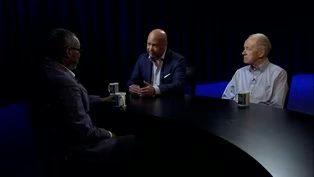
2026 Small Business Workshop explores how to navigate challenges in today’s economic environment
Video has Closed Captions
Clip: S54 Ep18 | 12m 52s | The theme for this year's workshop is "Resilient by Design: Innovating Through Disruption.” (12m 52s)
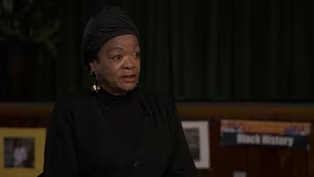
“Caregiving Conversations” highlights caregivers and their stories
Video has Closed Captions
Clip: S54 Ep18 | 7m 23s | As part of our ongoing caregiving coverage, Detroit PBS presents the stories of local caregivers. (7m 23s)
Providing Support for PBS.org
Learn Moreabout PBS online sponsorship
- News and Public Affairs

Top journalists deliver compelling original analysis of the hour's headlines.

- News and Public Affairs

Today's top journalists discuss Washington's current political events and public affairs.












Support for PBS provided by:
American Black Journal is a local public television program presented by Detroit PBS