
A Preview of the 2024 Detroit Jazz Festival
Season 52 Episode 34 | 26m 46sVideo has Closed Captions
A Preview of the 2024 Detroit Jazz Festival
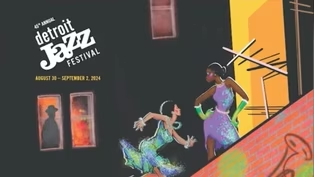
The Detroit Jazz Festival’s Chris Collins talks about the 2024 lineup and the festival’s impact on Detroit. Wayne State University’s Patrick Lindsey discusses the opening of the Gretchen C. Valade Jazz Center. This year’s Jazz Festival poster by artist Jess Fendo is revealed. Plus, a performance by the festival’s artist-in-residence Brian Blade and The Fellowship Band.
Problems playing video? | Closed Captioning Feedback
Problems playing video? | Closed Captioning Feedback
American Black Journal is a local public television program presented by Detroit PBS
A Preview of the 2024 Detroit Jazz Festival
Season 52 Episode 34 | 26m 46sVideo has Closed Captions
The Detroit Jazz Festival’s Chris Collins talks about the 2024 lineup and the festival’s impact on Detroit. Wayne State University’s Patrick Lindsey discusses the opening of the Gretchen C. Valade Jazz Center. This year’s Jazz Festival poster by artist Jess Fendo is revealed. Plus, a performance by the festival’s artist-in-residence Brian Blade and The Fellowship Band.
Problems playing video? | Closed Captioning Feedback
How to Watch American Black Journal
American Black Journal is available to stream on pbs.org and the free PBS App, available on iPhone, Apple TV, Android TV, Android smartphones, Amazon Fire TV, Amazon Fire Tablet, Roku, Samsung Smart TV, and Vizio.
Providing Support for PBS.org
Learn Moreabout PBS online sponsorship- Just ahead on "American Black Journal," one of Detroit's most popular annual events, and one of my favorites is just around the corner.
We're gonna hear all about the Detroit Jazz Festival and its lineup.
Plus, we're gonna get the first look at this year's official Jazz Festival poster.
We'll also talk about the grand opening of Detroit's newest music venue, the Gretchen C. Valade Jazz Center.
And we will end the show with a performance by the Jazz Festival's artist in residence, Brian Blade.
Don't go anywhere.
"American Black Journal" starts right now.
- [Announcer] From Delta faucets to Behr paint, Masco Corporation is proud to deliver products that enhance the way consumers all over the world experience and enjoy their living spaces.
Masco, serving Michigan communities since 1929.
Support also provided by the Cynthia and Edsel Ford Fund for Journalism at Detroit PBS.
- [Announcer] DTE Foundation is a proud sponsor of Detroit PBS.
Among the state's largest foundations committed to Michigan-focused giving, we support organizations that are doing exceptional work in our state.
Learn more at dtefoundation.com.
- [Announcer] Also brought to you by Nissan Foundation and viewers like you.
Thank you.
(upbeat music) - Welcome to "American Black Journal."
I'm your host, Stephen Henderson.
The world's largest free jazz festival is soon gonna bring thousands of music fans to downtown Detroit.
The stage is all set for Labor Day weekend, when jazz artists from around the globe are gonna perform at the 45th Annual Detroit Jazz Festival.
This year's event also coincides with the long-awaited grand opening of the Gretchen C. Valade Jazz Center on Wayne State University's campus.
It is named after the festival's late sponsor and foundation chair.
I spoke with the Detroit Jazz Festival Foundation President and Artistic Director Chris Collins along with this year's official poster artist, Jess Fendo, and Wayne State's Vice President for Government and Community Affairs, Patrick Lindsey.
This is my most favorite episode of the year.
Every year I look forward to talking about Jazz Fest.
Welcome to "American Black Journal."
- Thank you thank you.
- All right, so Chris, I'm gonna start with you.
We do this every year.
I'm always blown away by what you manage to put together for Detroit every Labor Day weekend.
Tell me about this year's Jazz Fest.
- Well we have an incredible team at Jazz Fest Foundation, and we're in such an incredible city with partners like Wayne State University and "American Black Journal" and others get the word out and let everyone know how special this thing really is and how fragile it can be.
But after 45 years, we're still free, and we're still one of the premier real jazz festivals in the world.
So to that end, as always, our programming, we look to have those legacy artists, Billy Giles, Monte Alexander, Christian McBride Quintet, James Blood Ulmer, talk about cats, and we have the incredible world class artists that are right here in Detroit living here and coming from here, our legacy artist the Great Wendell Harrison and the Walter White Big Band, and some upcomers, Mark Rosenblatt and Hockey.
These are cats looking to the future of where jazz is gonna go.
And some very special world premieres at the Jazz Festival, including Translinear Light, which is a beautiful tribute from the source, from the family of our great Detroit native, the great Alice Coltrane.
And it'll be with Robbie Coltrane and Brandy Unger on Harp and the Detroit Jazz Fest Orchestra, and so many things celebrating this incredible legacy.
And by the way, neat thing for your viewers, Alice Coltrane's original harp has been completely restored.
We were worried it wasn't gonna get done, but it's gonna be here and be part of the premiere, which is very rare, it's a historic moment.
So mix that with our artist in residence, the great Brian Blade who will be playing with the Jazz Fest big band.
He'll be playing with Octet, and of course the Fellowship Band.
So it's gonna be quite special.
- Yeah, yeah.
45 years.
That's an incredible run.
Talk about how significant that is for Detroit.
This is not just about us, but it does feature us, and it features us to the world in a way that I'm not sure everybody who lives here quite understands.
The festival is so much different and bigger than it has been in the past.
It really is a worldwide phenomenon.
- It is.
And everything we do in Detroit, these kind of things that draw tourists, Jazz Festival's now drawing a third of its audience in person, it's about 325,000 people from outside the region, outside the country.
Our streams, which we have metric by a professional companies, so there's no hyperbole.
They're free and they reach.
Last year they reached 1.6 million people in 32 countries.
And so it's a jazz festival that's in a city that has a symbiotic relationship between its culture and jazz.
They feed one another.
They always have.
And it's also in the city, the city, the architecture, skyline, the community is the backdrop for the entire festival.
So we're really proud of being able to be an ambassador to the artists, to the patrons, and all around the world because Detroit's a very special place.
And when they come here, they're rather blown away by that connectivity.
So that's along with our last economic thing showed a little over $30 million in economic development over the four days of Jazz Fest.
So we're trying to do everything we can to be great citizens, keep this thing alive, and keep it available to everyone by keeping it free.
Although when people can, we ask them to join our sponsors and our donors and help us reach that $4.5 million note every year to keep it alive.
- Yeah, yeah.
Patrick Lindsey, I wanna bring you into the conversation here.
This year's festival, of course, will feature the Gretchen C. Valade Jazz Performance Center on Wayne State University's campus.
I actually have had a chance to be there a couple times already.
It is a mind-blowing experience.
I predict that this will be, if not the premier, it will be one of the premier music venues in the city just because of how great it sounds, how great it looks, how great it feels.
I mean, it is a stunning achievement.
- Well thank you Stephen.
I think I couldn't say it any better.
As you can see, I am keeping Gretchen close to my heart.
Miss Valade's generosity, not only to Wayne State, but to the world, relative to building a world class center where artists can come and be featured and do it in such an intimate setting, but in such a dynamic place such as Wayne State, it is a great honor for us to host it and to welcome the community into this space.
I grew up here in Detroit.
Detroit is a place, in my opinion, where music is just a part of the fabric of our culture.
And music is the most universal language I know.
And we are most fluent in it here in Detroit between jazz, R&B, hip hop, gospel, classical, and the many other genres.
How blessed are we to have such richness here, but to Valade Center, in my opinion, will help to catapult and cultivate jazz even more so.
Because of its strong roots here, people will be able to experience it, to learn it, and to grow it here in the city and world through the Gretchen C. Valade Center.
- And talk about what it means to Wayne to have hosted the construction of this and that it will be part of the campus.
- Well the university obviously had to also put some skin in the game very significantly.
But it is both a responsibility and absolutely a one of a kind opportunity for the university to attract students from around the world who wanna study music, but what I love about it, Steven, is that at the Valade Center, not only will people be able to study the craft of music, be it jazz, but also what I call the business of jazz.
So students are introduced to lighting and sound technician and stage management and production.
There's a whole business side because at Wayne State, we're here to help students go higher.
The president has a prosperity agenda.
Where can we take them from where they are, which most of our students come maybe not from the top economic strata, but we leave them in a better place than when they arrive.
And so students going through our music programs are able to not only lead with a degree, but go out and make a living, make a life doing what they love.
And so this center, again, will bring a lot more attention and a lot more opportunity for students as they come study here at Wayne State.
- Yeah, yeah.
So Chris, every year now, we do a little special reveal here on "American Black Journal," the first look at the Jazz Festival poster.
Are you ready to unveil this year's?
- I think we are, how about, Jess, are you ready for the world to see your beautiful works?
- Yes I am.
- [Stephen] Jess, tell me about the poster.
What inspired you?
What does this poster kind of mean to you?
What do you think it means to the festival in the city?
- So when I saw the open call at first, I was thinking about what I could possibly do because I love jazz music, so I knew I wanted to apply for this opportunity.
And so one of the first things I thought of when I was thinking of the Detroit Jazz Festival was community.
I mean, that's one of the biggest jazz festivals ever.
You have a whole bunch of people like flocking down to downtown Detroit all with the same appreciation of like loving jazz music.
I knew that I wanted to use bright colors and not like super stereotypical dark blue, like jazzy, like super deep colors.
I wanted it to be like a celebration.
I wanted it to be fun.
There's literally like women dancing on the roof.
And I wanted to show like what I felt like when I go to the jazz festival and I see people having fun and being free and coming all together as one to like celebrate one thing that brings us together as a community because Detroit's been doing that forever.
It's like a celebration of history.
The on the side of the building is to pay homage to like every great jazz musician I guess you could say that there was.
And just to show that we still appreciate that after they like transcended and like moved on from that and we still have such a big appreciation for jazz music in Detroit.
And that's basically just what I wanted to showcase.
- Yeah, yeah.
And tell us a little bit about you, Jess.
What's your story?
- Well I do a whole bunch of different types of art in Detroit.
I've been here for a while now.
I'm a student at College for Creative Studies.
I'm studying illustration and entertainment arts.
I love doing gallery shows.
I love doing murals.
I recently just did a sculpture work with city walls for the NFL draft.
And I just love doing stuff for non-profits with the Steam Foundation and helping the Bella Isle Conservancy, and I just love giving back to the community.
So any way that I can volunteer that I could also use my art to help, it's like a win-win for me.
- Yeah.
And what does it mean to you to have won this call to find- - I mean, I'm sure he could tell you, but when he called me, I like, honestly couldn't believe it at first.
I was honestly so shocked.
I'm like, really?
Because I know a whole bunch of my friends and other people like applied for the open call, but I really put my heart and soul into it.
So I really made something that like meant a lot to me that I feel like a lot of people can resonate with.
So I'm really happy I applied and I'm super, super honored, like I said, to be showcasing something like that.
And this means the world to me.
So I appreciate all of you guys, and thank you.
- Yeah, no, it's really great.
So Chris, let's talk about the artist in residence this year, Brian Blade.
Tell us about him and how excited we should be to see him on stage Labor Day.
- Indeed, I can tell you that many people got introduced to him when he was in the famous trio with John Patitucci and Danile Perez with Wayne Shorter for all those years.
His solo career, the Fellowship Band, and what he's done with, oh my goodness, Herbie Hancock, I mean, you name it, he's been there.
But he appeals to so many generations with his music.
It's an incredible, unique artistic vision and texture.
And as I said, he's bringing that to bear in three different performances throughout the fest, as I explained.
But there's also members of his band, as you can imagine, that are quite significant.
And in fact, at the Gretchen C. Valade Jazz Center at Wayne State University, we are gonna be featuring a little series called the Midtown After Hours Special.
So on Friday night from 10 to one, a showcase of four of the incredible upcoming bands from a new generation from around the country.
On Saturday, from Brian's band, the great Kurt Roseneinkle in Trio, something you will not see at the festival, that's at 10:30.
And on Sunday, 10:30 will be Brian's pianist, John Cowherd playing solo piano concert on our beautiful Steinway nine foot Model D that Steinway got four of them for us to choose from and a bunch of artists played.
And I'm telling you, between the Valade Center being designed specifically for jazz acoustically and this beautiful instrument that John Cowherd is gonna be special.
So it's something we're really looking forward to and looking forward to having the festival expand in that direction with Wayne State and create an affiliation that will continue to grow as... - Yeah.
Chris, I wanna have you talk a little about the Valade Center as well.
You just mentioned that it's designed specifically for jazz music.
I know that this was a passion project of yours as well for a long time to get this done.
Tell us what you think of what we've got here.
- Well, the vision that Gretchen had, I mean, we were looking at buildings all over Detroit, and then the opportunity came up to do an indominant Wayne State, so it would be preserved in perpetuity.
I had to argue with her to put her name on the building because she's so humble.
But this is to stand for her and for jazz and for that sensibility of giving.
But the idea was to create a very high end Detroit jazz hall which seats about up to 340 people, and as all the accoutrement a big facility, but acoustically designed, back line designed sound, the back of house dressing room, everything is designed with the jazz world in mind.
And then downstairs, the second venue, which she named Dee Dee Bridgewaters and Dee Dee will be with us for the opening in the festival is like the hippest club jazz setting you're ever gonna see.
But both of them are full of high definition streaming capability, recording capability.
So there should be live records coming from there.
And I think the important thing is that it meant a lot to Gretchen, meant a lot to me, and means a lot to Wayne State is to elevate jazz, to create a venue for jazz that is equitable with the highest level of European and other art forms to put it in that bracket to show how important it is to Detroit.
And I can tell you every detail was looked at to provide jazz artists and jazz listeners with an experience they will never forget.
- Yeah, yeah.
Patrick, I wanna talk about where the center is and kind of how it activates a part of campus that is, I mean, it's in a part of Detroit that's also changing and it brings the university kind of front and center in that part of the city.
I mean, obviously Wayne is right there anyway, but this is a more, I don't know, I feel like it's a more public facing and maybe public embracing and welcoming part of the university.
That's a big change in that part of town for the university as well.
- Yes, Stephen, you're correct.
The Hilberry Gateway Center, which the Gretchen C. Valade Center for Jazz is located, is meant to be that southern gateway to our campus.
It was a lot of thought given into how to help continue to make Detroit more walkable and more welcoming.
And so there was a lot of intentionality to the large glass panels where you can see into the foyer there.
And certainly the space where Dean Elahi and the College of Fine, Performing, and Communications Arts, where the students do their plays, it's all right there on Cass Avenue, but built right into the older building, which certainly was a challenge.
But I think blending the history with the future, the symbolism in my opinion is perfect.
- Yeah, yeah.
Chris, speaking of the future, let's talk about the future of the festival, the future of jazz, how you're feeling about all those things now that you've been doing it for 45 years.
- Yeah, yeah.
Well greater people than me started this thing way back in Coleman Young days when Coleman went to Bob McCabe and said, "We wanna keep you around and you'll love jazz.
Let's start a jazz festival."
But the future of jazz looks great because new generations are always building on the language and moving it forward.
Right here in Detroit, I like to celebrate not just the legacy, but also the real legacy of the Detroit scene, which is to learn the history, to internalize it, but then build on it and find your own voice, your own direction.
That is very much the word of the day in the Detroit jazz scene.
And then jazz in general is opening up to all these different cultural elements.
At the festival, we use media in new ways with artists.
Kyle Eastwood, there'll be videos of him interviewing with his father Clint Eastwood on the great music of those films, and then recreating it and embellishing it with full Detroit Jazz Fest Symphony Orchestra and Kyle's quintet.
So it's how do we use jazz?
How do we grow jazz in different directions?
It's a living, breathing art that never stands still for a moment.
So we want to capture that and forward it.
And as far as the festival, my goal while I'm here is to keep, as Gretchen asked me to do, keep it jazz, and keep it free so that everybody's welcome.
And that's a challenge every year.
Everyone can help when they can.
But the key is to keep it going in that direction so that we can maintain a very special part of our cultural heritage and celebrate the future in new ways.
And of course, the expansion with the Gretchen C. Valade Jazz Center at Wayne State, it's an indication, you know, we're slowly spreading out the footprint, moving in different directions to include the whole city.
And this year is gonna be a trial run with Midtown, thanks to our friends on the queue line.
And they got great transportation from footprint to the Valade Center.
And we're gonna make it work.
It's gonna be an exciting addition and I think one that will evolve significantly.
- Yeah, yeah.
Chris, Patrick, and Jess, congratulations to everybody on another great Jazz Festival.
Good luck to you, Jess, of course, in the future.
And we'll look for more of your work around town.
But thanks to all three of you for being here on "American Black Journal."
- Thank you.
- Thank you.
- We're gonna leave you now with a performance by the Detroit Jazz Festival's artist in residence, drummer Brian Blade and the Fellowship Band.
They were recorded at the Gretchen C. Valade Jazz Center.
For more information on Jazz Festival and today's guests, go to americanblackjournal.org and you can connect with us anytime also on social media.
Take care, and we'll see you the next time.
(gentle jazz music) (gentle jazz music continues) (gentle jazz music continues) (gentle jazz music continues) (gentle jazz music continues) (gentle jazz music continues) (gentle jazz music continues) (audience applauding) (soft piano music) (soft piano music continues) - [Announcer] From Delta faucets to Behr paint, Masco Corporation is proud to deliver products that enhance the way consumers all over the world experience and enjoy their living spaces.
Masco, serving Michigan communities since 1929.
Support also provided by the Cynthia and Edsel Ford Fund for Journalism at Detroit PBS.
- [Announcer] DTE Foundation is a proud sponsor of Detroit PBS.
Among the state's largest foundations committed to Michigan-focused giving, we support organizations that are doing exceptional work in our state.
Learn more at dtefoundation.com.
- [Announcer] Also brought to you by Nissan Foundation and viewers like you.
Thank you.
(bright music)
Detroit Jazz Festival, Valade Jazz Center, Artist Jess Fendo
Video has Closed Captions
Clip: S52 Ep34 | 19m 47s | 2024 Detroit Jazz Festival lineup and poster design. The Gretchen C. Valade Jazz Center. (19m 47s)
Providing Support for PBS.org
Learn Moreabout PBS online sponsorship
- News and Public Affairs

Top journalists deliver compelling original analysis of the hour's headlines.

- News and Public Affairs

FRONTLINE is investigative journalism that questions, explains and changes our world.











Support for PBS provided by:
American Black Journal is a local public television program presented by Detroit PBS