
A Roman Dragon's Possible Link to King Arthur
Clip: Season 23 Episode 4 | 2m 10sVideo has Closed Captions
A Roman military belt bearing a dragon design may hint at the military roots of King Arthur.
Prof. Mark Horton examines a tiny carved dragon from a Roman military belt. Dragons were powerful symbols in the late Roman army, carried into battle as standards known as 'draco.' Could this rare artifact be linked to the legend of King Arthur?
Problems playing video? | Closed Captioning Feedback
Problems playing video? | Closed Captioning Feedback
SECRETS OF THE DEAD is made possible, in part, by public television viewers.
A Roman Dragon's Possible Link to King Arthur
Clip: Season 23 Episode 4 | 2m 10sVideo has Closed Captions
Prof. Mark Horton examines a tiny carved dragon from a Roman military belt. Dragons were powerful symbols in the late Roman army, carried into battle as standards known as 'draco.' Could this rare artifact be linked to the legend of King Arthur?
Problems playing video? | Closed Captioning Feedback
How to Watch Secrets of the Dead
Secrets of the Dead is available to stream on pbs.org and the free PBS App, available on iPhone, Apple TV, Android TV, Android smartphones, Amazon Fire TV, Amazon Fire Tablet, Roku, Samsung Smart TV, and Vizio.
Buy Now

Providing Support for PBS.org
Learn Moreabout PBS online sponsorship-When I first saw a photograph of it, I thought it was about twice the size but it's absolutely minute, but so intricately carved.
-A one-inch-long piece of metal shows a dragon figure coiled over itself.
It's the strap end from a military belt.
-You can see its head, its fiery tongue coming out.
Here's its eye, thats its skull, and then we've then got its body which has got these sort of scales on, going all the way 'round, twisting like it's waving in the wind.
The idea of a dragon goes back into the lat 4th century, to the Roman army that we knew ha dragon standards and those draco which they led into battle.
-The draco was a metal dragon standard carried in front of the army.
This piece of military uniform was found by the side of the Roman road leading to Badbury Rings.
Could it have been dropped by one of Arthurs soldiers?
-You can almost imagine a 5th-century army marching along this very road in which I'm standing.
Without sort of pressing the point too far, one must remember that the father of the legendary Arthur was Uther Uther Pendragon, which literally means head of the dragon.
So, head of the dragon militia.
In archaeology, we very rarely find these kind of things, but, you know, the it's circumstantial evidence, but it's really persuasive.
So close to Badbury Rings seems to me a really convincin piece of evidence that it might well have come from one of those Arthurian armies on their way to either fight the Battle of Mons Badonicus, or maybe to return back to Cirencester.
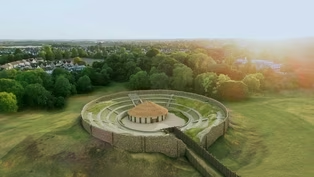
Discovered Ruins May Have Inspired the Round Table
Video has Closed Captions
Clip: S23 Ep4 | 3m 1s | New evidence suggests an amphitheater became a stronghold linked to Arthur’s Round Table. (3m 1s)
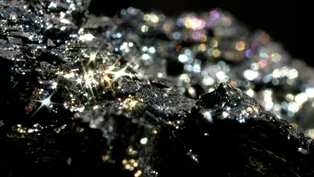
How the Sword in the Stone May Have Begun
Video has Closed Captions
Clip: S23 Ep4 | 1m 53s | Iron smelting at a temple site may have inspired the legend of King Arthur’s sword, Excalibur. (1m 53s)
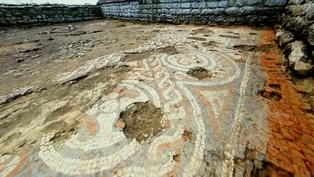
New Evidence That Roman Life Continued After the Empire's Fall
Video has Closed Captions
Clip: S23 Ep4 | 3m 1s | New dating shows a Roman villa mosaic was laid in the 5th century, reshaping post-Roman Britain. (3m 1s)

Preview | The Quest for Camelot
Video has Closed Captions
Preview: S23 Ep4 | 32s | A professor seeks to prove Arthurian legends have roots in actual British history. (32s)

Was This City the Real Camelot?
Video has Closed Captions
Clip: S23 Ep4 | 2m 53s | Did Cirencester remain the center of a prosperous post-Roman kingdom in the time of King Arthur? (2m 53s)
Providing Support for PBS.org
Learn Moreabout PBS online sponsorship














Support for PBS provided by:
SECRETS OF THE DEAD is made possible, in part, by public television viewers.