
Aaron Thompson Interview
Clip: Season 3 Episode 67 | 8m 44sVideo has Closed Captions
CPE's President discusses how students can bridge financial gaps.
The cost of a college education can be pricey. CPE President Aaron Thompson says the cost is just one of the barriers many students face. In this interview, he talks about how students can bridge those financial gaps so enrollment numbers can continue to grow.
Problems playing video? | Closed Captioning Feedback
Problems playing video? | Closed Captioning Feedback
Kentucky Edition is a local public television program presented by KET
Aaron Thompson Interview
Clip: Season 3 Episode 67 | 8m 44sVideo has Closed Captions
The cost of a college education can be pricey. CPE President Aaron Thompson says the cost is just one of the barriers many students face. In this interview, he talks about how students can bridge those financial gaps so enrollment numbers can continue to grow.
Problems playing video? | Closed Captioning Feedback
How to Watch Kentucky Edition
Kentucky Edition is available to stream on pbs.org and the free PBS App, available on iPhone, Apple TV, Android TV, Android smartphones, Amazon Fire TV, Amazon Fire Tablet, Roku, Samsung Smart TV, and Vizio.
Providing Support for PBS.org
Learn Moreabout PBS online sponsorshipbarriers many students face.
I continue my conversation with Aaron Thompson Day head of the Kentucky Council on Post-secondary Edge, education about how students can bridge those financial Enrollment numbers can KET the upward trajectory.
It's now on.
Here's part 2 of our conversation from Friday and our Education Matters segment.
Doctor Aaron Thompson is good to continue our conversation.
Love those matters.
Well, it's a let's talk now about what enrollment looks like overall across the university system in Kentucky's higher education system.
What does it look like?
Is it good better improving its a guy that we're we're happy, but we can always do better.
But we're good, but probably say it can take a while for states to rebound.
>> From COVID enrollment and we've kept that going last year.
We've set some record first-year enrollment sand and we had really good enrollment under kctcs system as well as a poor year.
>> System and also among over profits this year.
Early numbers cause yes, going take a while because there's drop.
There's other things that could happen but were running 5 plus percentage point center kctcs system and her 4 year as the 2 sons.
So we are up again.
They and their first year students are up also.
So it's looking really good for Kentucky.
And I'm proud their institutions and all of a folk they're involved are really engaged to make this happen.
>> Yeah.
Do you know what's driving those higher enrollment numbers?
Because the economy is looking up and we know that a lot of places are looking for work or so.
It's not like there's a work.
There's a workforce shortage, but there's not a worker shortage or work shortage.
Absolutely good strategy.
I tell people all the time and this is what we know.
I mean, we know that we're going to have to have.
>> At least 60% of our actually the data are showing 63% by Twenty-thirty for us to continue this.
The economy.
>> And we're going to have to have about 90% Geathers post-secondary certificate.
If they want to scale up, move up.
So what's driving?
And I think some variety of things, first of all, are working from all.
And yes, we're working on those first gear, traditional age population groups heavily from Kentucky.
But we also know that only about FORTY-SEVEN 0.8% of those students graduating from high school or going to college.
So we're having this supplement.
We have items like a, you know, our adult learners items like or out of state students with the hope.
May we bring them back and stay.
So we've got strategies said around that tuitions said around that.
The thing that we also have to do is stare once again, focus heavily.
How we get those numbers up in Kentucky for it, especially in areas like.
His turn and take it around from an inner inner cities.
But yeah, there's a variety of strategies.
Well, the thing I want to add is that where high state?
So I appreciate the for putting money in our but we also all of our campuses are focused heavily on that.
I met need.
So these are all been statewide strategies that we've been able to employ, but that we're want to add is it's not just a moment coming in right?
We're actually having success caliber institutions where tensions her way up, graduations away up and please understand we're keeping them or to the end where up with a four-year degree.
Now it's down to 4 years again.
>> Was it because it had gotten as high as 6, right, right?
Yeah.
So so all of these are strategies that we're focused on.
What I call the squeeze.
The you know, it's it's this strong student success effort, as you all know, with our collaborative and what the campuses are doing.
Also, this heavy recruitment effort letting students know the value proposition of the importance of Harriet.
And we're doing better in Kentuckyian selling that value proposition.
Many other states all about collaboration with the K through 12 system where you've got dual credit, right where kids are.
You know, they're getting their high school diploma and almost an associate's degree, right?
I they're starting out as a sophomore when they get to college.
>> That's all I've got kids that the bat, right?
So we're focused heavily on that.
We know we can make it better.
But her dual credits way up.
And the other point we're strategist is getting more access to people that have been left out of that process right.
And the idea that if you can get those college credits, you're going to go and look at least have a sophomore level.
Sometimes junior level and sometimes you're going to have that certificate about ways to pay for goods are way up in Kentucky.
And we're in for getting people in the workforce faster.
But the idea it's not only for the Bility we found out in our David that if you have a dual credit course, especially if you're an underrepresented minority, you have a greater chance of being successful in college.
And so all of this goes to exactly the set of strategies.
I mentioned earlier what I call home a state that focuses on exactly what students are meeting and how we can do that.
But we have to focus regionally.
We have to focus in ways on certain population groups that have been left out of it right.
>> Affordability is always one of the biggest concerns when it comes to higher education attainment.
And we know that there's been some snafu.
These are just some Conte ways of the Federal Financial Aid Program.
Right?
FAFSA Whats that like this time, it will have a program on KET that helps people understand it.
But where does that stand?
>> Yeah, absolutely.
I've been watching to see more in the last year.
I think ever that's not been good.
You know, they're supposed to be a last October.
They toast going to be delayed, too December 31st.
And when it came out, it didn't work very well.
And then they were other snafu, sort.
Spend not a great year for getting our students and wear high.
We're high poverty, state grant them.
And so the students that normally apply for a fast for our students.
The earlier people last May.
Have some income.
Those that apply lay her.
Not right.
So it's created some problems.
Now.
It looks like the really big rollout won't be until December again.
I'm not fully October.
A few will rollout in October, but I want to add one over here in Kentucky.
We've kept our tuition the lowest in history and the last 6 years, lowest in history in Kentucky.
And guess what?
Our debt load has has reduced tremendously.
We decrease over the last 5 year 60 26% you know, borrow money.
With the other point I'll make is we had, you know, 6 years ago, we were 59% of all of our students borrow money, go to school are now 42%.
So miss once again, the strategy around affordability, us not just one size fits all, but that's what I like about doing this job in Kentucky because we can really do those positive effects that helps all of our citizens get where they need to go right.
>> Along with students as also faculty and we know that the Legislature has maybe perhaps not with so much.
It rolled out legislation beat but conversation about tenure about administrative salaries, about things that they consider perhaps to bloat the cost of tuition of kids go into those schools.
Your response to that?
Yeah, absolutely.
Want to give this response.
First, though, the legislature in the last couple by.
>> Has really been able to supply dollars to hire.
Yeah, you know, some of our institutions haven't gotten as much as others that you all know.
>> But they've been able to to give us lifetime some money across the board.
We can get more faculty salaries.
More steps, hours.
that I know is if there's legislation coming in on any of those items as here, I hope they work with CP.
Mayor institutions to make the legislation be where we're not hurting the progress cuss.
We know that faculty engagement where those students who are positive way, of course, it's the greatest effect on student success.
Those programs serve as truly a national model for us to get where we need to go.
As you all know, I'm trying to bring employers and work with us earlier so we can have an already employable workforce for a Kentucky but legislation around anything to do with faculty, I think has to be shaped in a manner that helps us to advance.
And I and I have dealt with the people who've actually put forth some of that legislation before and they've been happily able to work with us as we are with them.
>> President Thompson says the council's priorities include more bridge programming for students in K through 12 to help them have a smoother transition to higher ed and engaging adult learners and those with a history of substance use and a post-secondary education

Headlines Around Kentucky (9-3-2024)
Video has Closed Captions
Clip: S3 Ep67 | 2m 29s | While the homicide is rate is falling in most cities, that's not the case in Louisville. (2m 29s)
Video has Closed Captions
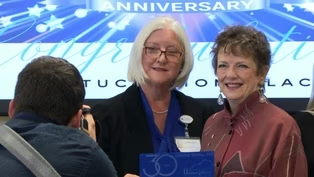
Clip: S3 Ep67 | 4m 14s | Kentucky Homeplace celebrates 30th anniversary. (4m 14s)

Video has Closed Captions
Clip: S3 Ep67 | 53s | Kentucky is moving to the next phase with the rollout of its medical cannabis program. (53s)

This Week in Kentucky History (9-3-2024)
Video has Closed Captions
Clip: S3 Ep67 | 1m 58s | When was the Kentucky Derby four months late? (1m 58s)
Providing Support for PBS.org
Learn Moreabout PBS online sponsorship
- News and Public Affairs

Top journalists deliver compelling original analysis of the hour's headlines.

- News and Public Affairs

FRONTLINE is investigative journalism that questions, explains and changes our world.












Support for PBS provided by:
Kentucky Edition is a local public television program presented by KET