State of Affairs with Steve Adubato
Abra Lee; Carolyn Welsh; Ronnie Agnew
Season 8 Episode 13 | 27m 28sVideo has Closed Captions
Abra Lee; Carolyn Welsh; Ronnie Agnew
Abra Lee, Director of Jewish Education & Learning Initiatives at Temple B’nai Jeshurun, discusses the work she is doing to enhance the Temple's youth mental health support. Carolyn M. Welsh, President and CEO of NJ Sharing Network, talks about the "Say YES Save Lives" campaign. Ronnie Agnew, General Manager of NJ Advance Media, delves into the financial aspect of digital journalism.
Problems playing video? | Closed Captioning Feedback
Problems playing video? | Closed Captioning Feedback
State of Affairs with Steve Adubato is a local public television program presented by NJ PBS
State of Affairs with Steve Adubato
Abra Lee; Carolyn Welsh; Ronnie Agnew
Season 8 Episode 13 | 27m 28sVideo has Closed Captions
Abra Lee, Director of Jewish Education & Learning Initiatives at Temple B’nai Jeshurun, discusses the work she is doing to enhance the Temple's youth mental health support. Carolyn M. Welsh, President and CEO of NJ Sharing Network, talks about the "Say YES Save Lives" campaign. Ronnie Agnew, General Manager of NJ Advance Media, delves into the financial aspect of digital journalism.
Problems playing video? | Closed Captioning Feedback
How to Watch State of Affairs with Steve Adubato
State of Affairs with Steve Adubato is available to stream on pbs.org and the free PBS App, available on iPhone, Apple TV, Android TV, Android smartphones, Amazon Fire TV, Amazon Fire Tablet, Roku, Samsung Smart TV, and Vizio.
Providing Support for PBS.org
Learn Moreabout PBS online sponsorship- [Narrator] Funding for this edition of State of Affairs with Steve Adubato has been provided by The Healthcare Foundation of New Jersey.
RWJBarnabas Health.
Let’s be healthy together.
Horizon Blue Cross Blue Shield of New Jersey.
Here when you need us most.
Valley Bank.
The Russell Berrie Foundation.
Making a difference.
Robert Wood Johnson Foundation.
Working for a more a healthier, more equitable New Jersey.
The Turrell Fund, a foundation serving children.
IBEW Local 102.
Lighting the path, leading the way.
And by The Adler Aphasia Center.
Promotional support provided by New Jersey Globe.
And by NJBIZ.
NJBIZ, providing business news for New Jersey for more than 30 years, online, in print, and in person.
[INSPRATIONAL MUSIC] - Hi everyone, Steve Adubato.
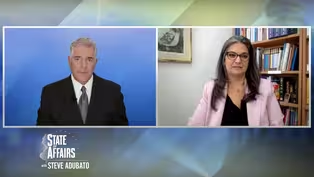
We kick off the program with an important and compelling conversation with Abra Lee, who's Director of Jewish Education and Learning Initiatives at Temple B'nai Jeshurun.
Abra, great to have you with us.
- Thanks for having me.
- You know, our friends at the Healthcare Foundation introduced us to you and the work that you're doing.
Talk about the work that you're doing at the Temple as it relates to youth mental health, which is more serious than ever, particularly with the population you're dealing with and working with.
- Yes, we are incredibly grateful to our partners at the Healthcare Foundation of New Jersey.
This is a project that I have really been dreaming about for a lot of years, when I first was introduced to Youth Mental Health First Aid and really for so many reasons, it was cost prohibitive to be able to bring this kind of training and awareness into our community.
And through the generosity of the foundation, we were finally able to start this project.
We're calling the project One Community, One Goal, Youth Mental Health First, and there are three main objectives to the project.
We aim to first certify five lead educators as instructors in mental health first aid.
Then we're gonna certify 85 classroom teachers and 125 teens in mental health first aid.
We will also plan to host a speaker series for families so that we can raise awareness and begin this conversation so we can start to end the stigma.
- Let me also disclose the Healthcare Foundation, a long time underwriter of our healthcare programming.
But Abra, let me, let's get at this.
How much worse is the mental health problem since October 7th, the horrific, barbaric attacks by Hamas in Israel, and since the war in Gaza?
As we're doing this program it'll be seen after that.
How much worse is the problem for the young people at Temple B'nai Jeshurun?
- Well, in our community, we started to see the rise in antisemitism even before the war began.
And this really has magnified that in ways that we never anticipated in our area, in Essex County, New Jersey.
Our partner synagogues are right next door to us in Union.
And the fear and the trauma that Jewish youth are experiencing right now is something that we haven't seen in generations.
- Describe more specifically what those young people are facing.
- Well, we know the impact of social media on our teens, and you know, most of our students are receiving their Jewish education in part-time synagogue schools, and with very few hours in a week, we really can't get to everything we want them to be able to know.
And what we've discovered in this last several months is their understanding of the history of the conflict in Israel is very limited.
So they're not equipped to be able to answer the questions that they have, that their friends have.
They're not equipped to respond to what they're seeing in the media and in social media and when friends say something in a classroom.
They just don't have the tools that they need to be able to deal with this.
So we immediately shifted our curriculum, most schools did, in addressing the history of the conflict and trying to help them to understand what they're hearing.
- Well, but how is that a mental health issue?
- Many of our students have family or some connection to Israel.
It is our spiritual homeland.
And seeing the ongoing war in a place that we've called home has impacted both our youngest students.
We have seven-year-olds who are asking us now, "Why do people hate Jews?"
That's never a question I thought as an educator I'd ever have to answer to a seven-year-old.
Teens, we've been having this conversation for years, but not the young children.
They don't understand the hate.
They have mostly been taught about Israel in a modern state, culturally.
We say often that we have taught our children that Israel is about falafel and camels and everything is beautiful and it's Jewish Disneyland.
And when the reality of war and conflict and this history that goes back to biblical times is just punching them in the gut.
They really don't understand what to do with this.
- I'm gonna put things in perspective for folks, for people saying, wow, you're talking about the rise in antisemitism, the impact that this is having on young people in your temple and Jewish communities and for Jewish young people across the state, the region, the country.
We also know clearly there are Palestinian children who are struggling.
There is a rise in Islamophobia.
They are not mutually exclusive.
So to be clear, we'll continue our programming to try to help young people, particularly young people disproportionately impacted by the events since October 7th.
To that end, Abra, if these young people that you're talking about don't get the help that you and your colleagues are trying to provide at Temple B'nai Jeshurun, what, I don't wanna be an alarmist, but they could face serious problems down the road if these issues are not addressed now.
- The fear and the lack of understanding leads to isolation.
The isolation, as we know, has a terrible impact.
We saw this with the COVID-19 pandemic, and- - Depression?
- Depression, and it has often led to substance use issues.
This is an ongoing mental health crisis that has just been magnified by what's been going on in our community.
- And again, to go back to this, it isn't a question of wanting to be helpful, it's a question of having the means to hire the staff to train the appropriate mental health professionals.
So it isn't, you know, "Why aren't you dealing with this?"
It's, "What does it take to deal with it?"
Is that a fair assessment?
- That's right.
That's right.
- Abra Lee is the director of Jewish Education and Learning Initiatives at Temple B'nai Jeshurun.
And Abra, this is a very important conversation.
We appreciate your time and the work that you and your colleagues are doing.
- Thank you so much.
- You got it.
Stay with us, we'll be right back.
(grand music) - [Announcer] To see more State of Affairs with Steve Adubato programs, find us online and follow us on social media.
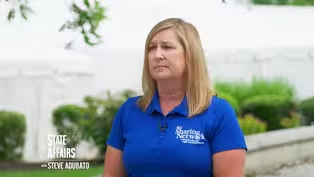
- We're at the New Jersey Sharing Network in beautiful New Providence, New Jersey.
This is the 5K and this is the President and CEO of the Sharing Network, Carolyn Welsh.
How you doing today?
- Good, how are you?
- I'm doing great.
Every year we talk about this, I ask why today?
'Cause this is one of many events why today is such a special day today?
Remind everyone.
- Today is an extremely special day at our headquarters in New Providence.
Donor families, recipients, and advocates for donation and transplantation come together to celebrate life.
- How's the event changed over the years, other than getting much bigger?
- The evolution and the way that this event has evolved for families is incredible.
It's a place for them to come to feel at home, and always be a part of our lives as long as they want us to.
- The campaign, "Say Yes, Save Lives", translate that.
- Yes.
To find a way to say yes that's our new kind of thematical and motive this year.
Everything starts with yes.
When a family says yes to donation.
When a patient says yes to be put on a transplant list.
So our "Say Yes Save Lives" is so that we save as many people as we can and we save as many donor families as we can.
They lose a loved one and our job is to comfort them and help them throughout that journey.
- 25 years with the Sharing Network.
- Yes.
- Remind everyone how you started.
- I answered an ad in the "Asbury Park Press."
- That was it.
- That was it.
Back when there was paper.
- Back then.
- Back then.
There was the Wednesday classified or the Sunday.
I answered an ad in the "Asbury Park Press" and said, "I would be an organ donor.
That sounds like a really cool job."
Learned about organ donation.
Came and never looked back and just celebrated my 25th year in March.
- Congratulations.
- Thank you.
- So do this for us.
Just as we're taping this program pretty early on in June, it'll be seen later.
There's an initiative that happened.
There's something to celebrate.
Back on May 31st, first ever Transplant Growth Collaboration event.
What the heck was, is that, and why is it so significant?
- It was an amazing program.
I was invited to an exclusive event in Utah for the first inaugural Transplant Growth Collaboration.
It was hosted by the Utah OPO, Donor Connect.
- Hold on, the OPO stands for?
- Organ Procurement Organization, just like the Sharing Network in Utah.
And they said yes to do the first one to increase transplantation with an endorsed organ.
It's OPTN, which is the Organ Procurement Transplant Network.
Joined with them to say, how can we be innovative?
How can we save more people's lives?
Donation has increased exponentially over the last five years.
Transplant has increased, but not at the rate of organ donation.
So as we're increasing organ donation, we need to make sure that we're increasing transplantation across the country so that we're saving as many lives and maximizing the gift when the family says yes to donation.
So I was in Utah and they asked for bold commitments and I raised my hand and said, "We'll do it in New Jersey."
Because New Jersey is New Jersey, right?
Jersey generosity.
Bring it to New Jersey.
We're on the East Coast.
We have more transplant centers than any other area in the country and we really can make an impact because we do what we say we're gonna do.
And in New Jersey we said we're gonna do it bigger, better.
And we did it and we planned it in five weeks.
- What other states were involved?
- We had all six New Jersey transplant centers and we had eight New York transplant centers of the 13.
And the others wanted to come, but it was really a two week notice.
So they're all gonna start to come and tour here at New Jersey Sharing Network and really build the collaboration between us and their centers.
- What's the payoff for that?
- More people getting lives saved.
The awareness of transplantation and helping to see what do they need?
What do their patients need?
What do their lists look like?
What do we need to do when caring for an organ donor that may make a difference?
And really bringing innovation to transplantation here in New Jersey.
- You know, Carolyn, again, we talk about these statistics all the time.
Remind everyone there are how many?
Nationally is over a hundred thousand?
- Yes.
- People waiting.
- Yes.
- New Jersey still at about 4,000.
- About 4,000, yes.
- But at the same time, fifth year in a row, organ donations have increased in the state.
Record numbers, but still 4,000.
Explain that.
- So there's about 33,000 people in New Jersey and New York on dialysis.
I think it's 15,000 in New Jersey and about 33,000 in New York.
Those are people on dialysis.
So with people on dialysis, they really, once they learn that they can get a transplant and then be removed from the dialysis, it's about education.
So even though we say there's 4,000 people waiting in New Jersey, there's many, many more people that need organs, but it's the supply and demand.
So once we increase the number and we can transmit more people, more people can get listed.
- You know, Carolyn, one of the things I was picking up on, we were talking to Lakisha earlier and check out that interview.
It's part of the larger conversation, but also Lakisha's interview will standalone.
She has a powerful story about her daughter, her sister.
The thing that I was thinking about is, and she was talking about in the African American community, of the 4,000 people waiting, 68% are African American.
One of the challenges facing the Sharing Network and the African American community is that parents are filling out, say they're filling out a form for their kid, their child growing up when they get their license.
When you get your license, there's a place to check off to be an organ donor.
Parents are doing that for kids.
What's the message to the parent?
What should the message be to the young person who's getting his or her their license?
Talk about that.
- So in New Jersey, your motor vehicle, you can designate your decision to be a donor, like you said.
- Just checking off?
- Just by checking a box, yes.
You could do it on your phone, your app on your phone, your health app.
You can go to our website, but for what you're talking about in getting parents to want their kids to say yes and their kids, we go to high schools all throughout New Jersey.
We also are bringing the message to the community where people are at.
So we did a school drive last year.
Our employees paid and donated money and we went and bought a ton of school supplies and we contacted schools that needed supplies.
And we went to Paterson, and we went to Camden, and we went to bring the message there.
- Urban areas.
- Yes.
- By design.
- By design.
- Because?
- Because they need it.
And our staff, when you work here, you want to help people.
So what else could we help with besides donation?
And we're in the communities for health fairs, at hospitals, that do things to bring diabetes screenings, high blood pressure screenings, and we go and we make sure that we're educating about donation prior to the question at the bedside.
- Making progress in the minority community when it comes to organ donation how do we know?
- So more families say yes that we interact with and their conversations back with us.
They're more open to the conversation.
The trust is there.
They've heard who we are.
They know that we're in their communities so that they trust when we're at that point of asking, or their kids knew and heard about it at high school and came home and talked about it with their family 'cause that's what we encourage them to do.
- Education, public awareness remains at the top of the list.
- Top of the list.
- Because?
- It's super important.
You never want to be asking this question for the first time, or hearing about this when your loved one has passed away.
If we can reach people prior to that conversation, it's much easier.
What would that person have wanted six months ago if we were around the table talking about it from a public health perspective, or if they ever needed an organ or someone in their family did, wouldn't they want someone to say yes?
And when you have that conversation, when you're not in trauma and tragic loss, the question becomes an easier conversation.
- Thanks Carolyn.
- Thank you.
(grand music) - [Announcer] To see more State of Affairs with Steve Adubato programs, find us online and follow us on social media.
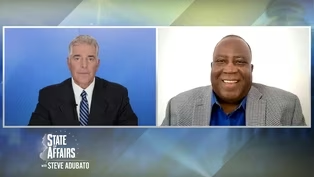
- We're joined once again by Ronnie Agnew, General Manager of NJ Advance Media.
Ronnie, good to see you again.
- Hey, I am great, it's great to see you, Steve.
Thanks for having me on your show.
- Ronnie, do us a favor, tell everyone the empire, the media empire that NJ Advance Media is.
- Well, it's an empire.
I am thrilled to be the general manager for the largest media source, well, we believe, the largest media source in New Jersey, journalists all over the state.
We cover every county, everything that happens here, and I'm really, really proud to be the head of it.
It's been an honor.
- Including NJ.com, Star-Ledger, and a whole range of other-- - NJ.com, Star-Ledger, the whole, everything.
It's, you know, they got little old me from Mississippi to come here to do this and that's quite an honor.
- We got you in Jersey.
So let's talk about this.
I've been talking to some folks about local media, local journalism and economics, translation.
I don't have to tell you, you run a business every day.
The economics of running a media organization are becoming more and more challenging.
To what degree do you believe the economics of running local media, state media, however you wanna describe it, really has to change because the, quote unquote, advertising model doesn't work anymore, or to the degree it needs to.
- Advertising model is shot, Steve.
It's gone.
We’ve had... That's why the innovation of NJ Advance Media is so special.
We've had to pivot, and we have pivoted into a whole different model, unlike anyone else's, you know, we-- - Describe it.
- Well, yeah, we have basically events, we do events, we do sports betting, we do subscriptions that are really important to us.
We do things that people probably, and some other places probably don't do, but they work for us.
We do affiliate revenue.
Affiliate revenue is that revenue, when you see that there's the Amazon sales and the other sales, those people report to me in news, actually, and they bring in a lot of revenue for us.
And you say, "Okay, wow, that is sacrilege in media."
Well-- - What about church and state?
What about, there's got the church, you got the business side is, you know, like, let's take care of the business, but then you got the news side.
And is there a wall in between, Ronnie, or?
- There's definitely a wall, and I gotta tell you that the wall is firm, and I've gotta say that, you know, just, gosh, I am so proud of the news side of it.
The news side of it is robust.
I mean, we have like 30 to 40 people on our breaking news team.
They're all over the state of New Jersey, we have investigative teams, we have everything that anyone would need to get information about New Jersey.
But we also have the fun teams.
We have food and entertainment.
That is huge for us.
You know, when I first got to Jersey, I'm, keep my answer short, I understand that, but when I first got to Jersey, I was like, "Bagels and pizza, really?"
- Hold on, that's what Genovese does, is it Pete Genovese?
- Yeah, Pete.
(laughs) - Come on.
We got the best bagels, - Yeah, I was like, what?
- the best pizza.
Seriously?
Ronnie, you didn't know that?
- No, I had no idea.
So I get to Jersey and I go to the office, which I love to do, by the way, we're completely remote, by the way.
- Same here.
- And I'm sitting in my living room right now, at the house, trying to make sure that you have a good background.
(Ronnie laughs) - I love it, I love it.
- But Pete Genovese, man, when I go to the office, there's pizza there.
And I was like, I've eaten more pizza in the last 18 months since I've been here than I have in my freaking life.
But-- - But that's just the food piece.
What you're saying is there's gotta be fun stuff that also makes money in order to support the news side.
And by the way, - Yes, yes, guess what?
So I wanna be clear.
If there's the money-making side, and for us, look, if we're not bringing in underwriters, sponsors, we can't do this.
So, but how, - No.
- to what degree do you believe the news folks understand, there's gotta be a business side, or you can't do the other thing?
- Oh, gosh.
You know, our model works.
It works, because we do significant investigative reporting.
If you saw yesterday with George Norcross-- - We're taping the day after there was a major indictment.
- All over it.
The day that Tammy Murphy, on a Sunday afternoon at four o'clock, a Sunday afternoon at four o'clock, let me tell you, one of my reporters wrote a story with his family at a park on his cell phone.
And it was up in, the story was up in like five minutes.
That's what local news is.
It is fast and-- - So this technology allows for reporting.
- Yes.
No matter where you are.
- Journalism to be done, totally different fashion.
No matter where you are and what you're doing.
And you know, yesterday I was having a meeting with two of my key people.
I had my investigative editor and I had my breaking news editor on a call.
And then they told me about the Norcross story, and I said, "Meeting over.
"Do your job."
And that's exactly what we do.
We do-- - Hold on a second.
As a general, this is interesting.
For our organization, we're a not-for-profit, which (chuckles) trust me, we're very entrepreneurial, I have to be involved in the business side, the raising of the money, the keeping the finances together with my colleague, Mary Gamba.
But also there's the, but we don't ask of our producers to be involved in that.
They're involved on the journalistic side.
Are you involved in both sides?
- No, so this is Ronnie Agnew.
This is Ronnie Agnew's world, right?
I make sure that our VP of news is free and clear of all the business conversations.
- Really?
- And then I am here, I am kinda straddling both worlds, which I enjoy.
I've always done it.
I mean, I used to work at PBS, by the way.
You have to do that at PBS.
But what I enjoy the most is the fact that I get a chance to read significant enterprise stories, but I also get a chance to step out of that world and use my business acumen from that PBS world to help our business.
But never the twain shall meet.
They don't even know, the staff has no clue that I'm working on some things with our corporation to make our corporation better.
They don't know I have any, they have no idea that I do that.
And that's fine, because the thing is, I want them to be free to do what they wanna do, free to cover stories without me and without my interference.
And that happens all the, that happens.
- Got about minute left.
So the graphic, Democracy in Danger is gonna come up because democracy is in danger.
To what degree, Ronnie, do you, even not from a, just from a business, but from a journalistic point of view, are quite aware of the responsibility you and your colleagues have as an important media organization in this state, to provide critically important information to protect our very fragile democracy.
- You know, I gotta tell you that that's one of the things that really concerns me most, not so much just for the state but for this country.
I am on many, many boards of directors, and one of the boards I'm on is one that actually talks about democracy and trust in media.
I am very concerned about trusted media.
I am very protective of our prerogative, and making sure that people trust us.
You know, I am the one that they call when they feel there was an absence of trust.
And I try to explain to them exactly how decisions are made, what we do, how we do it.
But I gotta tell you, as a country, a state, we have an issue with trust, with trusted media.
And we have to do everything that we can, Steve.
We have to do everything we can.
You, me, everybody on this team, everybody on my team.
- That's right.
That's right.
- We have to everything we can to make sure that accuracy, trust, and integrity, that's what we stand for.
- And along those lines, as you listen to Ronnie Agnew, general manager of NJ Advance Media, let me disclose transparency, again, that New Jersey Advance Media, media partner of ours.
Ronnie, I promise you, we will continue the conversation because the work never ends.
Thank you, my friend.
I wish you all the best.
- Thank you so much for having me here, and I would love to come back again.
- You got it.
I'm Steve Adubato, thank you so much for watching.
That's Ronnie Agnew, NJ Advance Media.
See you next time.
- [Narrator] State of Affairs with Steve Adubato is a production of the Caucus Educational Corporation.
Celebrating 30 years in public broadcasting.
Funding has been provided by The Healthcare Foundation of New Jersey.
RWJBarnabas Health.
Let’s be healthy together.
Horizon Blue Cross Blue Shield of New Jersey.
Valley Bank.
The Russell Berrie Foundation.
Robert Wood Johnson Foundation.
The Turrell Fund, a foundation serving children.
IBEW Local 102.
And by The Adler Aphasia Center.
Promotional support provided by New Jersey Globe.
And by NJBIZ.
- I’m very grateful that I’m still here.
- That’s me and my daughter when we went to celebrate our first anniversary.
- With a new kidney I have strength.
- They gave me a new lease on life.
- I’m still going everywhere and exploring new places.
- Nobody thought I was going to be here, nobody.
- I look forward to getting older with my wife, that’s possible now.
- [Narrator] We’re transforming lives through innovative kidney treatments, living donor programs, and world renowned care at two of New Jersey’s premiere hospitals.
- They gave me my normal life back.
It’s a blessing.
- [Narrator] RWJBarnabas Health.
Let’s be healthy together.
Carolyn Welsh Highlights the "Say YES Save Lives" Campaign
Video has Closed Captions
Clip: S8 Ep13 | 9m 26s | Carolyn Welsh Highlights the "Say YES Save Lives" Campaign (9m 26s)
Digital Journalism and Ethical Reporting Practices
Video has Closed Captions
Clip: S8 Ep13 | 11m 10s | Digital Journalism and Ethical Reporting Practices (11m 10s)
Mental Health Support Initiatives at Temple B’nai Jeshurun
Video has Closed Captions
Clip: S8 Ep13 | 7m 48s | Mental Health Support Initiatives at Temple B’nai Jeshurun (7m 48s)
Providing Support for PBS.org
Learn Moreabout PBS online sponsorship
- News and Public Affairs

Top journalists deliver compelling original analysis of the hour's headlines.

- News and Public Affairs

FRONTLINE is investigative journalism that questions, explains and changes our world.












Support for PBS provided by:
State of Affairs with Steve Adubato is a local public television program presented by NJ PBS